
Meaning of Literally With Examples: Sentences With a Verdict

Meaning of literally with examples is what you need when a one-line definition has already failed you. Most pages define the word and stop; this page on MagazineSolo judges sentences instead.
Below are 48 example sentences, every one of them written for this page and sorted into four verdict classes. Each sentence carries its verdict and a one-line reason, so you can see exactly why it passes or fails.
The four classes are strict literal use, truth-emphasis use, the intensifier on figurative statements, and errors that fail in every register. Learn the classes and you can judge any new sentence yourself in seconds.
No dictionary page and no usage blog currently offers a judged bank like this. Dictionaries list examples without verdicts, and the blogs that do judge use one rule for everything, which the dictionary record does not support.
The One-Line Hand-Off: What Literally Means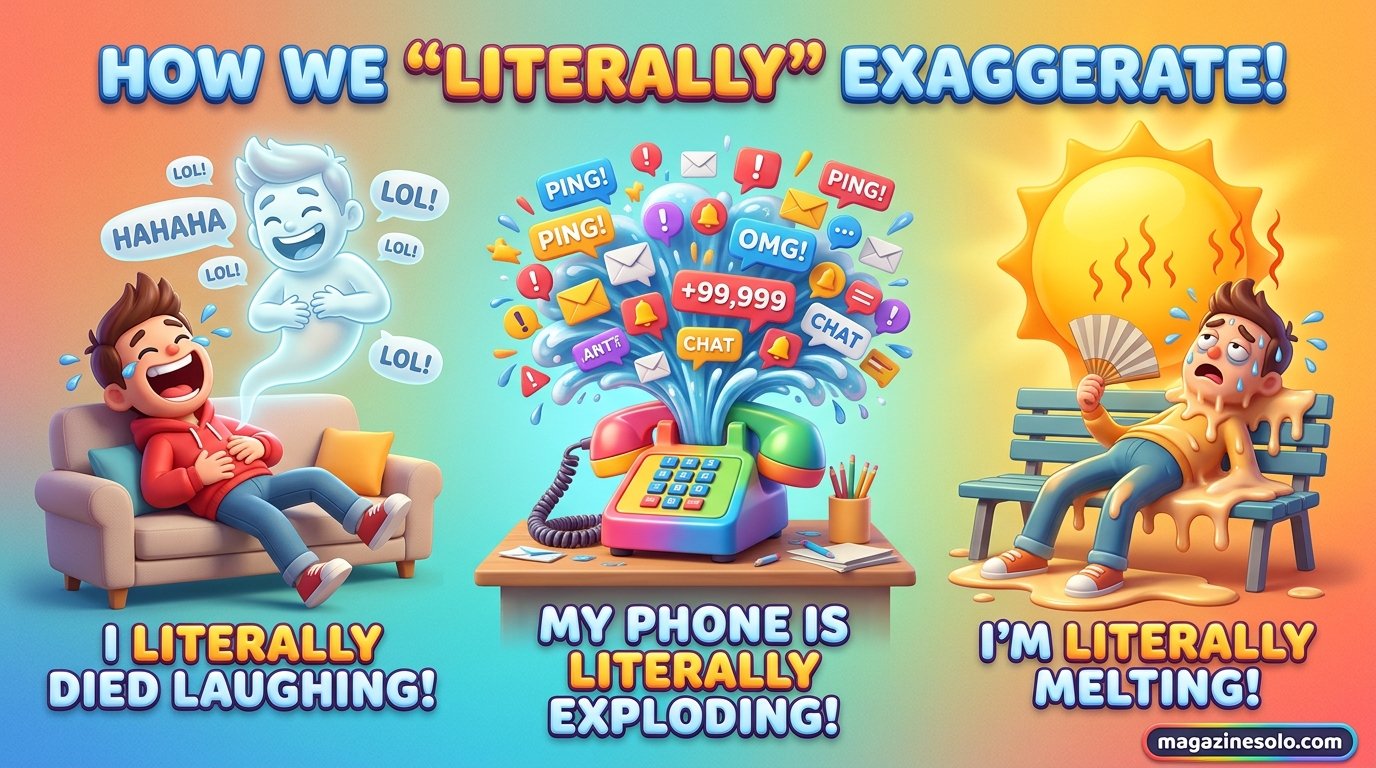
In one line: literally certifies that something is true exactly as worded, and in informal English it also works as an intensifier on statements that are not true word for word.
The full definition, the sense map and the two-senses test live on the base page, what does literally mean, which owns that layer for this cluster. This page hands the definition up to it and does not rebuild it here.
What this page adds is the layer the base page does not carry: sentences, judged. Where a verdict depends on how dictionaries label a sense, the label disagreement is summarised in its own section below, in short form only.
Examples need their own page for a practical reason: a definition can be memorised in a minute, but judgment cannot. Learners go wrong on sentences, not on definitions, so the practice material has to be sentences, in quantity, with the reasoning left visible.
How to Read the Verdicts: Four Classes
Every sentence in the bank was tested the same way. First, is the sentence true exactly as worded? If yes, it belongs to Class 1 or Class 2, and the only question left is what work the word is doing.
If the sentence is not true as worded, ask whether it is a figure of speech being intensified. That is Class 3, the informal sense the dictionaries record, and its verdict always carries a register note.
If the sentence contradicts itself, no register can rescue it. That is Class 4, and it is the class learners most need to see collected, because its failures look confident and sound fluent.
|
Class |
Verdict |
Where it is safe |
|---|---|---|
|
Class 1: strict literal use |
Correct, strict sense |
Every register, including exams |
|
Class 2: truth-emphasis use |
Correct, emphasis sense |
Every register |
|
Class 3: intensifier on a figure |
Accepted in informal English, dictionary-recorded |
Speech, messages, informal writing |
|
Class 4: errors and self-contradictions |
Wrong in any register |
Nowhere; rewrite the sentence |
Two quick tests do most of the judging. The deletion test: remove the word and reread. If the sentence loses truth, the use was Class 1 or 2; if it only loses volume, the use was Class 3.
The second test is the register check. Class 3 is a speech form that thins on the page, so a sentence can be honestly judged accepted and still be the wrong choice for an essay, an application or an exam.
One warning before the bank: some usage writers judge by a single rule and file every intensifier sentence as wrong. The dictionary record is wider than that rule, and the verdicts below follow the record, class by class.
A popular magazine treatment, for instance, sorts examples into correct and incorrect lists and files the died-laughing pattern as incorrect. That binary split is reported here as a competitor position, not adopted, because it contradicts the recorded informal sense and erases the middle class entirely.
Class 1: Strict Literal Use
Quick verdict: correct in every register. In this class the sentence is true exactly as worded, and the word certifies that exactness, the primary sense every dictionary lists first.
Watch for the word-for-word family inside this class: translation, quotation and instructions taken at face value. When the claim is about wording itself, the strict sense is doing its oldest job.
|
Sentence |
Why this verdict |
|---|---|
|
The sign says the bridge is literally closed, so we turned around at the barrier. |
The closure is physical and exact; no figure of speech is involved. |
|
She translated the poem literally, keeping every word in its original order. |
The word-for-word sense; the rendering follows the exact wording. |
|
He took the instructions literally and waited by the door for three hours. |
He followed the words in their primary sense, exactly as stated. |
|
The word breakfast literally means breaking a fast. |
The exact-equivalence sense; the word parts match the definition. |
|
The recipe literally calls for two cups of flour, not three. |
The printed text states exactly that amount. |
|
I literally read the contract twice before signing it. |
The reading actually happened, twice, as a matter of record. |
|
The map shows the river literally running through the middle of town. |
The river physically passes through the town; no metaphor is at work. |
|
When he said the box was heavy, he meant it literally; it weighed forty kilos. |
The description matches the measured fact. |
|
The children literally built the tower themselves, block by block. |
They did the building in person; nothing is figurative. |
|
Her name literally means ‘gift’ in her language. |
The name’s actual meaning is exactly that. |
|
The train literally stopped between stations for twenty minutes. |
The stop happened exactly as described, in real time. |
|
He literally wrote the letter by hand instead of typing it. |
The method was exactly handwriting, as stated. |
Notice what these sentences share: each one could be checked and confirmed. A barrier, a scale, a clock or a printed page settles every claim, which is why this class never needs a register warning.
Class 2: Truth-Emphasis Use
Quick verdict: correct, emphasis sense. Here the sentence is still true, but it sounds unlikely, surprising or easy to doubt, and the word leans on it to insist: this really happened.
This is the middle class almost every other page misses. Merriam-Webster records it as the sense that emphasises the truth and accuracy of a statement, separate from both the strict sense and the intensifier.
|
Sentence |
Why this verdict |
|---|---|
|
I literally told you yesterday that the meeting had moved to Friday. |
The telling really happened; literally stresses the truth of a plausible fact. |
|
There were literally hundreds of bees around the hive that morning. |
A large but believable count, stressed as accurate rather than rounded up. |
|
The bakery literally opens at five in the morning, every single day. |
A surprising but checkable fact, underlined as true. |
|
He literally works two jobs and still coaches the team on Sundays. |
Both jobs are real; the word underlines an unlikely sounding truth. |
|
The tickets literally sold out in under ten minutes. |
The speed is factual; literally answers the reader’s doubt in advance. |
|
She literally grew up in that house; her parents still live there. |
A plain biographical fact, stressed because it sounds like a figure of speech. |
|
The road literally ends at the lake; there is no bridge across. |
The geography is exact; the word warns the driver not to expect more road. |
|
I literally have three dollars left until payday. |
A precise, countable amount; emphasis sits on a verifiable number. |
|
The twins literally finished the race at exactly the same second. |
A timed fact that sounds exaggerated until the clock is checked. |
|
This phone literally takes all day to charge. |
Slow, but literally true of the faulty battery; emphasis, not metaphor. |
|
He literally apologized to every single person in the office. |
A complete round of real apologies; the word stresses the completeness. |
|
The village literally has no shop, no school and no bus service. |
A checkable absence, stated exactly; nothing figurative is claimed. |
The tell for this class is doubt management. The writer expects a raised eyebrow and spends the word in advance, which is why numbers, times and complete rounds of action fill these sentences.
If you removed the word from any Class 2 sentence, the sentence would stay true and only sound less defended. That is the deletion test separating this class from Class 3, where removal costs nothing but volume.
Class 3: The Intensifier on Figurative Statements
Quick verdict: accepted in informal English, dictionary-recorded. In this class the sentence is not true as worded, everyone in the conversation knows it, and the word is there to turn the volume up.
The dictionaries record this use as a real sense, glossed by Merriam-Webster as in effect, virtually and labelled informal. The verdict is therefore never a bare correct; it is accepted, with the register named.
|
Sentence |
Why this verdict |
|---|---|
|
I literally died laughing at his impression of the teacher. |
Nobody died; literally intensifies a figure of speech, the informal recorded sense. |
|
My phone literally exploded with messages after the photo went up. |
The phone did not detonate; the word stresses the volume of messages. |
|
She literally flew down the stairs when she heard the news. |
No flight took place; speed is expressed as a figure and then intensified. |
|
His jaw literally hit the floor when the results came out. |
Jaws do not detach; the shock figure carries the meaning. |
|
We literally melted in that heatwave last July. |
People do not melt; the word intensifies the heat figure. |
|
Her eyes literally sparkled when she saw the ring. |
Eyes emit no light; brightness is figurative and intensified. |
|
The suitcase literally weighs a ton. |
A ton is a measured unit the case does not reach; pure emphasis. |
|
I have literally told you a million times to lock the door. |
The count is impossible; the word is doing emphasis work only. |
|
The baby literally screamed the house down. |
The house is standing; volume is expressed as a figure. |
|
Time literally stood still during the last lecture. |
Time does not stop; boredom is intensified through a figure. |
|
She was literally glued to the screen for the whole final. |
No adhesive is involved; attention is the figure being stressed. |
|
The news literally knocked me sideways. |
No physical blow landed; shock is expressed figuratively. |
The honest way to hold this class is both halves at once. The use is centuries old and dictionary-recorded, and it is also the first thing a careful editor cuts, because on the page it spends credibility for emphasis.
Notice that the word never turns these sentences figurative by itself. The figure was already there; the word only insists on it, which is why dictionaries gloss the sense as in effect or virtually, not as figuratively.
The class survives because speaker and listener share a code: nobody at the table believes a phone detonated. Trouble starts only when the code is not shared, in print, across generations, or in front of a reader who takes words at face value.
Class 4: Errors and Self-Contradictions
Quick verdict: wrong in any register. These sentences fail not because they exaggerate but because they cancel themselves, and no audience, formal or informal, can settle on a stable reading.
Study the failure patterns, because they repeat. The commonest are the word attached to almost, the word attached to its own opposite, and a claim quietly refuted by the rest of its own sentence.
|
Sentence |
Why this verdict |
|---|---|
|
I literally did not move a muscle; I just ran to the door. |
Self-contradiction: the second clause cancels the first, so literally has nothing true to stress. |
|
He literally almost won the race. |
Literally attached to almost: the event never happened, so there is no fact to underline. |
|
She is literally the only person here, along with her five friends. |
Only cannot survive the five friends; the sentence contradicts its own claim. |
|
I literally never use the word literally. |
The sentence refutes itself in the act of being spoken. |
|
He literally meant it figuratively. |
The two adverbs cancel out and leave the reader no stable reading. |
|
The instructions were literally clear as mud. |
Clear as mud is an ironic figure; literally cannot make mud clear. |
|
I literally could care less about the result. |
The idiom’s logic runs the other way (could not care less); literally locks in the reversed meaning. |
|
She literally said nothing, and then explained it for an hour. |
An hour of explanation contradicts the claim of saying nothing. |
|
The meeting was literally postponed forever until next Tuesday. |
Forever and next Tuesday cannot both be true. |
|
I literally have no words, which is why I am writing this long letter. |
The long letter disproves the claim as it is being made. |
|
She literally agreed with everything he never said. |
Agreement with unspoken statements is impossible; the sentence defeats itself. |
|
The sign literally says keep off the grass, so I walked on it to obey. |
The action contradicts the literal content the sentence itself quotes. |
Class 4 is the class the single-rule judges never isolate. Their rule cannot distinguish a recorded intensifier from a self-cancelling sentence, so their lists mix Class 3 and Class 4 together and mark both wrong.
Keep the classes apart and the fix becomes obvious. A Class 3 sentence needs only a register decision; a Class 4 sentence needs a rewrite, because its problem is logic, not style.
The Label Disagreement in Summary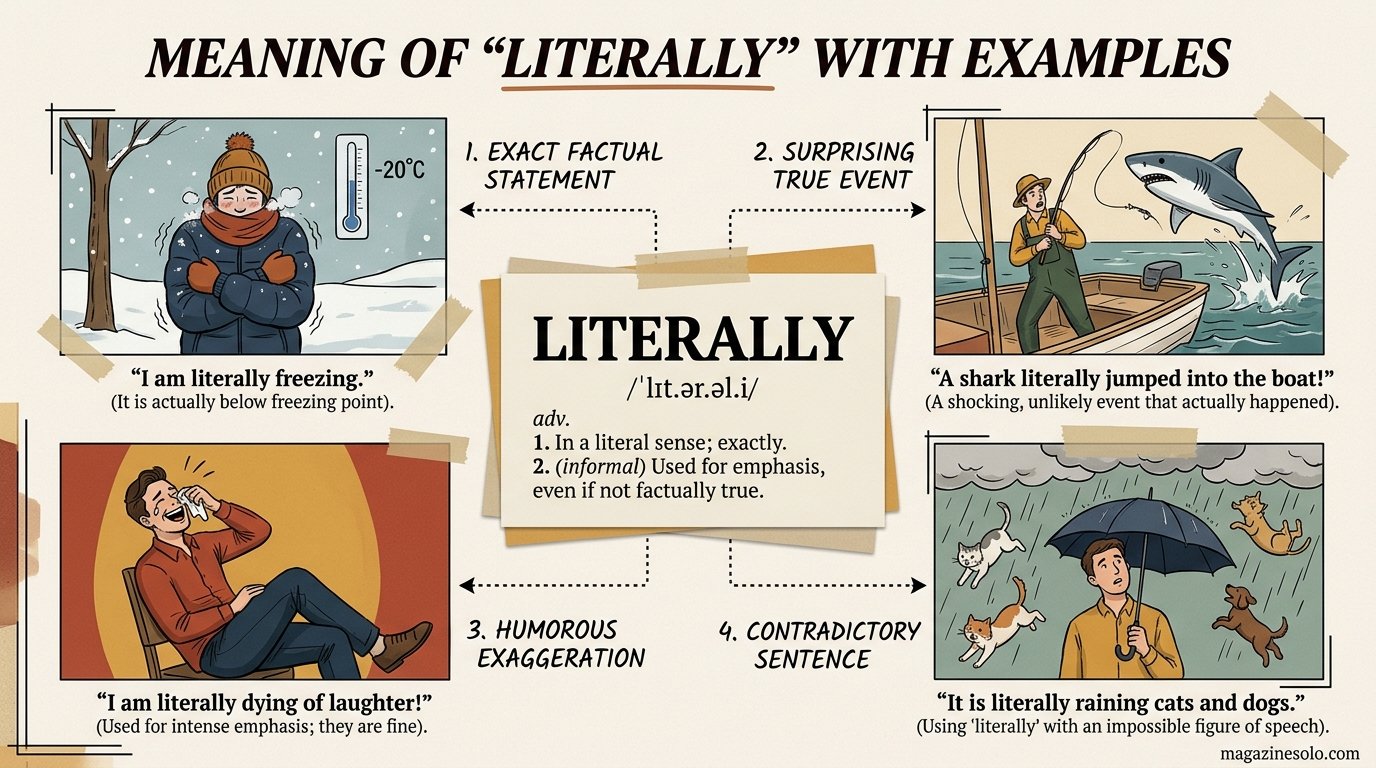
The verdicts above lean on how dictionaries label the intensifier sense, and the dictionaries do not present that label the same way. The full label apparatus belongs to a companion page in this cluster; what follows is the summary a reader of examples actually needs.
Merriam-Webster gives the intensifier its own numbered sense, defined as in effect, virtually, and labels it informal. The Oxford Advanced Learner’s Dictionary also labels its emphasis sense (informal), and adds the honest note that some people think it is not correct.
The Cambridge Dictionary entry labels both of its emphasis senses informal as well. The Oxford Advanced Learner’s Dictionary is the cleanest learner presentation of the same position, which is why Class 3 verdicts on this page cite the label rather than a bare yes.
Collins is the outlier in presentation: its American entry gives the sense in effect; virtually with no register label on the sense itself, and puts the warning in a usage note instead. Same recorded sense, different furniture, and learners meeting both deserve to be told so.
The dating of the intensifier is likewise a set of strands, not a fact. Merriam-Webster’s usage guide dates evidence of the exaggerated use to the mid-18th century; Collins dates its wide use as an intensifier to the early 20th century; Wikipedia dates its emergence at the latest by 1769, on a Frances Brooke example.
Famous names travel with this word, and they need care. Merriam-Webster’s own example list quotes James Joyce, in Dubliners in 1914, and William Makepeace Thackeray, in Punch in 1847, using the intensifier; Mark Twain and Charles Dickens are named across the field as users of the same device.
Literally, Actually, Really, Virtually: The Swap Test
When a sentence feels shaky, swap the word before you judge it. Each neighbour does a different job, and the swap that keeps the meaning tells you which job your sentence actually needed.
|
Swap word |
The job it does |
Fits this frame |
|---|---|---|
|
actually |
Confirms or corrects a fact |
The shop actually opens at five, not six. |
|
really |
Neutral emphasis, safe in most registers |
I really told you yesterday. |
|
virtually |
In effect, almost entirely true |
The road is virtually impassable after the flood. |
|
literally |
Certifies exact truth, or intensifies informally |
The recipe literally calls for two cups. |
Run the swap on a Class 4 pattern and the cure appears. He virtually almost won is still clumsy, but he nearly won is clean, because the honest word for a near event was never an emphasis word at all.
Run it on a Class 2 sentence and the word earns its place. I actually told you yesterday corrects a doubt; I literally told you yesterday insists on the record. Close neighbours, different pressure, and the swap shows which one you meant.
The swap test also explains why really is the safe default for hesitant writers. Really adds emphasis without claiming exact truth, so it can stand in for the intensifier in most informal sentences while making no promise the sentence cannot keep.
Using Literally in Formal Writing and Exams
The register rule is short: Classes 1 and 2 are safe everywhere, Class 3 is a speech form, and Class 4 is wrong everywhere. Formal writing is simply the register where the Class 3 bill comes due.
In school exams, markers read the intensifier as an error even though dictionaries record it. That is not hypocrisy; an exam tests the careful register, and in the careful register the recorded label informal is the whole answer.
The prescriptivist strand deserves its named place. Bryan A. Garner, in Garner’s Usage Tip of the Day on LawProse, calls the intensifier use a slipshod extension and advises deleting the word, a position quoted here as a position, not as consensus.
The Language Portal of Canada’s Writing Tips Plus takes the same careful-writing line in verdict form, marking I literally died laughing as Incorrect and offering I almost died laughing as the Correct version. The dictionaries record the sense; the careful-writing guides still tell you to avoid it, and both facts belong in an honest answer.
For work writing, the practical rule is deletion first. If removing the word costs the sentence nothing but volume, it was Class 3, and a report, application or client email is stronger without it.
Weighed as pros and cons, Class 3 buys warmth and voice in speech, messages and storytelling, and it costs precision and trust in reports, essays and applications. The word is the same in both columns; the audience is what changes the arithmetic.
Quick Self-Test
Judge these five sentences before reading the answers. Each one belongs to exactly one class, and the classes you have just read are the only marking scheme you need.
Work them in the bank’s order: ask first whether the sentence is true as worded, then whether a figure is being intensified, then whether anything in it cancels itself. Most learners misfile the truth-emphasis sentence, so check sentence 2 with special care.
- The instructions literally say to add the salt last.
- The shop literally gives away a free loaf every Friday morning.
- I literally froze when the cold water hit me.
- He literally almost missed the train.
- My head literally exploded when I saw the bill.
Answers: 1 is Class 1, a printed text stating exactly that. 2 is Class 2, a surprising but checkable fact. 3 and 5 are Class 3, figures intensified, fine in speech. 4 is Class 4: attached to almost, the word underlines an event that never happened.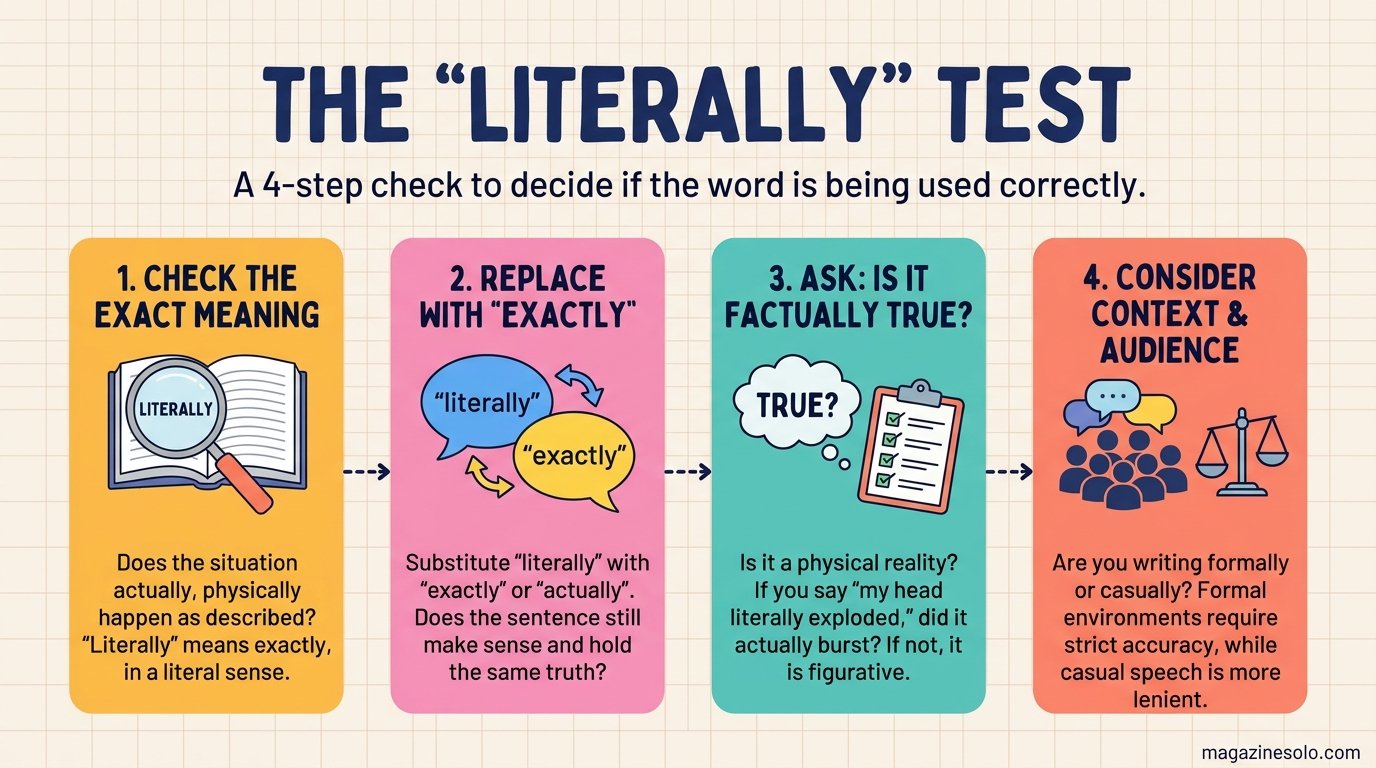
Frequently Asked Questions
1. What does literally mean in simple words?
In simple words, it means true exactly as said, word for word, with nothing exaggerated. Informally it also works as a strong emphasiser. The full definition lives on the what does literally mean base page.
2. What is the meaning of literally with examples?
It is the meaning shown through judged sentences, which is this page’s whole method. Strict: the recipe literally calls for two cups. Intensifier: I literally died laughing. The 48-sentence bank above sorts every pattern between those poles.
3. How many meanings does literally have?
Two working jobs, recorded as several dictionary senses. Merriam-Webster lists four strict and emphasis senses plus the informal intensifier; the Oxford Advanced Learner’s Dictionary lists three. The count differs because dictionaries slice the same jobs differently.
4. Is it correct to use literally for emphasis?
Yes, in informal English, where dictionaries record the intensifier sense and label it informal. In careful or formal writing the same use draws objections, so the honest verdict is always: accepted, with the register named.
5. Is ‘I literally died laughing’ wrong?
Not by the dictionary record: it is a Class 3 intensifier, accepted informally. The Language Portal of Canada marks the same sentence Incorrect for careful writing. Both strands are real; your register decides which one governs your sentence.
6. What is an example of literally used correctly?
From the bank: I literally read the contract twice before signing it. The reading happened, twice, as a matter of record, so the word certifies an exact fact. Any Class 1 or Class 2 sentence is a correct-use example.
7. What is an example of literally in its strict sense?
The word breakfast literally means breaking a fast. The word parts match the definition exactly, the exact-equivalence sense. Strict examples share one trait: a check, a text or a measurement can confirm every word of the claim.
8. What is an example of literally used for truth emphasis?
I literally told you yesterday that the meeting had moved to Friday. The telling really happened; the word stresses the truth of a plausible fact the listener seems to doubt. That is Class 2, the middle class most pages miss.
9. What is an example of literally used as an intensifier?
My phone literally exploded with messages after the photo went up. The phone did not detonate; the word stresses the volume. That is Class 3, recorded by dictionaries as an informal sense meaning in effect or virtually.
10. What is an example of literally used wrongly?
He literally almost won the race. The event never happened, so there is no fact for the word to underline. Class 4 errors fail in every register, unlike intensifiers, which fail only where the register is careful.
11. What is the difference between literally and figuratively, with examples?
Literally certifies a claim as worded; figuratively signals a claim true as a picture, not a fact. The ice literally melted in the sun is a report. Her anger melted as he apologised is figurative, and needs no marker at all.
12. Can literally and figuratively appear in the same sentence?
Yes, if each word keeps its own job: read literally, the line is a weather report; read figuratively, it is a warning. What fails is the Class 4 pattern he literally meant it figuratively, where the two adverbs cancel.
13. What can I say instead of literally in a sentence?
Match the replacement to the job. For truth, use actually or truly; for neutral emphasis, really; for near-truth, virtually. Often the strongest replacement is deletion, when the sentence loses nothing but volume without the word.
14. What are synonyms of literally that work in sentences?
Actually confirms facts: the shop actually opens at five. Exactly fits wording: the note says exactly that. Virtually covers in-effect claims: the hall was virtually empty. Each synonym keeps one job and drops the others, which is the point.
15. Is literally formal or informal?
The word is neutral; its senses are not. The strict and truth-emphasis senses fit every register, while the intensifier sense is labelled informal by Merriam-Webster, the Oxford Advanced Learner’s Dictionary and Cambridge alike.
16. Can I use literally in formal writing or an exam essay?
Use Classes 1 and 2 freely; they are exam-safe. Avoid the Class 3 intensifier, which markers read as an error even though dictionaries record it. When in doubt in formal prose, delete the word and let the fact carry itself.
17. Why do dictionaries list two opposite meanings for literally?
Because usage created a second job over centuries, a process called semantic change. Words that pick up opposite senses this way are called auto-antonyms, or Janus words. Dictionaries record both jobs because both are genuinely used and understood.
18. Since when has literally been used as an intensifier?
The sources disagree, so the answer is strands. Merriam-Webster’s usage guide dates evidence to the mid-18th century; Collins dates wide intensifier use to the early 20th century; Wikipedia dates its emergence at the latest by 1769.
19. Did famous writers use literally as an intensifier?
Yes. Merriam-Webster’s own example list quotes James Joyce and William Makepeace Thackeray using it, and Mark Twain and Charles Dickens are named across the field as users of the same device. The use is literary as well as colloquial.
20. Does literally mean figuratively now?
No. Dictionaries record an intensifier sense, glossed in effect or virtually; they do not record a sense meaning figuratively. In I literally died laughing, the sentence is figurative and the word adds force; the two jobs stay separate.
21. What does ‘taken literally’ mean in a sentence?
It means understood in the strict sense, at face value. He took the instructions literally and waited by the door for three hours: he followed the words exactly as stated, which is why the phrase often introduces a misunderstanding story.
22. What does ‘literally translated’ mean?
It means translated word for word, keeping the original wording as closely as the new language allows. She translated the poem literally, keeping every word in its original order. The opposite approach, translating for sense, produces freer and often better renderings.
23. How do I use literally in a sentence about numbers?
Use it when the number is exact or checkable: I literally have three dollars left until payday. A believable count stressed as accurate is Class 2. An impossible count, a million times, is Class 3 emphasis and belongs to informal settings.
24. Is ‘there were literally hundreds of people’ correct?
Yes, as truth emphasis, when the count is large but believable and the speaker is stressing its accuracy. The bank’s matching pattern is the hundreds of bees around the hive. If the count were invented for effect, the sentence would slide into Class 3.
25. Is ‘I literally can’t even’ a complete use of the word?
It is a fragment of the intensifier use, common in texting and speech, where the missing half is understood as strong feeling. As writing it is slang shorthand, not a complete sentence, and it carries no claim the word can certify.
26. Can literally go at the start of a sentence?
Yes. Literally, the road ends at the lake is grammatical and keeps the truth-emphasis job. Front placement suits Class 1 and Class 2 claims; it cannot rescue a Class 4 sentence, whose problem is logic rather than position.
27. Where does literally go in a sentence?
Usually next to the claim it certifies: before the verb or phrase it stresses. The recipe literally calls for two cups places it against the wording. If you cannot tell which claim it sits on, the sentence needs rewriting, not repositioning.
28. What is the opposite of literally?
Figuratively. The pair name the two reading modes: a statement taken literally is true as worded, and a statement taken figuratively is true as a picture or comparison. Most usage trouble comes from marking the second mode with the first mode’s word.
29. Is literally an adverb?
Yes. It is the adverb form of the adjective literal, and it modifies verbs, adjectives and whole statements. Its part of speech never changes across the classes; what changes is the job the adverb is doing in that sentence.
30. How do you pronounce literally?
LIT-er-uh-lee, four syllables in careful speech, often compressed toward three in fast conversation. The stress stays on the first syllable either way. Learners meet both forms in listening material, and dictionaries record the full form as the citation pronunciation.
31. What is the difference between literally and actually in sentences?
Actually confirms or corrects a fact: the shop actually opens at five, not six. Literally certifies exact truth or wording, or intensifies informally. The swap test separates them: whichever word keeps your meaning is the job your sentence needed.
32. What is the difference between literally and virtually in sentences?
Virtually means in effect, almost entirely true: the hall was virtually empty. It is the honest word for near-truths, which is why it cures Class 4 patterns. He literally almost won fails; he virtually won, or he nearly won, says the near event cleanly.
33. What is the difference between literally and really?
Really is the neutral emphasiser, welcome almost everywhere informal and harmless in most formal prose. Literally adds a truth claim on top of emphasis, which is its strength in Classes 1 and 2 and its risk in Class 3, where the claim is not true as worded.
34. Why do people say literally so much?
Because speech rewards emphasis, and the word is the strongest emphasis marker everyday English offers. Storytelling, surprise and argument all pull speakers toward it. The cost appears only in writing, where the volume it adds reads as carelessness to careful readers.
35. Is it wrong to say literally all the time?
Not wrong, but expensive. Constant use drains the strict sense you need when a claim must be certified, and it weakens credibility with careful readers. Speakers who save the word for Classes 1 and 2 keep its full force in reserve.
36. How is literally treated in school exams?
As a register test. Strict and truth-emphasis uses pass without comment; the intensifier is marked as an error in formal answers, following the dictionaries’ own informal label. Exam candidates should treat Class 3 as speech-only, whatever their personal view of the controversy.
37. Can I use literally in a job application or a work email?
Yes, in Classes 1 and 2: the form literally asks for two references is precise and safe. Keep the intensifier out; it reads as casual in exactly the documents where casualness costs most. Deletion is the safest edit when a sentence feels borderline.
38. What does literally mean in texting and online comments?
Almost always the intensifier: a signal of strong feeling, not a factual claim. I literally can’t even and I literally died are emotional shorthand between people who share the code. Judging texting by exam rules mistakes the register entirely.
39. How do I test whether my use of literally is correct?
Run three checks. The deletion test: remove the word; losing truth means Class 1 or 2, losing only volume means Class 3. The swap test: try actually, really or virtually. The register check: keep Class 3 out of formal writing.
40. What is a self-contradictory use of literally?
A Class 4 use, where the sentence cancels itself: she is literally the only person here, along with her five friends. The word claims exact truth for a claim its own sentence refutes, so it fails in every register, not just careful ones.
41. Is literally the most misused word in English?
It is often called that in usage writing, but the fairer label is most disputed. Dictionaries record both of its jobs, so most of its supposed misuse is a recorded sense meeting a careful audience. Genuine misuse is narrower: the Class 4 patterns.
42. Where can I practise more judged examples of literally?
Start with this page’s self-test, then re-judge the bank sentences with the reasons covered. The same verdict method runs through the what does irony mean examples on MagazineSolo, where sentences are likewise sorted by class rather than admired.
Conclusion
The meaning of literally with examples is, in the end, a sorting skill. Strict use certifies facts, truth emphasis defends surprising ones, the intensifier turns up figures in informal English, and self-contradictions fail everywhere, and each class now has twelve judged sentences behind it.
Keep the trio’s roles straight when you read on: the base page owns the definition and the two-senses test, and this page owns the examples. Judge first by truth, then by figure, then by register, and the word will rarely embarrass you again.
Readers who enjoy verdicts can keep going inside the same cluster, where word pairs are judged the same way: the adapt vs adopt difference, the adverse vs averse difference, the all ready vs already difference and the a lot vs allot vs alot pages.

Dilawar is a content writer at MagazineSolo, covering travel, home improvement, interior design, and everyday lifestyle topics. He enjoys researching practical solutions, exploring travel destinations, and sharing helpful guides that make daily life easier. His writing focuses on clear information, useful advice, and engaging stories for a wide audience.


