Precede vs Proceed Difference: The Difference, the Noun Forms and the Spelling Rule

The precede vs proceed difference comes down to direction. Precede means to come before something in time, order or rank. Proceed means to go forward or to continue with an action.
One word looks backward, the other pushes on. Winter precedes spring, because winter comes first. A meeting proceeds after a break, because the action keeps going.
The confusion is built into the pair. The two words sound almost alike, share a Latin root and differ by only a few letters. Even careful writers swap them in fast drafts.
The stakes are small but public. A swapped verb sits in wedding orders, legal filings and product screens where thousands read it. Getting the pair right is a cheap signal of careful writing.
Three small systems settle the choice. Precede runs on constructions, proceed runs on prepositions, and both grow noun forms with meanings of their own. The spelling family then explains the endings.
A shorter treatment already sits on this site. Readers in a hurry can start with our precede vs proceed guide for the basic contrast. The pages below build the full system around it.
One test decides most sentences in seconds. Swap in come before or go forward and keep whichever fits. The sections that follow show why that test works.
The Two-Word Rule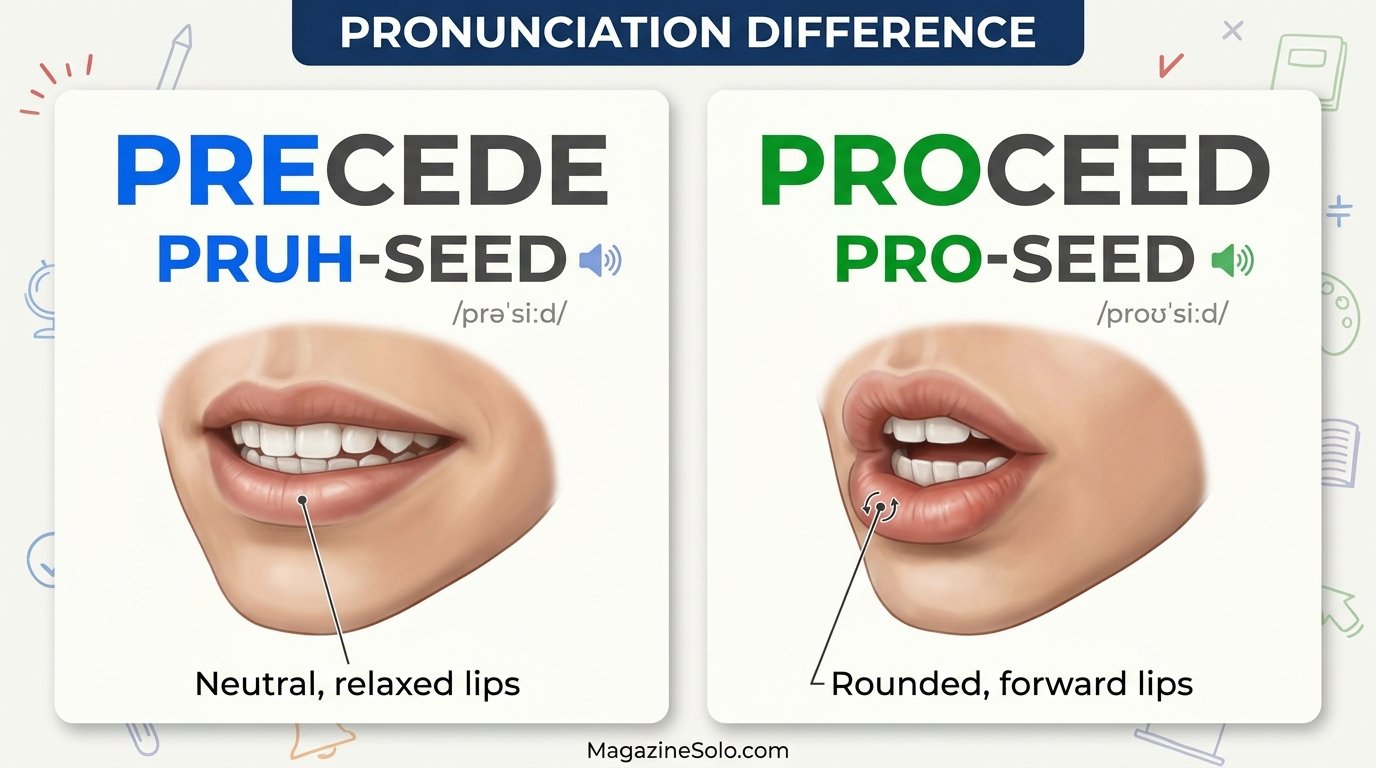
Precede answers the question before what. It places one thing ahead of another in time, in a sequence or in rank. Proceed answers the question what happens next, and it moves an action forward.
Merriam-Webster’s usage guide frames the split cleanly. The meanings of precede lean toward time, while the meanings of proceed lean toward movement. Its model sentence runs both words through one scene, later in this page.
|
Feature |
Precede |
Proceed |
|---|---|---|
|
Core meaning |
Come before |
Go forward, continue |
|
Question it answers |
Before what? |
What happens next? |
|
Grammar |
Transitive, takes an object |
Intransitive, takes a preposition |
|
Typical example |
Winter precedes spring |
Proceed to the front desk |
|
Watch out for |
The passive frame was preceded by |
The noun proceeds means money |
A two-question check makes the rule stick. Asking before what points to precede, while asking whether the action kept going points to proceed, a contrast the Lexicow comparison of precede vs proceed builds its whole comparison around.
Direction decides other pairs on this site too. Leaving a country and entering one split the same way, and our emigrate vs immigrate guide sorts the pair by which side of the border the subject stands on.
The fuller treatment goes one level deeper. Where the short guide gives the rule, our emigrate vs immigrate difference guide works through the forms and the sentences where the direction flips. Precede and proceed reward the same patience.
What Precede Means
Merriam-Webster gives precede four transitive senses. It can mean to surpass in rank, to be or go in front of, to be earlier than, and to preface something. Used without an object, it simply means to go or come before.
The learner definition is shorter. In the Cambridge Learner’s Dictionary entry for precede, the verb means to happen or exist before something else. The same entry flags a habit worth learning early: precede often appears in the passive voice.
Rank is the sense readers forget. Kofi Annan preceded Ban Ki-moon as Secretary-General of the United Nations, so one person can precede another in an office. Succession lists and ceremony orders run on this sense.
- Winter precedes spring. The seasons run in a fixed order, and precede names the earlier slot.
- The appetizer will precede the main course. Menus and itineraries use precede for sequence.
- Strong winds precede a hurricane. Weather writing uses the verb for what arrives first.
The preface sense hides in formal writing. To precede a statement with a qualification is to put the qualification first. Dictionary.com shows the same move with instructions preceded by an important announcement.
The forms stay regular throughout. Precede, precedes, preceded and preceding follow the standard pattern, and its synonyms run to predate and lead up to. Nothing about the verb’s shape explains the confusion; the meaning does.
Grammar books use precede about language itself. Verbs usually precede objects in English, as the Cambridge Advanced entry puts it, so the verb describes its own behavior in that sentence. Word-order statements are a quiet home of this sense.
What Proceed Means
Proceed is the verb of forward motion. Merriam-Webster centers it on beginning and carrying on an action, process or movement. It also covers continuing after a pause or interruption, which is its commonest everyday job.
The learner entry adds a register warning. In the Cambridge Learner’s Dictionary entry for proceed, proceed carries a formal label, and its core sense is to continue as planned. Lawyers deciding not to proceed with a case show the formal coloring.
One older sense points backward to a source. Strange sounds proceeded from the room, in Merriam-Webster’s example, because proceed can mean to come forth or issue from somewhere. The from frame carries this sense, below.
- Passengers for Sydney should proceed to gate 21. Airport language uses proceed for directed movement.
- After the interruption, she proceeded with her presentation. The with frame marks an action resumed.
- The work is proceeding well. Here the verb reports an action under way.
Checkout screens run on this verb. Proceed to checkout means start the next, not yet begun step. That small distinction between starting and continuing gets its own section below.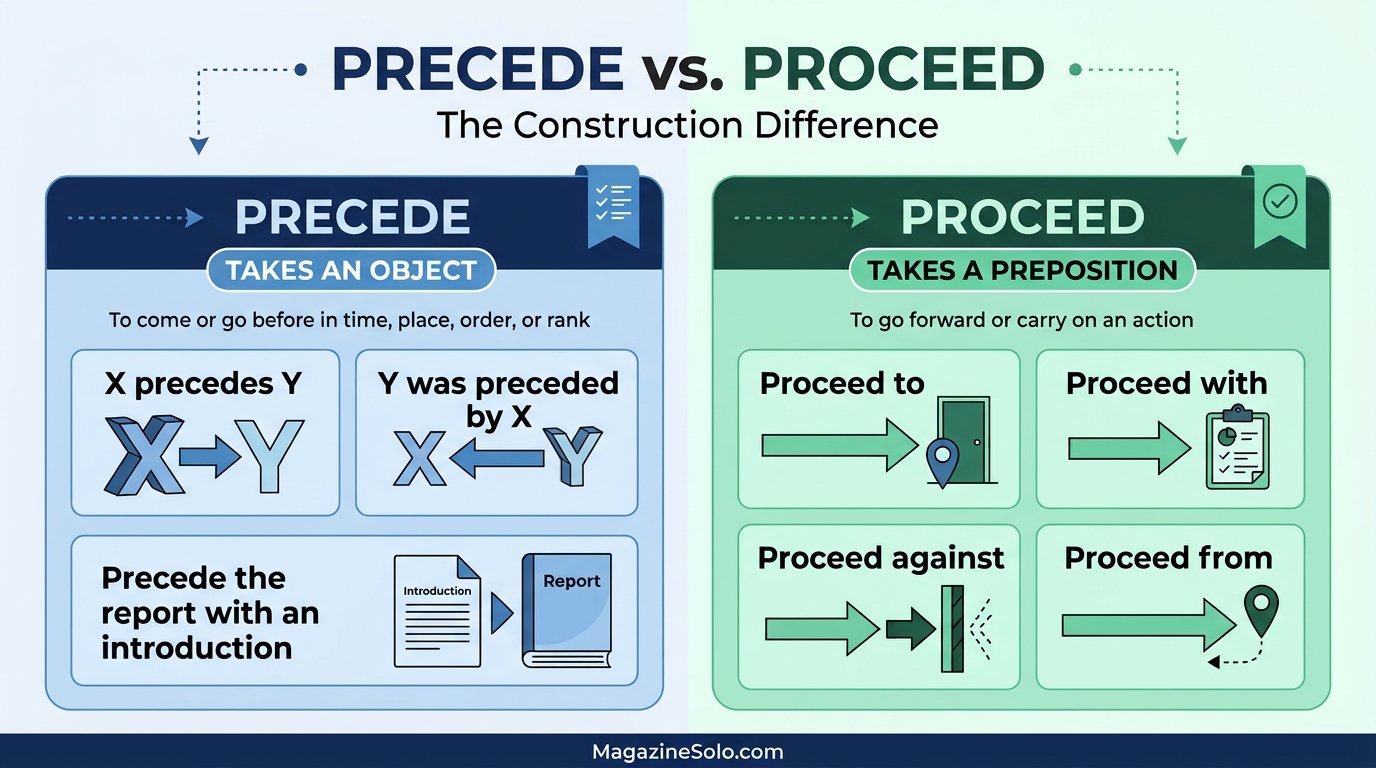
A fourth dictionary sense ties proceed to causes. Merriam-Webster’s synonym discussion says proceed stresses origin, derivation or logical cause, as when advice proceeds from the best of intentions. That is the from frame wearing formal dress.
Its synonyms point the same direction. Continue, carry on and begin all stand near proceed, while go before and predate stand near precede. A quick synonym swap is a fair first check on any doubtful sentence.
Precede Takes an Object: The Construction System
Precede is transitive, so it needs something to precede. Every correct use names two things: the one that comes first and the one it comes before. Three frames cover nearly every sentence you will write.
|
Frame |
Pattern |
Example |
|---|---|---|
|
Active |
X precedes Y |
A short speech preceded the dinner |
|
Passive |
Y was preceded by X |
The meeting was preceded by a brief welcoming speech |
|
With frame |
precede Y with X |
Precede the report with an introduction |
The passive frame does most of the work. Cambridge marks precede as often passive, and the pattern was preceded by is the pair’s most recognizable shape. The voice test in the QuillBot guide to proceed vs precede turns that habit into a rule.
The with frame reverses the camera angle. Instead of saying what came first, it names the main item and attaches the opener to it. The dedicated phrasal entry the Cambridge entry for precede something with something gives the pattern with a report and an introduction.
Converting between frames is the practical skill. The speech preceded the dinner turns into the dinner was preceded by the speech, and either can gain an opener: precede the dinner with a speech. Writers who can rotate all three rarely stall.
Transitivity sorts other stubborn pairs too. Lay takes an object and lie does not, and our lay vs lie guide teaches that pair through the same object test. If a verb needs a target, the transitive twin usually wins.
The difference page drills the object test harder. Worked sentences in our lay vs lie difference guide show the swap failing in both directions. Precede passes the same test every time, because something always stands after it.
Proceed Takes a Preposition: The Partner System
Proceed is intransitive, so its meaning rides on a small word after it. To, with, against and from each steer the verb into a different job. Learning the four partners is learning the verb.
|
Partner |
What it signals |
Example |
|---|---|---|
|
proceed to |
Move toward a place, or start the next act |
Proceed to gate 21; proceed to checkout |
|
proceed with |
Continue an activity already under way |
Proceed with the presentation |
|
proceed against |
Take legal action against someone |
The agency proceeded against the firm |
|
proceed from |
Come from a source, originate |
Sounds proceeded from the room |
To and with split on timing. The Government of Canada’s Writing Tips states the contrast no ranking guide teaches: proceed to starts an act not previously begun, while proceed with continues an activity already started. Checkout starts; presentations continue.
As planned is the collocation professionals lean on. Sales proceeded as planned and the talks proceeded as planned both report an action holding its schedule. The phrase only works with proceed, because only proceed reports an action under way.
Against turns the verb legal. Dictionary.com lists a law sense: to begin and carry on a legal action, usually followed by against. The full sense set sits in the Dictionary.com entry for proceed, including the older issue and arise meanings.
Two fixed phrases round out the system. Proceed as planned reports an action running on schedule, and proceed with caution warns before a step. Caution never takes precede, however often the swap appears in drafts.
Proceed to also introduces verbs, not only places. Cambridge treats proceed to do something as its own pattern: she sat down and proceeded to tell me about her holiday. The to belongs to the next act, not to a destination.
Pronunciation: Two Verbs and a Noun That Moves Its Stress
The verbs are almost homophones, not true homophones. Merriam-Webster treats them as near-identical in sound, with different first vowels doing the separating. Precede opens with a long ee sound, proceed with a long oh.
Plain respellings make the contrast easier. The respelling pair in the Grammarly guide to proceed vs precede writes proceed as PRO-seed and precede as PRUH-seed. Saying the two aloud, slowly, exposes the vowel gap that spelling hides.
British and American forms drift only slightly. Cambridge gives precede a short i in British speech and a long ee in American, and proceed a weak first vowel in British against a long oh in American. The first-vowel contrast survives in both varieties.
The noun breaks the pattern entirely. Proceeds, meaning money, moves its stress to the first syllable: PRO-ceeds. Collins prints the noun and verb pronunciations side by side, and the stress note in the LanguageTool guide to precede vs proceed flags the same shift.
Reading the pair aloud exposes the trap. In fast speech the first vowels shrink toward each other, which is why dictation software swaps the words so often. Slow down on the first syllable and the spelling follows the sound.
The Noun System: Preceding, Proceedings and Proceeds
Preceding is the adjective the pair grows on the precede side. It means coming before or previous, and it stands in front of nouns: the preceding chapter, the preceding months. It is a participle doing an adjective’s job.
|
Form |
Word class |
Meaning |
Example |
|---|---|---|---|
|
preceding |
Adjective |
Coming before, previous |
The preceding chapter |
|
proceeding |
Noun, singular |
One legal action or procedure |
A final proceeding |
|
proceedings |
Noun, plural |
Events at a formal occasion; legal action; a published record |
The proceedings began at nine |
|
proceeds |
Noun, plural |
Money from a sale, event or transaction |
The proceeds of the sale |
|
proceeds |
Verb form |
Third person singular of proceed |
She proceeds to the stage |
Proceedings carries three senses, and context picks one. It can name the happenings at a formal event, a legal action, or the published record of a conference. The three-way split is set out in the Cambridge entry for proceeding for the singular form.
One guide gives the noun family its fullest treatment. The headed sections in the QuillBot guide to proceed vs precede walk through preceding, proceeding and proceeds one by one. No other top page gives the record sense of proceedings its own space.
Proceeds the noun is always plural. All of the proceeds from the art auction were donated to charity, in the worked example inside the Dictionary.com comparison of proceed and precede. The same spelling as a verb form means she goes forward, so grammar decides.
One statute made the noun famous. The Proceeds of Crime Act puts proceeds in the title of British law, and the phrase proceeds of crime now travels with the money sense everywhere. The Grammar Monster test uses that title as a question.
Two neighbors are not forms of precede at all. A precedent is an earlier decision that guides later ones, and precedence means priority, as when safety takes precedence over speed. SpellRightDaily warns about both impostors.
The singular proceeding names one step of a case. My lawyer and I had to go to one final proceeding before the case was closed, in LanguageTool’s example. Writers who master the singular stop fearing the plural.
Precede in Rank, Office and Ceremony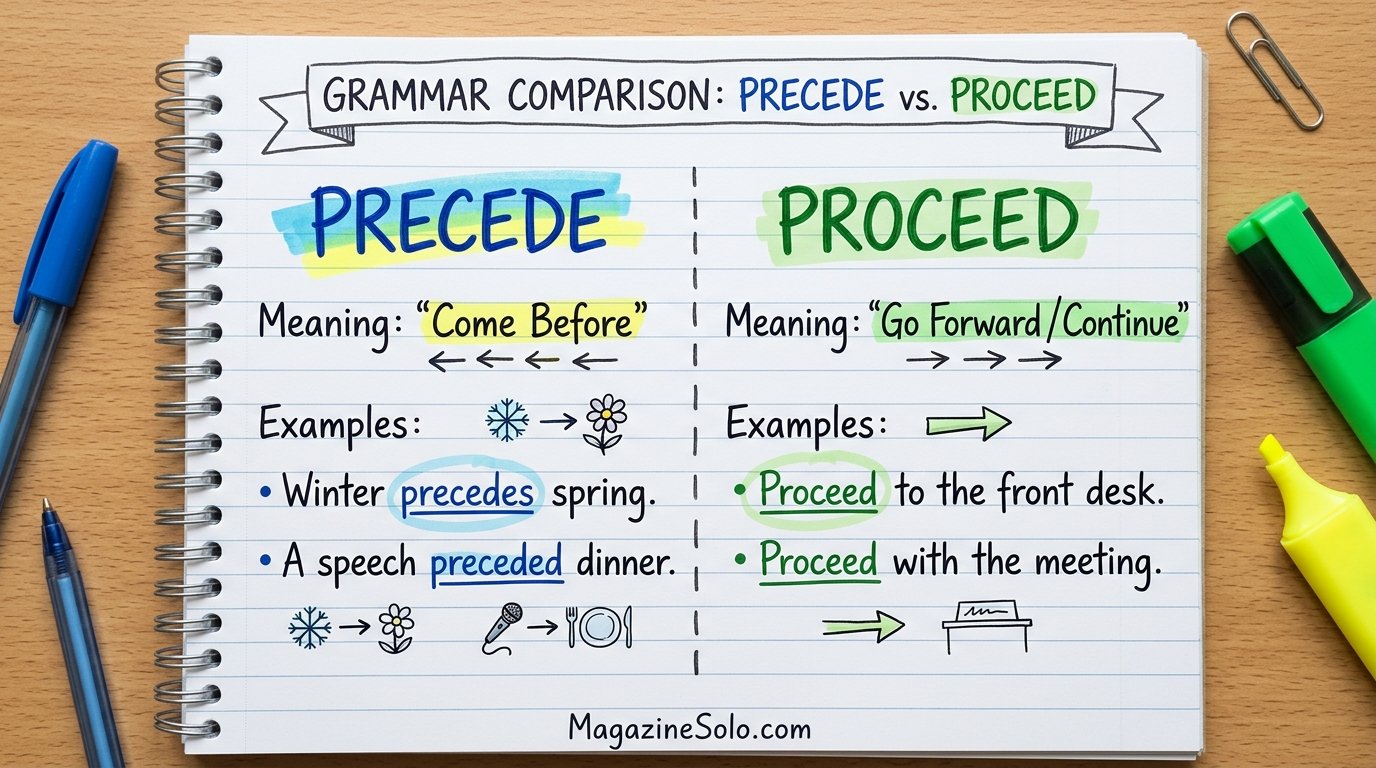
Rank is precede’s oldest surviving job. To precede someone can mean to surpass them in rank, dignity or importance, Merriam-Webster’s first listed sense. Courts, churches and state ceremonies still publish orders built on exactly this meaning.
Office succession runs on the same sense. A predecessor is simply the person who preceded the current holder, and lists of presidents, popes and chief executives are precede sentences in table form. Annan before Ban is the modern textbook case.
Protocol questions are rank questions. Who walks in first, whose name is read first and which flag stands first are all precedence decisions. The verb for the person ahead is always precede, never proceed.
The Spelling Family: -cede, -ceed and -sede
Only three common English verbs end in -ceed. Proceed stands with exceed and succeed, while the rest of the family ends in -cede. The family table in the Nexlatic guide to precede or proceed prints the split with its exception.
|
Ending |
Verbs |
Memory line |
|---|---|---|
|
-cede |
precede, recede, concede, secede, accede, intercede, antecede |
The default ending for the family |
|
-ceed |
proceed, exceed, succeed |
Only three common verbs |
|
-sede |
supersede |
A different Latin root, sedere, to sit |
Supersede is the family’s one true exception. It descends from Latin sedere, to sit, not from cedere, to go. That separate root is why supercede is always a misspelling, however logical it looks.
Precedent doubles as a spelling hook. Dictionary.com points out that precedent, which shares the cede shape, helps writers remember that precede ends in cede and not ceed. Recede, meaning go back, hangs on the same root.
Two misspellings stalk this pair specifically. Preceed adds a letter that no standard dictionary accepts, a trap Dictionary.com answers with a whole section. The check in the WordCompareHub check on proceed or procede confirms procede appears in no standard dictionary either.
Letter shapes can carry the memory load. The extra e in precede matches the e in before, and the o in proceed matches forward, the hooks taught in the Writing Explained guide to precede vs proceed. Small visual anchors beat rereading definitions.
One letter does the same deciding work elsewhere. A capital and a capitol differ in their final vowel, and our capital vs capitol guide sorts them by building versus city. The companion treatment in our capital vs capitol difference guide adds the memory hooks.
Doubling a letter is the mirror-image trap. Dessert carries two s letters where desert carries one, and our desert vs dessert guide ties the extra letter to a second helping. Spelling families reward one clear hook each.
Three-way lookalikes follow the same discipline. Ensure, insure and assure differ by prefix and by job, and our ensure vs insure vs assure guide separates them by what each one guarantees. One hook per word ends most swaps.
Where the Words Come From
Both verbs grow from one Latin root. Cedere meant to go, move away, withdraw or yield. Precede adds prae, before, giving praecedere, to go in front of. Proceed adds pro, forward, giving procedere, to go forward.
Both words crossed into English through French. Nexlatic dates precede to late Middle Ages French and proceed to Old French at about the same period. Merriam-Webster gives first known uses a century apart: proceed in the 1300s, precede in the 1400s.
The pair once overlapped completely. Merriam-Webster’s usage guide, citing the historical record, notes that precede once meant to proceed, with the last such citation around 1450. Five centuries of separation followed that shared start.
The confusion has an expert witness. Bryan Garner, quoted in ThoughtCo’s treatment, observes that the pair are sometimes confused even by otherwise literate people. Both can mean to go ahead, he notes, but in different senses.
Word class settles the pair the history muddied. Passed is a verb form and past usually is not, and our passed vs past guide sorts that pair by grammar first. Precede and proceed split the same way, by job.
The fuller comparison leans on the same method. Side-by-side sentences in our passed vs past difference guide show each word failing in the other’s slot. Run precede and proceed through the same exchange test before trusting either.
Common Mistakes and How to Catch Them
The costliest swap hides inside a single adjective. The proceeding chapter sounds plausible and is always wrong, because chapters come before, and coming before is preceding. Proceeding as an adjective belongs to actions under way, not to order.
One editor wants proceeded to banned from drafts. The stance in the SpellRightDaily guide to precede vs proceed meaning calls the pattern pure clutter in workplace prose. Treat it as one editor’s taste: the dictionaries list proceed to do something as a core sense.
The swap also breaks transitivity in the open. The press secretary proceeded the president to the microphone is wrong, because proceed cannot take the president as an object. Writing Explained uses that very pair to show the object test failing.
Workplace prose is where the swap survives longest. SpellRightDaily locates the confusion in executive summaries, legal briefs and speech-to-text meeting notes, where nobody rereads closely. A thirty-second substitution check before sending is the cheapest fix in this page.
Both words can share one sentence safely. As we proceeded from the house to the pool we were preceded by the children, in Merriam-Webster’s model. Movement takes proceed, and the group ahead takes preceded.
Direction of flow catches a cousin pair. Imply sends a meaning out and infer draws one in, and our imply vs infer guide teaches the pair from the speaker’s side. Precede and proceed split by direction in the same spirit.
The difference treatment adds the listener’s side. Worked exchanges in our imply vs infer difference guide show why swapping the verbs reverses who knows what. Direction errors always reverse something, which is why they survive casual proofreading.
Learners meet the pair early and formally. Airport signs, courtrooms and checkout screens all run on proceed, while syllabi and ceremonies run on precede. The learner-first walkthrough in the BroadLearners lesson on precede or proceed starts from those everyday scenes.
Self-Test: Ten Questions
Ten questions cover the whole system. Meaning, spelling traps, noun forms and the adjective swap all appear once. More drills of the same kind wait in the Grammar Monster test on precede or proceed for readers who miss more than two.
- Winter ___ spring in the calendar.
- Please ___ to the front desk.
- True or false: “the proceeding chapter” is correct.
- All of the ___ from the bake sale went to the shelter.
- Is preceed a word?
- The regulator will ___ against the firm.
- She ___ her announcement with a short apology.
- After lunch, the tour ___ to the museum.
- Which spelling is right: supercede or supersede?
- The conference ___ will be published online next month.
Answer Key
- Precedes. Winter comes before spring, so the time and order verb fits.
- Proceed. Directed movement toward a place takes proceed to.
- False. Chapters come before, so the adjective is preceding, never proceeding.
- Proceeds. Money from an event is the plural noun proceeds.
- No. Preceed appears in no standard dictionary; the spelling is precede.
- Proceed. Legal action runs on proceed against.
- Preceded. The with frame attaches the opener to the main item.
- Proceeded. The group moved forward to a new place.
- Supersede. Its root is sedere, to sit, not cedere.
- Proceedings. A published conference record is proceedings.
Scoring the test takes one minute. Eight or more right means the system has landed; five to seven means the noun forms need one more pass. Below five, reread the construction and preposition tables, then retake the test tomorrow.
Frequently Asked Questions
1. What is the difference between precede and proceed?
Precede means come before, and proceed means go forward. Precede places something earlier in time, order or rank.
Proceed begins or continues an action.
Swapping in come before or go forward settles most sentences.
2. What does precede mean?
Precede means to come before something else. Merriam-Webster lists coming ahead in front, being earlier, surpassing in rank and prefacing.
Cambridge shortens it to happen or exist before something else.
3. What does proceed mean?
Proceed means to go forward or continue. Merriam-Webster centers it on beginning and carrying on an action, process or movement.
It also covers continuing after a pause and, with from, issuing from a source.
4. How do you use precede in a sentence?
Put precede between the earlier thing and what follows it. Winter precedes spring, and a short speech preceded the dinner.
In the passive, the meeting was preceded by a brief welcoming speech.
5. How do you use proceed in a sentence?
Use proceed for movement or for an action moving forward. Passengers should proceed to gate 21, and after the break she proceeded with her presentation.
The verb takes a preposition, never a direct object.
6. Can I use precede and proceed in one sentence?
Yes, when one thing moves and another goes ahead of it. Merriam-Webster’s model runs: as we proceeded from the house to the pool we were preceded by the children.
Movement takes proceed; position takes precede.
7. How do you remember the difference between precede and proceed?
Anchor each word to its prefix and one picture. Pre means before, as in preview, and pro means forward, as in progress.
The extra e in precede also matches the e in before.
8. How do you pronounce precede and proceed?
The verbs differ in their first vowel. Grammarly respells proceed as PRO-seed and precede as PRUH-seed, while dictionaries give a long ee opening for precede and a long oh for proceed.
The noun proceeds stresses PRO.
9. Are precede and proceed homophones?
Almost, but not quite. Merriam-Webster treats the pair as almost homophones: the endings match, while the first vowels differ.
That small sound gap is why the words blur in speech yet stay separate in careful writing.
10. What does “proceeds” mean?
As a noun, proceeds means money obtained from something. It names the takings of a sale, event or transaction, and it is always plural in this sense.
The stress falls on the first syllable: PRO-ceeds.
11. What are the proceeds of a sale?
They are the money the sale brings in. The proceeds of the sale will be reinvested in the business, in one guide’s example.
What remains after costs is the net figure people usually quote.
12. What does proceedings mean?
Proceedings names what happens at a formal event, a legal action, or the published record of one. The proceedings began with a presentation, criminal proceedings followed, and the conference proceedings appeared online.
Context picks the sense.
13. What are court proceedings?
Court proceedings are the legal action itself. The term covers the steps a case takes through a court, from filing to hearing to judgment.
It is the plural noun built on proceed, not a form of precede.
14. What is the noun form of proceed?
Proceed grows two noun forms: proceeding and proceedings, plus proceeds. A proceeding is one legal action, proceedings are events, cases or records, and proceeds is money.
Precede, by contrast, grows the adjective preceding instead.
15. What is the adjective form of precede?
Preceding is the adjective form. It means coming before or previous, and it modifies nouns: the preceding chapter, the preceding months.
It began as the verb’s participle and now works as a standalone adjective.
16. What is the difference between preceding and proceeding?
Preceding means coming before; proceeding means going on. The preceding chapter sits earlier in the book, while the proceeding inquiry is under way.
Swapping them is the pair’s costliest error, because both spellings look plausible.
17. Precede vs proceed: which is correct in “the preceding chapter”?
Preceding is correct. A chapter’s position is about order, and order belongs to precede.
Proceeding would claim the chapter is an action under way, which is the legal and event sense, not a place in a sequence.
18. Can precede be used in the passive voice?
Yes, and the passive is its commonest shape. Cambridge marks precede as often passive: the formal ceremony was preceded by a parade.
When a sentence runs was something by, the missing word is almost always preceded.
19. Can you precede something with something else?
Yes; that is the with frame. Cambridge lists precede something with something as its own pattern: precede the report with an introduction.
The sentence names the main item first and attaches the opener after with.
20. What is the difference between “proceed to” and “proceed with”?
Proceed to starts the next act; proceed with continues a current one. The Government of Canada’s Writing Tips states the contrast plainly: to marks an act not previously begun, with marks an activity already under way.
21. What does “proceed against” mean in law?
It means to begin and carry on legal action against someone. Dictionary.com lists the law sense with against as its usual partner.
Companies and agencies proceed against firms, and courts proceed against defendants.
22. What does “proceed from” mean?
It means to come forth from a source, or to arise from one. Strange sounds proceeded from the room, in Merriam-Webster’s example.
Advice that proceeds from good intentions uses the same origin sense.
23. Is it “proceed with caution” or “precede with caution”?
Proceed with caution, always. Caution is an activity you continue carefully, so the with frame of proceed carries it.
Precede with caution would put caution before something, which is not what the warning means.
24. Is it “proceed as follows” or “precede as follows” in a technical manual?
Proceed as follows. The manual is starting the steps that come next, and starting forward motion belongs to proceed.
Precede as follows would claim the steps come before something the sentence never names.
25. What are the past tense forms of precede and proceed?
Preceded and proceeded, both regular. Each verb adds the standard ed ending, and the participles match: preceded and proceeded again, with preceding and proceeding as the present participles.
The forms never swap endings.
26. Is preceed a word?
**No.
Preceed appears in no standard dictionary.** Dictionary.com gives the question its own section because the error is so common.
The verb meaning come before is spelled precede, with the family ending cede.
27. Are “preceed” and “procede” real words?
Neither is a real word. Preceed misspells precede, and procede misspells proceed, and no standard dictionary lists either form.
The correct pair keeps one ending each: precede with cede, proceed with ceed.
28. Is procede a misspelling of proceed?
Yes, procede is simply proceed misspelled. It borrows the cede ending from the larger family, but proceed belongs to the small ceed group with exceed and succeed.
WordCompareHub confirms no dictionary lists procede.
29. Is “procede” ever correct in British English?
No, procede is wrong on both sides of the Atlantic. British and American spelling agree on this pair completely.
The misspelling survives because the cede family is larger, not because any variety allows it.
30. Do Americans and British people spell precede and proceed differently?
No, the spellings are identical in both varieties. Precede ends in cede and proceed ends in ceed in American and British English alike.
Only pronunciation drifts slightly, and even that stays close.
31. Why does proceed end in -ceed but precede ends in -cede?
History, not logic, fixed the endings. Both verbs descend from Latin cedere, to go, through French.
English settled proceed into the tiny ceed group and precede into the larger cede family, and the spellings froze there.
32. How many English words end in -ceed?
Three common verbs: proceed, exceed and succeed. Every other common verb in the family ends in cede, including precede, recede, concede and secede.
Supersede stands outside both groups with its sede ending.
33. Is it supersede or supercede?
Supersede is the only correct spelling. The word descends from Latin sedere, to sit, not from cedere, to go.
Its sede ending is a family of one, and supercede is always a misspelling.
34. What is the difference between precedent and precede?
A precedent is a noun; precede is a verb. A precedent is an earlier decision or example that guides later ones, especially in law.
Precede is the action of coming before something in time or order.
35. What is the difference between precedence and precede?
Precedence is a noun meaning priority; precede is the verb of coming before. Safety takes precedence over speed, while the safety briefing precedes the flight.
SpellRightDaily flags both nouns as impostors beside the verb.
36. What is the difference between proceeds and precedes?
Precedes is a verb form; proceeds is a verb form and a noun. She precedes him in rank, and she proceeds to the stage, while the proceeds of the raffle are money.
Grammar decides which one fits.
37. What is the opposite of precede?
Follow is the everyday opposite. What precedes comes before, and what follows comes after, so follow and succeed both reverse the order.
QuillBot gives follow as the direct answer for the verb’s main sense.
38. What are synonyms for precede?
Predate, lead up to, and go or come before. Grammarly lists predate and lead up to, and dictionaries add antecede for formal writing.
Each synonym keeps the core idea of standing earlier in a sequence.
39. What are synonyms for proceed?
Continue, carry on, begin and advance. Grammarly offers continue, carry on and begin for the action senses.
For movement toward a place, go on and head toward serve as plainer everyday substitutes.
40. Is proceed more formal than continue?
Yes, proceed carries a formal register. Cambridge marks the verb formal, which is why signs, courts and airlines choose it.
Continue is the neutral everyday word, and go on is the most casual of the three.
41. Did precede ever mean proceed?
Yes, centuries ago the words overlapped. Merriam-Webster’s usage guide notes that precede once meant to proceed, with the last such citation around 1450.
The shared past explains why the pair still blurs today.
42. Can a person precede another person?
Yes, in rank, office or a line. Kofi Annan preceded Ban Ki-moon as Secretary-General, and a chairperson can precede a speaker to the podium.
The sense covers succession and ceremony, not only clocks and calendars.
Conclusion
The precede vs proceed difference is a direction check. Precede points backward to what came before, and proceed points forward to what happens next. Ask which way the sentence faces, and the word chooses itself.
The systems behind the rule are small. Three constructions carry precede, four prepositions carry proceed, and the noun forms proceeds and proceedings each keep their own meaning. The spelling family then locks the endings in place.
Keep the substitution test in reach. Come before for precede, go forward for proceed, and the stress shift to PRO-ceeds whenever money appears. Those three checks catch nearly every swap this pair produces.
More pairs wait on the same shelf. The confused-words guides collected at the MagazineSolo home page apply the same method: find the job each word does, then let grammar decide. Direction first, spelling second, confidence throughout.

Dilawar is a content writer at MagazineSolo, covering travel, home improvement, interior design, and everyday lifestyle topics. He enjoys researching practical solutions, exploring travel destinations, and sharing helpful guides that make daily life easier. His writing focuses on clear information, useful advice, and engaging stories for a wide audience.