Allusion vs Illusion vs Delusion: The Difference, the Six Types and the Root They Share

Allusion vs illusion vs delusion is a three-way choice between pointing, misreading and refusing to move. An allusion points to a text, an illusion misreads the senses, and a delusion holds a belief still against the evidence.
Three channels carry the whole system. Allusion works in language, where a writer drops a name and trusts the reader to catch it. Illusion works in perception, and delusion works in belief, where nothing needs to be perceived.
The three words sit at three distances from reality. Merriam-Webster’s usage guide sets allusion nearest reality, illusion in the middle as something not as it seems, and delusion furthest out. Distance from fact increases at each step.
One Latin root explains all three. The words grow from ludere, to play: one plays toward a reference, one plays against the senses, and one settles down into a fixed belief. The family table below turns that root into a memory system.
**The comparison table here is the first single table built for these three words, and a three-question decision flow follows it. Delusion types, the sound ladder and a ten-question self-test complete the system.
The pair underneath gets its own deep treatment. The two-word choice, its preposition clue and its five types are worked in full in our allusion vs illusion guide. This page builds upward from that pair.
The Three-Word Rule
Allusion points, illusion misreads, delusion will not move. Each word fails in the other two channels: a reference cannot deceive the eyes, a misread image cannot refer, and a fixed belief needs nothing seen or said.
|
Word |
Channel |
What is real |
What goes wrong |
Type example |
Fixed phrase |
|---|---|---|---|---|---|
|
Allusion |
Language |
The text it points to |
Nothing: the pointing is deliberate |
An Achilles heel |
Make an allusion to |
|
Illusion |
Perception |
The stimulus being misread |
The senses report it wrongly |
A mirage on a hot road |
The illusion of space |
|
Delusion |
Belief |
The evidence against the belief |
The belief stays fixed anyway |
Delusions of grandeur |
Under the delusion that |
A role test makes the split vivid. Allusion is what a writer makes, illusion is what a magician creates, and delusion is what a believer holds. Crafted reference, allusion; crafted deception, illusion; held belief, delusion.
Direction decides cousin pairs on this site too. Leaving a country and entering one split by direction, and our emigrate vs immigrate guide sorts that pair by which side of the border the subject stands on. Channel does the same sorting work here.
What Allusion Means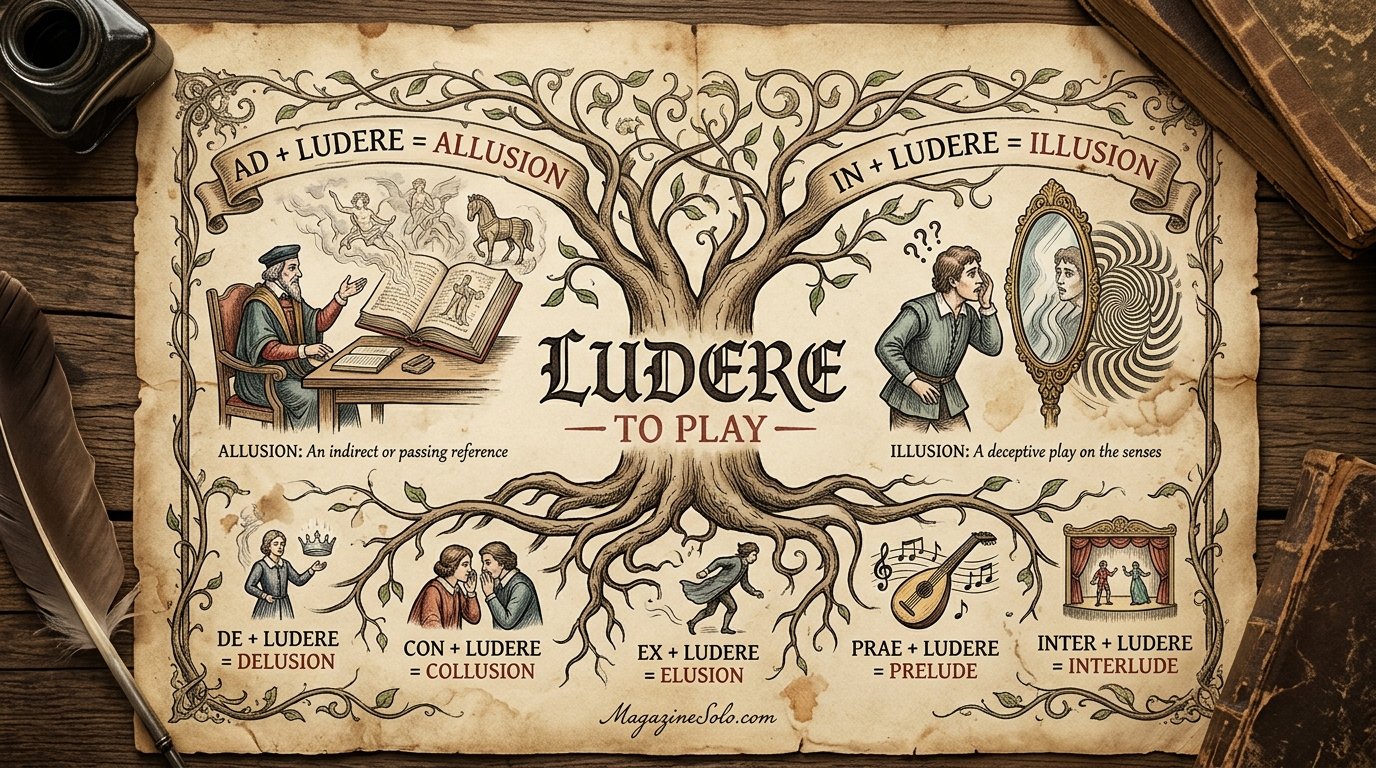
Merriam-Webster defines allusion as an implied or indirect reference. The entry adds the act of making such a reference, and its examples run from classical literature to song lyrics. The word entered English in 1542.
The Cambridge corpus shows the word at work. Examples collected in the Cambridge entry for allusion include readers who picked up on a historical allusion and pop songs full of classical allusions. The pattern is constant: a name dropped, a connection left to the reader.
- They made no allusion to the incident. Silence itself can be the reference, as Merriam-Webster’s example shows.
- The lyrics contain biblical allusions. Songs borrow scripture the same way novels do.
Indirectness is the whole definition. An allusion never explains itself, and explaining one converts it into a direct reference. The pattern make an allusion to, with to as the partner, is the formal frame.
What Illusion Means
Merriam-Webster leads with the eyes: a misleading image presented to the vision. The same entry covers what deceives the mind intellectually and the effect a magician produces by sleight of hand. One word serves the stage, the page and the laboratory.
Cambridge gives the shorter working definition. In the Cambridge entry for illusion, an illusion is something that is not really what it seems to be. The entry’s collocations, dangerous illusion and illusion of depth, show how often the word pairs with of.
The belief sense runs on a fixed frame. To be under the illusion that something is true is to be intellectually deceived, in Merriam-Webster’s sorting. Its example player believed he was the best on the team, and the that clause names the false belief.
The same entry hides a sense nobody prints. Illusion also names a fine, transparent silk tulle used for veils and trimmings. Dictionaries keep the fabric; usage guides drop it, because nobody confuses a veil with a reference.
- A technique that creates the illusion of space. Flat walls borrow depth they do not have.
- The shimmering heat created the illusion of water. A real stimulus is present and misread.
What Delusion Means
Merriam-Webster’s everyday sense is a false idea or belief. Its own examples run from the schedule frame, under the delusion that they will finish on schedule, to the fixed phrase delusions of grandeur. Belief, not perception, is the home ground.
The entry also carries a labelled psychology sense. There, a delusion is a persistent false psychotic belief regarding the self or persons or objects outside the self. The same sense adds that it is maintained despite indisputable evidence to the contrary.
Dictionary.com prints the same two levels. The senses in the Dictionary.com entry for delusion run from a false belief or opinion to the psychiatry strand: a fixed false belief resistant to reason or confrontation with actual fact. Fixity is what the clinical level adds.
The oldest sense is about deceiving, not believing. Merriam-Webster’s second sense names the act of tricking or deceiving someone, and the first known use falls in the 15th century with that meaning. The belief sense grew out of it.
One Root, Three Directions: The Ludere Family
All three words descend from the Latin ludere, to play. Allusion adds ad, toward: alludere means to play beside or toward something. Illusion adds in, against: illudere means to mock, fool or dupe, and illusio is ridicule.
The third prefix is printed two ways, and the strands stay separate. Kirk Mahoney glosses deludere with de as down, play pressing downward into a fixed belief. The pair treatment glossed de as away, and Merriam-Webster gives deludere itself as to deceive, dupe.
|
Word |
Built from |
Core meaning |
|---|---|---|
|
allusion |
ad + ludere, play toward |
An indirect reference |
|
illusion |
in + ludere, play against |
A deceptive impression |
|
delusion |
de + ludere, play down or away |
A false belief held fixed |
|
collusion |
com + ludere, play together |
Secret cooperation |
|
elusion |
e + ludere, play out of reach |
A clever escape |
|
prelude |
prae + ludere, play before |
An introduction |
|
interlude |
inter + ludere, play between |
An interval |
The family tree is older than the confusion. The full set, ludicrous included, is traced in the Daily Writing Tips post on allusion, illusion and elusion, the one older post that builds the whole family. Prelude and interlude carry the play root into concert halls.
One warning protects the table. Include, conclude and exclude look like relatives and are not: they grow from a Latin root meaning to close. Daily Writing Tips flags the impostors so the family stays honest.
Mahoney’s post is the only grammar page giving all three etymologies. The three prefixes in the Kirk Mahoney post on allusion, delusion and illusion run toward a reference, against the senses, and down into a fixed belief.
A shared root settles another pair on this site. Precede and proceed grow from cedere, to go, and our precede vs proceed guide teaches the pair through root and prefixes. Its companion in our precede vs proceed difference guide adds noun forms and the spelling family.
The Patterns That Choose the Word
The next word often chooses for you. The preposition clue in the MicroEnglish lesson on allusion or illusion observes that allusion pairs with to, because a reference points toward a target. Illusion pairs with of for appearances and that for beliefs.
Delusion runs on belief frames instead. Speakers live under the delusion that something is true, harbor delusions of grandeur, and hold delusions of persecution. The of phrases name the belief’s content, and the that clause states the belief itself.
Direction pairs elsewhere work the same way. Imply sends a hint out and infer draws a conclusion in, and our imply vs infer guide teaches the pair from the speaker’s side. Allude works like imply: both point without stating anything outright.
The Decision Flow: Three Questions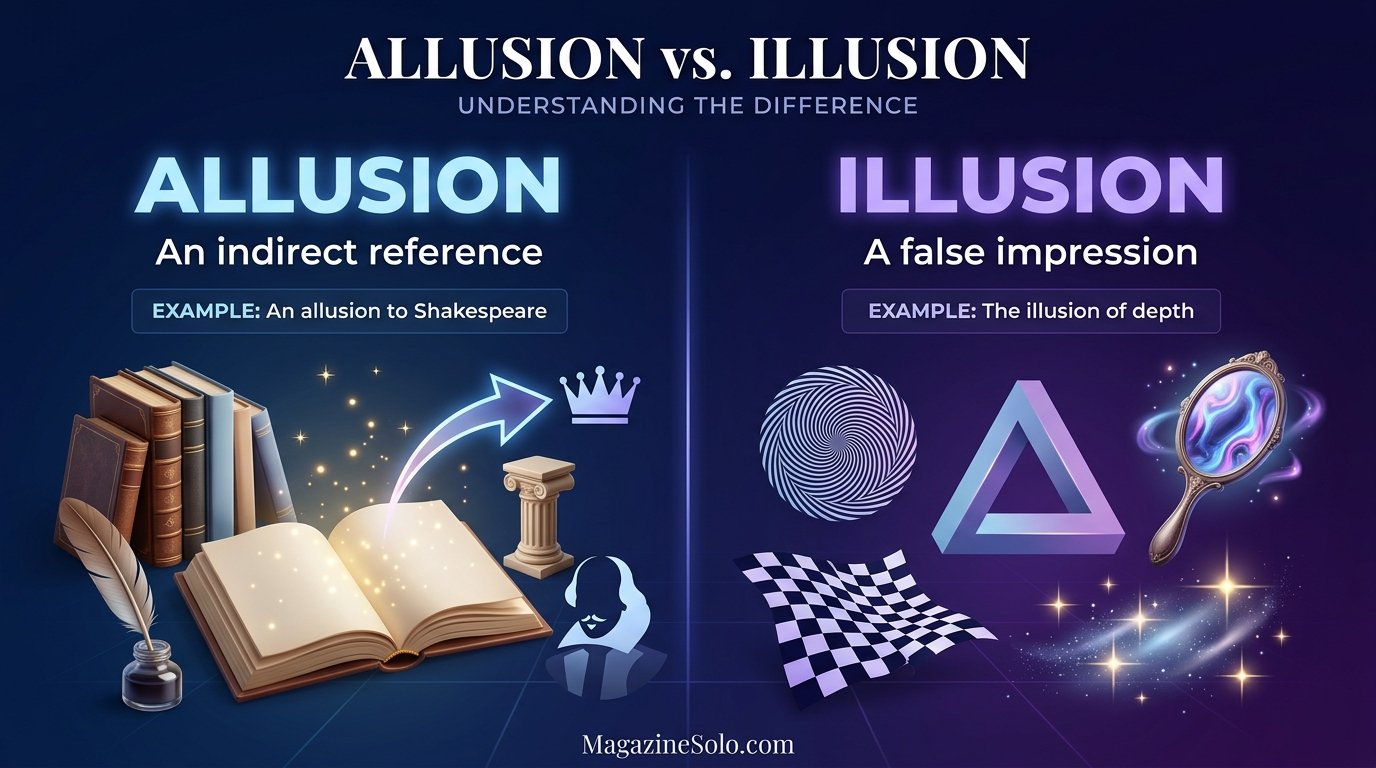
Psychology pages sort their own trio with a stimulus test. The DifferenceBetweenZ comparison asks whether a real stimulus exists. Three questions, asked in order, sort any case the three words fight over, that test extended to the headword trio.
- Is the word pointing at another text, story or event? A name or echo arrives unexplained and borrows meaning from outside. If yes, the word is allusion, and the other two channels close.
- Is something real being misperceived? A stimulus is present, the senses are working, and the report they file is wrong. If yes, the word is illusion, as with the mirage.
- Is a belief being held against the evidence? Nothing needs to be seen or referenced, and correction does not move the conviction. If yes, the word is delusion, however ordinary the sentence sounds.
Watch the flow run on the mirage. Nothing is referenced, so question one fails. Heated air and light are really there and really misread, so question two lands: illusion.
Watch it run on grandeur. Nothing is pointed at, and nothing is perceived. A belief about one’s own importance simply refuses to move, so question three lands: delusion, and the fixed phrase follows.
Pronunciation: The Sound Ladder
The ladder has two rungs, not three. Allusion opens with a weak schwa, while illusion and delusion share the short i vowel. Delusion differs from illusion only in its first consonant, d against l, which makes that pair the harder spoken swap.
|
Word |
IPA |
Respelling |
Opening sound |
|---|---|---|---|
|
allusion |
/əˈluʒən/ |
uh-LOO-zhun |
A weak uh |
|
illusion |
/ɪˈluːʒən/ |
ih-LOO-zhun |
A short i after l |
|
delusion |
/dɪˈluːʒən/ |
dih-LOO-zhun |
A short i after d |
An IPA pair covers the first two words. The pair in the Grammarly guide to allusion vs illusion runs the schwa form for allusion against the short i form for illusion. The Cambridge learner entry prints the same pattern for delusion, with d in front.
The stress never moves. All three words stress the second syllable, so rhythm cannot rescue a doubtful choice. In fast speech the weak first vowels shrink toward each other, which is why listeners confuse the trio.
Allusion in Brief: Five Types and How to Spot One
Study guides sort allusions by what they point to. SuperSummary’s allusion page names five types: religious, historical, literary, mythological and autobiographical. Each type below carries one explained example, compressed because the pair page teaches this shelf in full.
- Biblical: a Good Samaritan helps a stranger. The name imports the parable’s kindness across social lines in two words.
- Classical: an Achilles heel. The phrase imports a hero’s one weak point, with real strength around it.
- Literary: The Sound and the Fury as a title. Faulkner borrows Macbeth’s despair before the first page opens.
- Historical: crossing the Rubicon. The phrase imports Caesar’s irreversible decision, with no road back.
- Pop culture: Kryptonite as a weakness. An ordinary pleasure defeats an otherwise strong person, as myths once did.
Spotting an allusion is a three-step skill. Students are asked to identify allusions in set texts, yet few pages teach spotting as a procedure. Three questions, asked in order, turn a suspicious phrase into a named device.
- Spot the unexplained name or echo. A person, place, phrase or image arrives with no introduction and no explanation. That gap is the signal: the text is pointing somewhere else.
- Ask what it points to outside the text. Name the story, work, event or figure behind the phrase. If nothing outside the text answers, the phrase may be a metaphor instead, so test before labelling.
- Ask what association the writer imports. The pointed-to story carries a mood or judgment with it. Name that cargo in one clause, and the allusion’s work in the sentence stands exposed.
Delusion in the Clinic: Types and Guardrails
This section stays at the level of definitions. Clinical words appear here as vocabulary, the way dictionaries and clinic pages print them, with no advice attached. What a delusion is called, and what tests the definition carries, is the whole scope.
The DSM-5 wording is the definition’s anchor. As carried by the MIT Open Encyclopedia of Cognitive Science and the psychology comparisons that quote it, delusions are fixed beliefs that are not amenable to change in light of conflicting evidence. Every guardrail below hangs on that sentence.
|
Type |
The fixed belief |
Stock example |
|---|---|---|
|
Erotomanic |
Another person, often famous, is in love with them |
A stranger certain a singer loves her |
|
Grandiose |
Inflated worth, power, knowledge or identity |
A clerk certain he made a great discovery |
|
Jealous |
A spouse or partner is unfaithful |
Certainty held without any concrete evidence |
|
Persecutory |
Someone is mistreating, spying on or plotting harm |
A worker certain colleagues are poisoning him |
|
Somatic |
A physical problem exists in the body |
A patient certain of a parasite or bad odor |
|
Mixed |
Two or more of the themes together |
Grandeur combined with persecution |
Six types come from one clinic page. The themes in the Cleveland Clinic page on delusional disorder name erotomanic, grandiose, jealous, persecutory, somatic and mixed. The Clinic calls persecutory the most common type, and puts the disorder at roughly 0.05 to 0.1 percent of adults, its own figure.
Fixity outranks falsity in the modern test. Older glosses stop at false belief, but a false belief that corrects itself is an ordinary mistake. The clinical line is that the belief does not change when clear evidence against it is presented.
Shared beliefs are excluded by definition. A belief held by the person’s culture or community is not a delusion, however strange it looks from outside. The test is individual: one person’s conviction, fixed against evidence almost everyone else accepts.
A delusion is a sign, not a diagnosis. Psychology references describe delusions by content type and treat the word as one feature among several. Diagnosis belongs to clinicians, not to vocabulary pages.
Casual delusional fails the definition at once. Thrown at any strong opinion, the word ignores the exclusion rule, since shared beliefs never qualify. Bizarre and non-bizarre mark the Clinic’s other split: impossible events against situations that could occur.
The Fourth Term: Hallucination
Hallucination completes the map one step beyond delusion. Merriam-Webster’s synonym essay groups delusion, illusion, hallucination and mirage as things believed real that are actually false. Hallucination is the member where the senses report something with nothing there.
|
Word |
Stimulus |
Channel |
Type example |
|---|---|---|---|
|
Illusion |
Present and misread |
Perception |
A mirage pools on a hot road |
|
Hallucination |
Absent entirely |
Perception |
A voice heard in an empty room |
|
Delusion |
Not applicable |
Belief |
Delusions of persecution |
The stimulus test sorts the three cleanly. A real stimulus misread is an illusion; no stimulus at all, with the experience still occurring, is a hallucination. If nothing is being perceived and the issue is belief, the word is delusion.
The Forms System: Verbs and Adjectives
Each noun carries a verb of its own. Allude refers indirectly and takes to, delude deceives someone into a false belief, and illude survives as a rare verb meaning to delude. Modern writers create an illusion instead, and illude stays in dictionaries.
The verb pairs get their own drills elsewhere. The pattern work in the 5MinuteEnglish guide to allude vs elude sets allude beside elude sentence by sentence. The rule in the BroadLearners lesson on allusion, illusion and elusion runs: allusion refers, illusion deceives, elusion escapes.
|
Adjective |
Parent word |
Meaning |
Example |
|---|---|---|---|
|
allusive |
allusion |
Full of indirect references |
An allusive poem |
|
illusory |
illusion |
Based on illusion, not real |
An illusory sense of safety |
|
illusive |
illusion |
Deceptive, not real (rarer twin) |
An illusive peace |
|
delusional |
delusion |
Holding or showing a delusion |
A delusional certainty |
|
elusive |
elude |
Hard to catch, find or grasp |
An elusive solution |
Delusional is the family’s only everyday adjective. Allusive and illusory live in literary criticism, while delusional runs in daily speech, usually as a loose insult for a wrong opinion. Merriam-Webster also lists delusionary, a rarer adjective almost nobody uses.
The forms sit scattered until someone assembles them. The word-form sections in the CorrectWording guide to allusion vs illusion give allusive for allusion and illusory for illusion, each on its own page half. Printed side by side with delusional, the swap risk becomes visible at a glance.
Three-way lookalikes follow the same discipline. Ensure, insure and assure differ by prefix and by job, and our ensure vs insure vs assure guide separates them by what each one guarantees. Parent word first, then meaning, ends most adjective swaps too.
Objects sort the verb branch. Lay takes an object and lie does not, and our lay vs lie guide teaches that pair through the same object test. The fuller drills in our lay vs lie difference guide show each verb failing without its proper partner.
Fixed Phrases and Classic Mistakes
The classic wrong phrase swaps in the senses word. Writers print illusions of grandeur because grandeur feels grand, but the phrase names a belief, and beliefs take delusion. The grandeur section in the ProWritingAid guide to allusion vs illusion settles it: delusions of grandeur.
Even the top three-way page blurs its own line. The delusion teaser in the Vocabulary.com guide to allusion, illusion and delusion calls delusion a belief with no evidence, then a complete illusion. A page that collapses the distinction it teaches shows why the channel test matters.
Even a major guide gets the verb wrong. The Grammarly guide states twice that allusion has no verb form, which is false: the verb is allude, as the dictionaries state. Its definition block also allows a direct allusion, against every dictionary’s indirect core.
The classic wrong sentence swaps the reference noun. Making an illusion to Romeo and Juliet fails, because references take allusion, and one learner guide prints exactly that error for correction. The preposition to was the tell all along.
- Delusions of grandeur. A fixed belief in one’s own inflated importance or power.
- Delusions of persecution. A fixed belief that others are spying, mistreating or plotting harm.
- Under the delusion that. Believing something false as if it were settled fact.
- Have no illusions about the task. See it clearly, with no comforting false hopes.
Word class settles the first question. All three headwords are nouns, so the choice is never about tense or form. Passed is a verb form and past usually is not, and our passed vs past guide sorts that pair by grammar first.
The fuller comparison leans on exchange tests. Side-by-side sentences in our passed vs past difference guide show each word failing in the other’s slot. Run allusion, illusion and delusion through the same three-way exchange before publishing any of them.
First letters carry part of the memory load. The I in illusion pairs with eye in the Dictionary.com comparison of allusion and illusion, since illusions fool the senses. Vocabulary.com extends the hooks: an allusion shows up in art, and a delusion is believed despite reality.
One vowel does the same deciding work elsewhere. A capital and a capitol differ by one letter’s job, and our capital vs capitol guide sorts them by building versus city. Its companion in our capital vs capitol difference guide adds hooks that keep the vowel straight.
Doubling is the mirror-image trap. Dessert carries two s letters where desert carries one, and our desert vs dessert guide ties the extra letter to a second helping. One clear hook per word ends most swaps in this family too.
The difference pages add the listener’s side. Worked exchanges in our imply vs infer difference guide show why swapping hint verbs reverses who knows what. The fuller treatment in our emigrate vs immigrate difference guide runs the same exchange test this trio needs.
Self-Test: Ten Questions
Ten questions cover the whole system. Three-way meaning, the grandeur phrase, the types, the adjective forms, the sound choice and the mirage all appear. More drills wait in the Grammar Monster test on allusion and illusion, whose test runs the pair through quotations from Shaw and Orson Welles.
- The lyrics are full of ___ to the Bible.
- Heat shimmering on the road created the ___ of water ahead.
- True or false: “illusions of grandeur” is the standard phrase.
- No evidence could move him from the belief that rivals were spying on him: a persecutory ___.
- An ___ poem keeps pointing to myths and older books.
- The promised cure-all proved ___, a benefit that was never real.
- Calling a new manager a Scrooge is which type of allusion?
- Which word differs from illusion only in its first consonant?
- A voice heard in an empty room, with nothing there to hear, is a ___.
- She ___ to the scandal without naming it.
Answer Key
- Allusions. The sentence names references to an outside text, and allusion pairs with to.
- Illusion. A real stimulus, heated air, is misread as water.
- False. The fixed phrase is delusions of grandeur, because grandeur is a belief.
- Delusion. A belief fixed against evidence, with a persecution theme, is the persecutory type.
- Allusive. The adjective from allusion describes a text full of indirect references.
- Illusory. The adjective from illusion describes something based on a false impression.
- Literary. Scrooge points to Dickens and A Christmas Carol, a work of literature.
- Delusion. The two words share their vowel and stress, and only the opening consonant separates them.
- Hallucination. A perception arrives with no stimulus at all behind it.
- Alluded. Allude to is the verb of indirect reference.
Scoring takes one minute. Eight or more right means the system has landed; five to seven means the tables need one more pass. Below five, reread the three-word rule and the decision flow, then retake the test tomorrow.
Frequently Asked Questions
1. What is the difference between allusion, illusion and delusion?
An allusion points, an illusion misreads, and a delusion will not move. An allusion is an indirect reference in language.
An illusion misreads a real stimulus, and a delusion is a belief held fixed against the evidence.
2. What is the difference between allusion and illusion?
An allusion points to a text, and an illusion tricks the senses. Allusion is an indirect reference a reader must catch.
Illusion is a false impression, like a mirage pooled on a hot road.
3. What is the difference between an illusion and a delusion?
An illusion misreads something real, and a delusion is a belief held against reality. Merriam-Webster says a delusion implies an inability to distinguish what is real from what only seems real.
That is why the fixed phrase is delusions of grandeur.
4. What is the single clearest difference between a delusion and an illusion?
An illusion is about perception, and a delusion is about belief. Something real is present and misread in an illusion.
In a delusion, nothing needs to be perceived at all, because the conviction itself is the problem.
5. What is the difference between a delusion and a hallucination?
A delusion is a fixed belief, and a hallucination is a perception with no stimulus. Psychology references sort them by channel: belief against evidence on one side.
A voice heard in an empty room on the other.
6. What is the difference between an illusion and a hallucination?
An illusion misinterprets a real stimulus, and a hallucination has no stimulus at all. Something is present and misread in an illusion.
In a hallucination, the senses report something entirely absent.
7. What is a delusion?
A delusion is a false belief held fixed against the evidence. Merriam-Webster’s everyday sense is a false idea or belief.
Its psychology sense is a persistent false belief maintained despite indisputable evidence to the contrary.
8. What does delusional mean?
Delusional means holding or showing a delusion. It is the everyday adjective from delusion, as in a delusional belief.
Clinicians use it for beliefs that meet the fixed-belief test, not for any strong opinion.
9. What is delusional disorder?
Delusional disorder is the condition whose main feature is one or more delusions. The Cleveland Clinic calls it a type of psychotic disorder.
This page names it only as vocabulary, since diagnosis belongs to clinicians.
10. What are the types of delusional disorder?
The Cleveland Clinic lists six types: erotomanic, grandiose, jealous, persecutory, somatic and mixed. Each type names the theme the fixed belief takes.
Persecutory beliefs are the Clinic’s most common type.
11. What is the most common type of delusional disorder?
The persecutory type is the most common, on the Cleveland Clinic’s account. Its theme is being mistreated, spied on or targeted for harm.
The fixed phrase delusions of persecution belongs to this type.
12. What is a grandiose delusion?
A grandiose delusion is a fixed belief in inflated worth, power, knowledge or identity. The Cleveland Clinic gives great talent or an important discovery as the shape it takes.
The fixed phrase is delusions of grandeur.
13. What is a persecutory delusion?
A persecutory delusion is a fixed belief that someone is mistreating, spying on or trying to harm the believer. Merriam-Webster’s synonym essay uses delusions of persecution as its example.
It is the Clinic’s most common type.
14. What is an erotomanic delusion?
An erotomanic delusion is a fixed belief that another person is in love with the believer. The Cleveland Clinic notes the person is often important or famous.
The belief holds despite no relationship existing.
15. What is a somatic delusion?
A somatic delusion is a fixed belief about a physical problem in the body. The Cleveland Clinic gives a parasite or a bad odor as examples.
The belief persists despite examinations finding nothing.
16. What is a jealous delusion?
A jealous delusion is a fixed belief that a spouse or partner is unfaithful. The Cleveland Clinic stresses that it is held without any concrete evidence.
Suspicion alone, however strong, is not the clinical pattern.
17. What are bizarre and non-bizarre delusions?
Non-bizarre delusions involve situations that could possibly occur, and bizarre ones involve impossible events. Being followed is non-bizarre on the Cleveland Clinic’s account.
Believing an organ was removed without evidence is bizarre.
18. Is it “illusions of grandeur” or “delusions of grandeur”?
Delusions of grandeur is the fixed phrase. Grandeur is a false belief about one’s own importance, and false beliefs are delusions in the dictionaries’ sorting.
Illusions belong to the senses, not to fixed beliefs.
19. What does “delusions of grandeur” mean?
It means fixed beliefs in one’s own inflated importance, power or talent. Merriam-Webster prints the phrase under delusion’s first sense.
The grandeur is believed, not seen, which is why delusion takes the phrase.
20. What does “delusions of persecution” mean?
It means fixed beliefs that others are spying on, mistreating or plotting harm. Merriam-Webster uses the phrase in its synonym essay for delusion.
The persecutory type is the Cleveland Clinic’s most common delusion type.
21. What does “under the delusion that” mean?
It means believing something false as if it were settled fact. Merriam-Webster’s example runs under the delusion that they will finish on schedule.
The that clause names the false belief itself.
22. What does “under the illusion that” mean?
It means believing something false as if it were true. He was under the illusion that he was the best player is Merriam-Webster’s example.
It is the illusion twin of under the delusion that, one step nearer the senses.
23. What does “to have no illusions” mean?
It means to see a situation clearly, without false hopes. Merriam-Webster’s example has someone harboring no illusions about the difficulty of a task.
The phrase clears away comforting mistakes before the work starts.
24. Is a mirage an allusion, an illusion or a delusion?
A mirage is an illusion. Dictionary.com uses the desert pool of water that is not there to define the word.
A real stimulus, heated air and light, is present and misread, and nothing is referenced or believed.
25. Are illusions a sign of mental illness?
No, illusions are ordinary perception doing its normal work. Everyone in the room sees the same optical illusion, because a real stimulus is being misread.
Psychology references treat that shared, correctable quality as the line.
26. Does knowing an illusion is false make it go away?
No, the percept persists even when the belief corrects. Measured lines still look unequal after the ruler proves them equal.
That split, belief correcting while perception holds, is one clean line between illusion and delusion.
27. Can a strongly held religious or political belief be a delusion?
Not by the clinical definition, when the belief is shared by the person’s culture or community. The DSM-5 wording carried in psychology references excludes shared beliefs.
A delusion is individual, fixed and held against conflicting evidence.
28. What conditions are delusions associated with?
Delusions appear as a feature across several psychotic disorders, with delusional disorder the one defined by them. Psychology references describe delusions by content type, like persecutory or grandiose.
A delusion is a sign, not a diagnosis by itself.
29. Can you have a delusion because of an illusion?
Yes, one can grow out of the other. The Kirk Mahoney post notes that a misread perception can harden into a fixed belief.
The channels differ, but a misreading that refuses correction has crossed into belief.
30. How do you pronounce allusion, illusion and delusion?
Allusion opens with a weak uh sound, and illusion and delusion open with a short i. All three stress the second syllable.
Delusion differs from illusion only in its first consonant, d against l.
31. Are allusion, illusion and delusion homophones?
No, though they come close. The opening sounds differ, uh against ih, and delusion starts with a d where illusion starts with an l.
In fast speech the gaps shrink, which is why listeners confuse all three.
32. Do allusion, illusion and delusion come from the same root?
Yes, all three grow from the Latin ludere, to play. Allusion adds ad, toward, illusion adds in, against, and delusion adds de.
One root splits into pointing, misreading and refusing to move.
33. What is the verb form of delusion?
The verb form of delusion is delude. To delude someone is to deceive them into a false belief.
The adjective is delusional, and delusionary is a rarer adjective listed by Merriam-Webster.
34. What is the verb form of allusion?
The verb form of allusion is allude. To allude to something is to refer to it indirectly, and the pattern is allude plus to.
The adjective is allusive, and the adverb is allusively.
35. Can “allusion” be a verb?
No, allusion is a noun, and its verb is allude. One widely read guide states that allusion has no verb form, but that is an error: allude is the verb.
It has been in English since the early 1500s.
36. What is the difference between illusive and elusive?
Illusive means deceptive and not real, and elusive means hard to catch or grasp. An illusive peace belongs with illusory, its rarer twin.
An elusive solution keeps escaping, which is why exam guides pair the two spellings.
37. What does delusional mean in everyday speech?
In everyday speech it loosely labels any belief the speaker finds wildly wrong. That casual use fails the clinical definition, which needs an individual belief fixed against evidence.
A widely shared opinion cannot qualify, however mistaken.
38. What are the types of allusion?
Study guides sort allusions into five types by what they point to. The types are religious, historical, literary, mythological and autobiographical.
An Achilles heel is mythological, and a Good Samaritan is biblical, under the religious type.
39. How do you identify an allusion in a text?
Spot the unexplained name or echo first. Then ask what it points to outside the text, and what association the writer imports by pointing there.
If the sentence works without the reference but gains meaning with it, you have found one.
40. What is the difference between allusion and reference?
A reference names its source directly, and an allusion only hints at it. A direct citation is a reference, while an allusion never explains itself.
Swap allusion for reference in a sentence: if nothing breaks, allusion was probably right.
41. How do you remember the difference between allusion, illusion and delusion?
Match each word to its channel. Allusion points in language, illusion misreads in perception, and delusion will not move in belief.
The first letters help too: an allusion shows up in art, and a delusion is believed despite reality.
42. Can a delusion be cured by showing someone the evidence?
Evidence alone does not settle it, because fixity is the defining feature. The DSM-5 wording describes fixed beliefs that are not amenable to change in light of conflicting evidence.
That resistance is exactly what separates a delusion from an ordinary mistake.
Conclusion
The allusion vs illusion vs delusion difference is a channel check. An allusion points outside the text, an illusion misreads what the senses report, and a delusion holds a belief still against the evidence. Name the channel and the word follows.
One root carries the memory. Ludere, to play, splits three ways by prefix: toward a reference, against the senses, and down into a fixed belief. The reality scale runs the same order, from the word nearest fact to the word furthest from it.
The traps sit at the edges. Grandeur and persecution belong to delusions, delusional is the family’s everyday adjective, and illusion and delusion differ by one consonant in speech. The three questions sort any case the traps leave behind.
More pairs wait on the same shelf. The confused-words guides collected at the MagazineSolo home page apply the same method: find the channel each word works in, then let the pattern decide. Root first, channel second, confidence throughout.

Dilawar is a content writer at MagazineSolo, covering travel, home improvement, interior design, and everyday lifestyle topics. He enjoys researching practical solutions, exploring travel destinations, and sharing helpful guides that make daily life easier. His writing focuses on clear information, useful advice, and engaging stories for a wide audience.