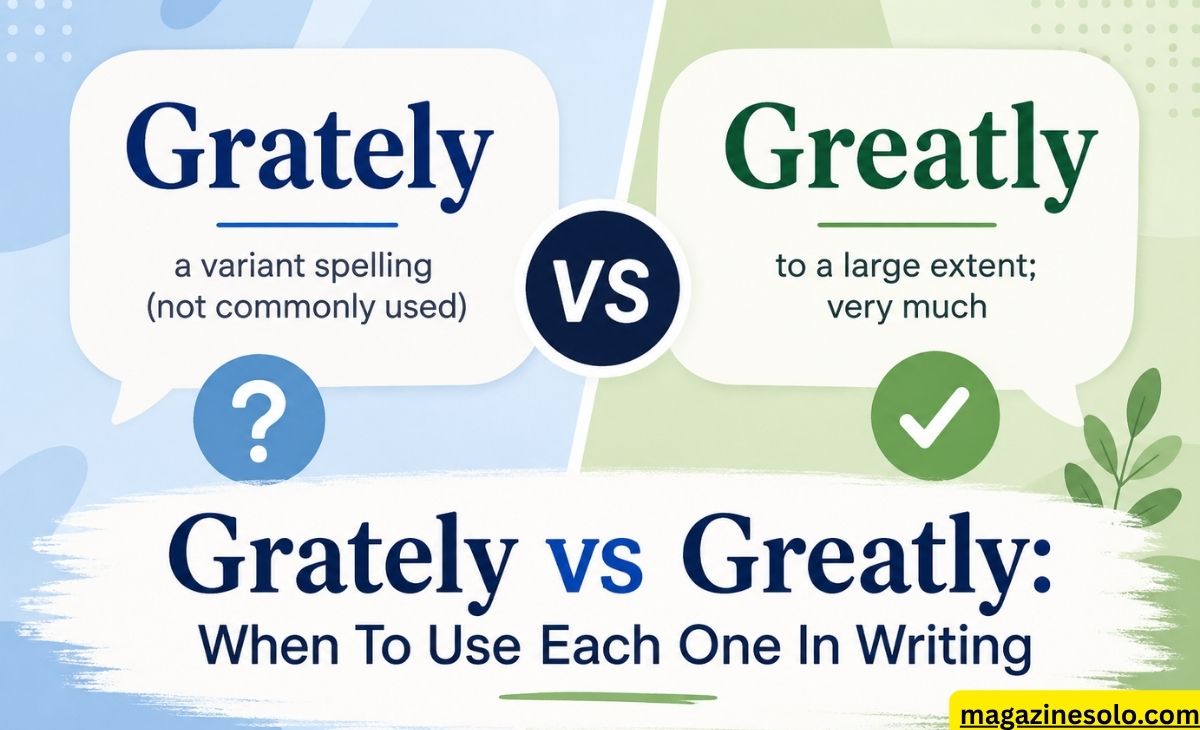
Grately vs Greatly: When To Use Each One In Writing
If you have ever wondered whether to write grately or greatly, you are not alone. This is one of the most common spelling mistakes in English writing. Many writers accidentally type grately because it sounds similar to greatly, but only one of these words is considered correct in standard English.
Understanding the difference between grately vs greatly is important for clear communication, professional writing, and strong grammar skills. Whether you’re writing an email, blog post, academic paper, or social media content, using the correct word helps establish credibility and avoids unnecessary mistakes.
In this guide, you’ll learn the meaning of both terms, proper usage, common errors, examples, exceptions, and practice exercises to help you confidently choose between greatly or grately every time.
What Is the Difference Between Grately and Greatly?
Before diving into usage rules, let’s settle the core question once and for all with a clear side-by-side comparison.
| Word | Part of Speech | Standard English? | Meaning |
| Greatly | Adverb | Yes | To a large extent or degree; very much |
| Grately | — | No | Not a recognized English word |
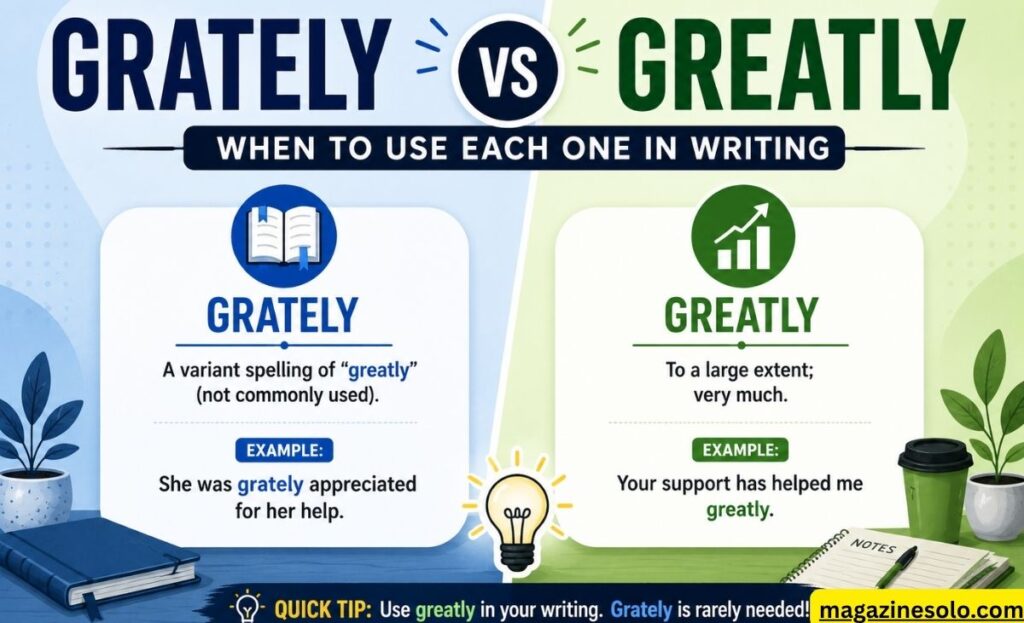
The answer is clear: greatly is the correct spelling. Grately is a misspelling, nothing more, nothing less. Understanding why this confusion happens (and how to avoid it) is what the rest of this article is about.
Define Grately
Grately is not a word recognized in standard English dictionaries, including Merriam-Webster, Oxford, or Cambridge. It does not have a definition because it does not officially exist as a legitimate term. It most commonly appears as a typographical error, a spelling mistake made under the influence of fast typing, autocorrect errors, or simple unfamiliarity with the correct form.
Some writers have occasionally attempted to use grately as an adverb meaning “in a great manner,” borrowing from informal or archaic usage patterns, but this is not accepted in modern formal writing. If you encounter grately in someone else’s writing, it is almost certainly an unintentional error rather than a stylistic choice.
Bottom line: Grately is not a word. Do not use it in formal, professional, or academic writing.
Define Greatly
Greatly is a standard English adverb derived from the adjective great by adding the suffix -ly. This follows one of the most common adverb-formation rules in the English language: adjective + -ly = adverb.
- great → greatly
- quick → quickly
- clear → clearly
Greatly means to a large or significant extent or degree. It is used to intensify the meaning of a verb or, in some cases, an adjective. It conveys magnitude, whether that is magnitude of emotion, effort, change, influence, or quality.
Synonyms for greatly include:
- Considerably
- Significantly
- Enormously
- Tremendously
- Substantially
- Very much
- To a great degree
How To Properly Use The Words In A Sentence
Now that the definitions are clear, let’s look at how each word functions in actual sentence construction, because knowing a definition is different from knowing how to apply it naturally.
How To Use “Grately” In A Sentence
Since grately is not a recognized English word, there is no correct way to use it in a sentence. Any sentence that contains grately should be revised to use greatly instead.
That said, some writers do use it, usually by accident. Here is what that looks like and why it is problematic:
- “I am grately thankful for your support.”, Incorrect. Replace with greatly.
- “The project was grately improved by his feedback.”, Incorrect. Replace with greatly.
- “We are grately honored to receive this award.”, Incorrect. Replace with greatly.
In each case above, the intended meaning is perfectly valid, only the spelling is wrong. Swapping grately for greatly fixes the error instantly.
How To Use “Greatly” In A Sentence
Greatly is versatile and can be placed in a sentence to intensify verbs and descriptions. The typical placement is directly before or after the verb it modifies.
Sentence structure tips:
- Subject + greatly + verb: “I greatly admire her dedication.”
- Subject + verb + greatly: “She has improved greatly over the past year.”
- Greatly + past participle: “His contribution was greatly appreciated.”
Here are well-constructed examples:
- “We greatly appreciate your patience during this process.”
- “The new policy has greatly reduced employee turnover.”
- “She was greatly affected by the news of his passing.”
- “This discovery has greatly influenced modern medicine.”
- “Their partnership greatly expanded the company’s reach.”
Notice how greatly amplifies the verb in each sentence, it does not merely describe that something happened, but signals how much it happened.
More Examples Of Grately & Greatly Used In Sentences
Examples Of Using Grately In A Sentence
As established, every instance of grately is an error. Below are examples of how this mistake commonly appears, followed by the corrected version.
| Incorrect (Grately) | Correct (Greatly) |
| “I am grately sorry for the confusion.” | “I am greatly sorry for the confusion.” |
| “The results were grately above expectations.” | “The results were greatly above expectations.” |
| “He is grately respected in his community.” | “He is greatly respected in his community.” |
| “We were grately impressed by the presentation.” | “We were greatly impressed by the presentation.” |
| “Sales have grately increased this quarter.” | “Sales have greatly increased this quarter.” |
Examples Of Using Greatly In A Sentence
Here are natural, varied examples of greatly used correctly across different contexts:
In professional writing:
- “Your mentorship has greatly shaped my career path.”
- “The merger greatly increased the firm’s market value.”
In academic writing:
- “Access to clean water greatly reduces child mortality rates.”
- “The Industrial Revolution greatly altered social structures across Europe.”
In everyday communication:
- “I greatly enjoyed our conversation last week.”
- “The weather has greatly improved since Monday.”
In formal appreciation:
- “We are greatly honored by your trust in our services.”
- “Your generosity is greatly valued by everyone here.”
Common Mistakes To Avoid
Mistakes To Avoid
Understanding the grately or greatly confusion means recognizing why people make this error in the first place. Here are the most common mistakes writers make:
- Typing too fast, Fingers slip, and “grately” comes out instead of “greatly.” This is the most common cause.
- Phonetic spelling, Some people spell words as they sound. Since “greatly” is pronounced quickly in speech, the “t” sound in the middle can lead writers to type “grate-ly” rather than “great-ly.”
- Autocorrect failures, On some devices, autocorrect does not catch “grately” because it may recognize it as a potential proper noun or simply miss the error.
- Assuming both are valid, Some writers have seen “grately” used online so frequently that they assume it must be correct. This is the “frequency = validity” trap, common use does not make something grammatically correct.
- Influence of the word “grate”, The word grate (as in a fireplace grate, or to grate cheese) may subconsciously pull the spelling toward grately rather than greatly.
How To Avoid These Mistakes
Fixing this error permanently comes down to a few simple habits:
- Use the root word test: Ask yourself, does the word come from great or grate? It comes from great, so the adverb is great + ly = greatly.
- Proofread before sending: A quick read-through of any important document will catch this mistake easily.
- Enable grammar checkers: Tools like Grammarly, Microsoft Editor, or even Google Docs’ spell check will flag “grately” as incorrect.
- Use the replacement test: If you can replace the word with “very much” or “significantly” and the sentence still makes sense, you need greatly, not grately.
- Commit the spelling to memory: Great → Greatly. Say it, write it, repeat it.
Context Matters
While greatly works across nearly all writing contexts, knowing when it sounds most natural helps you use it with confidence.
Examples Of Different Contexts
| Context | Example Sentence | Tone |
| Professional email | “I greatly appreciate your prompt response.” | Formal |
| Academic paper | “Climate change has greatly accelerated glacier retreat.” | Scholarly |
| Cover letter | “I greatly admire your organization’s mission.” | Respectful |
| Personal message | “I greatly enjoyed spending time with you.” | Warm |
| News / journalism | “The hurricane greatly disrupted the region’s infrastructure.” | Neutral |
| Social media | “This book greatly changed how I see the world.” | Casual-formal |
In highly casual text messages or social media posts, writers sometimes prefer “a lot,” “so much,” or “really” over “greatly”, and that is perfectly acceptable. Greatly leans slightly formal, which makes it a particularly strong choice in professional and written contexts.
Exceptions To The Rules
When “Grately” Might Be Used
There is essentially one scenario where grately might appear intentionally: creative or humorous writing. A novelist writing a character who consistently misspells words as part of their personality, or a satirical piece mocking poor grammar, might deliberately use grately. In these highly specific creative contexts, it serves a narrative purpose.
Outside of deliberate stylistic choices like these, grately has no place in correct writing.
When “Greatly” Might Not Be Used
Even though greatly is always the correct spelling, there are contexts where it might feel out of place stylistically:
- Very casual texting: “I greatly enjoyed the meme you sent” might come across as oddly stiff. In casual digital conversation, “loved it” or “that was hilarious” flows more naturally.
- Simple, direct instructions: In user manuals or instruction guides, clear and simple language is preferred. “This will greatly improve your results” could simply be “This improves your results.”
- Poetry with specific meter: Some poets avoid adverbs like “greatly” because they can feel flat in verse. In poetic writing, stronger verbs often replace adverb-heavy constructions.
In these cases, the word greatly is not wrong, it simply may not be the most effective stylistic choice.
Practice Exercises
Test your understanding of grately vs greatly with these quick exercises.
Exercise 1: Fill In The Blank
Fill in each blank with either grately or greatly:
- “The students ________ benefited from the new tutoring program.”
- “She was ________ moved by the farewell speech.”
- “His absence was ________ felt by the entire team.”
- “The renovation has ________ improved the building’s value.”
- “I am ________ looking forward to your reply.”
Answers: All five blanks should be filled with greatly. “Grately” is never the correct answer.
Exercise 2: Identify The Correct Word
Choose the correct word in parentheses for each sentence:
- “We are (grately / greatly) honored to have you here.”
- “The new system has (grately / greatly) reduced processing time.”
- “I (grately / greatly) appreciate your feedback on my report.”
- “Her confidence has (grately / greatly) improved this semester.”
- “The storm (grately / greatly) damaged the coastal communities.”
Answers: In every sentence, greatly is correct. If you chose grately for any of them, review the root word rule: great + ly = greatly.
Frequently Asked Questions (FAQs)
Is “grately” ever correct in English?
No. “Grately” is not a recognized word in standard English and should always be replaced with “greatly.”
What does “greatly” mean?
“Greatly” is an adverb meaning to a large or significant extent, used to intensify verbs and show a high degree of something.
Why do so many people write “grately” instead of “greatly”?
Fast typing, pronunciation habits, and autocorrect failures are the most common causes of this frequent spelling mistake.
Can I use “very much” instead of “greatly”?
Yes. In most sentences, “very much,” “significantly,” or “considerably” can replace “greatly,” though “greatly” sounds more formal.
How do I remember the correct spelling of “greatly”?
Use the root word: it comes from great, not grate. So it’s great + ly = greatly, never “grately.”
Is “greatly or grately” a common Google search?
Yes. Thousands of writers search “greatly or grately” every month, showing just how widespread this confusion is.
Conclusion
When comparing grately vs greatly, the answer is simple: greatly is the correct word, while grately is a common misspelling. If you want to express that something happened to a significant degree, was highly appreciated, or had a substantial impact, greatly is the word you should use.
Remember this simple formula:
Great + ly = Greatly
The next time you’re unsure whether to write grately or greatly, you’ll know that greatly is the proper choice. Using the correct spelling improves grammar, strengthens credibility, and ensures your writing remains professional and easy to understand.

Shoaib Ahmad is a language-focused content writer and researcher at magazinesolo.com, where he explains the meaning of words, phrases, and text in a clear and reader-friendly way. His work focuses on simplifying language, uncovering context, and helping readers understand text with confidence and clarity.