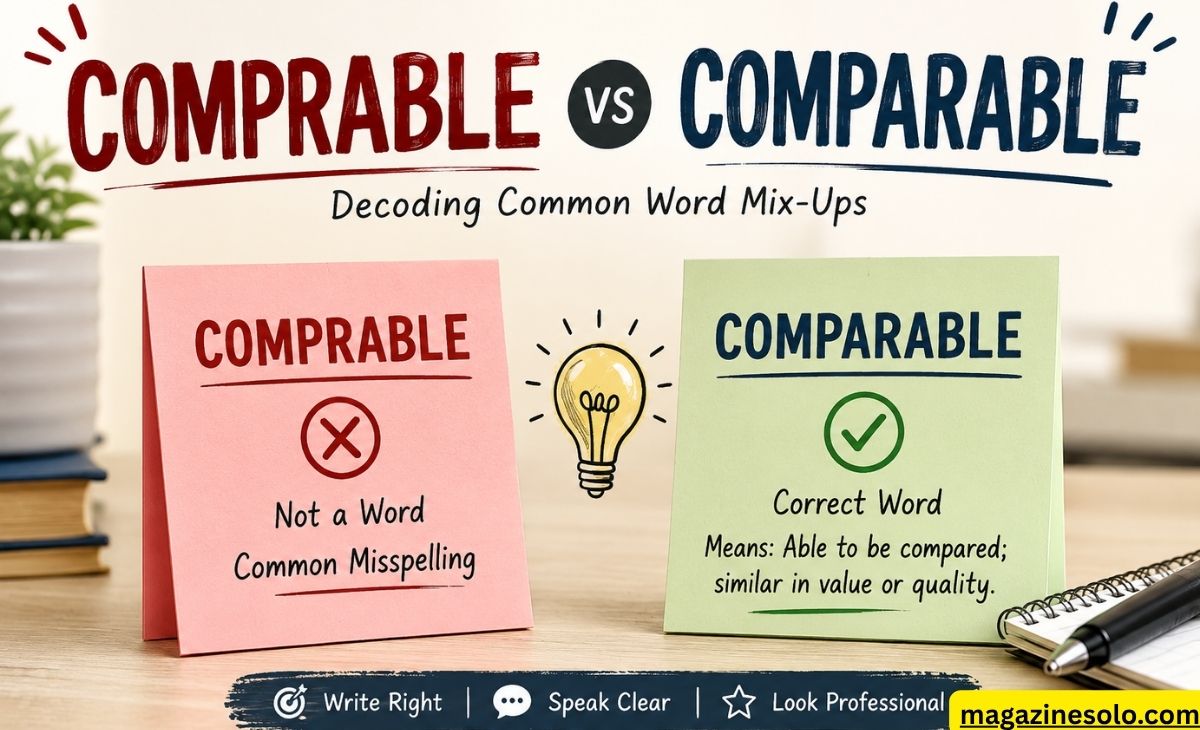
Comprable vs Comparable: Decoding Common Word Mix-Ups
Have you ever paused while writing and wondered whether to use comprable or comparable? You’re not alone. The confusion between comprable vs comparable is surprisingly common, especially because the words sound similar when spoken quickly.
The good news is simple: only one of these spellings is considered correct in standard English. Understanding the difference between comparable vs comprable can help you write more professionally, avoid spelling mistakes, and improve clarity in academic, business, and everyday communication.
In this guide, we’ll break down the meaning of each term, explain proper usage, provide examples, discuss common mistakes, and explore situations where context matters.
Quick Comparison Table
| Feature | Comprable | Comparable |
| Is it a real English word? | No | Yes |
| Dictionary recognized? | No | Yes |
| Correct spelling? | No | Yes |
| Meaning | None | Able to be compared; similar |
| Professional writing | Avoid | Use |
Define Comprable
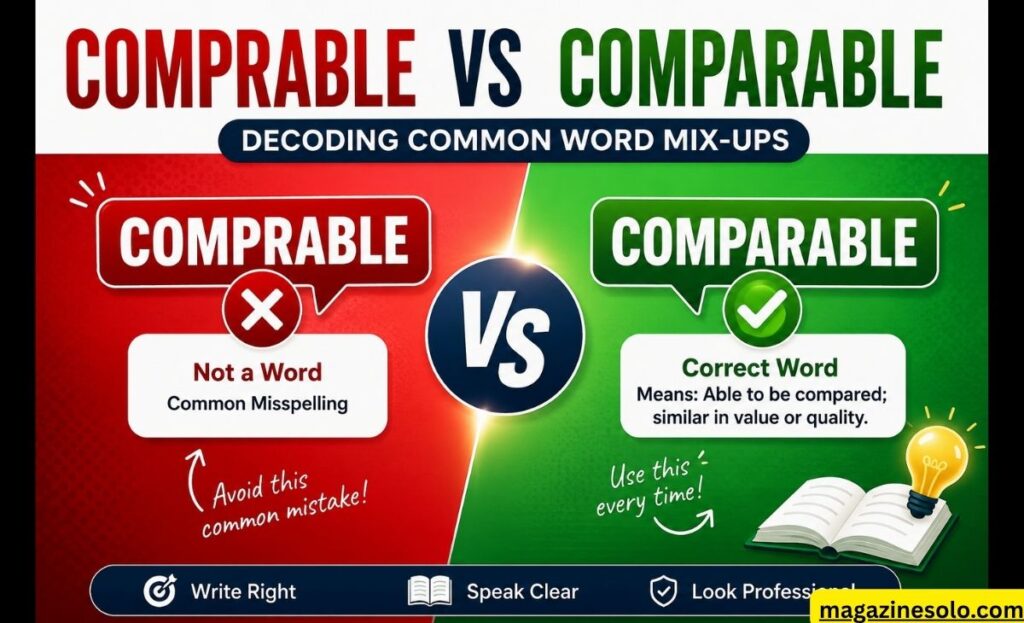
Comprable is not a recognized English word. It is generally considered a misspelling of comparable.
Many writers accidentally omit the second “a” when typing the word, creating “comprable.” While it occasionally appears in informal writing, it is not accepted in standard English dictionaries or grammar references.
Meaning: None officially recognized.
Status: Incorrect spelling.
Define Comparable
Comparable is a valid English adjective that means:
- Able to be compared
- Similar in quality, value, size, or characteristics
- Suitable for comparison
Examples:
- These two smartphones are comparable in performance.
- Their salaries are comparable to industry standards.
- The houses are comparable in size and location.
In professional writing, academic papers, business reports, and everyday communication, comparable is always the correct choice.
How to Properly Use the Words in a Sentence
How to Use “Comprable” in a Sentence
The honest answer: you should never use “comprable” in a sentence, because it is not a valid English word. If it appears in your writing, it should be corrected before publishing or submitting.
Here is what incorrect usage looks like , and how to fix it:
- The two laptops offer comprable performance at very different price points.
- The two laptops offer comparable performance at very different price points.
- Her qualifications are comprable to those of the other candidates.
- Her qualifications are comparable to those of the other candidates.
Whenever you encounter “comprable or comparable” as a choice, always go with comparable.
How to Use “Comparable” in a Sentence
“Comparable” functions as an adjective. It typically follows a linking verb (such as “is,” “are,” or “seem”) or directly modifies a noun. Common constructions include comparable to and comparable with.
- The two job offers are comparable in terms of salary and benefits.
- This laptop delivers comparable performance to models that cost twice as much.
- Scientists noted that the results were comparable across all three test groups.
- She received a wage comparable to that of her male colleagues.
- The living costs in both cities are broadly comparable.
More Examples of Comprable & Comparable Used in Sentences
Examples of Using “Comprable” in a Sentence
Again , do not use “comprable.” Below are examples of the error in the wild, included purely so you can recognize and correct them:
- This smartphone has comprable features to the latest flagship model.
- The study found comprable outcomes in both test groups.
- We need a comprable analysis before we make a final decision.
Each of these sentences contains a spelling error. The correct word in every case is comparable.
Examples of Using “Comparable” in a Sentence
Here are ten natural, correctly written examples of comparable in action:
- The quality of the store-brand product is comparable to the premium label.
- Researchers found no drug with comparable efficacy and fewer side effects.
- His salary is now comparable to what he was earning before the layoff.
- Both cars have comparable fuel efficiency, but different ride quality.
- The two athletes have comparable records entering the championship.
- A comparable house in the suburbs would cost half the urban price.
- The legal teams reached a settlement based on comparable cases from prior years.
- There is no technology remotely comparable to this in terms of precision.
- Inflation is now at a rate comparable with levels seen in the 1980s.
- The two proposals are not directly comparable, since they address different goals.
Common Mistakes to Avoid
Using “Comprable” Instead of “Comparable”
This is the most frequent mistake. Writers drop the first “a” in “comparable” while typing quickly, and forget to proofread. The fix is simple: always run a spell check, and read your work before publishing. No reputable dictionary recognizes “comprable” as a valid word.
Using “Comparable” When “Similar” or “Related” Would Be More Appropriate
“Comparable” implies that two things are similar enough to be meaningfully measured against each other. It is not always interchangeable with “similar” or “related.”
- “These two concepts are related” , they share a connection, but may not be directly measurable.
- “The two results are similar” , they share common traits, but comparison may be informal.
- “The two results are comparable” , they can be objectively measured side by side.
If you are simply noting that two things share characteristics without implying rigorous evaluation, “similar” is often the cleaner, more precise choice.
Not Understanding the Difference Between “Comparable” and “Complementary”
These two words are entirely different in meaning, yet writers sometimes confuse them.
| Word | Meaning | Example |
| Comparable | Similar enough to compare | The two salaries are comparable. |
| Complementary | Completing or enhancing each other | The two skills are complementary. |
A hammer and a screwdriver are complementary tools , they work well together. A hammer and a mallet are comparable tools , they are similar in function and can be evaluated side by side.
Using “Comparable” Too Frequently
Repeating “comparable” in the same paragraph or passage makes your writing feel monotonous. Vary your vocabulary with alternatives like:
- Similar
- Equivalent
- Proportionate
- Analogous
- On par with
- In line with
- Matching
Tips to Avoid These Mistakes
- Proofread every draft before publishing or submitting.
- Use a spell checker, but do not rely on it exclusively , some tools may not flag “comprable” depending on settings.
- Read your writing aloud , mispronunciation often reveals a misspelling.
- Build vocabulary actively by noting when and how “comparable” appears in professional content you read.
- Keep a style sheet for words you commonly misspell or misuse.
Context Matters
The word comparable carries slightly different weight depending on the field in which it is used. Context shapes meaning, so understanding these nuances helps you use the word with precision.
Comparing Products or Services
In everyday consumer writing, “comparable” signals that two offerings are in the same general league , similar price range, feature set, or quality tier. It is widely used in product reviews, buying guides, and marketing copy.
“Both wireless headphones deliver comparable audio quality, though Brand A offers better noise cancellation.”
Legal or Financial Contexts
In law and finance, “comparable” carries significant weight. Comparable sales (or “comps”) are used in real estate appraisals to determine fair market value. In legal proceedings, comparable cases , cases with sufficiently similar facts , are cited as precedents.
“The appraiser identified three comparable properties within a one-mile radius to establish the market value.”
Misusing or misspelling this word in professional documents can damage credibility and, in some cases, create ambiguity in contracts or filings.
Scientific Comparisons
In research and academic writing, “comparable” describes conditions, samples, or results that are similar enough in quantity or quality to be meaningfully analyzed together. It is a precision term , and spelling it correctly (“comparable,” never “comprable”) is a matter of academic integrity.
“The study used two groups of comparably qualified participants to minimize selection bias.”
Exceptions to the Rules
Grammar has rules , and sometimes, nuances.
1. Adjective-Noun Combinations
“Comparable” most commonly follows a verb (they are comparable), but it can directly precede a noun as an attributive adjective: “a comparable outcome,” “a comparable price.” Both uses are correct.
2. Regional Differences
No major regional variety of English , American, British, Australian, or otherwise , accepts “comprable” as a valid spelling. Standard English across all regions recognizes only comparable. This is not a case of British vs. American spelling differences; it is simply a typo.
3. Typos and Misspellings
Typing errors happen to everyone. The important thing is to catch them. “Comprable” almost always enters documents as an accidental keystroke, not a genuine belief that it is a word. A final proofread before publishing eliminates this error entirely
Practice Exercises
Test your understanding with the exercises below.
Exercise 1: Fill in the Blank
Choose the correct word , comparable or comprable , to complete each sentence.
- The two job offers are _______ in salary but differ significantly in benefits.
- She purchased a car with _______ fuel efficiency at a much lower price.
- No other treatment has shown _______ effectiveness in clinical trials.
- Researchers looked for _______ data sets from previous studies.
- The living standards in both cities are broadly _______.
Answers: All five blanks should be filled with comparable. “Comprable” is never correct.
Exercise 2: Multiple Choice
Choose the best option for each sentence:
1. Which sentence is grammatically correct?
- (A) The two laptops offer comprable battery life.
- (B) The two laptops offer comparable battery life. ✅
- (C) Both are correct.
2. Which word best fits this sentence: “The hotel offers _______ amenities to five-star resorts at a fraction of the price”?
- (A) Comprable
- (B) Complementary
- (C) Comparable ✅
3. “Comprable or comparable” , which should you always use in professional writing?
- (A) Comprable
- (B) Comparable ✅
- (C) Either is fine
FAQ’s
Is “comprable” a real word?
No. “Comprable” is not recognized by any major English dictionary and is considered a misspelling of “comparable.”
What does “comparable” mean?
It means similar in quality, quantity, or nature , similar enough that a meaningful comparison can be made between two or more things.
What is the difference between comparable and complementary?
“Comparable” means two things are similar and can be measured against each other; “complementary” means two things work well together or complete each other.
How do you pronounce “comparable”?
In American English: /ˈkɑːmpərəbəl/. In British English: /ˈkɒmpərəbəl/. The stress falls on the first syllable.
What are good synonyms for “comparable”?
Equivalent, similar, proportionate, analogous, parallel, and on par with are all strong alternatives.
Why do people write “comprable” instead of “comparable”?
It is almost always a typing error, the “a” and “o” keys are close on a standard keyboard, making it easy to accidentally skip the first “a” when typing fast.
Conclusion
When it comes to comprable vs comparable, the answer is clear. Comparable is the correct spelling and the only accepted English word. Comprable is simply a common misspelling that should be avoided in professional, academic, and everyday writing.
Whenever you’re deciding between comparable vs comprable, remember the connection to the word compare. If something can be compared because it shares similar characteristics, qualities, values, or features, then it is comparable.
Keeping this simple rule in mind will help you avoid spelling mistakes, strengthen your writing, and communicate more effectively.

Shoaib Ahmad is a language-focused content writer and researcher at magazinesolo.com, where he explains the meaning of words, phrases, and text in a clear and reader-friendly way. His work focuses on simplifying language, uncovering context, and helping readers understand text with confidence and clarity.