All-Time Favorite or All Time Favorite: Which is Correct?
Have you ever tried to write something like “Pizza is my all time favorite food” and then stopped to wonder: wait, is that even right? Should it be all-time favorite or all time favorite?
You are not alone. Lots of people get confused by this. Even grown-ups who write every day make this mistake. So let’s fix it once and for all in the simplest way possible.
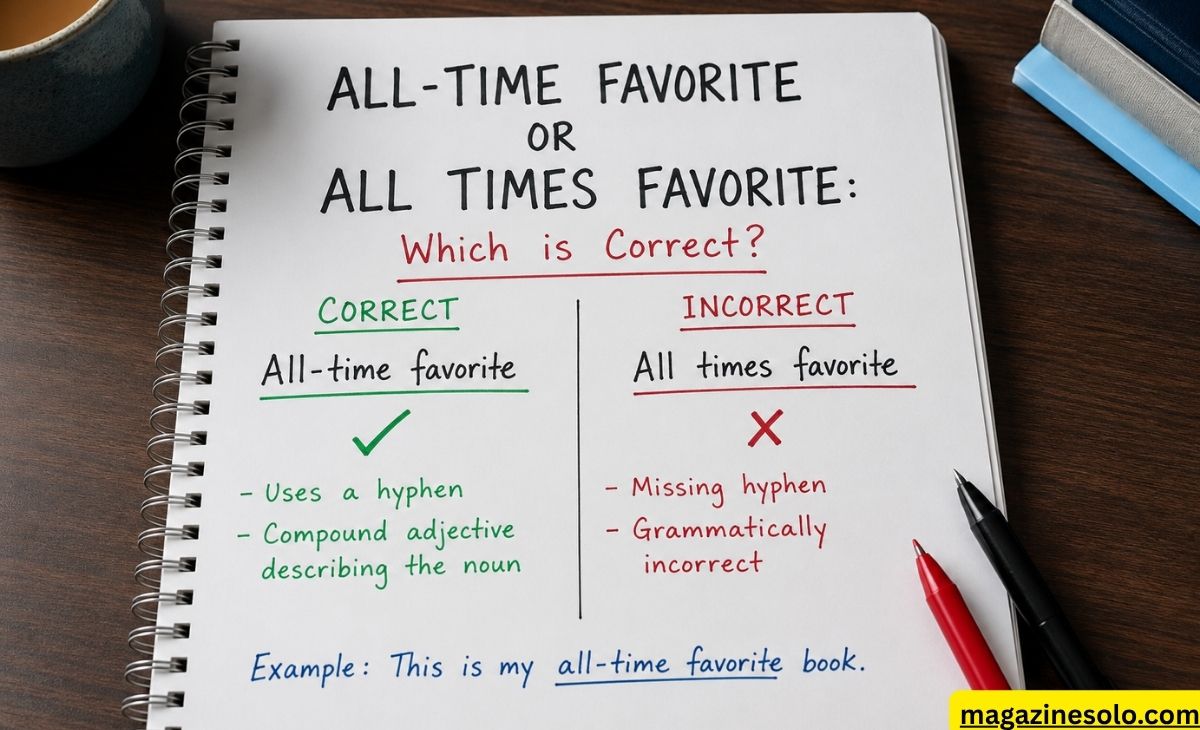
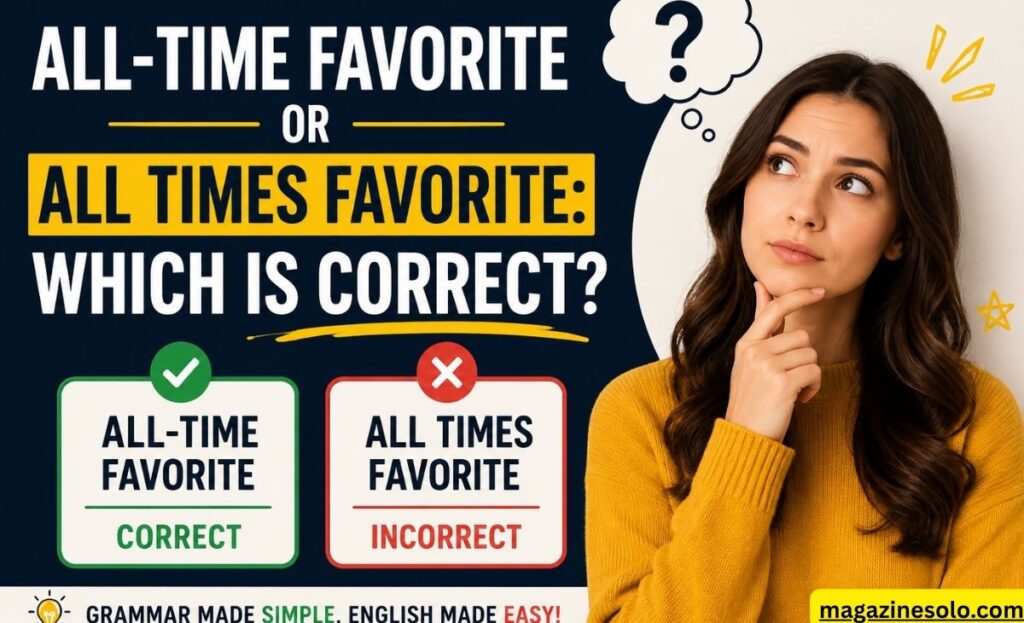
The correct phrase is: all-time favorite.
“All times favorite” is wrong. And by the end of this article, you will know exactly why and how to use “all-time favorite” like a pro.
Why is “All-Time Favorite” the Correct Usage?
Let’s start with the basics. What does all-time favorite even mean?
The all-time favorite meaning is simple: it’s the one thing you love the most, more than anything else not just today, but forever. It’s your number one pick of all time. Your top choice. The best of the best.
For example:
- 🍕 “Pizza is my all-time favorite food.”
- 🎬 “Spider-Man is my all-time favorite movie.”
- ⚽ “Messi is my all-time favorite football player.”
Now, why is “all times favorite” wrong?
Think of it this way. You say “part-time job” not “parts-time job.” You say “full-time student” not “fulls-time student.” The same rule applies here. When two words are joined together to describe something, the first word stays singular (no “s” at the end).
So it’s always “all-time” never “all times.”
And the little dash between “all” and “time”? That’s called a hyphen, and it’s very important. It glues the two words together so they work as one unit. Without it, the phrase falls apart.
Simple Breakdown Table
| What You Write | Correct? | Why |
| all-time favorite | Yes, correct | Proper hyphen, singular “time” |
| all time favorite | Sort of | Missing hyphen, okay in casual texting only |
| all times favorite | Wrong | “Times” (plural) is never correct here |
| all-times favorite | Wrong | Even with a hyphen, “times” is still wrong |
Quick tip: If you’re writing a school essay, article, or anything important, always use all-time favorite with the hyphen. If you’re texting a friend, saying “all time fav” is totally fine too.
Using “All-Time Favorite” in Different Situations
The cool thing about all-time favorite is that you can use it for anything you love the most. Let’s look at how people use it in real life.
🎵 Music
“Bohemian Rhapsody is my all-time favorite song. I’ve heard it a hundred times and I still love it.”
When someone says a song is their all time fav, they mean no other song — ever — beats it.
🎬 Movies
“The Lion King is my all-time favorite movie. I watch it every year and I always cry at the same part.”
This means out of every movie ever made, this one wins forever.
🍔 Food
“My mom’s chicken karahi is my all-time favorite meal. Nothing in the world tastes better.”
It doesn’t matter if a fancy restaurant opens nearby. This is still number one.
⚽ Sports
“Ronaldo is his all-time favorite football player. He has posters of him all over his room.”
📚 Books
“Harry Potter is her all-time favorite book series. She has read it three times already.”
🌍 Places
“Lahore is their all-time favorite city. They love the food, the history, and the people.”
What About “All Time Fav” and “All Time Fave”?
You’ve probably seen these on Instagram captions or WhatsApp messages:
- “This song is my all time fav 🎶”
- “Naan with daal is my all time fave no cap 😭”
These are just short, casual ways of saying “all-time favorite.” “Fav” and “fave” are abbreviations of “favorite.” Totally fine when chatting with friends. But in school work or professional writing, use the full correct form: all-time favorite.
American vs British English: Usage of “All-Time Favorite”
Here’s something interesting that many people don’t know.
People in America and people in Britain spell this word differently but they mean the exact same thing!
- 🇺🇸 Americans write: all-time favorite (no “u”)
- 🇬🇧 British people write: all-time favourite (with a “u”)
That’s it. The only difference is the letter “u” in the word favorite/favourite.
This same thing happens with many other English words too:
| American English | British English |
| color | colour |
| honor | honour |
| favorite | favourite |
| all-time favorite | all-time favourite |
Both are correct just used in different countries. The grammar rule (hyphen + singular “time”) is exactly the same in both.
Which One Should You Use?
- If you’re in Pakistan, India, or any country that follows British English → use all-time favourite
- If you’re writing for an American website or audience → use all-time favorite
- If you’re not sure, pick one and stick with it throughout your writing. Don’t mix both in the same article.
Does the Meaning Change?
No! Whether you write “all-time favorite” or “all-time favourite,” it means the exact same thing. Your number one pick. Your top choice. The thing you love most of all time.
Alternative Ways to Say “All-Time Favorite”
Sometimes you don’t want to say “all-time favorite” over and over. Here are some great alternatives, simple words that mean the same thing:
Easy Alternatives
Number one pick : The simplest way to say something is your top choice.
“Mango is my number one pick when it comes to fruits.”
Top choice : Short and clear. Works for anything.
“Italy is their top choice for a holiday.”
Go-to choice : Something you always come back to.
“Biryani is my go-to choice at any restaurant.”
Ultimate favorite : Means “the absolute best, no question.”
“Tom and Jerry is my ultimate favorite cartoon.”
Perennial favorite : Something that people love year after year. (This one sounds a bit fancy but it’s useful!)
“Cricket is a perennial favorite sport in Pakistan.”
Unequivocal favorite : Means your favorite with zero doubt.
“Naan and karahi is our unequivocal favorite meal.”
Classic favorite : Something loved by everyone, not just you.
“Samosas are a classic favorite at every Eid party.”
Quick Reference Table
| Alternative Phrase | Use It When… |
| Number one pick | You want to sound casual and clear |
| Top choice | You want short and simple |
| Go-to choice | Something you always return to |
| Ultimate favorite | You want to sound extra sure |
| Perennial favorite | Something loved for many years |
| Classic favorite | Something universally loved |
FAQ’s
Is “all-time favorite” grammatically correct?
Yes, “all-time favorite” is grammatically correct because “all-time” acts as a compound adjective before the noun.
Is “all times favorite” wrong?
Yes, “all times favorite” is incorrect in standard English grammar and is rarely used by native speakers.
What is the all time favorite meaning?
It means something you like the most compared to everything else over your lifetime.
Can I write “all time favorite” without a hyphen?
You can in informal writing, but “all-time favorite” is the correct and preferred form in formal English.
What does all time fave meaning mean?
“All time fave” is a casual short form of “all-time favorite,” mostly used on social media and texting.
Is “favorite” or “favourite” correct?
Both are correct. “Favorite” is American English, while “favourite” is British English.
Conclusion
In conclusion, “all-time favorite” is the correct and grammatically accepted phrase, while “all times favorite” is incorrect in standard English. The hyphen in “all-time” is important because it forms a compound adjective that clearly describes the noun that follows. Whether you are talking about movies, songs, sports, books, or food, using the correct phrase helps make your writing more professional and natural.
Understanding the all time favorite meaning also improves your communication skills and prevents common grammar mistakes. You can confidently use related informal terms like all time fav, all time fave meaning, or my all time favorite meaning in casual conversations and social media, but for formal writing and SEO content, all-time favorite remains the best and most accurate choice.

Shoaib Ahmad is a language-focused content writer and researcher at magazinesolo.com, where he explains the meaning of words, phrases, and text in a clear and reader-friendly way. His work focuses on simplifying language, uncovering context, and helping readers understand text with confidence and clarity.