Offered vs Offerred: Differences And Uses For Each One
If you’ve ever paused mid-sentence wondering whether to write “offered” or “offerred,” you’re not alone. This is one of the most common spelling mix-ups in English, and it trips up native speakers and learners alike. The good news? Once you understand the simple rule behind it, you’ll never second-guess yourself again.
In this guide, we’ll break down the correct spelling, explain why the confusion happens in the first place, and show you exactly how to use the word correctly in everyday writing, whether you’re drafting an email, writing a resume, or working on a school assignment.
Offered vs Offerred: What’s The Real Difference?

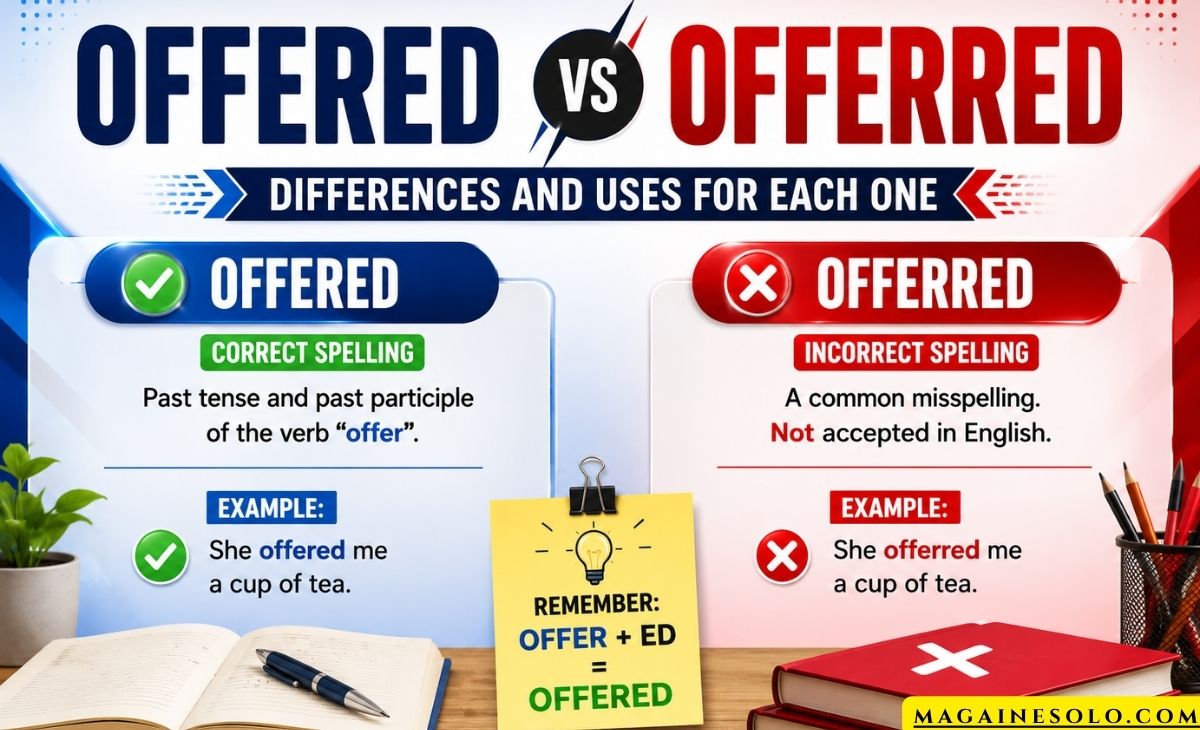
Let’s clear this up right away: “offered” is the correct spelling, and “offerred” is an incorrect spelling that doesn’t exist in standard English dictionaries.
So when people search “offered or offerred,” the answer is simple, always go with offered. The word “offerred” with a double “r” is a spelling error, plain and simple. It’s not a variant, not British vs. American English, and not an alternative form. It’s just a mistake that happens because of how the word sounds when spoken quickly.
Why Do People Write “Offerred” Instead Of “Offered”?
This mix-up usually comes down to one of these reasons:
- Double-consonant confusion: English has many words where adding “-ed” doubles the final consonant (like “stop” → “stopped” or “drop” → “dropped”). People sometimes apply this rule to “offer” by mistake.
- Autocorrect habits: Typing fast on phones or keyboards can lead to extra letters slipping in.
- Mishearing the pronunciation: “Offered” is pronounced with a soft, quick second syllable, which can make it sound like it has a doubled “r.”
- Visual memory errors: If you’ve seen the word misspelled before (in a text, social post, or even a typo-filled article), your brain might remember it incorrectly.
The key takeaway is this: offered, not offerred, is the word you want in every context, formal writing, casual messages, resumes, emails, and academic papers.
What Does “Offered” Mean?
Before diving into usage, let’s quickly define the word so you understand exactly when and how to use it.
Offered is the past tense and past participle form of the verb “offer.” It generally means:
- To present something for someone to accept, reject, or consider.
- To express willingness to do something for someone.
- To put forward an idea, suggestion, or proposal.
For example:
- “She offered her seat to the elderly woman.”
- “The company offered him a promotion.”
- “He offered to help with the project.”
Since “offer” follows standard English spelling rules for adding “-ed,” there’s no need to double the final “r.” This is the core reason “offerred” is incorrect, the spelling rule simply doesn’t apply here.
How To Properly Use The Words In A Sentence
Now that we know “offered” is the correct spelling, let’s look at exactly how to use it properly in different types of sentences. Understanding the grammar behind it will help you avoid mistakes permanently, not just memorize the spelling.
1. Using “Offered” As A Past Tense Verb
When describing an action that already happened, “offered” works as the simple past tense of “offer.”
Example: “Last week, the manager offered me a raise.”
Here, “offered” shows that the action (offering) is complete and happened in the past.
2. Using “Offered” As A Past Participle
“Offered” can also pair with helping verbs like “has,” “have,” or “had” to form perfect tenses.
Examples:
- “She has offered her assistance multiple times.”
- “They had offered the job before he applied.”
- “We have offered several solutions to the problem.”
3. Using “Offered” In Passive Voice
When the subject of the sentence receives the action rather than performs it, “offered” appears in passive constructions.
Examples:
- “A discount was offered to loyal customers.”
- “The position is being offered to two candidates.”
- “Free shipping will be offered during the sale.”
4. Using “Offered” With Infinitives
“Offered” frequently pairs with “to + verb” to describe an action someone proposed to do.
Examples:
- “He offered to drive us to the airport.”
- “She offered to pay for dinner.”
- “The volunteer offered to organize the event.”
Quick Reference Table: Offered vs Offerred
| Spelling | Correct? | Part of Speech | Example Sentence |
| Offered | Yes | Verb (past tense / past participle) | “She offered her help to the team.” |
| Offerred | No | Not a real word | (Avoid using this spelling entirely) |
| Offer | Yes | Base verb / noun | “He made an offer on the house.” |
| Offering | Yes | Gerund / noun | “The offering included a free trial.” |
This table makes it easy to see at a glance: whenever you’re tempted to write “offerred,” simply remove the extra “r” and you’re good to go.
More Examples Of Offered & Offerred Used In Sentences
To really lock this in, let’s look at a variety of real-world examples. We’ll show correct usage with “offered” and highlight why “offerred” would be wrong in each case.
Correct Examples Using “Offered”
- “The bank offered a lower interest rate to new customers.”
- “My neighbor offered to watch our dog while we were on vacation.”
- “The university offered scholarships to top-performing students.”
- “He offered his resignation after the meeting.”
- “The store offered a buy-one-get-one-free deal.”
- “She offered constructive feedback on my essay.”
- “The airline offered compensation for the delayed flight.”
- “They offered their condolences to the family.”
- “A reward was offered for information about the missing dog.”
- “The teacher offered extra credit to students who attended the workshop.”
Incorrect Examples Using “Offerred” (Do Not Use These)
To show exactly what to avoid, here’s how the same sentences would look, incorrectly, with “offerred”:
- “The bank offerred a lower interest rate.”
- “He offerred to watch our dog.”
- “The university offerred scholarships.”
Notice how unnatural and “off” these look once you know the correct spelling? That’s your cue to always double-check before hitting send or publish.
Using “Offered” In Professional Contexts
Since “offered” is commonly used in resumes, job descriptions, business emails, and proposals, getting it right matters for credibility. Here are some workplace-specific examples:
- “The candidate was offered the position after a successful interview.”
- “Our company offered flexible working hours starting this quarter.”
- “The vendor offered a discount for bulk orders.”
- “Management offered additional training resources to the new hires.”
Using “Offered” In Casual Conversation
In everyday speech and informal writing, “offered” fits naturally too:
- “She offered me some of her snacks during the movie.”
- “My friend offered to lend me his charger.”
- “They offered us a ride home after the party.”
Tips To Remember The Correct Spelling
If you want a foolproof way to never write “offerred” again, try these memory tricks:
- Think of “offer” + “ed”: Just add “-ed” to “offer” without changing anything else. No letters are doubled.
- Compare with similar words: Words like “answered,” “covered,” and “remembered” don’t double their final consonant either, and neither does “offered.”
- Say it slowly: Pronouncing “off-er-ed” in three distinct parts can help your brain register the correct spelling.
- Use spell-check, but don’t rely on it blindly: Most spell-checkers will catch “offerred,” but it’s still good to know the rule yourself.
FAQ’s
Is “Offerred” A Real Word?
No. “Offerred” is not recognized in any standard English dictionary. The correct spelling is always “offered.”
Offered Or Offerred, Which Spelling Should I Use?
Always use “offered.” It’s the only grammatically correct past tense and past participle form of the verb “offer.”
Why Do People Confuse Offered With Offerred?
The confusion usually comes from double-consonant rules in other words (like “stopped” or “dropped”), which don’t apply to “offer.”
Is “Offered” Past Tense Or Past Participle?
It’s both. “Offered” works as the simple past tense (“She offered help”) and as the past participle in perfect tenses (“She has offered help”).
Can “Offered” Be Used In Passive Voice?
Yes. For example, “A discount was offered” is a correct passive construction using “offered.”
Does British English Spell It Differently As “Offerred”?
No. Both British and American English use the same spelling, “offered”, with a single “r.”
Final Thoughts
The takeaway here is straightforward: “offered” is correct, and “offerred” is simply a spelling mistake. There’s no debate, no regional variation, and no exception to remember, just one clean rule: add “-ed” to “offer” without doubling the final letter.
Whether you’re writing a job application, a business email, a school essay, or a quick text to a friend, sticking with “offered” will keep your writing accurate, professional, and easy to read. Next time you catch yourself typing “offerred,” pause, delete that extra “r,” and move on with confidence, you’ve got this spelling locked in for good now.

Shoaib Ahmad is a language-focused content writer and researcher at magazinesolo.com, where he explains the meaning of words, phrases, and text in a clear and reader-friendly way. His work focuses on simplifying language, uncovering context, and helping readers understand text with confidence and clarity.