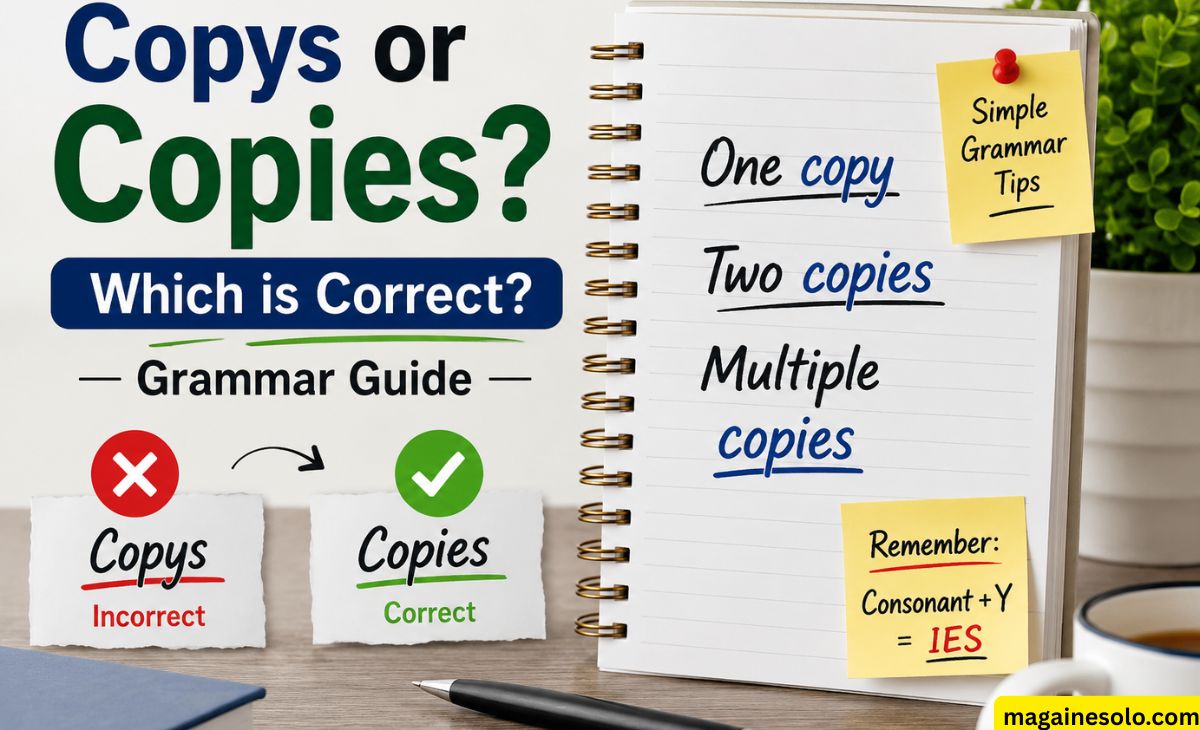
Copys or Copies: Which is Correct? Grammar Guide
Many English learners and even native speakers get confused about copys or copies. Since English spelling rules are not always straightforward, it’s easy to wonder whether copies or copys is the correct form.
If you’ve ever typed copys, copy’s, or searched for copys or copies, you’re not alone. Fortunately, the answer is simple.
The correct spelling is copies.
This guide explains why copies is correct, why copys is wrong, and how to use the word properly in everyday writing.
Copys or Copies: Which is Correct?
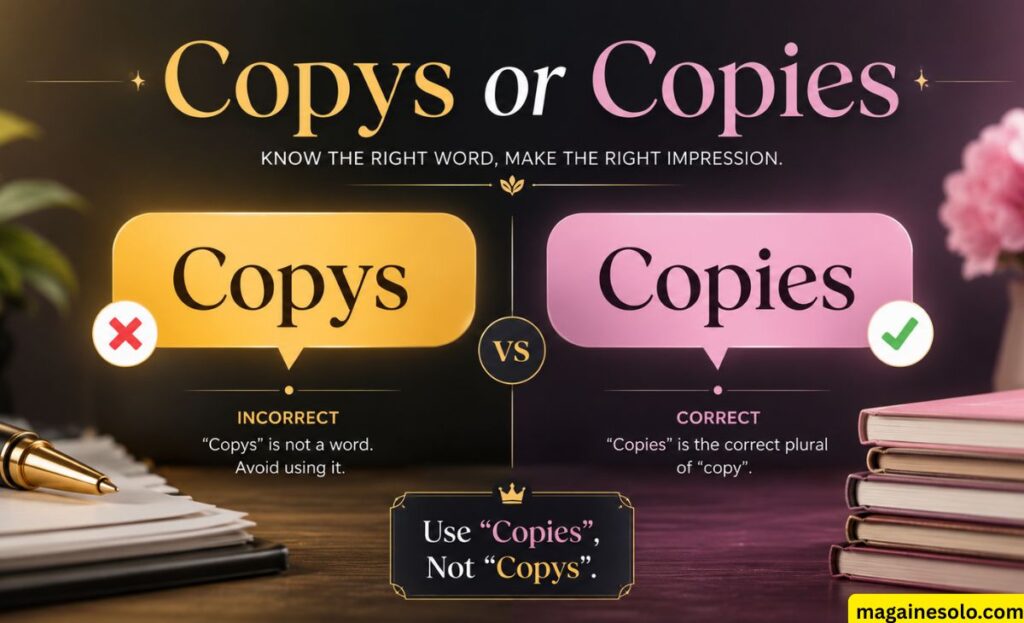
When choosing between copys or copies, only one spelling follows standard English grammar.
| Word | Correct? | Meaning |
| Copies | Yes | More than one copy |
| Copys | No | Incorrect spelling |
| Copy’s | Usually incorrect for plural | Possessive form of copy |
Correct Examples
- I printed three copies of the document.
- She made two copies of the report.
- Please send me extra copies of the receipt.
Incorrect Examples
- I printed three copys of the document.
- Please send two copy’s.
Simply put:
Copies is correct. Copys is incorrect.
Why “Copies” is the Correct Spelling?
To understand why “copies” is correct, we need to look at a basic spelling rule in English grammar, one that applies to many common nouns ending in “y.”
The “Consonant + Y” Rule
Here’s the rule in plain English:
When a noun ends in a consonant + y, you drop the “y” and add “ies” to form the plural.
The word “copy” ends in p + y, and “p” is a consonant. That means we follow this exact rule:
- Drop the “y”
- Add “ies”
- copy → cop + ies → copies
This isn’t a random exception, it’s a consistent pattern you’ll see across hundreds of English words. Once you understand it, you’ll never second-guess yourself again.
Other Words That Follow the Same Rule
To make this rule stick, look at these similar examples:
- baby → babies
- city → cities
- story → stories
- family → families
- party → parties
- lady → ladies
Notice the pattern? In every single case, the word ends in a consonant followed by “y,” and the plural is formed by changing “y” to “ies.” “Copy” is no different.
When “Y” Stays the Same: Vowel + Y Words
There’s an important contrast here too. If a word ends in a vowel + y, you simply add an “s”, no changes needed. For example:
- toy → toys
- day → days
- boy → boys
- key → keys
This is why words like “days” and “toys” don’t follow the same transformation as “copies.” The letter before the “y” determines the rule, and that’s the entire secret behind this spelling confusion.
Why “Copys” Feels Tempting (But Is Wrong)
Many people write “copys” because adding “s” feels like the default, easiest option for plurals. After all, most English nouns just need an “s”, cat becomes cats, dog becomes dogs, book becomes books.
But “copy” doesn’t belong to that group. Because it ends in a consonant + y, it follows the “ies” rule instead. Writing “copys” essentially applies the wrong rule to the wrong word, a very common and very understandable mistake, but a mistake nonetheless.
READ MORE: https://magazinesolo.com/transferred-or-transfered/
“Copy’s” vs “Copies”: Don’t Confuse These Two
This is where a lot of writers get tripped up, especially because “copy’s” and “copies” sound nothing alike when spoken correctly, but look deceptively similar when written quickly.
- Copies = plural noun (more than one copy) OR a verb form (he/she/it copies)
- Copy’s = possessive form, showing that something belongs to “the copy”
Examples to Tell Them Apart
- “I printed three copies of the report.” (plural noun)
- “She copies the homework every morning.” (verb)
- “The copy’s cover page was missing.” (possessive, the cover page belongs to the copy)
A simple trick: if you can replace the word with “of it” or “belonging to it” and the sentence still makes sense, you need the possessive form “copy’s.” If you’re talking about multiple items, you need “copies.”
Examples of Using “Copies” in a Sentence
Seeing a word used in real sentences is one of the best ways to lock in correct spelling. Below are several examples of “copies” used naturally across different contexts.
As a Plural Noun
- Please make five copies of this contract before the meeting.
- The library has multiple copies of that bestselling novel.
- He kept backup copies of all his important files on a hard drive.
- The teacher handed out copies of the worksheet to every student.
- We need extra copies of the invitation for late guests.
As a Verb (Third-Person Singular)
- My brother always copies my homework, and it drives me crazy.
- The software automatically copies files to the cloud every night.
- She copies the recipe by hand instead of printing it.
- The printer copies documents in seconds.
- He copies the design exactly, line for line.
In Everyday and Business Contexts
- Could you send me digital copies of those photos?
- The company distributed printed copies of the new policy to all employees.
- Original copies of historical documents are kept in secure archives.
- The artist sold limited edition copies of the painting.
- We ordered extra copies of the magazine for the office.
As you can see, “copies” fits naturally whether you’re writing a formal email, a school assignment, or a casual text message. There’s no version of “copys” that works in any of these examples, and that’s the easiest way to remember the rule.
READ MORE: https://magazinesolo.com/bachelor-vs-batchelor/
Common Mistakes to Avoid With “Copies”
Even though the rule is straightforward, here are a few mistakes people often make:
- Writing “copys” instead of “copies”, Always incorrect, regardless of context.
- Using “copy’s” when you mean plural, “copy’s” is possessive, not plural.
- Mixing up “copies” with “copy”, “Copy” is singular; “copies” is for two or more.
- Autocorrect overrides, Sometimes spell-checkers don’t catch “copys” if it’s used inside informal text or social media posts, so don’t rely on autocorrect alone.
A quick proofreading habit: whenever you write a word ending in “y” and you’re making it plural, ask yourself, does it end in a consonant + y? If yes, change “y” to “ies.”
READ MORE: https://magazinesolo.com/grately-vs-greatly/
Quick Reference Table: Copy and Its Forms
| Form | Type | Example Sentence |
| Copy | Singular noun / verb | I need one copy of this file. |
| Copies | Plural noun / verb (he/she/it) | She copies notes every class. |
| Copy’s | Possessive | The copy’s quality was poor. |
| Copying | Present participle/verb | He is copying the document now. |
| Copied | Past tense | I copied the file yesterday. |
| Copys | Incorrect | Never use this spelling. |
FAQ’s
Is “copys” ever correct?
No. “Copys” is not a recognized English word in any context, the correct plural is always “copies.”
What is the plural of “copy”?
The plural of “copy” is “copies,” formed by changing the “y” to “ies” because the word ends in a consonant + y.
What’s the difference between “copies” and “copy’s”?
“Copies” means more than one copy or is a verb form, while “copy’s” shows possession, meaning something belongs to the copy.
Why do some words add “s” while “copy” adds “ies”?
Words ending in a vowel + y (like “toy”) simply add “s,” while words ending in a consonant + y (like “copy”) change to “ies.”
Can “copies” be used as a verb?
Yes. “Copies” is the third-person singular present tense of “copy,” as in “he copies the file every day.”
Is “copies” used in formal writing?
Yes, “copies” is completely appropriate for formal, academic, and professional writing whenever referring to multiple items.
Conclusion
If you’ve been wondering about copys or copies, the answer is clear.
Copies is the correct spelling, while copys is incorrect. Likewise, copy’s should only be used to show possession, not to indicate more than one copy.
Remember the simple grammar rule:
Consonant + y = ies
Just as baby becomes babies and city becomes cities, copy becomes copies.
Using the correct spelling will make your writing clearer, more professional, and grammatically accurate.

Shoaib Ahmad is a language-focused content writer and researcher at magazinesolo.com, where he explains the meaning of words, phrases, and text in a clear and reader-friendly way. His work focuses on simplifying language, uncovering context, and helping readers understand text with confidence and clarity.