

Fraboc is the informal spelling of FRA-BOC, a retired Australian clinical tool. Its full name is Familial Risk Assessment, Breast and Ovarian Cancer.
Cancer Australia built the tool for health professionals in Australia. General practitioners and nurses used it to assess cancer risk from family history.
The tool is no longer available today. Cancer Australia removed it from its website, and newer risk assessment tools have taken its place.
This information is general only, not medical advice. Anyone worried about personal cancer risk should discuss it with their own doctor.
Most searchers meet fraboc inside old documents first. A referral letter, clinical note, or exam paper mentions FRA-BOC without explaining it.
Other searchers meet a very different claim online. Some websites describe fraboc as a business framework, which no primary source supports at all.
Short sections below separate verified facts from claims. Every statistic carries its source label, so Australian figures never get sold as universal facts.
Fraboc at a Glance: Verified Facts
Fraboc becomes clear once the basic facts sit together. One small table answers the questions almost every searcher brings to this keyword.
The primary source is Cancer Australia, the national cancer agency. Its breast cancer awareness page describes FRA-BOC directly and confirms its retirement.
The Royal Australian College of General Practitioners agrees completely. Its RACGP acronym list expands FRA-BOC with exactly the same full name.
| Detail | Verified information |
|---|---|
| Formal name | FRA-BOC |
| Full form | Familial Risk Assessment, Breast and Ovarian Cancer |
| Created by | Cancer Australia |
| Country | Australia |
| Type | Online clinical risk assessment tool |
| Designed for | General practitioners and nurses |
| Input used | Family history of breast and ovarian cancer |
| Output | One of three risk categories |
| Was it a diagnosis? | No |
| Was it a genetic test? | No |
| Current status | Retired, no longer on the Cancer Australia website |
| Replacement in Australia | iPrevent |
What Is Verified and What Is Only Claimed
Verified facts come from Cancer Australia itself today. The definition, intended users, purpose, and retired status all appear on its official page.
Government confirmed facts come from Queensland health services. BreastScreen Queensland states the iPrevent replacement and publishes current category thresholds.
Historical facts come from period documents and journals. A 2016 Medical Journal of Australia article and a circa 2011 patient fact sheet show FRA-BOC in live use.
Competitor reported figures appear in the statistics section later. Relative risk numbers summarised from Cancer Australia material carry a clear reported label there.
Unverified claims describe fraboc as a productivity framework. No creator, organisation, standard, or primary document supports that meaning anywhere online.
What Does FRA-BOC Stand For?
FRA-BOC breaks into two simple parts for readers. Each part names one half of the tool’s actual job.
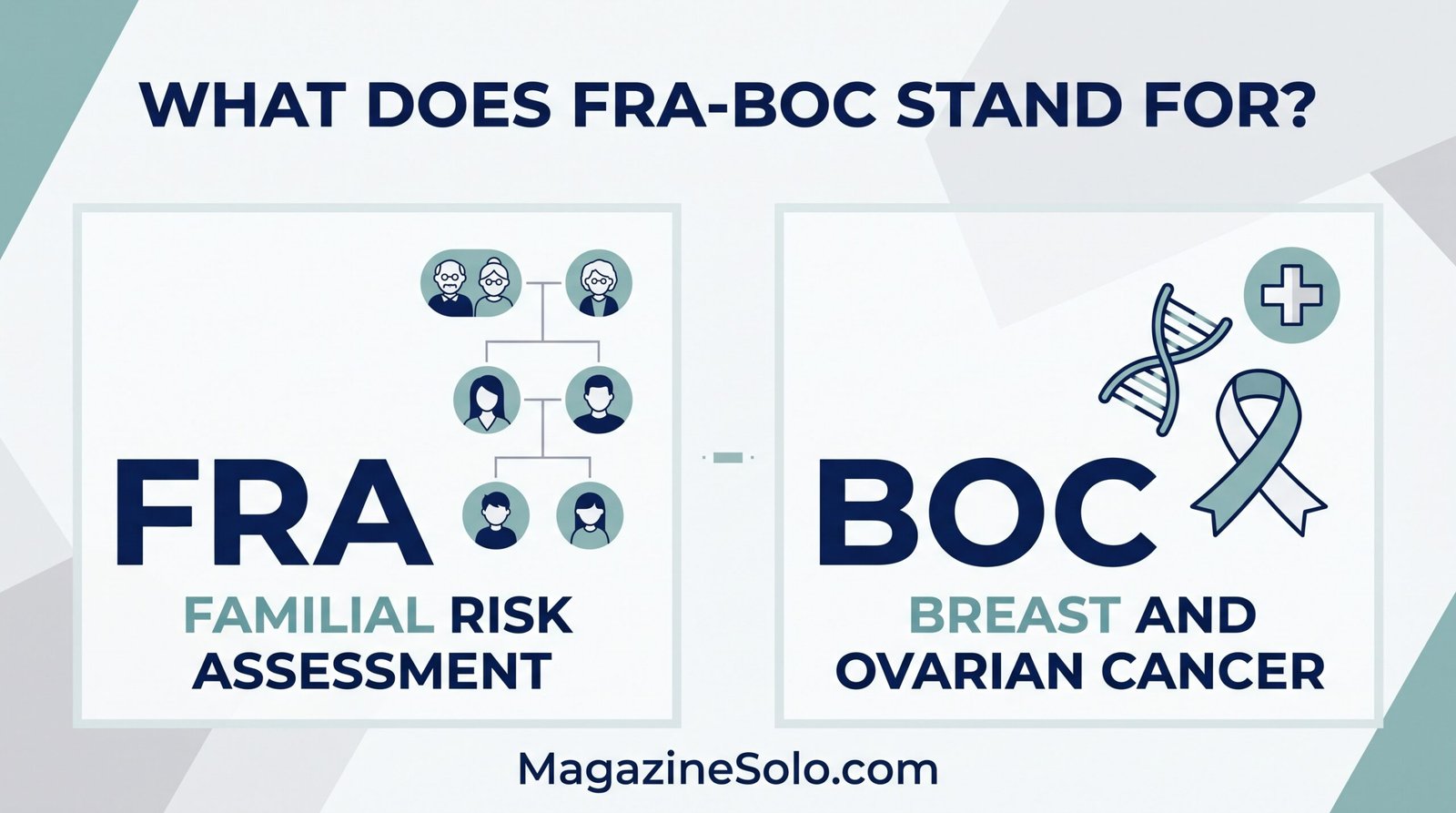
FRA stands for Familial Risk Assessment. Familial means the assessment studies cancers appearing inside a family across generations.
BOC stands for Breast and Ovarian Cancer. Those two cancers formed the tool’s entire focus from start to finish.
Together the name describes the method honestly. It assessed risk from family patterns, rather than testing a person’s body or genes.
Why the Spelling Changes Between Fraboc, FRABOC and FRA-BOC
Writers shorten long acronyms in different ways online. FRA-BOC keeps its hyphen, FRABOC drops it, and fraboc drops the capital letters too.
That one word habit is familiar on Magazine Solo already. Readers of Atleast or At Least? know how joined writing changes whether a form counts as correct.
The meaning stays the same in every spelling here. All three forms point to one retired Australian tool and nothing else.
Exams and documents prefer FRA-BOC with capitals and hyphen. Casual web pages prefer fraboc, which is why the lowercase form became the search term.
What Was the FRA-BOC Tool and Who Used It?
FRA-BOC was an online assessment on Cancer Australia’s website. Health professionals opened it during consultations and worked through family history questions.
Its users were general practitioners and nurses specifically. Cancer Australia describes it as designed for health professionals such as these two groups.
Patients did not use it alone at home. A professional interpreted the result, because family histories are messy, incomplete, and easy to misread.
The tool served women unaffected by cancer mainly. It estimated future risk for women whose relatives had breast or ovarian cancer.
Built for GPs and Nurses, Not Self Diagnosis
Professional interpretation protected patients from wrong conclusions. A category result needed context about age, relatives, and missing information before it meant anything.
Structured questions replaced vague family conversations in appointments. Instead of asking whether cancer ran in the family, clinicians recorded precise, comparable details.
Referral decisions were the practical output of assessments. Higher categories pointed toward family cancer clinics and genetic assessment discussions in Australia.
Reassurance was the output for most women assessed. Most family histories land near average risk, and a structured result made that reassurance credible.
Why Family History Tables Were Not Always Enough
Cancer Australia also published printed family history tables then. Simple tables sorted common family patterns into risk levels quickly and cheaply.
Some families did not fit those tables neatly. Multiple cancers, mixed sides, unusual ages, and bilateral disease created patterns tables could not score.
Historical guidance sent those complex cases to FRA-BOC. The online tool handled detailed family situations that printed tables could not assess accurately.
That division explains the tool’s real niche clearly. FRA-BOC was the detailed second step, not the everyday first glance at risk.
How Did FRA-BOC Work?

FRA-BOC asked about family patterns, not personal symptoms. It never examined a patient, scanned a breast, or sampled any tissue.
The clinician entered relatives’ cancer details into the tool. Relationships, cancer types, family side, and ages at diagnosis all shaped the result.
The output placed the woman into one category. Three broad categories covered average, moderately increased, and potentially high familial risk.
That category then guided the conversation afterward. Screening advice, reassurance, or specialist referral followed from it, based on Australian guidance at the time.
The Five Question Areas (Historical)
A 2018 conference presentation by breast surgeons survives online. It lists the five question areas FRA-BOC worked through, in this order.
- Has a woman had a gene test? Previous testing changes how any family history should be interpreted by clinicians.
- Is there a gene mutation in the family? A known mutation raises the stakes of the whole assessment immediately.
- Founder mutations and Jewish ancestry questions. Certain ancestries carry specific founder mutations linked to hereditary breast and ovarian cancer.
- Familial incidence of ovarian cancer. The tool counted ovarian cancer cases across the family history carefully.
- Familial incidence of breast cancer. Breast cancer cases, relationships, and ages completed the core family pattern.
These areas are historical information from conference material. They describe how the retired tool worked, not how anyone should assess risk today.
From Family Details to a Risk Category
Step one collected the family story carefully. Names mattered less than relationships, cancer types, sides of family, and diagnosis ages.
Step two looked for significant pattern features. Multiple relatives, early diagnoses, and breast plus ovarian combinations carried the most weight.
Step three assigned one broad category only. The tool deliberately avoided fake precision, because family information is often incomplete or uncertain.
Step four returned the result to clinical judgement. The category informed decisions, but the doctor or nurse made them with the patient.
The Three Risk Categories Explained
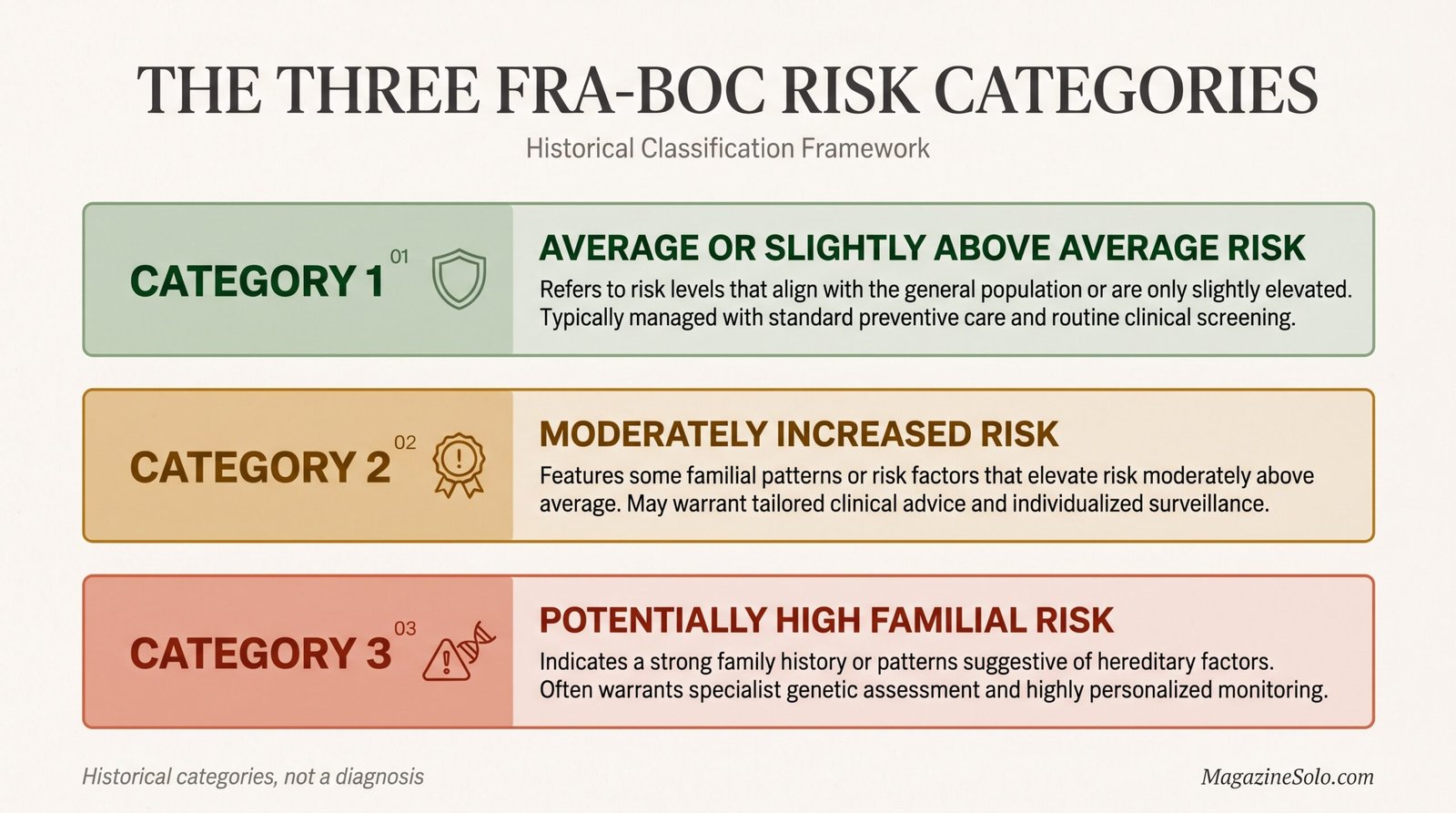
FRA-BOC sorted women into three broad categories overall. The categories described family history patterns, not personal destinies or diagnoses.
Category 1 meant at or slightly above average risk. Most women assessed fell here, including many with one or two affected relatives.
Category 2 meant moderately increased risk overall. The family pattern was notable, but it did not clearly signal a high risk inherited syndrome.
Category 3 meant potentially high risk in Australia. Women here were referred to a family cancer clinic for specialist assessment.
A 2016 journal article confirms this structure independently. The Medical Journal of Australia describes FRA-BOC levels 1, 2, and 3 as normal, moderately elevated, and significantly elevated.
Category Thresholds in Numbers, Carefully Labelled
Numbers need honest labels in this topic especially. Current thresholds and historical category risks come from different sources and different decades.
BreastScreen Queensland publishes current category thresholds for iPrevent practice. Average is under 1.5 times population risk, moderate is 1.5 to 3 times, and high is over 3 times.
Those thresholds describe current Australian categories today. They should not be pasted onto FRA-BOC itself, whose categories were described in words.
Historical conference material gives FRA-BOC era ranges separately. Category 2 lifetime risk sat around 1 in 8 to 1 in 4, and Category 3 exceeded 25 percent.
| Category | Meaning in words | Current Queensland threshold (iPrevent era) |
|---|---|---|
| Category 1 | At or slightly above average risk | Under 1.5 times population risk |
| Category 2 | Moderately increased risk | 1.5 to 3 times population risk |
| Category 3 | Potentially high risk | Over 3 times population risk |
What a Category Result Did and Did Not Mean
A category summarised a pattern, nothing more than that. It compared one family history against population level risk using structured rules.
A category did not predict an individual’s future. Women in Category 3 could stay healthy, and women in Category 1 could still develop cancer.
A category did not diagnose anything at all. It said nothing about whether cancer existed in the woman’s body at that moment.
A category did guide sensible next steps though. Reassurance, routine screening discussion, or specialist referral each matched different category levels appropriately.
Why Family History Matters in Breast and Ovarian Cancer
Family history matters because relatives share genes partly. They also share environments, habits, and sometimes simple chance across a family.
One relative with cancer rarely changes much alone. Breast cancer is common, so many families include one case without any inherited pattern.
Patterns change the picture far more than single cases. Several relatives, young diagnoses, and related cancer types together suggest something inherited may operate.
Clinicians therefore ask detailed questions about every relative. The answers below are the details that shaped FRA-BOC and still shape modern tools.
Number and Closeness of Affected Relatives
First degree relatives carry the most weight here. Mothers, sisters, and daughters share half a person’s genes on average.
Second degree relatives matter at lower weight individually. Grandmothers, aunts, and half sisters still add meaningful pattern information when several appear.
More affected relatives strengthen a pattern progressively. Each additional close case makes coincidence a weaker explanation for the family story.
Same side concentration strengthens patterns further still. Several cases along one parental line suggest one inherited thread running through them.
Age at Diagnosis and Early Onset Patterns
Young diagnoses raise professional attention very quickly. Breast cancer under 50 in a relative signals possible inherited susceptibility more strongly.
Average age diagnoses carry less pattern weight alone. A relative diagnosed at 78 fits population patterns far more comfortably.
Bilateral breast cancer adds significant pattern weight too. Cancer in both breasts of one relative suggests stronger underlying susceptibility factors.
Male breast cancer in a family also matters. It is rare, so its presence in a family history is clinically notable.
Both Sides of the Family Count
Inherited risk passes through fathers as well equally. A father can carry and pass a gene fault without developing breast cancer himself.
Many families ignore the father’s side completely. That habit hides real patterns, because paternal grandmothers and aunts count fully in assessments.
FRA-BOC asked about both parental sides deliberately. Modern tools including iPrevent still collect family history from both sides today.
A complete record lists every relative’s side clearly. Mother’s side and father’s side should never be merged into one vague family label.
What the Relative Risk Figures Really Mean
Competitor pages quote Cancer Australia figures for relative risk. Treat these as reported summaries of Cancer Australia material, not personal predictions.
They report about 1.80 times the risk with one affected first degree relative. The comparison group is women with no such family history.
They report about 2.93 times with two affected relatives. With three or more affected first degree relatives, the reported figure reaches about 3.90.
Relative risk compares groups, not individual futures. A doubled risk of a small absolute chance can still remain a small chance.
Most women with an affected relative never develop breast cancer. Cancer Australia’s own materials stress that risk factors raise chances without guaranteeing outcomes.
FRA-BOC Was Not a Cancer Test

Confusing risk assessment with testing causes real harm here. Readers who misread old letters sometimes fear a diagnosis that never happened.
Risk assessment estimates future likelihood from information. FRA-BOC did exactly this, using family history patterns and nothing else.
Screening looks for existing disease in healthy people. Mammograms screen breasts for early signs of cancer that may already exist.
Diagnosis confirms whether cancer is actually present. Biopsies and pathology testing diagnose, after imaging or examination raises a question.
Genetic testing examines DNA for inherited variants directly. FRA-BOC never sampled DNA, blood, or saliva from anyone at any point.
| Process | Question it answers | Example |
|---|---|---|
| Risk assessment | How likely is future cancer? | FRA-BOC, iPrevent, BCRAT |
| Screening | Is there an early sign now? | Mammogram |
| Diagnosis | Is this actually cancer? | Biopsy and pathology |
| Genetic testing | Is an inherited variant present? | BRCA1 and BRCA2 testing |
Why This Distinction Protects Readers
An old letter mentioning FRA-BOC records an assessment only. It never records a cancer finding, a positive test, or a confirmed mutation.
Reading it as a diagnosis causes needless fear. Families have worried for years over acronyms that only meant a structured conversation happened.
Reading it as nothing also misses value though. The letter shows a clinician once considered the family history worth structured attention.
The balanced reading is historical context plus professional advice. Note the date, understand the term, and ask a current clinician if it still matters.
Fraboc and Genetic Risk: BRCA1, BRCA2 and HBOC
Some breast and ovarian cancers involve inherited gene faults. These cases form a minority, but their risk levels can be substantially higher.
BRCA1 and BRCA2 are the best known genes here. Inherited faults in either gene can raise breast and ovarian cancer risk significantly.
The related condition is called hereditary breast and ovarian cancer syndrome. Clinicians shorten it to HBOC when discussing families with suggestive patterns.
Founder mutations matter in some populations specifically. Ashkenazi Jewish ancestry is the classic example FRA-BOC asked about in its questions.
Family History Is a Clue, Not a Genetic Result
A strong family pattern suggests possible inherited risk only. It cannot prove a mutation exists in any particular person.
Some mutation carriers have quiet family histories instead. Small families, early deaths, and unknown diagnoses can hide an inherited pattern completely.
Only genetic testing can assess a variant directly. Testing normally follows counselling, because results affect relatives as well as the person tested.
FRA-BOC sat before testing in the pathway. Its job was spotting patterns that might justify a genetics conversation, not replacing that conversation.
Why Was FRA-BOC Retired and What Replaced It?
Cancer Australia lists FRA-BOC as a former tool now. Its page says the tool is no longer available and more up to date tools exist.
Risk science moved beyond family history alone meanwhile. Personal, reproductive, lifestyle, and breast factors also shape risk, and newer models use them.
BreastScreen Queensland states the replacement plainly and officially. FRA-BOC is no longer available on Cancer Australia’s website and has been replaced by iPrevent.
No single dramatic failure caused the retirement publicly. Tools retire when better validated methods and updated guidelines make them obsolete.
iPrevent: The Current Australian Tool
iPrevent is a validated breast cancer risk tool. Peter MacCallum Cancer Centre developed it for women and their doctors to use together.
It integrates two validated risk models internally. The IBIS and BOADICEA models estimate risk depending on the information a woman enters.
An assessment takes about 30 minutes to complete. BreastScreen Queensland gives that timing for clinicians planning appointments around the tool.
iPrevent suits women without invasive breast cancer history. It is not intended for women who have had invasive breast cancer or DCIS.
It also protects privacy by design in sessions. Breast Cancer Trials notes that no personal information is saved once the session closes.
FRA-BOC vs iPrevent vs BCRAT
| Feature | FRA-BOC | iPrevent | BCRAT (Gail model) |
|---|---|---|---|
| Country | Australia | Australia | United States |
| Status | Retired | Current | Current |
| Main inputs | Family history only | Personal, family, lifestyle, reproductive | Age, reproductive, biopsies, first degree family history |
| Output | Three broad categories | Personalised risk estimates and options | 5 year and lifetime risk percentages |
| Designed for | GPs and nurses | Women with their doctors | Clinicians, women aged 35 plus |
| Genetic models inside | None | IBIS and BOADICEA | None |
| Ovarian risk focus | Yes, core purpose | Breast focused | Breast only |
FRA-BOC remains the simplest tool in this table. Its family history only design made it fast, structured, and limited at once.
iPrevent widened the lens for Australian practice. More inputs produce personalised estimates, at the cost of a longer assessment session.
BCRAT serves the United States pathway instead. American readers meet it through the National Cancer Institute and US clinical practice.
Fraboc in the USA: What American Readers Should Know
Fraboc confuses American readers more than Australian ones. The tool never operated in the United States, yet US searchers keep finding it.
Old Australian documents travel online without borders today. So do exam materials, fact sheets, and content pages written about the tool.
The key point is jurisdiction in risk guidance. Australian categories, clinics, and screening ages do not transfer into US care automatically.
US readers should use US tools and guidance instead. The next sections name them in general information terms only.
US Tools and Pathways: BCRAT, Tyrer-Cuzick and USPSTF Guidance
The Breast Cancer Risk Assessment Tool is America’s standard. Known as BCRAT or the Gail model, it estimates 5 year and lifetime invasive breast cancer risk.
MD Anderson Cancer Center explains that a 1.7 percent 5 year risk counts as high. That threshold applies to women aged 35 and older in US practice.
The Tyrer-Cuzick model appears in many US clinics too. It uses richer inputs including breast density, body measurements, and wider family history details.
The USPSTF addresses BRCA related risk for US women. Its guidance supports risk assessment and genetic counselling referral for women with suggestive family patterns.
None of these tools diagnoses cancer either, ever. US risk tools share FRA-BOC’s basic limit: they estimate likelihood, they never confirm disease.
Why Australian Categories Do Not Transfer Directly
Category labels sound universal but are not. Category 3 in Australia triggered family cancer clinic referral under Australian guidelines specifically.
US pathways use different structures and thresholds instead. Genetic counselling services, high risk clinics, and insurance rules organise American follow up differently.
Screening ages also differ between the countries significantly. Australian and US mammogram recommendations follow separate national evidence reviews and programmes.
The family facts still transfer perfectly well though. Relatives, cancer types, sides, and ages at diagnosis help clinicians in every country equally.
Found FRA-BOC in an Old Letter or Record? What to Do
Finding FRA-BOC in paperwork usually means one thing. A clinician once assessed, or planned to assess, family cancer history in a structured way.
It does not mean cancer was found then. It also does not prove an inherited mutation was suspected strongly or confirmed.
Work through the document calmly with these steps. They preserve the useful history without turning a retired tool into current advice.
Numbered Steps for Reading an Old FRA-BOC Reference
- Check the document date first. FRA-BOC references belong to its active era, mainly the years around and after 2011.
- Find the category if one is recorded. Category words like moderately increased describe the family pattern assessed at that time.
- Note the surrounding clinical context carefully. Referral letters often pair the assessment with screening advice or a family cancer clinic suggestion.
- Update your family history since then. New diagnoses, corrected details, and deaths change what the old assessment would say today.
- Bring the document to your doctor. Ask whether the historical assessment still matters under current guidance in your country.
- Ask about current tools if concerned. iPrevent in Australia or BCRAT in the US can reassess risk with modern methods.
How to Prepare Your Family History for an Appointment
Good preparation makes any assessment more accurate today. Clinicians can only score the family details they actually receive from patients.
Record each relative’s relationship to you first. Add whether they belong to your mother’s side or your father’s side.
Record the type of cancer each relative had. Breast, ovarian, pancreatic, and prostate cancers all carry pattern value in modern assessments.
Record the approximate age at diagnosis too. Early onset cases change risk interpretation more than almost any other single detail.
Note any genetic testing already done in family. A known mutation, or a tested relative’s clear result, reshapes the whole conversation.
Accept gaps honestly rather than guessing details. Unknown is useful information, while invented precision quietly corrupts an assessment result.
Fraboc, Worry and the Value of a Structured Answer
Family cancer history often creates quiet, lasting worry in people. The fear sits in the background for years without facts to contain it.
Many people avoid assessment because answers feel frightening. Yet unstructured worry usually grows larger than a clear, professional explanation ever does.
That human problem explains FRA-BOC’s original appeal best. A structured conversation gave worry a shape, a category, and a sensible next step.
Most assessments ended in reassurance grounded in facts. The majority of family histories sit near average risk once someone examines them properly.
Even a higher category brought practical value then. It opened doors to specialists whose entire job is interpreting complex family patterns carefully.
October conversations help many American families start this process. Breast Cancer Awareness Month prompts relatives to share diagnoses, ages, and testing history openly.
Use those conversations to build your written record calmly. Facts collected kindly at a table serve you far better than memories reconstructed under stress.
The Business Framework Claim: Clearly Labelled
Some newer websites describe fraboc as a management framework online. They promise workflow, productivity, and digital process benefits under this name.
No primary source supports that meaning anywhere. No creator, company, book, standard, or research paper establishes a fraboc methodology.
Magazine Solo readers know this confusion pattern well already. The guide on Ally vs Allie shows how one form can be a word while another is a name.
Sound based errors create similar traps in writing daily. Per Say or Per Se? Which Is Correct? explains how a heard phrase gets written wrongly and believed.
Small letter changes also invent false words convincingly. Grately vs Greatly shows how one wrong letter manufactures a term that looks real.
Similar names cause wrong identity matches in research too. Magazine Solo’s profile of Rajesh Nihalani separates two people whom similar names wrongly merge together.
Apply those lessons to fraboc every time you search. A confident framework page is not evidence, however polished its design looks.
How to Check Any New Fraboc Claim Online
Ask who created it before believing any definition. Real frameworks and real tools always trace back to identifiable people or organisations.
Ask for primary documentation behind the claim next. Manuals, official pages, guidelines, and studies separate real things from repeated content.
Compare definitions across several websites for consistency. Ten different definitions of one term signal invention, not an established concept.
Check the domain’s purpose before trusting its content. Health claims on unrelated domains deserve the same suspicion here as anywhere.
Prefer the traced meaning when sources conflict openly. FRA-BOC traces to a national cancer agency, while the framework claim traces to nothing.
Mistakes to Avoid When Researching Fraboc
Mistake one is treating fraboc as a disease. The name belonged to an assessment tool, never to a condition or diagnosis.
Mistake two is treating a category as prophecy. Categories summarised group level patterns, and individuals routinely defy group level expectations.
Mistake three is using the retired tool today. Screenshots, archives, and copied calculators cannot substitute for current validated assessment methods.
Mistake four is importing Australian guidance into America. Categories, clinics, and screening advice must come from the reader’s own country.
Mistake five is trusting spun health content online. Pages with garbled, synonym swapped English recycle medical facts without understanding or checking them.
Expert Tips for Reading Medical Acronyms Online
Tip one: expand the acronym from a professional source. College and agency glossaries, like the RACGP list, settle expansions reliably and quickly.
Tip two: check whether the thing still exists. Retired tools keep ranking in search results long after official pages close them.
Tip three: read the date on every document. Medical guidance ages fast, and an undated page about risk deserves extra caution.
Tip four: keep family facts and feelings separate. Worry is understandable, but accurate records help clinicians far more than anxious summaries.
Key Takeaways for Busy Readers
- Fraboc is FRA-BOC, Cancer Australia’s retired family history risk tool.
- Three categories sorted women into average, moderately increased, and potentially high risk.
- iPrevent replaced FRA-BOC for current Australian breast cancer risk assessment.
- BCRAT is the standard risk tool for readers in the United States.
- Family history is a clue, never a diagnosis or a genetic result.
- Framework definitions of fraboc remain unverified claims with no primary source.
- Old references deserve a calm, dated reading with your own doctor.
Fraboc Timeline: From Live Tool to Retired Reference
Dating FRA-BOC helps readers judge old documents accurately. A reference from its live era means something different from one copied yesterday.
Around 2011, patient materials recommended it openly. A Breast Cancer Network Australia fact sheet told women their doctor could complete a FRA-BOC assessment.
That fact sheet also dates the era precisely. It notes the July 2011 amalgamation that formed Cancer Australia as a single national agency.
In 2016, a medical journal described it clinically. The Medical Journal of Australia explained its three levels inside a breast cancer prevention review.
In 2018, surgeons still taught it at conferences. Their presentation detailed the five question areas and category lifetime risks for practising clinicians.
Exam materials preserved it for trainees afterward. RACGP revision flashcards continued testing FRA-BOC categories for general practice candidates in Australia.
Today the official position is retirement and replacement. Cancer Australia calls it a former tool, and Queensland guidance points professionals to iPrevent instead.
| Period | Evidence | What it shows |
|---|---|---|
| Circa 2011 | BCNA family history fact sheet | FRA-BOC live, free, used with patients |
| 2016 | Medical Journal of Australia article | Three levels described in clinical literature |
| 2018 | GPCME surgeons conference slides | Still taught, with question areas detailed |
| Recent years | RACGP flashcards and acronym list | Survives in study and reference material |
| Today | Cancer Australia official page | Retired, replaced by current tools |
Why Retired Tools Keep Appearing in Records
Medical records persist far longer than websites do. Letters, summaries, and fact sheets stay in files for decades after tools retire.
Copied web content also preserves retired names indefinitely. Pages written during the live era remain indexed, and newer pages copy them.
Exam syllabuses change slowly in every country too. Students keep meeting FRA-BOC because family history categories remain useful teaching material.
Understanding this timeline prevents two opposite errors completely. Readers neither panic over an old acronym nor treat it as current medical guidance.
A Worked Example: Reading One Family Pattern
Examples make category logic easier to grasp safely. The following example is illustrative only and describes no real patient.
Imagine a woman whose mother developed breast cancer at 72. No other relative on either side has had breast or ovarian cancer.
That pattern looks close to average in structure. One older first degree relative, without early onset or supporting pattern features, rarely signals inheritance.
Now imagine three maternal relatives diagnosed under 50 instead. Add one ovarian cancer case in the same line of the family.
That second pattern looks potentially high risk in structure. Multiple early cases plus ovarian cancer form exactly the pattern structured assessments flagged.
A clinician would not score either example from this page. Real assessment needs verified diagnoses, complete relatives, and current tools with professional interpretation.
The example only shows which details move assessments. Count, closeness, age, cancer type, and family side do the work, not worry alone.
What Modern Tools Ask That FRA-BOC Did Not
Modern tools widened beyond family history for accuracy. iPrevent also asks about personal medical history, reproductive factors, and lifestyle factors.
Previous breast disease now enters Australian assessments too. Biopsy history and conditions like atypical hyperplasia refine modern risk estimates meaningfully.
Breast density informs newer approaches in several systems. Dense tissue slightly raises risk and also makes mammogram reading harder for clinicians.
These additions explain why replacement happened in practice. FRA-BOC answered one question well, while modern care asks a broader set of questions.
FAQs
What does fraboc mean?
Fraboc means FRA-BOC, the Familial Risk Assessment, Breast and Ovarian Cancer tool. Cancer Australia created it for health professionals assessing family history risk.
What does FRA-BOC stand for?
FRA-BOC stands for Familial Risk Assessment, Breast and Ovarian Cancer. FRA names the family based method, and BOC names the two cancers it covered.
Is fraboc a disease?
No, fraboc is not a disease at all. It was the name of an online risk assessment tool used by Australian health professionals.
Who created FRA-BOC?
Cancer Australia created and hosted the FRA-BOC tool. It is the Australian Government’s national cancer control agency, publishing guidance for clinicians and patients.
Who was FRA-BOC designed for?
It was designed for general practitioners and nurses in Australia. They used it with patients, rather than patients using it alone for self diagnosis.
Is FRA-BOC still available?
No, the tool is no longer available online. Cancer Australia states it is not on its website anymore, and more up to date tools exist.
Why was FRA-BOC retired?
It was superseded by better methods over time. Newer tools use more risk factors than family history alone, and guidelines have been updated since.
What replaced FRA-BOC?
iPrevent replaced FRA-BOC in Australian breast cancer risk assessment. BreastScreen Queensland states this replacement directly on its health professionals page.
How long does an iPrevent assessment take?
An iPrevent assessment takes about 30 minutes to complete. BreastScreen Queensland gives that timing, including entering personal and family history details carefully.
Was FRA-BOC a cancer test?
No, FRA-BOC was not a cancer test ever. It estimated future risk from family history and never examined, scanned, or sampled the body.
Was FRA-BOC a genetic test?
No, it did not test DNA at all. It assessed family patterns, which can suggest, but never prove, an inherited genetic variant.
What are the three FRA-BOC risk categories?
The categories were average, moderately increased, and potentially high risk. They described family history patterns and guided reassurance, screening discussion, or specialist referral.
What does Category 2 mean?
Category 2 means moderately increased risk overall. The family pattern is stronger than average, without clearly signalling a high risk inherited syndrome.
What does Category 3 mean?
Category 3 means potentially high risk in Australia. Women in this category were referred to a family cancer clinic for specialist assessment.
Does a family history mean I will get breast cancer?
No, family history does not guarantee cancer ever. It can raise probability, but most women with affected relatives never develop the disease.
How much does one affected relative raise risk?
Competitor summaries of Cancer Australia material report about 1.80 times the risk. That population level figure compares groups and never predicts one person’s future.
Does the father’s side count for breast cancer risk?
Yes, the father’s side counts fully in assessments. Gene faults pass through either parent, including fathers who never develop breast cancer themselves.
I found FRA-BOC in an old letter. What should I do?
Treat it as historical information about an assessment. Check the date, note any category, and discuss it with your doctor if it concerns you.
What breast cancer risk tool is used in the USA?
US practice commonly uses BCRAT, the Gail model. It estimates 5 year and lifetime invasive breast cancer risk for women aged 35 and older.
Is fraboc a business or productivity framework?
No primary source supports that claim anywhere. Some websites use the word that way, but the documented meaning is the retired Australian medical tool.
Conclusion
Fraboc turns out to have a clear, traceable story after all. Behind the acronym stands a structured Australian attempt to read family cancer patterns fairly.
FRA-BOC helped GPs and nurses sort family histories calmly. Its three categories turned vague worry into reassurance, closer screening discussion, or specialist referral.
That tool has retired, and fraboc now lives in documents. iPrevent carries its work forward in Australia, while BCRAT serves readers in the United States.
Keep checking unfamiliar terms against primary sources before believing them. Start with the word and name guides on Magazine Solo, where confusing spellings and similar names get verified properly.

Dilawar Mughal is an SEO expert with 8 years of hands-on experience helping websites grow their organic traffic, rankings, and revenue. He specializes in content-driven SEO, local SEO, and Pinterest SEO, and builds practical, results-focused strategies for businesses and publishers.




1 Comments