Why Does Sunscreen Pill Under Makeup? 10 Ways to Fix It
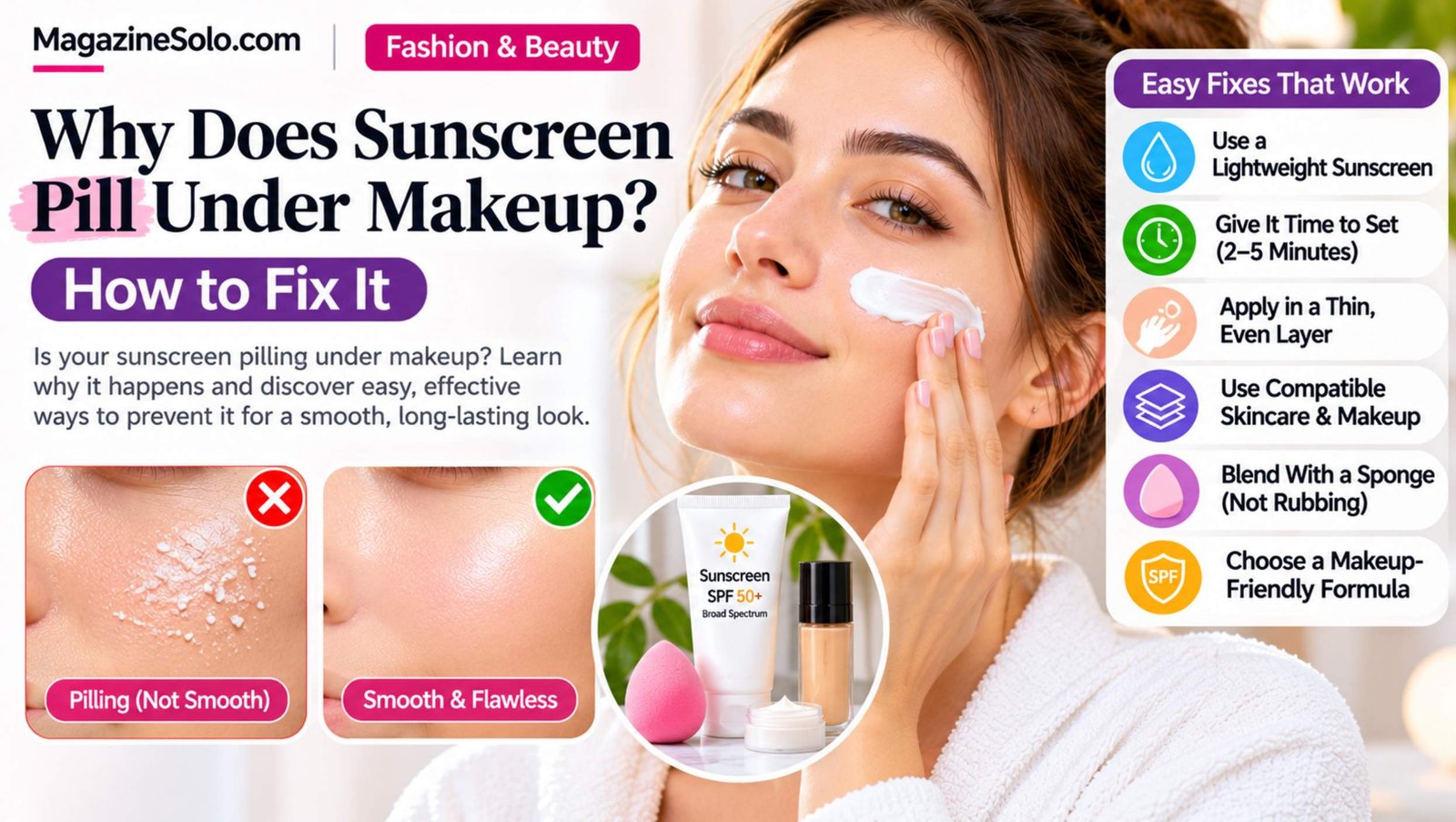
You finish your morning skincare routine, apply sunscreen, and reach for your foundation. But as soon as you start blending, tiny white flakes or little rolls of product appear on your cheeks and forehead.
You try smoothing them away, only to make the problem worse.
If you’re dealing with sunscreen pilling under makeup, the issue may involve incompatible skincare layers, excessive product buildup, or the way you’re applying foundation.
Pilling is frustrating because it can make otherwise smooth-looking makeup appear uneven, flaky, or patchy.
Fortunately, you don’t have to skip sunscreen to achieve a better makeup finish.
This guide explains why sunscreen pills and shares 10 practical ways to improve your skincare and makeup routine while maintaining sun protection.
What Is Sunscreen Pilling?
Sunscreen pilling happens when a product forms small clumps, flakes, or rolls on the skin.
These particles may appear when you rub your face, apply foundation, or layer another skincare product over sunscreen.
Pilling doesn’t necessarily mean your skin is peeling.
In many cases, the visible particles are made up of cosmetic products that aren’t forming or maintaining a smooth layer.
What Does Sunscreen Pilling Look Like?
Common signs include:
- Small white or beige rolls on the skin
- Flaky-looking product around the nose
- Foundation that won’t blend evenly
- Makeup that separates during application
- Tiny particles appearing when you rub your face
Pilling can happen with both mineral and chemical sunscreen formulas.
The problem often depends on the complete product combination rather than one ingredient alone.
Why Does Sunscreen Pill Under Makeup?
Several factors may contribute to sunscreen pilling.
These include:
- Applying too many skincare products
- Using excessive amounts of moisturizer or primer
- Incompatible product textures
- Rubbing the skin repeatedly
- Applying makeup before sunscreen has formed an even layer
- Using products that don’t layer well
- Applying foundation too aggressively
- Product residue from previous skincare steps
Importantly, sunscreen pilling is primarily a cosmetic formulation and application issue.
It doesn’t automatically mean a sunscreen is defective.
However, if sunscreen visibly rubs off or forms clumps, you cannot assume the remaining layer provides the labeled protection.
1. Simplify Your Morning Skincare Routine
Using multiple serums, moisturizers, primers, and sunscreen products can increase the chance of unwanted layering problems.
Each additional product introduces another formula that may interact with the products above or below it.
Try a Simpler Routine
For many people, a basic morning routine may include:
- Gentle cleansing
- Moisturizer, if needed
- Broad-spectrum sunscreen
- Makeup
You don’t necessarily need several serums and a separate primer every morning.
Try removing one optional product at a time to identify which combination causes pilling.
The American Academy of Dermatology’s skincare guidance provides information about building a practical routine.
2. Choose a Sunscreen That Layers Well With Makeup
Sunscreens come in different textures, including lotions, creams, gels, and fluids.
Some formulas may feel lighter or work better beneath foundation.
However, there is no single sunscreen texture that guarantees zero pilling.
Sunscreen Texture Comparison
| Sunscreen Texture | Typical Characteristics | Makeup Consideration |
|---|---|---|
| Lightweight Fluid | Thin, spreadable texture | May layer comfortably |
| Cream | Richer consistency | May suit dry skin |
| Gel | Often lightweight | Finish varies by formula |
| Lotion | Versatile texture | Depends on ingredients |
| Tinted Sunscreen | Adds some visible coverage | May reduce the need for foundation |
Choose a sunscreen based on your skin needs, comfort, and sun protection requirements.
The American Academy of Dermatology recommends broad-spectrum sunscreen with SPF 30 or higher and water resistance when appropriate.
3. Allow Your Skincare Products to Settle
Applying several products immediately on top of one another may sometimes cause mixing, slipping, or pilling.
Allowing each layer to settle can help with certain formulas.
How to Layer Skincare Before Makeup
Apply moisturizer if needed.
Allow it to absorb or settle according to its instructions.
Apply sunscreen evenly and in the recommended amount.
Follow the sunscreen label for timing before sun exposure.
Then apply makeup gently.
Waiting a few minutes may improve the cosmetic finish, but there is no universal waiting period that guarantees products will be compatible.
Important: Do not reduce the recommended amount of sunscreen just to make makeup easier to apply.
4. Avoid Excessive Rubbing
Rubbing your face repeatedly can disturb skincare layers.
Some formulas may begin rolling into small particles when subjected to friction.
Better Application Techniques
Spread sunscreen evenly as directed.
Avoid repeatedly rubbing the same area after application.
When applying foundation, try gentle tapping or pressing motions.
Use a clean makeup sponge or suitable brush.
Avoid aggressively dragging makeup across your face.
The goal is to minimize unnecessary friction while maintaining even sunscreen coverage.
5. Check Your Moisturizer and Sunscreen Combination
Sometimes sunscreen works perfectly on bare skin but pills when applied over moisturizer.
This suggests the combination may not layer well.
How to Test the Combination
On separate days, compare the sunscreen over your usual moisturizer with the sunscreen over a different suitable moisturizer, or without a separate moisturizer if your skin tolerates that routine.
Follow the sunscreen’s instructions in every test.
Observe whether pilling occurs before adding makeup.
If pilling disappears when you change the moisturizer, the original combination may be contributing.
Don’t stop moisturizing if your skin requires it; instead, look for a compatible routine.
6. Use Primer Only When Necessary
Primer can help adjust the appearance or wear of makeup.
However, some sunscreen and primer combinations may pill.
If your makeup starts forming small rolls immediately after applying primer, test your routine without it.
Do You Need Primer Over Sunscreen?
Not necessarily.
Some sunscreens provide a finish that works well under foundation without additional primer.
Others may benefit cosmetically from a compatible primer.
The best approach is to test your actual products rather than assuming primer is always necessary.
7. Apply Foundation in Thin Layers
Heavy foundation application can disturb the sunscreen underneath.
Using smaller amounts may reduce friction and visible product buildup.
How to Apply Foundation Over Sunscreen
- Apply sunscreen as directed.
- Allow the product to settle.
- Place a small amount of foundation on your makeup tool.
- Gently blend without excessive rubbing.
- Add coverage only where needed.
Avoid repeatedly moving the foundation back and forth over the same area.
If foundation itself looks uneven, read our related guide on why foundation looks patchy on dry skin.
8. Try a Clean Makeup Sponge
A clean, slightly damp sponge can help blend some foundation formulas with less dragging.
However, it isn’t guaranteed to prevent pilling.
Sponge Application Tips
Use a clean sponge.
Squeeze out excess water before use.
Apply foundation with gentle pressing motions.
Avoid aggressively rubbing over sunscreen.
Clean and dry your makeup tools according to their care instructions.
If the sponge causes the sunscreen to lift or roll, try another application method or a different product combination.
9. Avoid Overloading Your Skin With Products
More skincare doesn’t always produce better results.
Using excessive amounts of several products can create thick layers that don’t work well together.
How to Reduce Product Buildup
Use optional serums and moisturizers according to their directions.
Avoid unnecessary duplicate products.
Apply foundation sparingly.
Skip primer if it doesn’t improve your makeup.
Do not apply less sunscreen than directed. Sunscreen protection depends on applying an adequate, even amount and reapplying when needed.
For information about sunscreen labeling and use, consult the U.S. Food and Drug Administration’s sunscreen guidance.
10. Replace an Incompatible Product Combination
Sometimes changing your technique isn’t enough.
If a sunscreen repeatedly pills despite careful application, it may simply not work well with your other products.
Try testing a different sunscreen that meets your protection needs.
You may also experiment with another foundation or moisturizer.
Change one product at a time so you can identify what actually improves the result.
Choose sun protection based on safety, suitability, and proper use—not only how smoothly it works beneath makeup.
Sunscreen Pilling vs. Dry Skin Flaking
Sunscreen pilling and dry skin flaking can look similar.
However, they have different causes.
| Feature | Suns

Washim is a lifestyle and entertainment writer at MagazineSolo, specializing in fashion, beauty, wellness, celebrity trends, and modern living. She enjoys exploring fresh ideas and turning complex topics into engaging, reader-friendly stories. Her goal is to inspire readers with useful tips, creative insights, and informative articles.