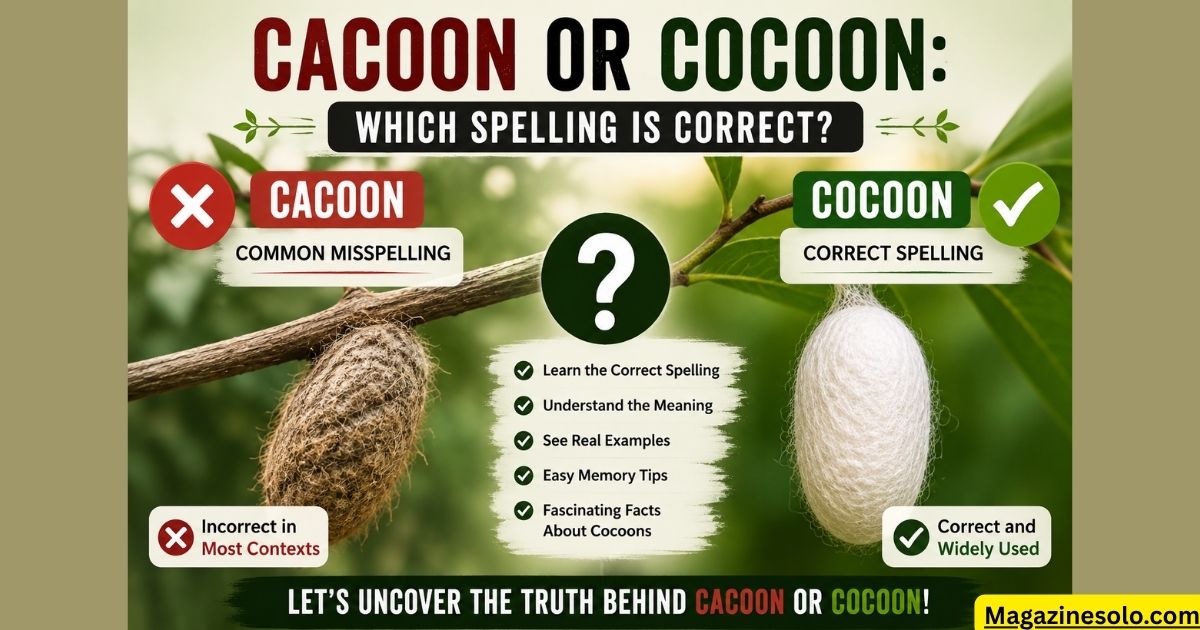
If you’ve ever wondered whether cacoon or cocoon is the correct spelling, you’re not alone. Thousands of people search for this question every month because the two words look almost identical. However, only one is the standard English spelling used to describe the protective covering made by insects like silkworms and moth caterpillars.
The correct spelling is cocoon.
The word cacoon is usually a misspelling of cocoon. Interestingly, “cacoon” has also been used as the name of a rare tropical climbing plant, but this usage is uncommon and unrelated to insects.
Whether you’re writing a school assignment, blog post, email, or simply trying to spell cocoon correctly, this guide explains everything you need to know in simple language.
The Root of Confusion: Why Do People Mix Up Cacoon and Cocoon?
The confusion between cacoon and cocoon is completely understandable, and there are several real reasons it happens so often.
They sound identical.
When you say both words out loud, “kuh-KOON”, there is no difference. Your ears give you zero clues. In a language where spelling doesn’t always follow pronunciation, this creates a perfect storm for errors.
English double-vowel patterns are unpredictable.
Words like balloon, moon, spoon, and raccoon all use double-O, yet they don’t follow one single, predictable rule. This inconsistency causes people to wonder whether “cacoon” might just be an acceptable variant, the way color and colour both exist.
Autocorrect doesn’t always catch it.
Typing quickly on a phone or keyboard, your fingers might press “a” instead of the first “o.” Some autocorrect systems fail to flag cacoon as wrong, which lets the mistake spread silently through social media posts, blog comments, and product listings.
Brand names add to the noise.
At least one furniture brand, Cacoon World, deliberately uses the misspelled version for their hanging chair products. Seeing a misspelling used confidently in a brand name makes it feel legitimate to everyday readers.
So the confusion isn’t a sign of carelessness. It’s a natural result of how English works.
Cocoon: The Correct Spelling and Its Rich Meanings
The word cocoon is the only correct standard English spelling. It appears in every major dictionary, Merriam-Webster, Oxford English Dictionary, Cambridge Dictionary, without exception.
What Does Cocoon Mean?
Cocoon carries both a literal and a figurative meaning, and understanding both helps you use the word with confidence.
Literal meaning (Biology / Entomology): A cocoon is the silky, protective casing that certain insect larvae spin around themselves before entering the pupal stage of metamorphosis. Moths and silkworms are the most well-known cocoon builders. Inside this casing, a remarkable biological transformation takes place, the larva reorganizes itself at a cellular level and eventually emerges as an adult insect.
A few important biological facts:
- Silkworms (Bombyx mori) produce the most economically valuable cocoons, which have been used in silk production for thousands of years.
- A single silkworm cocoon can contain anywhere from 300 to 900 meters of continuous silk thread.
- Cocoons protect developing insects from predators, weather, and parasites during the vulnerable pupal stage.
Figurative meaning (Everyday Language):
In modern speech and writing, “cocoon” has grown far beyond its entomological roots. People use it to describe any safe, enclosed, or comforting space, physical or emotional.
- “After a brutal week at work, she cocooned herself in blankets and watched old films.”
- “Growing up in a small town, he lived in a cocoon of familiar faces and routines.”
- “The startup created a cocoon of innovation, shielding the team from outside distractions.”
Cocoon as a verb:
Yes, you can “cocoon” something. To cocoon means to wrap, enclose, or shield. “She cocooned the fragile package in bubble wrap before shipping it.” This verbal usage has become especially popular in lifestyle and wellness writing.
The Etymology of Cocoon
The word cocoon traces its roots to the French word cocon, which itself comes from the Old French coque (shell or husk) and the Latin coccum (a type of round berry). The imagery is consistent across all these languages, something small, round, and enclosed. The word entered English in the 1600s and has been spelled the same way ever since.
Cacoon: The Misspelling and Its Unexpected Twist
Here is where things get genuinely interesting. Cacoon is almost always a misspelling of cocoon, but not always.
In botanical terminology, cacoon is a real word with a specific meaning. It refers to the large, bean-like seed of the Fevillea cordifolia plant, sometimes called the snuffbox bean or the cacoon vine. This tropical climbing plant is native to Central America, parts of South America, and the Caribbean. Its large, flat, hard seeds, the “cacoons”, have been used in traditional practices:
- Decorative crafts: Local artisans carve and polish cacoon beans into jewelry and ornaments.
- Traditional medicine: In parts of the Caribbean, cacoon seeds have been used in folk remedies, though scientific validation of these uses is limited.
- Cultural significance: The seeds are distinctive enough in shape and size to have earned their own name in regional usage.
Some sources also identify cacoon with the Entada rheedii vine, known as the sea heart or monkey ladder plant, which produces large, sea-drifting seeds.
The key takeaway: If you are writing about insects, metamorphosis, or anything that involves a silky protective casing, use cocoon. If you are a botanist writing specifically about Fevillea cordifolia seeds, then cacoon is the correct term. For everyone else, in every other context, cacoon is simply a misspelling.
Comparison Table: Cocoon vs. Cacoon
| Feature | Cocoon | Cacoon |
| Correct in standard English | ✅ Yes | ❌ No (except botanical use) |
| Appears in major dictionaries | ✅ Yes | ⚠️ Only as botanical term |
| Refers to insect silk casing | ✅ Yes | ❌ No |
| Used figuratively | ✅ Yes (comfort, isolation) | ❌ No |
| Botanical meaning | ❌ No | ✅ Fevillea cordifolia seed |
| Common in everyday writing | ✅ Very common | ⚠️ Rarely, mostly as error |
| Etymology | French cocon, Latin coccum | Botanical/regional Caribbean origin |
Cocoon vs. Chrysalis: Not the Same Thing
A lot of people assume cocoons and chrysalises are the same structure. They are not, and mixing them up is a separate but common error worth clearing up.
- A cocoon is spun by moth larvae and silkworms using silk threads. It is a soft, fibrous covering.
- A chrysalis is the hardened outer shell that forms around a butterfly pupa. It is not spun, it is actually the pupa’s own transformed skin, which hardens into a protective shell.
So: moths make cocoons. Butterflies form chrysalises. They are completely different structures, produced by different insects through different biological processes.
Fascinating Facts About Cocoons in Nature
Understanding what a cocoon actually is makes the spelling easier to remember and the word more meaningful to use.
- Silk production: The global silk industry, worth billions of dollars annually, depends almost entirely on silkworm cocoons. Each cocoon is carefully unraveled to produce continuous silk filament.
- Structural diversity: Not all cocoons look the same. Some are compact and oval, others are loose and papery. The material composition varies by species.
- Duration: Depending on the species and climate, the pupal stage inside a cocoon can last from a few weeks to several months.
- Temperature sensitivity: Many insects time their emergence from cocoons based on temperature cues, which is why spring is associated with caterpillar-to-butterfly transformations.
- Survival engineering: The silk in a cocoon is one of the strongest natural materials by weight, far stronger than steel on a gram-for-gram basis.
The Evolutionary Significance of Cocoons
The cocoon is not just a pretty object in nature, it represents a sophisticated evolutionary solution. The pupal stage, protected by the cocoon, allows insects to undergo complete metamorphosis (holometabolism), a process where the body is essentially rebuilt from the inside. This biological flexibility has made holometabolous insects, moths, butterflies, beetles, bees, flies, among the most diverse and successful groups of animals on Earth.
The cocoon provides:
- Physical protection from predators and environmental stress
- Thermal insulation to regulate the temperature of development
- A sealed environment that reduces infection and moisture loss
In evolutionary terms, the development of the cocoon was a transformative adaptation that opened entirely new ecological possibilities.
Cocoon in Popular Culture, Tech, and Design
The word cocoon has moved well beyond science and into art, psychology, and product design.
In film and literature: The 1985 Ron Howard film Cocoon used the word as a metaphor for rejuvenation and transformation. In psychology, “cocooning” describes the trend of people preferring home-based comfort over social outings, a term that gained renewed attention during and after the pandemic years.
In architecture and design: “Cocoon design” refers to furniture and spaces that wrap the user in a sense of enclosure and safety. Pod chairs, wraparound sofas, and enclosed reading nooks are all described using cocoon-inspired language.
In technology: Cocoon has been used as a brand name and design philosophy in everything from wireless headphones to smart home pods, all drawing on the idea of a protective, enveloping shell.
Tips for Remembering the Correct Spelling
You only need to remember one thing: cocoon starts with CO, not CA.
Here are a few memory tricks that actually work:
- “CO” stands for “COzy”, a cocoon is a cozy, protected space. Both cocoon and cozy start with CO.
- Double-O for double protection, the two O’s in cocoon are like two layers of silk wrapping something safe inside.
- Think of the moon, moon, spoon, cocoon. They all rhyme and they all use double-O.
- Visualize the shape, the letters “oo” in the middle of cocoon look like two round eggs side by side, which visually echoes the oval shape of an actual cocoon.
- Remember it starts the same as “cobra” and “cobra”, no, actually, those start with “co” too. English words about nature and science that start with the “kuh” sound are usually spelled CO-, not CA-.
The Impact of Misspelling: Why Correct Spelling Matters
You might think a one-letter difference between cacoon and cocoon is harmless. In casual texting, it probably is. But in professional and digital contexts, spelling accuracy has real consequences.
In academic writing: A misspelled scientific term in an essay or research paper signals a lack of attention to detail and can undermine your credibility.
In SEO and online content: Search engines are sophisticated enough to connect cacoon and cocoon queries, but content that consistently uses the wrong spelling can appear less authoritative to both algorithms and human readers.
In professional communication: Misspellings in business writing, emails, reports, product descriptions, make a poor impression. Clarity and precision are marks of professionalism.
For language learners: Encountering misspelled words online can lead non-native speakers to internalize incorrect forms, making errors harder to correct later.
The fix is simple. When you mean the silky casing, the protective shelter, the metaphor for transformation, write cocoon.
Case Study: The Silk Industry and Cocoons
The relationship between cocoons and human civilization is ancient and economically significant. China has been producing silk from silkworm cocoons for over 5,000 years. At the peak of the Silk Road trade era, silk was so valuable it was literally used as currency.
Today, the global silk industry processes hundreds of millions of cocoons annually. A single kimono can require the cocoons of up to 3,000 silkworms. Modern silk production is a careful balance of tradition and biotechnology, with researchers studying the proteins in silk to develop everything from biodegradable surgical sutures to bulletproof materials.
The humble cocoon, the same structure that confuses people’s spelling, sits at the center of one of humanity’s oldest and most valuable industries.
The Future of Cocoon-Inspired Technology
Scientists and engineers have long drawn inspiration from the cocoon’s elegant engineering. Current and emerging research includes:
- Biomimetic materials: Researchers are replicating the structure of cocoon silk to develop ultra-strong, lightweight fibers for aerospace and medical applications.
- Drug delivery systems: The silk proteins in cocoons are biocompatible and biodegradable, making them promising candidates for controlled drug-release capsules.
- Protective coatings: Cocoon-inspired layering techniques are being applied in materials science to create impact-resistant surfaces.
- Sustainable textiles: Biotechnology companies are developing lab-grown silk proteins that replicate cocoon silk without requiring silkworm farming.
The cocoon, in short, is not just a word to spell correctly, it is a structure that continues to inspire human innovation.
FAQ’s
Is “cacoon” ever a correct spelling?
Only in a very specific botanical context, cacoon refers to the seed of the Fevillea cordifolia tropical plant. In all other situations, it is a misspelling of cocoon.
How do you spell cocoon correctly every time?
Remember the double-O: C-O-C-O-O-N. Think of words like moon and spoon, they share the same sound and the same double-O pattern.
What is the difference between a cocoon and a chrysalis?
Moths and silkworms spin cocoons from silk. Butterflies form chrysalises, which are hardened shells made from the pupa’s own transformed skin. They are different structures from different insects.
Can cocoon be used as a verb?
Yes. “To cocoon” means to wrap or enclose in protective comfort. Example: She cocooned herself in a warm blanket.
Why do so many people spell it “cacoon”?
The two words are pronounced identically (“kuh-KOON”), and English spelling does not always match pronunciation. Fast typing, autocorrect failures, and the presence of branded products using the misspelling all contribute to the confusion.
What is the plural of cocoon?
The plural is simply cocoons. Example: The silkworms produced dozens of cocoons.
Where does the word cocoon come from?
It comes from the French cocon, derived from the Old French coque (shell) and Latin coccum (a round berry-like shape). It entered English in the 17th century.
Final Word
Language is how we share ideas clearly. When you spell cocoon correctly, you signal to your reader, whether that reader is a teacher, an editor, a search engine, or simply a friend, that you care about precision. It is a small thing that makes a real difference.
Here is the simplest possible summary:
- Cocoon = the correct word. Use it for insect casings, metaphorical protection, and everything else in standard English.
- Cacoon = almost always a misspelling. Only valid in narrow botanical contexts.
- When in doubt, remember: two O’s, like two layers of silk.