Stellar vs Steller: Usage Guidelines and Popular Confusions
Have you ever seen the words stellar and Steller and wondered whether they mean the same thing? They look almost identical, differ by only one letter, and are often confused in writing. However, they are not interchangeable.
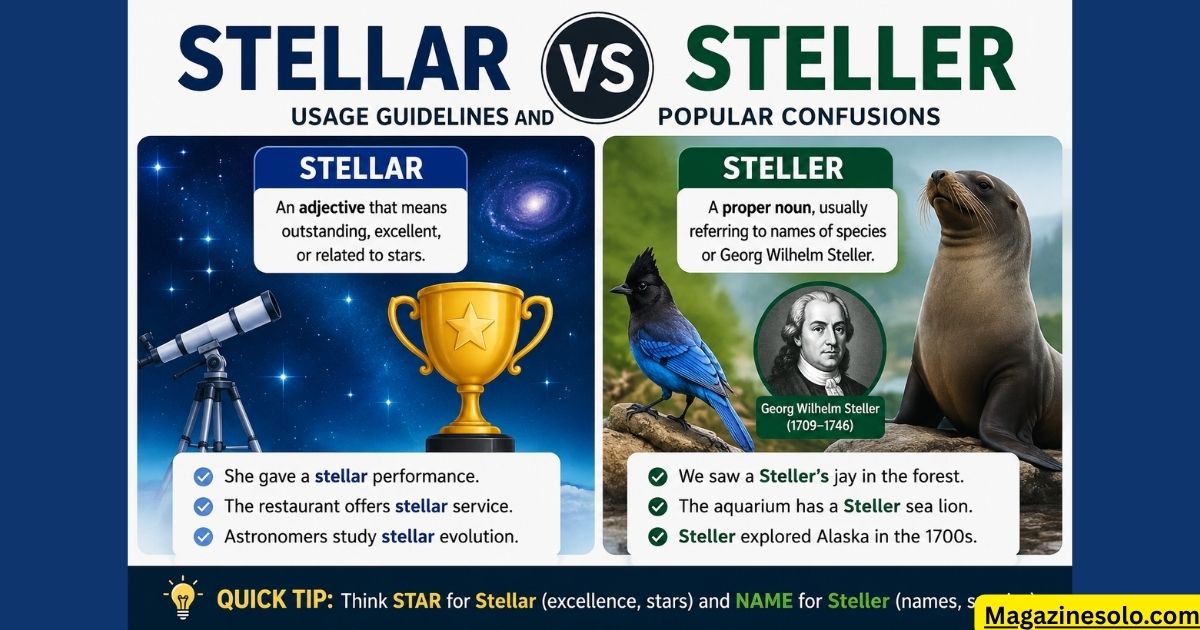
In most situations, stellar is the correct word. It is a common English adjective that describes something outstanding, exceptional, or related to stars. On the other hand, Steller is usually a proper noun found in scientific names, geographic references, and names honoring the German naturalist Georg Wilhelm Steller.
Understanding the difference between these two words will help you write more accurately, avoid spelling mistakes, and improve your English vocabulary.
Whether you’re a student, blogger, writer, or English learner, this guide explains everything in simple language with clear examples.
How To Properly Use The Words In A Sentence
Let’s start with the basics, because once these click, the rest of this guide will feel like common sense.
Stellar comes from the Latin word stella, meaning “star.” It’s used in two main ways:
Literally, to describe anything connected to stars or astronomy (stellar formation, stellar mass, stellar explosion).
Figuratively, to describe something excellent, remarkable, or top-tier (a stellar report card, a stellar customer review, a stellar career).
Because it’s a regular adjective, stellar is never capitalized unless it starts a sentence, and it can be placed directly before almost any noun to boost its meaning.
Steller, by contrast, isn’t a descriptive word you can drop into a sentence to praise something. It’s a proper noun that traces back to Georg Wilhelm Steller, an 18th-century German naturalist who documented several species during an expedition to the North Pacific. His name lives on in scientific and common names like:
Steller’s jay
Steller sea lion
Steller’s sea eagle
Steller’s sea cow (now extinct)
Because Steller is a name, it should always be capitalized, and it should only appear when you’re actually referring to the naturalist or a species named after him. If you’re tempted to use “steller” to mean “great,” stop, that’s the single most common error people make with this word pair.
Quick rule of thumb: If you can replace the word with “excellent” or “amazing” and the sentence still makes sense, you need stellar. If you’re talking about a specific animal or historical figure, you need Steller.
More Examples Of Stellar & Steller Used In Sentences
Seeing the words in context makes the difference stick far better than any rule ever could. Here are some natural, everyday examples of each.
Sentences using “stellar”:
The sales team delivered a stellar quarter, beating every target on the board.
Astronomers are studying stellar evolution to understand how stars age and die.
Her stellar performance in the interview landed her the job on the spot.
The hotel has a stellar reputation for customer service.
His stellar academic record earned him a full scholarship.
Sentences using “Steller”:
Steller’s jay is easy to spot thanks to its bright blue feathers and loud call.
Georg Wilhelm Steller documented the sea cow that would later carry his name.
The Steller sea lion is one of the largest sea lion species in the world.
Researchers are tracking the declining population of Steller’s sea eagle.
The museum’s exhibit honors Steller and his contributions to natural history.
Notice how “stellar” flows naturally into everyday praise, while “Steller” only ever shows up in a specific, name-based context. That pattern holds true across nearly every piece of writing you’ll come across.
Common Mistakes To Avoid
Most stellar vs steller errors fall into a small handful of predictable traps. Here’s what to watch for:
| Mistake | Why It’s Wrong | Correct Version |
| “She gave a steller speech.” | Steller isn’t a descriptive word; it can’t mean “excellent.” | “She gave a stellar speech.” |
| “stellar sea lion” | The animal’s name honors Georg Steller, not the stars. | “Steller sea lion” |
| “steller” left lowercase | Steller is a proper noun and must be capitalized. | “Steller” |
| Using the two words interchangeably | They belong to completely different grammar categories, one is an adjective, one is a name. | Choose based on meaning, not sound |
| Relying on autocorrect | Both spellings are valid English words, so spell-checkers often won’t flag the swap. | Proofread manually |
A few extra tips to keep you on track:
Read the sentence aloud. If it sounds like you’re complimenting something, you almost certainly need stellar.
Check for capitalization. A capital “S” is your visual cue that you’re dealing with a name, not a description.
When in doubt, go with stellar. It’s the far more common word in everyday writing, appearing thousands of times more often than Steller in general English.
Context Matters
The real trick to mastering stellar vs steller isn’t memorizing a rule, it’s paying attention to what your sentence is actually about.
Ask yourself: Am I praising something, or am I naming something?
If you’re writing about performance, quality, achievement, or anything in outer space, you’re in stellar territory. This covers business writing, marketing copy, product reviews, academic papers, and casual conversation.
If you’re writing about wildlife, biology, or 18th-century exploration history, you’re likely in Steller territory. This word shows up almost exclusively in scientific names and historical references tied to the naturalist himself.
This distinction matters more than it might seem, especially in professional or published writing. A single wrong letter can make a strong sentence look careless, and in fields like biology or nature writing, using the wrong word can actually introduce a factual error rather than just a spelling one. A blog post calling an animal a “stellar sea lion” isn’t just a typo, it’s technically naming a different (nonexistent) species.
Search engines and readers alike also pick up on these small inconsistencies. Clean, accurate word choice signals credibility, whether you’re writing a resume, a research paper, or a quick social media caption.
Exceptions To The Rules
English rarely gives us a rule without at least one wrinkle, and stellar vs steller is no different. Here are the situations where things get a little less black-and-white:
Branding and stylized spelling. Some companies or product names intentionally use “Steller” as a stylized variant of “stellar” for branding purposes. In these cases, the spelling is a deliberate creative choice, not a grammar rule, but it only applies to that specific brand name, not to general writing.
Direct quotes from historical texts. If you’re quoting older scientific literature or historical documents that use inconsistent spelling conventions from Steller’s era, you should preserve the original spelling within the quotation marks, even if it looks unusual by modern standards.
Compound species names. Names like “Steller’s eider” or “Steller’s sea eagle” always keep the possessive apostrophe and capital S, even though the species itself has nothing to do with excellence or stars. Don’t be tempted to “correct” these to stellar, that would actually be the mistake.
Regional and academic conventions. Some ornithology and marine biology sources drop the possessive apostrophe (writing “Steller sea lion” instead of “Steller’s sea lion”). Both are widely accepted, so check your field’s style guide if you’re writing for a scientific publication.
Outside of these narrow cases, the rule holds firm: stellar describes, Steller names. Keep that distinction in mind, and you’ll never confuse the two again.
Frequently Asked Questions
Is it “stellar” or “steller”?
It’s almost always stellar when you mean excellent or star-related. “Steller” is only correct as a proper noun referring to the naturalist or species named after him.
What does “stellar” mean?
Stellar means related to stars, or figuratively, outstanding and exceptional in quality.
What does “Steller” mean?
Steller is a surname referring to Georg Wilhelm Steller, also used in species names like Steller’s jay and Steller sea lion.
Is “steller” ever a correct spelling on its own?
No, except as the capitalized proper noun Steller. Lowercase “steller” used to mean “great” is always a spelling mistake.
Why do people confuse stellar and steller so often?
The two words sound almost identical when spoken, and both are technically valid English words, so spell-checkers often miss the error.
Can I use “Steller” to describe a great performance?
No. Steller only functions as a name, never as a descriptive adjective, so it can’t replace “stellar” in that context.
Which word is more common in everyday writing?
Stellar is far more common, appearing constantly in business, marketing, science, and casual writing, while Steller is limited to specific naming contexts.
Final Thoughts
The confusion between steller vs stellar is understandable because the two words look almost identical. However, their meanings are very different.
Use stellar when talking about something exceptional, impressive, or related to stars. Use Steller when referring to the surname Steller or species named after Georg Wilhelm Steller.
A simple way to remember the difference is:
🌟 Stellar shines like a star.
🦅 Steller is a name found in wildlife and history.
By paying attention to context, capitalization, and meaning, you can confidently choose the correct spelling every time. Whether you’re writing a school assignment, blog post, business email, or social media caption, understanding the difference between stellar and Steller will help your writing look more professional and accurate.

Shoaib Ahmad is a language-focused content writer and researcher at magazinesolo.com, where he explains the meaning of words, phrases, and text in a clear and reader-friendly way. His work focuses on simplifying language, uncovering context, and helping readers understand text with confidence and clarity.