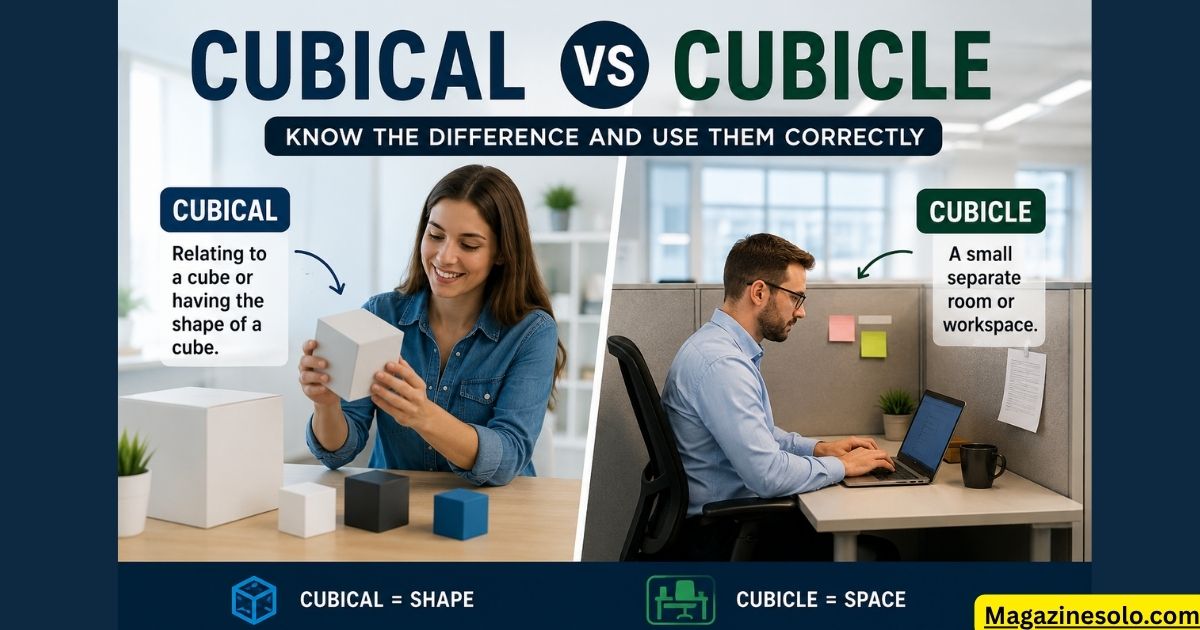
Cubical vs Cubicle: Know the Difference and Use Them Correctly
Have you ever wondered whether cubical and cubicle mean the same thing? These two words look and sound very similar, so it’s easy to mix them up. In fact, many English learners and even native speakers accidentally use one when they actually mean the other.
Although they differ by just one letter, cubical and cubicle have completely different meanings. One describes the shape of an object, while the other refers to a small enclosed workspace or room. Using the wrong word can confuse readers and make your writing seem less professional.
In this guide, you’ll learn the difference between cubical vs cubicle, understand when to use each word, discover common mistakes, and see plenty of easy examples. By the end, you’ll know exactly whether to choose cubical or cubicle in any situation.
Whether you’re a student, office worker, writer, or simply improving your English vocabulary, this article will help you use both words with confidence.
Understanding the Terms: Cubical and Cubicle
At first glance, cubical and cubicle seem like they should mean the same thing. They share the same root word, “cube”, and even sound nearly identical when spoken aloud. That single shared root is exactly why so many people use them interchangeably, even though doing so is incorrect.
Here’s the simplest way to remember the split:
- Cubical is an adjective. It describes a shape.
- Cubicle is a noun. It names a place, specifically, a small enclosed workspace.
Think of it this way: a box can be cubical (cube-shaped), but the little partitioned desk area you sit in at the office is a cubicle. One word describes what something looks like; the other names what something is.
Understanding this one distinction, adjective vs. noun, shape vs. space, solves 90% of the confusion around these words.
Cubical
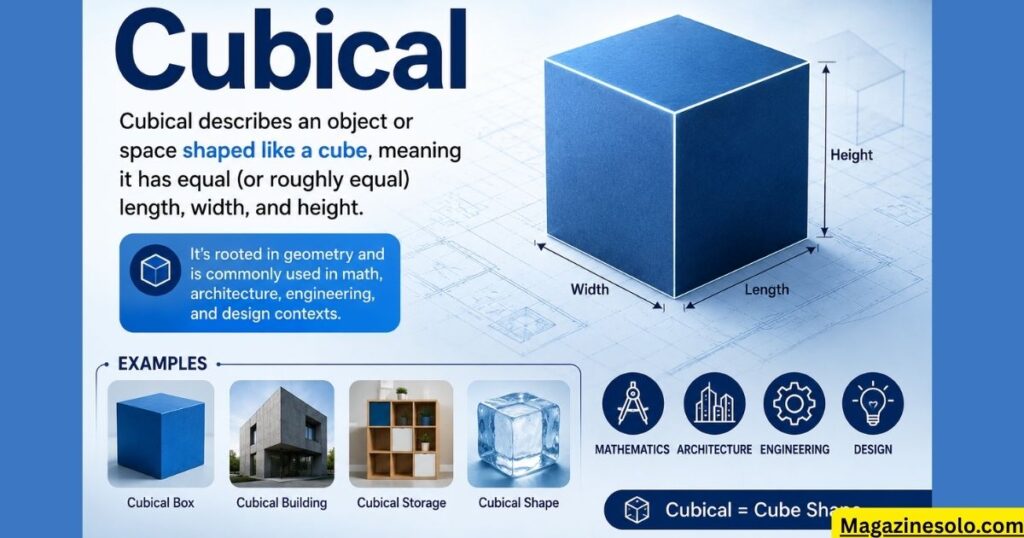
Cubical describes an object or space shaped like a cube, meaning it has equal (or roughly equal) length, width, and height. It’s rooted in geometry and is commonly used in math, architecture, engineering, and design contexts.
Key facts about cubical:
- Part of speech: adjective
- Pronunciation: roughly “KYOO-bih-kul”
- Root: from the Greek kubikos, meaning “cube-shaped”
- Describes: six equal faces, twelve edges, eight vertices, the geometry of a cube
Example sentences:
- The sculpture had a cubical shape, with every side perfectly equal.
- Architects sometimes favor cubical structures for a clean, minimalist look.
- The storage container was cubical, making it easy to stack.
- In geometry class, students calculated the volume of a cubical block.
You’ll notice cubical almost always modifies a noun, a shape, a block, a room, a structure. It never refers to a workstation.
Cubicle
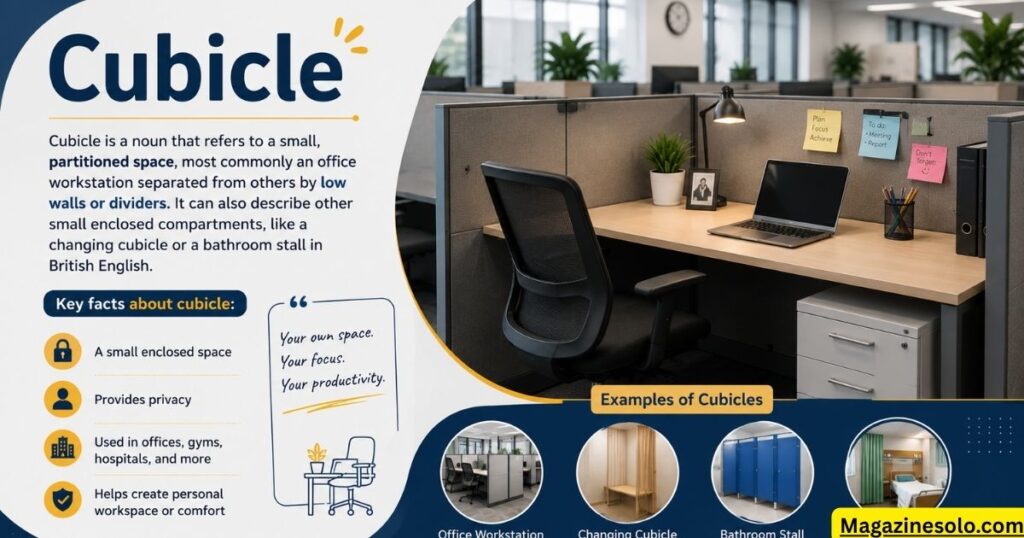
Cubicle is a noun that refers to a small, partitioned space, most commonly an office workstation separated from others by low walls or dividers. It can also describe other small enclosed compartments, like a changing cubicle or a bathroom stall in British English.
Key facts about cubicle:
- Part of speech: noun
- Pronunciation: sounds almost the same as cubical, but functions differently in a sentence
- Root: from the Latin cubiculum, meaning “bedroom” or “sleeping chamber”
- Refers to: a compact, enclosed personal space, not necessarily cube-shaped at all
Interestingly, a cubicle doesn’t have to be cube-shaped. Most office cubicles are rectangular, not perfectly cube-like. The word is about function and privacy, not geometry.
Example sentences:
- She decorated her cubicle with photos and a small desk plant.
- Open-plan offices later gave way to individual cubicles for more privacy.
- He spent his lunch break at his cubicle, catching up on emails.
- The changing area had six small cubicles for customers to try on clothes.
Key Differences Between Cubical and Cubicle
Here’s a side-by-side breakdown to make the distinction crystal clear:
| Feature | Cubical | Cubicle |
| Part of speech | Adjective | Noun |
| Meaning | Cube-shaped; having equal dimensions | A small, enclosed workspace or compartment |
| Used in | Math, geometry, architecture, design | Offices, workplaces, changing rooms, bathrooms |
| Root word | Greek kubikos | Latin cubiculum |
| Example | “The box was cubical in shape.” | “She works in a cubicle.” |
| Describes | Shape or form | Space or function |
| Common context | Academic and technical writing | Everyday and professional writing |
The takeaway is simple: if you’re talking about a shape, reach for cubical. If you’re talking about a place someone works or sits, use cubicle.
Common Misconceptions and Mistakes
Even confident writers slip up with this pair. Here are the most frequent errors and how to fix them.
Mistake 1: “I spent all day in my cubical at work.” This is incorrect. A workspace is never described as cubical, it’s a cubicle. Correct version: “I spent all day in my cubicle at work.”
Mistake 2: Assuming a cubicle must be cube-shaped. Not true. A cubicle is defined by its function (a small, private work area), not its exact geometry. Most are rectangular.
Mistake 3: Relying on autocorrect or spellcheck. Some spellcheck tools default to “cubical” simply because it’s a less common word and gets flagged less often, or because of a nearby typo pattern. Always double-check before hitting send.
Why does this mix-up happen so often?
- The words are near-homophones, they sound almost the same out loud.
- They share the same root (“cube”), which tricks the brain into thinking they’re interchangeable.
- Cubicle is used far more often in daily conversation, so people sometimes reach for the “fancier-sounding” cubical without realizing it’s the wrong word entirely.
Usage in Everyday Life
Knowing the textbook definitions is one thing, knowing where each word actually shows up in real life makes it stick.
Where you’ll see “cubical”:
- Math and geometry lessons (volume of cubical shapes)
- Architecture and interior design discussions
- Product descriptions for cube-shaped furniture, boxes, or storage units
- Engineering and 3D modeling, where cubical templates are common
Where you’ll see “cubicle”:
- Corporate offices and open-plan workspaces
- Call centers and customer service floors
- Libraries and study rooms (individual study cubicles)
- Changing rooms and fitting rooms
- In British English, public restroom stalls
A quick real-world test: if you can replace the word with “workstation” or “booth” and the sentence still makes sense, you need cubicle. If you can replace it with “cube-shaped,” you need cubical.
Language Tips and Memory Aids
Here are a few simple tricks to lock in the correct usage for good:
- Cubical = Cube. Both start the same way and both describe shape.
- Cubicle ends in “-cle,” just like article and particle, all nouns.
- Cubical ends in “-ical,” just like chemical and practical, all adjectives.
- Remember the short phrase: “Cubical shapes, cubicle spaces.”
- Picture a math classroom for cubical, and picture an office desk for cubicle, visual association makes the difference stick faster than memorizing rules.
If you ever hesitate while writing, ask yourself: “Am I describing a shape, or a place someone sits?” The answer tells you exactly which word to use.
Fun Facts and Interesting Insights
- The modern office cubicle traces back to a 1964 design called the “Action Office,” created by designer Robert Propst. It was originally meant to give workers more freedom and privacy, not box them in, a twist most people don’t know today.
- “Cubicle” originally had nothing to do with offices at all. In ancient Rome, a cubiculum referred to a small bedroom or private sleeping chamber, a meaning that slowly evolved over centuries into today’s workplace sense.
- “Cubical,” on the other hand, has stayed remarkably consistent in meaning for centuries, always tied to geometry and cube-like shapes.
- Despite popular culture often poking fun at cubicles as boring “boxes,” many modern offices now design ergonomic, flexible, and even soundproof cubicles to boost focus and comfort.
- Both American and British English follow the exact same distinction between cubical and cubicle, the difference is purely about meaning, not regional spelling.
Frequently Asked Questions
Is “cubical” the same as “cubicle”?
No. Cubical is an adjective meaning cube-shaped, while cubicle is a noun meaning a small, enclosed workspace.
Which word describes an office workspace: cubical or cubicle?
Cubicle is correct for an office workspace. “Cubical” should never be used to describe a desk area.
Does a cubicle have to be shaped like a cube?
No. Most cubicles are rectangular. The word describes function and privacy, not exact geometric shape.
How do you pronounce cubical and cubicle?
Both words sound very similar when spoken, which is exactly why context, not sound, is the safest way to tell them apart.
What’s an easy way to remember the difference?
Use the phrase “cubical shapes, cubicle spaces,” or remember that cubicle ends like article and particle (nouns), while cubical ends like chemical and practical (adjectives).
Is this difference the same in British and American English?
Yes. Both varieties of English use the words the same way; only the frequency of use differs slightly by region.
Can “cubicle” refer to anything besides an office desk?
Yes. It can also describe changing rooms, study booths, and, in British English, bathroom stalls.
Conclusion
Although cubical and cubicle look nearly identical, they serve completely different purposes in English. Cubical is an adjective used to describe something that has the shape of a cube, while cubicle is a noun that refers to a small enclosed workspace, study area, or private compartment.
Understanding this difference can improve your writing, reduce grammar mistakes, and help you communicate more clearly in school, at work, and in everyday conversations. Whenever you’re unsure, remember the simple rule: if you’re describing a shape, use cubical; if you’re talking about a workspace or small room, use cubicle.
With regular practice and the memory tips shared in this guide, choosing between cubical or cubicle will soon become second nature.

Shoaib Ahmad is a language-focused content writer and researcher at magazinesolo.com, where he explains the meaning of words, phrases, and text in a clear and reader-friendly way. His work focuses on simplifying language, uncovering context, and helping readers understand text with confidence and clarity.