The its vs it’s difference is the purest apostrophe trap in English: two forms, one sound, and a rule that runs backwards compared with nouns.
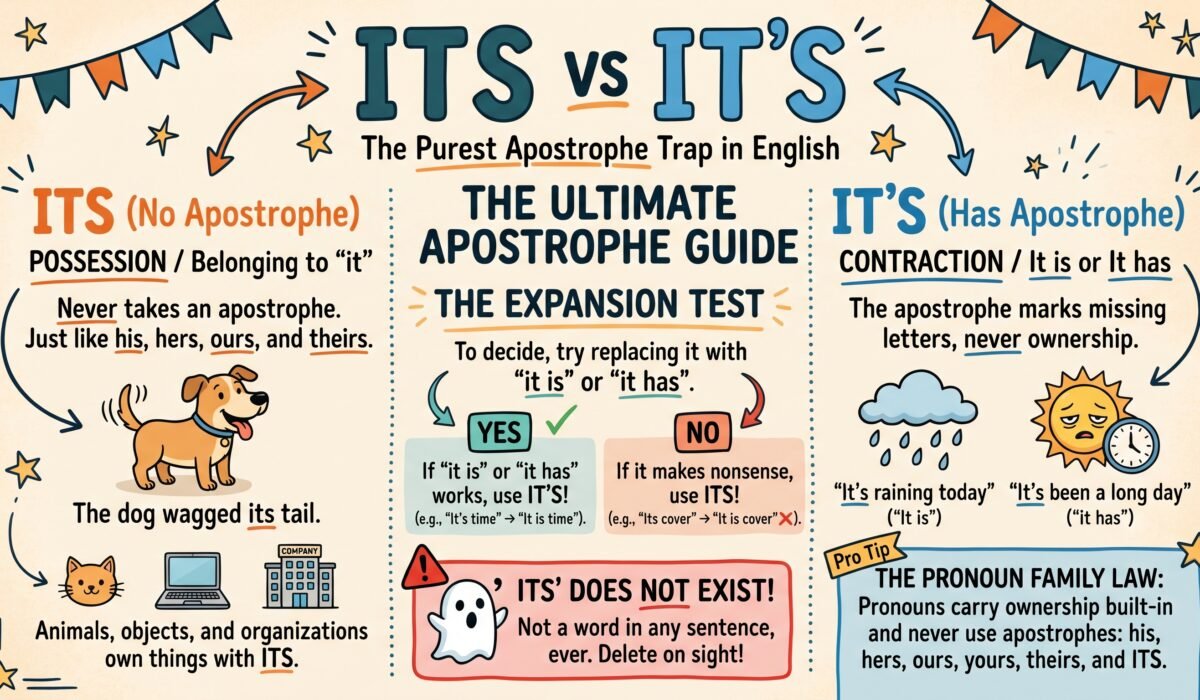
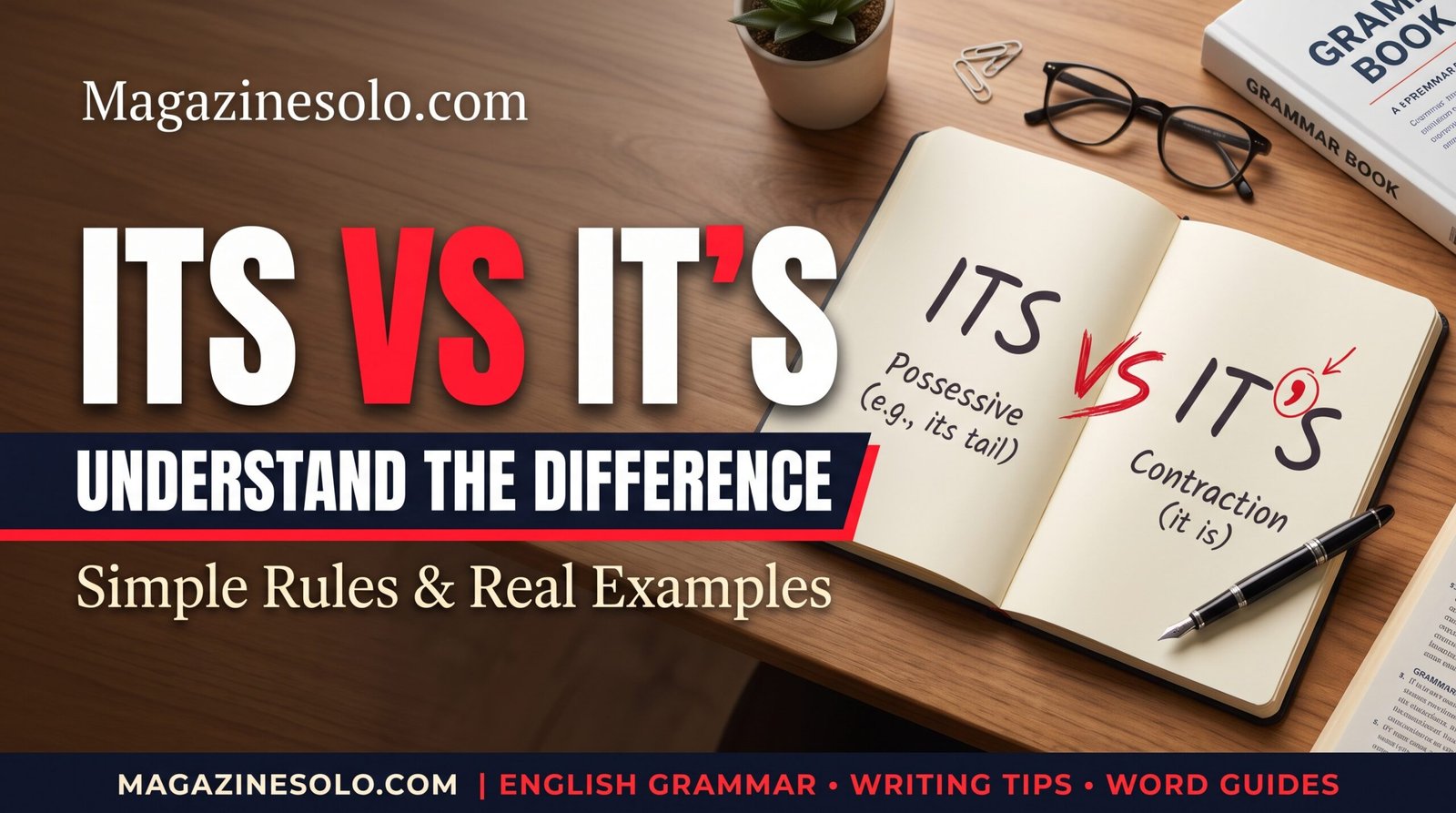
Its means belonging to it and never takes an apostrophe. It’s means it is or it has, and its apostrophe marks missing letters, never ownership.
Writers trip here because the familiar rule points the wrong way. Nouns really do show possession with an apostrophe (the dog’s tail), so the hand reaches for one in its too, and produces the single most common apostrophe error in the language.
This guide settles the pair with one test and one law: the expansion test with both of its halves, and the pronoun family law that explains why the apostrophe behaves backwards here.
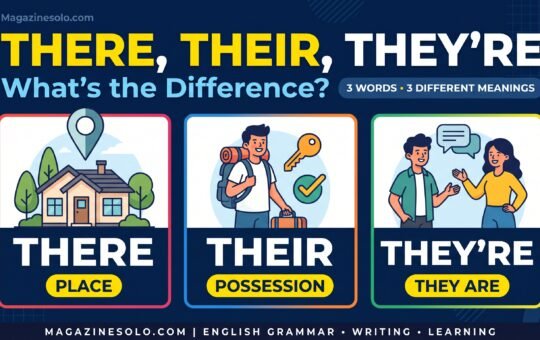
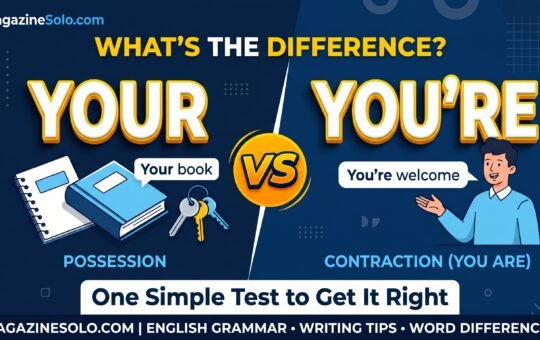
It joins the word confusion guides at MagazineSolo, alongside there their they’re difference and your vs you’re, the cluster siblings that run on the same law.
The Two Jobs Answer
|
Form |
Job |
Apostrophe |
Test |
Signature example |
|---|---|---|---|---|
|
Its |
Belonging to it (possession) |
Never |
Does his fit the same slot? |
The dog wagged its tail |
|
It’s |
It is; it has |
Always, marking missing letters |
Does it is or it has survive? |
It’s raining; it’s been a long day |
|
Its’ |
Nothing. Not a word |
Never correct |
None. Delete on sight |
Always an error |
Merriam-Webster’s entry for its anchors the possessive, Merriam-Webster’s entry for it’s confirms the contraction, and the third row is the ruling most explainers bury: its’ does not exist, in any sentence, in any register, ever.
Read the matrix once and the whole topic is visible: the form without the apostrophe does the owning, the form with it does the expanding.
Everything below is the working out of those two sentences, plus the history that explains why the trap feels so natural.
The Expansion Test
One procedure decides every case, and it has two halves, because it’s hides two different pairs of words.
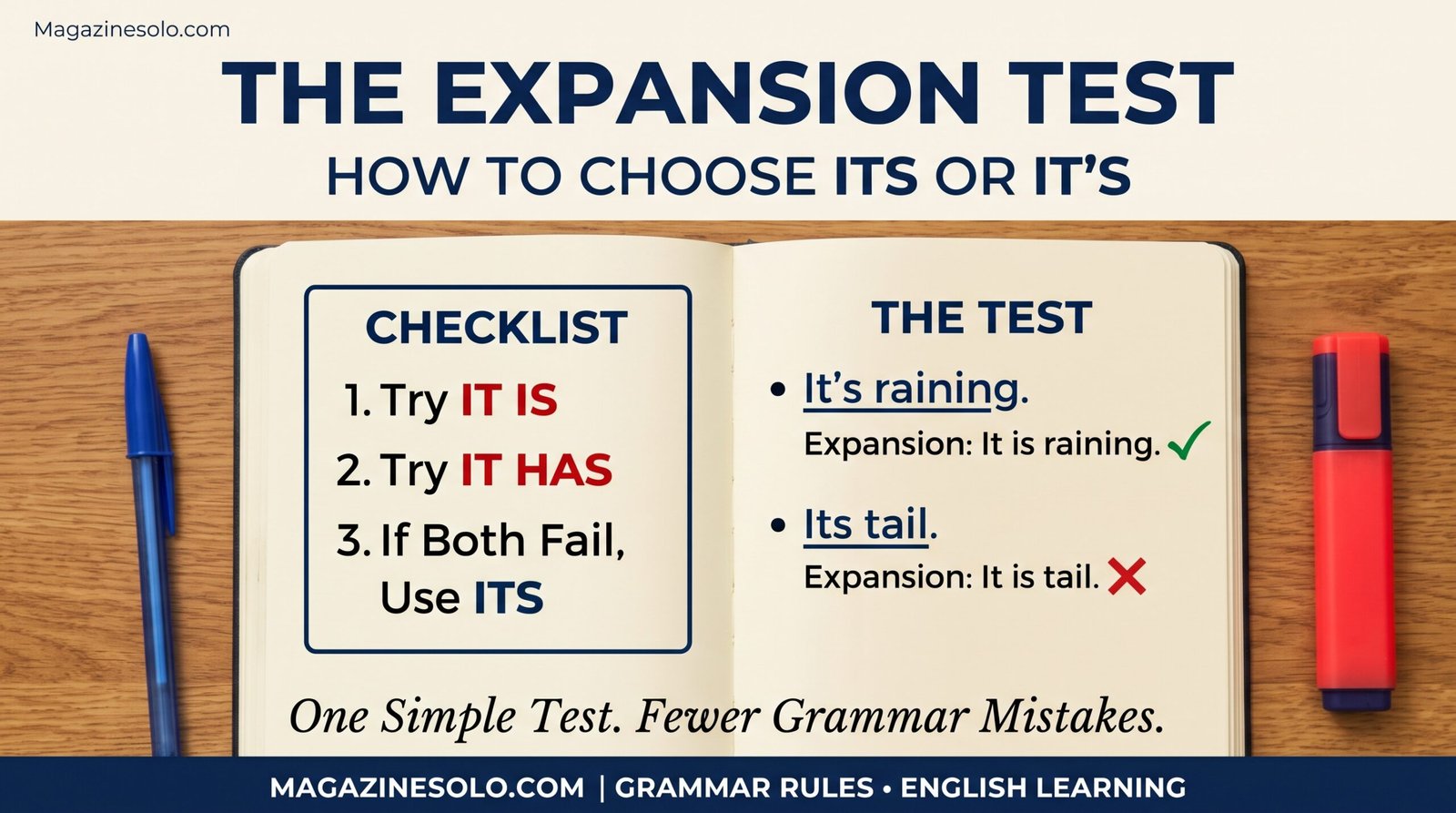
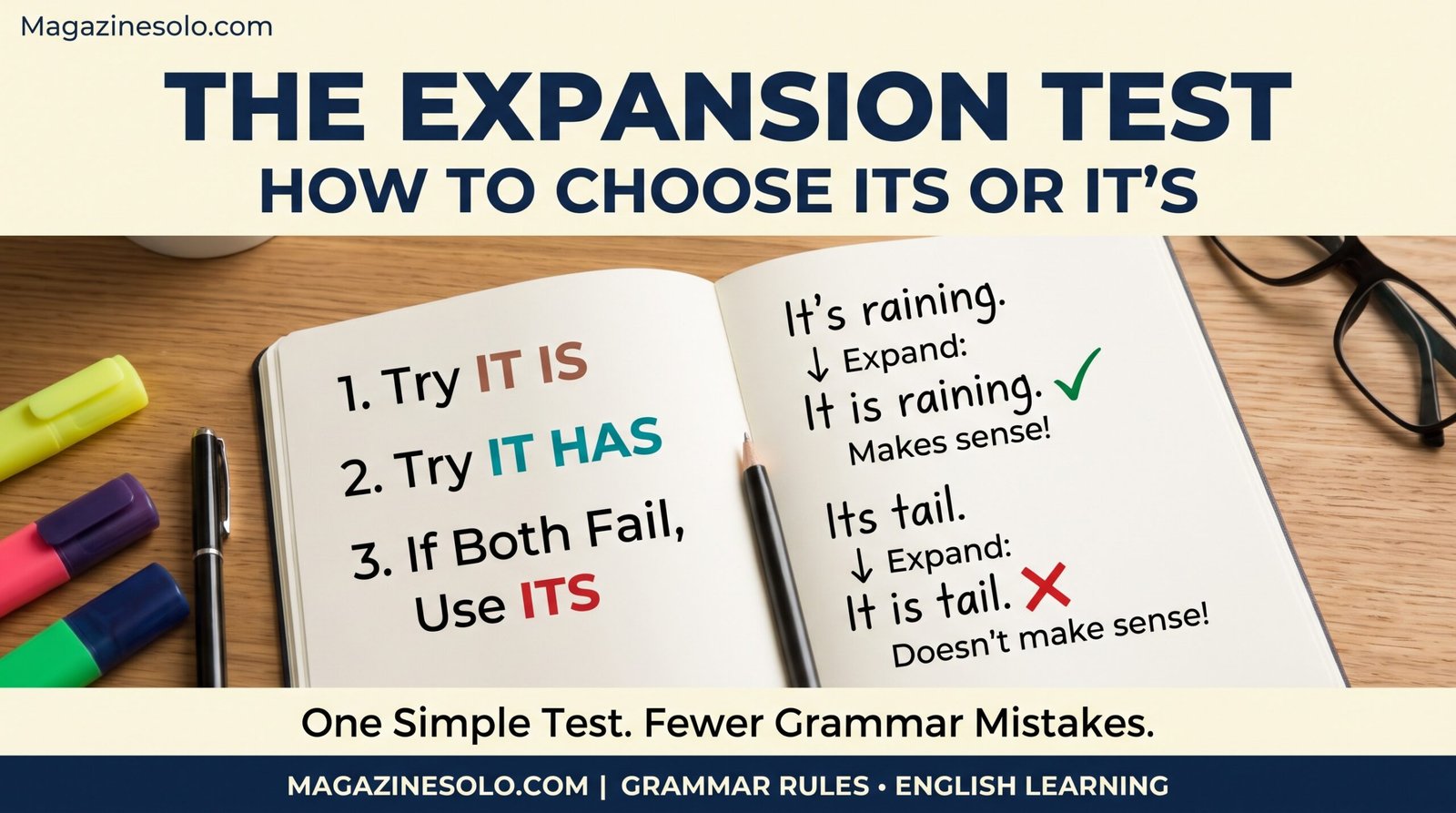
Step 1: Try it is. Read the sentence with it is in place of the doubtful word. It’s raining becomes it is raining, perfect, so the apostrophe form is right. Its tail becomes it is tail, nonsense, so the possessive form is right.
Step 2: Try it has. If it is fails, try it has before concluding.
It’s been a long day fails the first try (it is been) and passes the second (it has been), so it’s is correct. Guides that teach only the first half leave this whole family of sentences unjudged.
Step 3: If both fail, write its. A word that expands to neither it is nor it has is doing possession, and possession in this pair is spelled with no apostrophe.
The test has no exceptions, which is why editors run it instead of trusting their eyes.
A companion check reinforces it: the his swap. His is unmistakably possessive and never takes an apostrophe.
If his fits the slot with the sentence keeping its shape (the cat licked his paw), the word is its. The two tests agree on every sentence ever written.
Its: Belonging to It
Its is the possessive form of the pronoun it: belonging to it.
Like their in the trio, it stands before a noun and answers the question whose: its tail, its cover, its policy, its limits. Grammars call it a possessive determiner (school grammar often says possessive adjective); the behavior matters more than the label.
The owners of its are the neuter world: anything English refers to as it.
Animals (the deer raised its head), objects (the laptop lost its charge), organizations (the company changed its logo), and ideas (every theory has its limits). For learners, the Cambridge Dictionary entry for its works the same ground, with dogs and covers among its model sentences.
Two boundaries define the word. It never refers to a person in modern English (people take his, her, or their), and it never stands alone at the end of a phrase the way theirs can.
Where a sentence wants bare its at the end, English reaches for its own: a charm all its own, a logic of its own. The own construction also adds emphasis anywhere: its own engine, its own rules.
Its for Organizations, Places, and Ideas
Modern prose runs on organizational its: the company and its profits, the university and its policy, the city and its suburbs, the theory and its limits. American English treats these owners as singular its, consistently, across reports and news pages.
Countries sit in the same neutral frame in current style: the country defended its interests. An older personifying tradition sometimes writes her for ships and countries, a style choice rather than a rule, and either way the possessive takes no apostrophe.
Itself completes the form set: the reflexive (the cat cleaned itself) and emphatic (the machine itself decided) form, one word, no apostrophe ever.
It is built the same way as himself and themselves, and it follows the family rule that pronoun forms take no apostrophes.
It’s: It Is and It Has
It’s is a contraction, two words squeezed into one with the apostrophe standing where letters were removed.
It unpacks into exactly two things: it is (it’s raining; it’s important; it’s time) or it has (it’s been years; it’s gone quiet; it’s changed). For learners, the Cambridge Dictionary entry for it’s gives the contraction in its everyday frames.
It never unpacks into anything else. Not it was, not it will, and above all not possession. Which brings up the blind spot that produces a whole error family of its own.
The Has Blind Spot
Has contracts only when it is a helper verb, standing before a past participle: it’s been, it’s gone, it’s changed, it’s got (informal). There, has is an auxiliary, and the apostrophe replaces its missing ha.
When has is the main verb, meaning possesses, it cannot contract at all.
It has a tail can never become it’s a tail, because the sentence is about owning, and ownings in this family never wear apostrophes. Writers who learn “it’s equals it has” without the auxiliary condition produce exactly this error, confidently.
The practical check takes one second: look at the word after has.
A past participle (been, gone, done, changed) means the contraction is legal. A noun (a tail, a cover, three wheels) means it is not, and the sentence wants its or the full it has.
The Backwards Apostrophe
Here is the law that runs the pair, stated the way the LibreTexts chapter on apostrophes frames it in textbook form: apostrophes show possession for nouns, but for pronouns the apostrophe only ever marks missing letters.
Nouns: the dog’s tail, the company’s logo, Sarah’s phone. Possession, apostrophe, correct. Pronouns: his, hers, its, ours, yours, theirs, whose. Possession, no apostrophe, also correct, because pronouns carry their possession built into the word itself and need no punctuation to add it.
The complete possessive pronoun list is short enough to memorize in one reading: my, your, his, her, its, our, their before nouns, and mine, yours, his, hers, ours, theirs standing alone.
Not one of them takes an apostrophe in any variety of English. Its is not the exception to the apostrophe rule; it is a perfectly regular member of its family.
So the mental model flips: in this corner of English, the apostrophe means something is missing, and its absence means something is owned.
Writers who internalize that single inversion stop making the error permanently, because they are no longer fighting the noun rule; they are applying the pronoun one.
The Word That Does Not Exist: Its’
Every pair in this cluster has a ghost form, and this pair’s ghost is its’: apostrophe after the s. It is not a word, has never been a word, and no context rescues it.
Its cause is traceable: writers know the plural possessive pattern (the dogs’ toys, the students’ essays), where the apostrophe follows the s, and they pour the pronoun into the same mold.
But its is not a plural and not a noun. It belongs to the pronoun family, where apostrophes do not mark possession at all.
The repair is absolute: wherever its’ appears, the sentence wants its (possession) or it’s (expansion), and the expansion test says which. Editors delete the form on sight, without a meeting.
A Young Word: The History of Its
Most writers assume its is ancient and their confusion is a personal failure. The history says the opposite: its is one of the youngest possessives in English, and the language itself spent centuries unsure what to write.
For most of English history, the possessive of it did not exist as its own word.
The neuter pronoun borrowed his, the same form used for men, so older texts say things modern readers misread: the King James Bible’s salt loses his savour, meaning its flavor. Nobody was confused at the time; his simply did both jobs.
Its was formed around the turn of the 1600s, as writers felt the need for a dedicated neuter possessive, and it spread through the 1600s and 1700s.
During the transition, printers frequently wrote the possessive as it’s, with the apostrophe, by analogy with nouns. The modern split, apostrophe for the contraction only, settled during the 1800s as grammars standardized.
So the error has a pedigree: the form it’s tail was once ordinary printing.
Modern English has since made its choice, and the choice is absolute, but a writer who knows the history stops feeling stupid about the slip and starts simply applying the test.
Dummy It: Weather, Time, Distance
One corner of English uses it with no owner and no thing behind it at all. In weather, time, and distance sentences, it is a dummy subject: it’s raining, it’s five o’clock, it’s two miles to town, it’s getting late.
These sentences matter for this pair because they have no possessive twin.
Nothing is being owned; there is no its version of a weather sentence waiting to trap anyone. The it’s in them always expands to it is (never it has), and the construction is the safest practice ground in the topic.
If a learner can expand ten weather sentences, the test is installed.
The same dummy it opens formal statements: it’s important to note, it’s clear that, it’s worth remembering. All expand to it is, all take the apostrophe, and none of them owns anything.
Both in One Sentence
Sentences holding both forms side by side teach the pair faster than any chart, because the two jobs appear in a single breath and the tests can be run in public.
- The cat licked its paw because it’s trying to clean itself. Its paw (the paw belongs to the cat); it’s trying (it is trying); itself for the reflexive flourish.
- The company updated its website, and now it’s faster and easier to navigate. Its website (the site belongs to the company); it’s faster (it is faster).
- It’s its own worst enemy. It is, plus belonging to it: the phrase means a thing harms itself more than anything else harms it, and it is grammatically perfect.
- The tree shed its leaves early this year because it’s been unusually cold. Its leaves; it’s been (it has been), the two halves of the test in one sentence.
- Although the robot lost its balance, it’s still functioning properly. Ownership, then expansion, in a single machine sentence.
Write five of your own on this pattern and the pair installs itself: production fixes what reading only describes.
The Quick Decision Card
For the wall, the notebook, or the top of a worksheet, the whole pair compresses into three lines and a warning.
|
You mean |
Write |
Because |
|---|---|---|
|
Belonging to it |
Its |
Pronouns own without apostrophes |
|
It is |
It’s |
The apostrophe marks the missing i |
|
It has (been, gone, done) |
It’s |
The apostrophe marks the missing ha |
|
It has (a tail, a cover) |
It has, in full |
Main verb has never contracts |
|
Its’ |
Nothing |
The form does not exist |
The card’s last two rows are where this pair’s surviving errors live: main verb has, and the ghost form.
Sentence Surgery
The gallery: real errors from the documents where this pair carries a price, corrected, with the test that catches each one.
|
As written |
Corrected |
The test that catches it |
|---|---|---|
|
The dog wagged it’s tail |
The dog wagged its tail |
Expansion: it is tail is nonsense; possession |
|
Don’t judge a book by it’s cover |
Don’t judge a book by its cover |
The cover belongs to the book |
|
Its raining again today |
It’s raining again today |
Dummy it expands to it is |
|
Its time to update the policy |
It’s time to update the policy |
It is time; nothing owns the time |
|
The report lost its’ way in revisions |
The report lost its way in revisions |
Its’ is not a word; delete on sight |
|
The company increased it’s profits |
The company increased its profits |
Profits belong to the company |
|
It’s been designed with it’s users in mind |
It’s been designed with its users in mind |
First expands (it has been); second owns |
|
Its a given that errors happen |
It’s a given that errors happen |
It is a given; the fixed phrase fools writers |
One modern caution belongs here as well: autocorrect manufactures this error after correct typing, swapping in the more frequent it’s, and spellcheck cannot catch either direction because both forms are real words.
The proofreading pass below exists precisely because the tools cannot be trusted with this pair.
Formal Writing: The Expansion Escape
Formal and academic writing offers a legitimate shortcut: expand every contraction. Essays and reports that write it is and it has in full remove it’s from the page entirely, leaving only its to choose, and its before a noun is rarely in doubt.
The escape has one limit: it cannot rescue the possessive direction. A formal writer still must not write it’s profits, and the expansion habit actually trains the eye, because every expanded it is rehearses the test the informal writer runs mentally.
Near Misses: One Law, Four Pairs
The pronoun apostrophe law that runs this pair runs three more famous pairs, and they retire together once the law is learned.
- Your vs you’re: your owns (your car), you’re expands to you are. The flagship printed error of that pair is your welcome; the expansion test repairs it.
- There, their, they’re: their owns (their coats), they’re expands to they are, and there covers place and existence. The trio is this pair with an extra member.
- Who’s vs whose: who’s expands to who is or who has, whose owns (whose shoes are these?). Identical machine, question words.
In every pair, the apostrophe form expands and the plain form owns. A learner who truly owns that sentence owns four topics at once, which is why the cluster teaches the pairs together rather than as isolated accidents.
The Find and Expand Proofreading Pass
For documents where this pair carries a price (applications, reports, product pages), a two minute pass removes the risk.
1. Search for all three forms. Find it’s, its, and its’, and list every hit. The family is small enough to audit completely in most documents.
2. Delete every its’ on sight. It is never correct; replace it by running the expansion test on the sentence.
3. Expand every it’s. Read it is, then it has, in place of each one. Any it’s that survives neither expansion is a possessive wearing the wrong costume; change it to its.
4. Check every its for its noun. Its must stand before a noun it owns. An its with no noun after it signals a broken sentence; add own or rewrite.
5. Re scan after autocorrect has finished. Run the pass on the final version, not the draft, because the tools make their swaps last.
The Word Confusion Cluster
This pair belongs to a family of sound alike traps, each settled by its own test. Its nearest relatives run on the same apostrophe law, and the rest of the cluster makes good next reads.
- there their they’re difference: the three jobs machine, expand, place or existence, ownership
- your vs you’re: the sibling pair where your welcome is the flagship error
- than vs then difference: compared to what, or when: the two questions procedure
- affect vs effect: the verb and noun pair settled by RAVEN, with its honest exceptions
- ally vs allie: the friend and partner against the girl’s name, one sound apart
- atleast or at least: two words or one, decided by what the sentence is measuring
- per say or per se: the Latin phrase hiding inside an English sound alike
- grately vs greatly: the grateful word against the grating sound alike
- half day or half-day: the hyphen question that changes what a day off means
The method transfers intact: name the job each form does, attach a test to each job, and let the sentence grade itself.
Frequently Asked Questions
What is the difference between its and it’s?
Its owns: the possessive form of it, belonging to it, with no apostrophe ever (the dog wagged its tail).
It’s states: a contraction of it is or it has (it’s raining; it’s been a long day). Test by expanding; if it is or it has survives, write it’s, otherwise its.
How can I remember its vs it’s?
Think of the family: his, hers, its, ours, yours, theirs are all possessive, and none takes an apostrophe. The apostrophe in it’s marks missing letters, not ownership.
If you would never write hi’s for possession, never write it’s for possession either. Ownership has no apostrophe; contraction always does.
What does its mean?
Belonging to it: the possessive form of the pronoun it, used for animals, objects, organizations, and ideas whose gender is not specified.
Its paw, its cover, its policy, its limits. Grammars call it a possessive determiner (or possessive adjective) because it stands before a noun.
What does it’s mean?
It’s is a contraction, a shortened form of it is (it’s raining; it’s important) or of it has (it’s been years; it’s gone quiet). The apostrophe stands where letters were removed. It’s never means it was, and it is never a possessive.
Is its’ a word?
No. Its’ is not a word in standard English, in any context.
The possessive is its with no apostrophe anywhere, and the contraction is it’s with the apostrophe between t and s. Its’ appears only as a misspelling, usually when a writer mixes the plural possessive pattern (dogs’) into a pronoun.
Why does its not have an apostrophe if it is possessive?
Because the apostrophe possessive rule belongs to nouns (the dog’s tail), while pronouns carry their own built in possessive forms that never take apostrophes: his, hers, its, ours, yours, theirs.
Adding an apostrophe to its would make it identical to the contraction it’s, and English spelling keeps the two jobs visibly separate.
What is the fastest test for its vs it’s?
The expansion test: read the sentence with it is in place of the word. It’s raining becomes it is raining, correct.
Its tail becomes it is tail, nonsense, so its is right. If it is fails, try it has (it’s been, it’s gone). If both fail, the word is its, and the case is closed.
Is it ‘the dog wagged its tail’ or ‘it’s tail’?
Its tail. The tail belongs to the dog, so the possessive form is required, and possessive pronouns take no apostrophe.
The dog wagged it is tail is the nonsense the expansion test exposes. The dog’s tail with an apostrophe is also correct, because dog is a noun; the pronoun version is its.
Can it’s show possession?
No, never in standard modern English. It’s always expands to it is or it has.
Possession is always its. Historical note: printers in earlier centuries sometimes used it’s for the possessive before the modern convention settled, which is part of why the confusion feels natural, but today the rule is absolute.
When does it’s mean it has?
When has works as an auxiliary verb before a past participle: it’s been a long day (it has been), it’s gone (it has gone), it’s changed (it has changed).
It cannot contract the possessive has: it has a tail cannot become it’s a tail, because there has is the main verb, not a helper.
What does ‘it’s been’ mean?
It has been.
Been is the past participle of be, so has is the auxiliary, and the contraction is legal: it’s been raining means it has been raining. Writers who expand every it’s to it is only will misread this case; the test is it is OR it has.
Is it ‘its a beautiful day’ or ‘it’s a beautiful day’?
It’s a beautiful day. The sentence means it is a beautiful day, a statement about the day, not something belonging to anything. Its a beautiful day is one of the most common written errors in English; the expansion test catches it instantly.
Is it ‘it’s time’ or ‘its time’?
It’s time: it is time. Time here is not owned by anything; the sentence announces the moment. Its time would mean the time belonging to it, which works only in sentences like the idea had its time (its moment, which has passed).
Why do people write it’s for its so often?
Because nouns form possessives with apostrophe s (the company’s logo), and its is the one possessive that breaks the visible pattern. Frequency does the rest: it’s is extremely common, autocorrect prefers it, and the ear cannot help because the two words are perfect homophones.
Does a company take its or it’s?
Its for possession: the company changed its logo; the organization updated its policy. A company is an it in American English, singular, so its is its possessive. It’s appears only where it is or it has fits: it’s hiring (it is hiring).
Can its be used for a person?
Almost never in modern English. Its belongs to the neuter pronoun it, used for animals, things, organizations, and ideas.
For people, English uses his, her, or their. Older usage occasionally applied it to babies, which now reads as dated or cold; modern style avoids it.
What is the his swap test for its?
Replace the doubtful word with his. His is unmistakably possessive and takes no apostrophe.
The cat licked his paw keeps the sentence shape, so its paw is right. If the his swap produces nonsense and it is produces sense, the word is it’s. It is the same slot test used for their in the trio.
Is ‘don’t judge a book by its cover’ spelled with its or it’s?
Its. The cover belongs to the book, so the possessive form is required: do not judge a book by its cover. The it’s version is such a widespread error that the idiom itself has become a teaching example. Belonging means no apostrophe.
What does ‘it’s its own worst enemy’ mean, and is it correct?
It is correct, and it is the pair in one sentence: it’s (it is) plus its own (belonging to it).
The phrase means something harms itself more than anything else harms it. Sentences holding both forms side by side are the best proof that the two words do different jobs.
Is itself spelled with an apostrophe?
No. Itself, the reflexive and emphatic form of it, is one word with no apostrophe ever: the cat cleaned itself; the machine turns itself off. It follows the family rule: pronoun forms built on possessives take no apostrophes, exactly like himself and themselves.
Can its start a sentence?
Yes: Its color faded years ago. Its is a determiner and can open a sentence before its noun. It’s can also open one (It’s raining). Capitalization does not change the rule; run the expansion test on the opening word exactly as anywhere else.
Can its end a sentence?
Only with its noun attached: a sentence may end on the noun (by its cover), never on bare its. When a sentence seems to want bare its at the end, writers use its own (a charm all its own) or rewrite.
What is a dummy it in sentences like ‘it’s raining’?
In weather, time, and distance sentences, it is a dummy subject with no real referent: it’s raining, it’s five o’clock, it’s two miles to town.
The it’s in these sentences always expands to it is, never to it has, and the construction has no possessive version at all, which makes weather sentences the safest place to practice.
Why does spellcheck miss its vs it’s errors?
Both spellings are real words, so a spellchecker sees nothing wrong; it validates letters, not jobs.
Grammar checkers catch many cases by parsing the sentence, and autocorrect actively causes others by swapping in the more frequent it’s after correct typing. The expansion test remains the reliable check.
Is there a British vs American difference for its and it’s?
No. The rule is identical in British and American English: its possessive without an apostrophe, it’s for it is or it has, and its’ never. Style guides on both sides agree completely, which is rare enough to be worth saying.
Do formal essays allow it’s?
Most academic style discourages all contractions in formal essays, so the practical advice is to write it is and it has in full.
That removes it’s from the page and leaves only its to choose, which formal writers often find simpler. The possessive its is fully formal and appears constantly in academic prose.
Where did its come from historically?
Its is a surprisingly young word: the possessive of it was formed in early modern English, around the turn of the 1600s.
Before it existed, English used his for neuter things as well (the King James Bible has the salt losing his savour). The apostrophe version it’s was also used for possession in early printing before the modern split settled in the 1800s.
What are the most common its vs it’s mistakes?
The gallery: it’s tail and it’s cover (possessive with apostrophe), its raining and its time (contraction without), its’ anywhere, it’s used for it was, and it’s a tail written for it has a tail.
Every one is caught by expanding to it is or it has and asking whether the sentence survives.
Is it’s ever short for it was?
No. It’s contracts only it is and it has.
It was has no standard contraction. Sentences like it’s been years since it happened keep both apart: it’s is it has, and the past event itself takes the full it was or a past tense verb.
Can I write ‘it’s got’ and what does it mean?
Yes, in informal English: it’s got means it has got (it’s got its own engine).
Note the sentence holds both forms: it’s (it has) and its (belonging). In formal American writing, it has is preferred, and in formal British writing it’s got is common but still informal.
What’s the difference between its and itself and it’s?
Three forms, three jobs: its owns (its paw), it’s states or has (it’s here; it’s gone), itself reflects or emphasizes (the cat itself opened it; it hurt itself). None of the possessive or reflexive forms takes an apostrophe; only the contraction does.
Does its need a noun after it?
Yes, in its standard use as a possessive determiner: its plus a noun (its color, its people, its own rules).
The determiner cannot stand alone the way mine or theirs can. Where a noun is missing, writers add own (its own) or rewrite the sentence.
Is ‘its own’ correct, and what does it add?
Fully correct and very common: its own house, a mind of its own.
Own adds emphasis of separate possession, that the thing belongs to it alone. The construction is also a useful repair when a sentence wants its to stand at the end: the house is its own is not idiomatic, but it has its own house is perfect.
How do teachers test its vs it’s?
With gap fills in the signature contexts (tails, covers, weather, time), correction hunts in short paragraphs, and same sentence items (the cat licked its paw because it’s dirty).
The expansion test answers every item, which is why worksheets teach the test rather than the definitions alone.
Is ‘its a given’ correct?
No: it’s a given (it is a given, a fixed expression meaning an accepted certainty).
The its a given error is common in business writing precisely because a given feels like a possession. Expand it: it is a given makes sense; belonging to it a given does not.
What about ships and countries: its or her?
Tradition sometimes personifies ships and countries as her (the ship and her crew), especially in British and nautical writing.
Modern neutral style, and most American style guides, prefer its: the ship changed its course. Either way, the possessive takes no apostrophe; the choice is personification, not punctuation.
Can animals take its, or should it be his or her?
Both are correct depending on knowledge and tone: a pet whose sex is known often takes his or her (the dog wagged her tail), while animals in general, wildlife writing, and unknown cases take its (the deer raised its head).
Grammar allows both; consistency within a text is what editors check.
Is the apostrophe in it’s replacing one letter or two?
Both cases exist: in it is, the apostrophe replaces one letter (the i of is).
In it has, it replaces two (the h and a of has). The rule is that the apostrophe marks missing letters, however many; it never marks possession in this word.
How do I proofread for its vs it’s?
Run a find pass for it’s, its, and its’ in the document. Expand every it’s to it is or it has and confirm the sentence survives.
Check every its stands before a noun it owns. Delete every its’ on sight. The pass takes a minute and retires the whole error family.
What are the other pairs this rule fixes?
Your and you’re, their and they’re, and who’s and whose run on the identical machine: the apostrophe form expands (you are, they are, who is), and the plain form owns (your, their, whose).
Learn the pronoun apostrophe rule once and four famous confusions retire together.
Is its a pronoun or an adjective?
Both labels circulate: school grammar often calls its a possessive adjective, modern grammar a possessive determiner. It belongs to the pronoun it family either way, and its behavior is fixed: possessive, before a noun, never with an apostrophe.
Why is its vs it’s called the most common grammar mistake?
Because the ingredients are maximally unfair: identical sound, opposite punctuation logic to nouns, extreme frequency of both forms, and tools that cannot reliably catch it.
Usage writers routinely name it among the very top written errors in English, and it appears in professionally edited text often enough to embarrass everyone equally.
Conclusion
The its vs it’s difference is one law wearing two forms: its owns, with no apostrophe, the way his and hers and theirs own; it’s expands, to it is or it has, with the apostrophe standing where letters went missing.
Its’ does not exist, and a pair whose history includes the Bible writing his for its can forgive any writer one slip.
Run the expansion test with both halves, keep the pronoun family in view, and the pair stops being a coin flip. It becomes a habit that checks itself every time the two forms appear.
Work through the sibling pairs next: the same law that settles its and it’s retires your and you’re, their and they’re, and who’s and whose in a single sitting.

Dilawar Mughal is an SEO expert with 8 years of hands-on experience helping websites grow their organic traffic, rankings, and revenue. He specializes in content-driven SEO, local SEO, and Pinterest SEO, and builds practical, results-focused strategies for businesses and publishers.