Lay vs Lie: The Object Test and the Three Verb Table

The lay vs lie problem looks like a vocabulary problem and is actually a plumbing problem. One of these verbs carries an object, and the other refuses one, forever.
Lay is the carrying verb. To lay is to put or place something down: you lay the book, the blanket, the baby, your head on the pillow.
Lie is the self contained verb. To lie is to recline or be positioned, with nothing receiving the action: you lie down, the dog lies in the sun.
Ask one question and the pair separates: lay what? If the sentence answers with a thing, the verb is lay. If nothing answers, the verb is lie.
Underneath sit three verbs, not two, and one famous collision. This page tables all three, teaches the collision, and rules the songs everyone quotes.
The Three Verb Table
|
Verb |
Meaning |
Present |
Past |
Past participle |
Ing form |
|---|---|---|---|---|---|
|
Lie |
Recline, be situated |
lie |
lay |
lain |
lying |
|
Lay |
Put or place something |
lay |
laid |
laid |
laying |
|
Lie |
Tell an untruth |
lie |
lied |
lied |
lying |
Read the collision cell first. The past tense of lie, to recline, is lay, spelled exactly like the present tense of lay, to place.
That single overlap causes more errors than the rule itself. Yesterday he lay down is reclining in the past, while today I lay the book down is placing in the present.
The third row explains the hesitation around the word lie itself. The untruth verb is regular and separate, and it never borrows a form from either neighbor.
The Clarifyra lies or lays guide prints this same three verb table with Cambridge confirmation. It adds that the past of lay is laid, never layed, and that lain is rare in speech.
Keep the whole table in view. Every hard case on this page is one of its nine content cells wearing a sentence as a disguise.
Lay in Depth: The Verb That Carries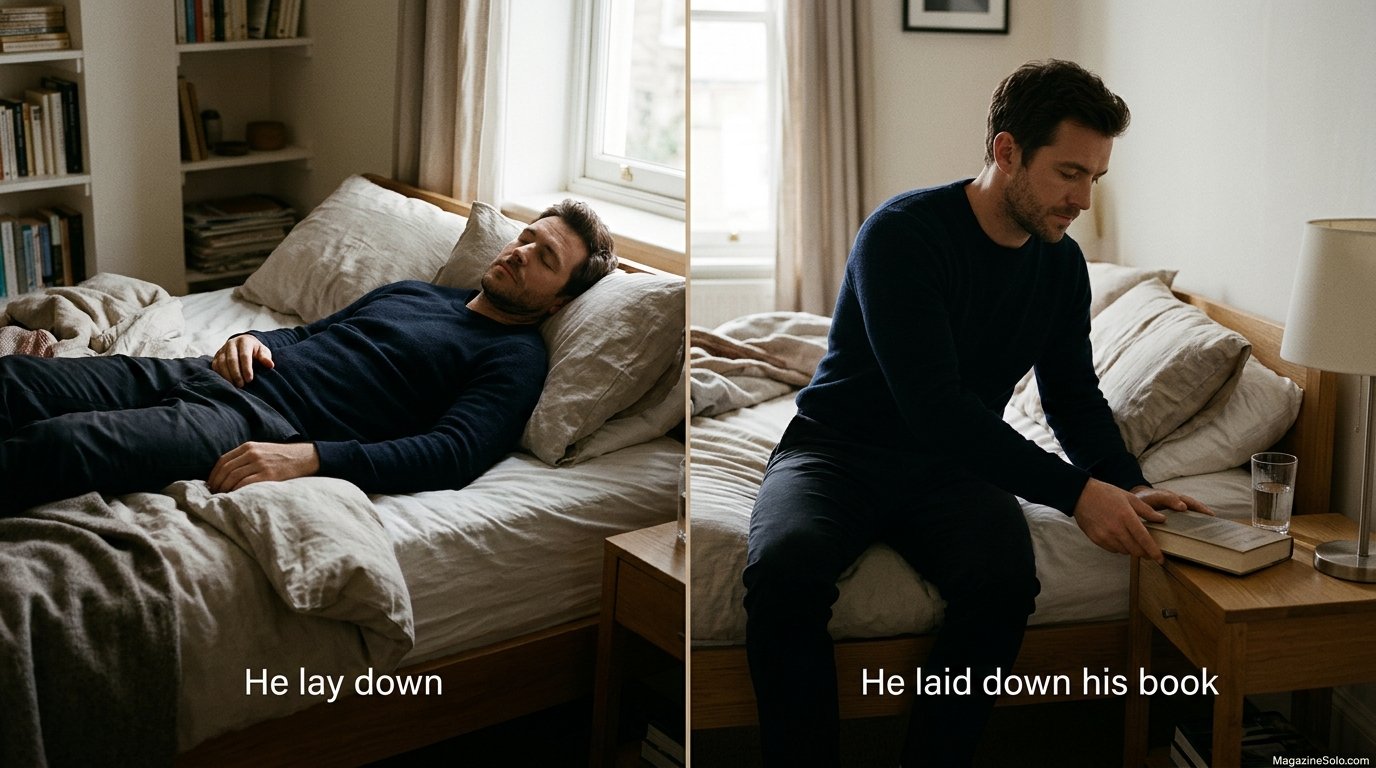
Lay always delivers its action to something. Grammarians call it transitive, which means the sentence is unfinished until an object receives the placing.
Name the objects in real sentences and the verb feels obvious. She lays the towels on the bed, he laid the foundation, the hen lays an egg daily.
Lay is regular in behavior. Its forms run lay, laid, laid, laying, with no surprises in any cell, which makes it the stable half of the system.
Its stability is part of the trap. Because lay looks so dependable, writers reach for its past, laid, to do every past job, including reclining, where it cannot serve.
Lay also hides inside set phrases with their objects attached. Lay the table, lay down arms, lay the groundwork: in each, something named is being placed.
Historically, lay is the causative partner of lie. Old English formed it from the same root to mean cause to lie, the way set means cause to sit.
That history is why the object test works. A verb built to place something onto a surface still demands the something, a thousand years later.
Lie in Depth: The Verb That Stands Alone
Lie asks for nothing after it. It is intransitive: the subject reclines, rests, or sits situated, and the sentence completes itself.
Its subjects range wider than sleepy people. The village lies in a valley, the book lies on the table, and the answer lies in the data.
That figurative reach is where third person errors breed. Writers who would never lay a person down write that the answer lays in the data, and the object test catches it.
The Mental Floss explainer teaches the contrast with one family story. You lie on your bed, you lay your baby in the crib, and the same household carries both verbs correctly.
Lie is the irregular half. Its forms run lie, lay, lain, lying, a paradigm that borrows its past from its rival and ends in a participle many speakers avoid.
Lain deserves its own sentence. Cambridge notes it is very formal and rarely used, so speakers rephrase around it, and the avoidance loosens the whole system further.
The untruth verb shares the spelling and nothing else. He lies about his age runs lie, lied, lied, and confusing it with reclining is a reading error, not a grammar one.
The Object Test: A Thirty Second Method
Step 1: find the verb in your sentence. Ignore every other word until the candidate verb stands alone in front of you.
Step 2: ask the verb, lay what, or lay whom. Say the question out loud if the sentence is long; the ear often answers before the eye does.
Step 3: hunt for the thing placed. If a noun after the verb is genuinely being put somewhere, the verb is a form of lay.
Step 4: if nothing is being placed, choose lie. Reclining, resting, being situated, and existing somewhere all belong to lie and its forms.
Step 5: check the tense cell. Once the verb is chosen, take its form from the correct row of the table, never from the row beside it.
Test it on the classic: I want to lay down. Lay what? Nothing answers, so the sentence wants lie down, whatever habit says in the moment.
Test it on the trap: the dog is laying in the sun. Laying what? Nothing, so the dog is lying in the sun, and the sentence heals instantly.
The Rephrasely conjugation guide frames the same fact as a genuine overlap. Context is the only resolver in past tense sentences, which is exactly what the object test supplies.
The Collision: When the Past of Lie Is Lay
The collision deserves its own chapter because it is where good writers fall. Two different verbs keep arriving at the same spelling from opposite directions.
Collision pair one. He lay down at noon (reclined, past of lie). He laid down his rifle at noon (placed, past of lay). One letter separates rest from surrender.
Collision pair two. She has lain awake for hours (recline participle). She has laid the towels out (place participle). The participles never collide, which makes them the safe diagnostic.
Collision pair three. The cat lay in the sun all afternoon (past reclining). The cat lays claim to the sunny spot daily (present placing, figuratively). Tense and object together sort them.
Reading finished prose, work backwards. If a past participle with has appears, lain means reclining and laid means placing, with no exceptions to memorize.
If a bare past form appears, ask the tense question and the object question together. He lay reads as reclining because no object follows and down completes the reclining phrase.
The merger forecast belongs in this chapter too. Linguists note that intransitive lay keeps spreading in speech, and the paradigm may simplify over generations.
Edited prose is where the split stays load bearing. Examiners, editors, and clients still grade by the table, and this page teaches the table as the house standard.
Speech will keep doing what speech does. A parent telling a child to lay down is understood instantly and corrected by nobody who matters, and the language moves on.
The page you write is a different country. There the table rules, the test takes seconds, and the difference between a careful writer and a careless one is exactly this size.
Laid or Lain: The Participle Problem
No single cell of the table gets searched more than this one. After has, have, or had, writers must choose between laid and lain, and the choice is mechanical.
Laid belongs to placing. She has laid the book on the desk, they had laid the groundwork for years, the hen has laid another egg this morning.
Lain belongs to reclining. He has lain in bed all day, the dog had lain in that puddle before, the letter has lain unopened for a week.
Say the object test inside the participle. Has laid what answers easily, because placing always leaves its object in the sentence.
Has lain what answers nothing, because reclining leaves only the subject and a place. The silence after the question is the signature of lie.
When lain feels too formal to write, rephrase honestly. He stayed in bed all day keeps the meaning and drops the archaism without breaking any rule.
What you may not do is promote laid into the vacancy. He has laid in bed is the field’s most common participle error, and editors flag it on sight.
The Songs: Dylan, Clapton, and One Correct Verse
Pop music is this topic’s public classroom, and its most famous lessons are wrong. Ruling them properly, by object, teaches the test better than any definition.
Lay Lady Lay (Bob Dylan, 1969). The line invites the lady to rest across the big brass bed, with no object placed, so the rule wants lie, lady, lie.
Geoffrey Pullum, writing in The Language Log analysis, rules that title incorrect. The same table rules Dylan’s other famous line correct, as the next entry shows.
Lay Down Your Weary Tune (Dylan again). Here tune is a genuine object being set down, so lay is correct, and the two Dylan lines split by exactly one noun.
One explanation offered for the famous error is the third verb. Singing lie, lady, lie risks sounding like an accusation of untruth, and lay simply sings cleaner.
Lay Down Sally (Eric Clapton). Sally is being asked to rest, not placed, so edited prose wants lie down Sally, however permanent the recording is.
Lay You Down (Bon Jovi, Bed of Roses). This one is correct, because you is the object: he is placing her down, which is precisely lay’s job.
Lay Me Down to Sleep (the prayer). Also correct, quietly: me is the object, supplied by the speaker about himself, and the test finds it every time.
Grammar Girl’s own memory hook runs the same way. Lay it on me is correct because it is an object, and the phrase teaches the test while pretending to be slang.
Set Phrases and the Land Split
Set phrases freeze one verb in place, and usage follows the phrase, not fresh logic. Learn the shelf as vocabulary and the sentences stop wobbling.
Lay phrases: lay the table, lay an egg, lay down the law, lay the groundwork, lay blame, lay claim, lay odds. Every one places something, named or understood.
Lie phrases: lie low, lie ahead, lie in wait, lie dormant, let sleeping dogs lie, the answer lies in. None of them places anything at all.
The land idiom splits by dialect. American English says the lay of the land, while British English traditionally says the lie of the land, and editors keep each on its own shore.
Figurative uses obey the same physics. Success lies in preparation (situated, no object), while credit is laid at someone’s door (placed, object present).
Headlines test the shelf daily. A report that the future lays ahead has mixed the phrases, because ahead belongs to lie’s frozen set, not to lay.
When a phrase feels half familiar, check which shelf it lives on before writing. Frozen phrases forgive no improvisation, and readers hear the wrong one instantly.
Mistakes to Avoid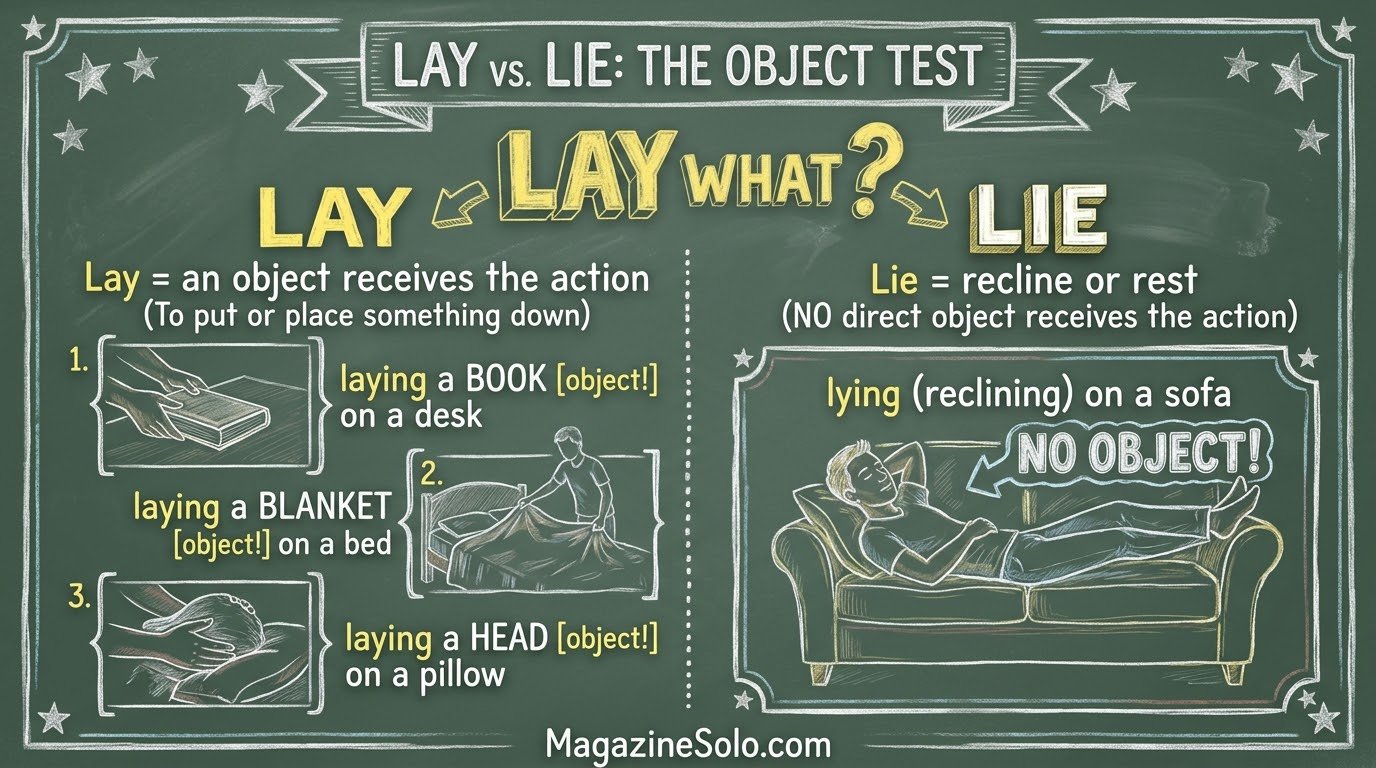
Mistake one: layed. The past of lay is laid, always, and layed is not a form of any English verb. Spellcheckers miss it because it looks plausible.
Mistake two: laid in bed. After has, reclining takes lain. He has laid in bed promotes the placing participle into a job it cannot do.
Mistake three: the laying dog. Dogs lying in the sun are not placing anything, and the present participle of reclining is lying, however common laying sounds.
Mistake four: lays in the data. Figurative situated subjects (answers, clues, futures) belong to lie, and the third person form is lies, never lays.
Mistake five: correcting the set phrases. Lay the table and let sleeping dogs lie are frozen correct, and applying fresh logic to them creates errors out of right answers.
Mistake six: judging speech by the editing rule. Intransitive lay is spreading in conversation; the split is the standard for edited prose, and confusing the two registers helps nobody.
The confused verbs shelf at MagazineSolo runs on the same discipline as this page. Find the object, or find its absence, and the verb chooses itself.
Sibling Pairs on This Site
English keeps building these two way traps, and the tests rhyme even when the verbs change.
Start with the imply vs infer guide, which settles a message pair by direction. The speaker implies and the listener infers, and asking who acts plays the role the object test plays here.
A viewpoint pair lives at the emigrate vs immigrate guide. One person emigrates from a country and immigrates to it, and the reference point selects the word.
A three way object test lives at the ensure, insure and assure trio guide. Ensure, insure, and assure divide by what follows them, which is the closest cousin this page’s method has.
Even the building pair at the capital vs capitol difference page follows the pattern. One word is the building, the other is everything else, and a single test settles every sentence.
The Causative Cousins: Sit and Set, Rise and Raise
Lay and lie are the famous members of an old family. English built several verb pairs on the same plan: one verb acts alone, its causative twin acts on something.
Sit and set repeat the pattern exactly. You sit (no object), and you set the vase down (object), with set historically meaning cause to sit.
Rise and raise repeat it in the other spelling direction. The sun rises alone, and workers raise a flag with their hands on it, object present.
Lie and lay are the pair where the family resemblance turned dangerous. The causative twin’s name collided with the base verb’s past, and the system has confused learners since.
Knowing the family helps because the test transfers. Whatever works for lay what works for set what and raise what, and one habit covers three shelves of errors.
Old English built these pairs deliberately, with lecgan formed from licgan for our pair. The language designed the object in; the object test just reads the blueprint.
Modern English keeps simplifying the family in speech. Edited prose keeps the distinctions, and writers who hold them sound precise without ever sounding stiff.
A Twelve Sentence Drill
Sorting sentences is where the rule becomes reflex. Name the object, or name its absence, and let the answer pick the verb before you check the reasoning.
Item 1: Please ____ the files on my desk. Files are placed, so lay fits, with the object sitting right after the verb.
Item 2: I am going to ____ down for twenty minutes. Nothing is placed, so lie fits, and habit must be overruled.
Item 3: Yesterday she ____ the baby in the crib. Placing in the past takes laid, and the baby is the object.
Item 4: Yesterday he ____ in the hammock all afternoon. Reclining in the past takes lay, the collision form, with no object present.
Item 5: The dog has ____ by the fire since lunch. Reclining participle takes lain, however formal it sounds to modern ears.
Item 6: The hen has ____ six eggs this week. Placing participle takes laid, and the eggs answer the object question.
Item 7: Do not ____ the blame on me. Blame is placed figuratively, so lay fits, with blame as the object.
Item 8: The village ____ between two rivers. Situated subjects take lie, so lies fits in the third person present.
Item 9: He ____ awake half the night. Past reclining takes lay again, and awake is a state, not an object.
Item 10: ____ the table, dinner is at seven. The frozen phrase takes lay, with table as the standing object.
Item 11: Success ____ in preparation. The figurative situated use takes lies, and in marks the position.
Item 12: She ____ her head on the pillow and slept. Head is placed, so laid fits, closing the dozen where the rule began.
Twelve sentences, four tenses, both verbs, one question. Every correct answer arrived by asking what is being placed, and none needed a memorized list.
Lay vs Lie at Work and in Exams
The pair earns its keep in professional settings, where the wrong verb is read as carelessness. Three arenas punish the swap in different currencies.
In exams, the pair is a designed trap. Test writers plant laid in bed and the laying dog because they know the collision confuses prepared students on schedule.
In publishing, it is a house style checkpoint. Copyeditors correct intransitive lay in manuscripts daily, and authors who self correct earn a quiet reputation for reliability.
In the workplace, it surfaces in plain sentences. Emails about laying out plans (correct, plans are objects) and reports where the answer lies in the data (also correct).
The stakes never involve meaning collapse. Readers understand the wrong verb perfectly, which is why the correction reads as polish rather than rescue.
That is still worth having. Edited prose is a uniform, and this split is part of the uniform, in boardrooms and examination halls alike.
The Difference in One Glance
For the note app, the whole topic compresses into a pocket card. Copy it once and the next hundred decisions take seconds each.
Lay: places something, object required, lay laid laid laying, eggs and tables and groundwork.
Lie (recline): rests or is situated, no object, lie lay lain lying, beds and dogs and villages.
Lie (untruth): deceives, regular, lie lied lied lying, ages and alibis, never near the other two.
Test: ask lay what. Trap cells: past of lie is lay; participle of recline is lain. Never: layed.
Songs: Dylan’s lady wrong, Dylan’s tune right, Clapton wrong, Bon Jovi right. Land: American lay, British lie.
Carry the card into your next editing pass. The sentences you meet will sort themselves into its rows faster than any definition paragraph can sort them.
Why the Confusion Persists: Four Causes
Understanding why this mix up survives helps writers fix it without self blame. Four causes keep the pair tangled long after the rule is first learned.
Cause one: the collision itself. A language that spells the past of reclining exactly like the present of placing has built the error into its own machinery.
Cause two: the stable verb lends its forms. Lay behaves so regularly that laid feels like the universal past, and the hand reaches for it in every tense cell.
Cause three: the fading participle. As lain retreats into formality, the reclining paradigm loses its most distinctive member, and the whole row blurs toward lay.
Cause four: the songs teach it wrong. Generations learned the pair from choruses first and classrooms second, and the choruses overwhelmingly use lay for resting.
None of the four causes is carelessness. Each is the language’s own history pressing on the writer, which is why a mechanical test outperforms memorized indignation.
Five Hard Cases, Ruled
Rules earn trust at their edges. These five sentences sit near the border, and each ruling shows the object test doing real work.
Case 1: Lay your head on my shoulder. Ruled correct. Head is a genuine object being placed, so lay governs the sentence, however tender it sounds.
Case 2: The land lies fallow this year. Ruled correct. Fallow land is situated and resting, placing nothing, so the third person of lie is lies.
Case 3: She laid down for a nap after lunch. Ruled wrong in edited prose. Nothing is placed, so the past of reclining is lay: she lay down for a nap.
Case 4: They have laid the matter to rest. Ruled correct. The matter is an object set down figuratively, and laid is its participle.
Case 5: Now I lay me down to sleep. Ruled correct, and it fools many correctors. Me is the object, so the prayer’s lay is the placing verb, properly used.
Two of the five turn on objects hiding in plain sight (head, me). The test catches them because it asks the question mechanically instead of trusting the sentence’s mood.
Keep the habit for your own drafts. Circle every lay, laid, lain, and lying in an editing pass and ask the question at each one; the pass takes a minute.
Teaching the Pair in Five Minutes
The pair can be taught in one short lesson, because the test is a question rather than a chart. Run these five steps in order.
Step 1: place a book. Put a book on the table and say, I lay the book down. Ask the class what was placed, and let them answer: the book.
Step 2: rest a volunteer. Have a student lie on a mat and say, she lies down. Ask what was placed, and let the silence teach the second verb.
Step 3: travel in time. Repeat both scenes in the past: I laid the book down, she lay down. The collision appears live, in their own sentences.
Step 4: rule a song. Play the Dylan line in your head together and vote. The class that rules it wrong has understood the object test completely.
Step 5: freeze two phrases. Lay the table and let sleeping dogs lie close the lesson as vocabulary, exceptions that are not exceptions at all.
Parents can run the same five steps at a kitchen table with a book and a cushion. No worksheet survives contact with homework as well as a question the child can ask alone.
That is the deepest service a verb page can offer. Not a table to memorize, but a question that keeps answering correctly long after the lesson ends.
One distinction belongs on the record before the questions. Intransitive lay is not illiteracy. It is the spoken language simplifying a broken paradigm in real time, and linguists document it the way they document weather.
The writer’s task is narrower than the linguist’s. Hold the split where the split is graded, which is on the page, and let conversation carry whatever it carries.
File the card where you edit most, and run the one minute circle pass on your next finished draft. The errors it catches will teach the paradigm faster than the card itself ever could.
Repeat the pass on the draft after that, and notice how the circles thin out. By the third draft, most writers find the question asking itself before the hand can type the wrong form.
Worth one plain sentence before the questions. Nobody is confused by the actions themselves. Everyone understands placing and resting perfectly; only the labels collide, which is why the question test beats the definition here.
Carry one picture out of this page if the card gets lost. A hand placing a book is lay in every tense it earns, and a body settling onto a bed is lie in every tense it earns, and the tenses themselves are just the table read aloud.
Frequently Asked Questions
1. What is the difference between lay and lie?
Object or no object. Lay places something and always carries an object (lay, laid, laid).
Lie reclines or is situated and carries none (lie, lay, lain).
2. Is it lay down or lie down?
Lie down, for people resting. Down has no object after it, so resting takes lie.
Lay down needs a thing: lay down your arms, lay down the book.
3. What is the past tense of lie?
Lay. The past tense of lie, to recline, is lay: yesterday I lay down for an hour.
This is the collision at the heart of the topic.
4. What is the past tense of lay?
Laid. Lay, to place, runs lay in the present and laid in the past and participle: she laid the towels on the bed.
5. What are the principal parts of lie (recline)?
Lie, lay, lain, lying. Lie to recline is irregular: I lie today, I lay yesterday, I have lain all morning, I am lying down.
6. What are the principal parts of lay?
Lay, laid, laid, laying. Lay to place is regular in behavior: I lay it down, I laid it down, I have laid it down, I am laying it down.
7. Is layed a word?
No. The past of lay is spelled laid, and layed is not a form of any English verb, however plausible it looks on the page.
8. Is it laid or lain in bed?
Lain. Bed rest is reclining, so after has or had the participle is lain: he has lain in bed all day, never has laid.
9. Has laid or has lain: which is correct after has?
Depends on the object. Has laid needs a thing placed (has laid the book down).
Has lain means reclined (has lain awake for hours).
10. Is the dog laying down or lying down?
Lying down. The dog places nothing, so the reclining participle is lying: the dog is lying in the sun, not laying.
11. Do chickens lay or lie?
Lay, with an object. Hens lay eggs, and the egg is the object that makes lay correct.
People, placing nothing, lie down.
12. Why is the past tense of lie spelled lay?
Because the paradigms overlap. Lie to recline is an old irregular verb whose past form happens to be lay, identical to the present of the placing verb.
13. How do you remember lay vs lie?
Ask lay what. If the sentence answers with a thing being placed, use lay forms.
If nothing answers, use lie forms, and check the tense cell.
14. What is the object test for lay vs lie?
One question: lay what. Lay must name what it places.
When the question finds no answer in the sentence, the verb belongs to the lie family.
15. Lay what: how does the question test work?
Say the question at the verb. Lay the book answers book.
I want to lay down answers nothing, so the sentence is corrected to lie down.
16. Is lay me down to sleep correct?
Correct. Me is the object of the verb, placed by the speaker himself, so lay is right in the prayer and the song alike.
17. Is lay yourself down correct grammar?
Correct. Yourself is the object, so lay yourself down passes the test, unlike bare lay down, where nothing is placed at all.
18. Why is lay lady lay wrong?
No object is placed. Dylan invites the lady to rest across the bed, which is reclining, so edited prose wants lie, lady, lie.
19. Was Bob Dylan wrong in lay down your weary tune too?
That one is correct. Tune is a real object being set down, so lay down your weary tune passes the object test cleanly.
20. Why is lay you down in Bed of Roses correct?
Because you is the object. In lay you down on a bed of roses, he places her, which is exactly the transitive job lay exists for.
21. Is lay down Sally wrong too?
Yes, by the rule. Sally is asked to rest rather than be placed, so edited prose wants lie down Sally, whatever the recording says.
22. Do people say I am going to lay down in everyday speech?
Constantly. Intransitive lay is the commonest spoken swap in this topic, understood everywhere, and still corrected in edited prose, exams, and careful writing.
23. Is lay becoming an intransitive verb?
In speech, gradually. Linguists expect the merger to keep spreading in conversation, while dictionaries and editors maintain the split for edited English.
24. What does laid mean and when is it used?
Placed. Laid is the past and participle of lay: she laid the cloth, the hen has laid an egg, they had laid the foundation.
25. What does lain mean and why does it sound formal?
Reclined. Lain is the past participle of lie: he has lain awake, the letter had lain unopened.
It sounds formal because speakers now use it rarely.
26. How can you avoid saying lain?
Rephrase the reclining. Stayed in bed, rested, or was lying there all carry the meaning without the archaic participle, and none breaks a rule.
27. Is it lying in bed or laying in bed?
Lying in bed. Nothing is being placed, so the reclining participle is lying.
Laying in bed would need an object after it.
28. Is it lies or lays for the third person?
Both exist, for different verbs. She lies in the sun (recline) and she lays the book down (place).
The object question separates them instantly.
29. The book lies or lays on the table?
Lies. The book is situated, placing nothing, so the book lies on the table.
Lays would demand something the book is putting down.
30. The answer lies or lays in the data?
Lies. The answer is situated in the data, not placing anything, so the figurative use takes lies, a common edited prose checkpoint.
31. What is the difference between lay of the land and lie of the land?
Dialect decides. American English says the lay of the land.
British English traditionally says the lie of the land.
Keep each idiom on its own shore.
32. Is lie low or lay low correct?
Lie low, in edited prose. Hiding places nothing, so the phrase takes lie.
Lay low survives in speech and in its other sense, to defeat.
33. What about let sleeping dogs lie?
Lie, frozen in the proverb. The dogs are resting and placing nothing, and the phrase is a set form that is never modernized to lay.
34. Where does the third verb lie (lied) fit?
A separate regular verb. Lie meaning tell an untruth runs lie, lied, lied, lying.
It never interacts with lay or with the reclining paradigm.
35. Can lie (deceive) ever take lay forms?
Never. Nobody has ever lay about their age.
The untruth verb is fully regular, and its past is always lied.
36. Is lay vs lie the same in British and American English?
Yes for the verbs. Both dialects split lay and lie identically.
They differ on the land idiom (American lay, British lie) and little else here.
37. What are common lay vs lie set phrases?
Two frozen shelves. Lay the table, lay an egg, lay the groundwork.
Lie low, lie ahead, let sleeping dogs lie.
Learn them as vocabulary.
38. How is lay vs lie like sit vs set and rise vs raise?
The same causative design. Lay historically means cause to lie, set means cause to sit, and raise means cause to rise.
The object test reads the blueprint.
39. Why does lay need an object grammatically?
Because of what it means. To lay is to place, and placing is unfinished until something is placed.
The object completes the action the verb names.
40. Which is correct: I lay awake or I lie awake last night?
Lay awake, for last night. Awake last night is past reclining, and the past of lie is lay: I lay awake for hours.
41. He lay down or he laid down yesterday?
Depends on the object. He lay down (he rested).
He laid down his rifle (he placed it).
The object, or its absence, decides.
42. How do you teach lay vs lie to a child or a student?
With the object question. Ask lay what at every sentence, use the dog and the book as the two mascots, and rule the famous songs together.
Conclusion
The lay vs lie choice is never a memory contest once the object test is in your hand. One question, asked at the verb, sorts the present tense in seconds.
Respect the collision. The past of lie is lay, the participles are laid for placing and lain for reclining, and the third verb, lied, never enters the room.
Learn the frozen phrases as vocabulary. Lay the table, lie low, let sleeping dogs lie, and the land idiom on your own side of the Atlantic.
Take the sentence that brought you here and ask it lay what, out loud. If a thing answers, place it with lay. If silence answers, rest with lie.

Dilawar is a content writer at MagazineSolo, covering travel, home improvement, interior design, and everyday lifestyle topics. He enjoys researching practical solutions, exploring travel destinations, and sharing helpful guides that make daily life easier. His writing focuses on clear information, useful advice, and engaging stories for a wide audience.