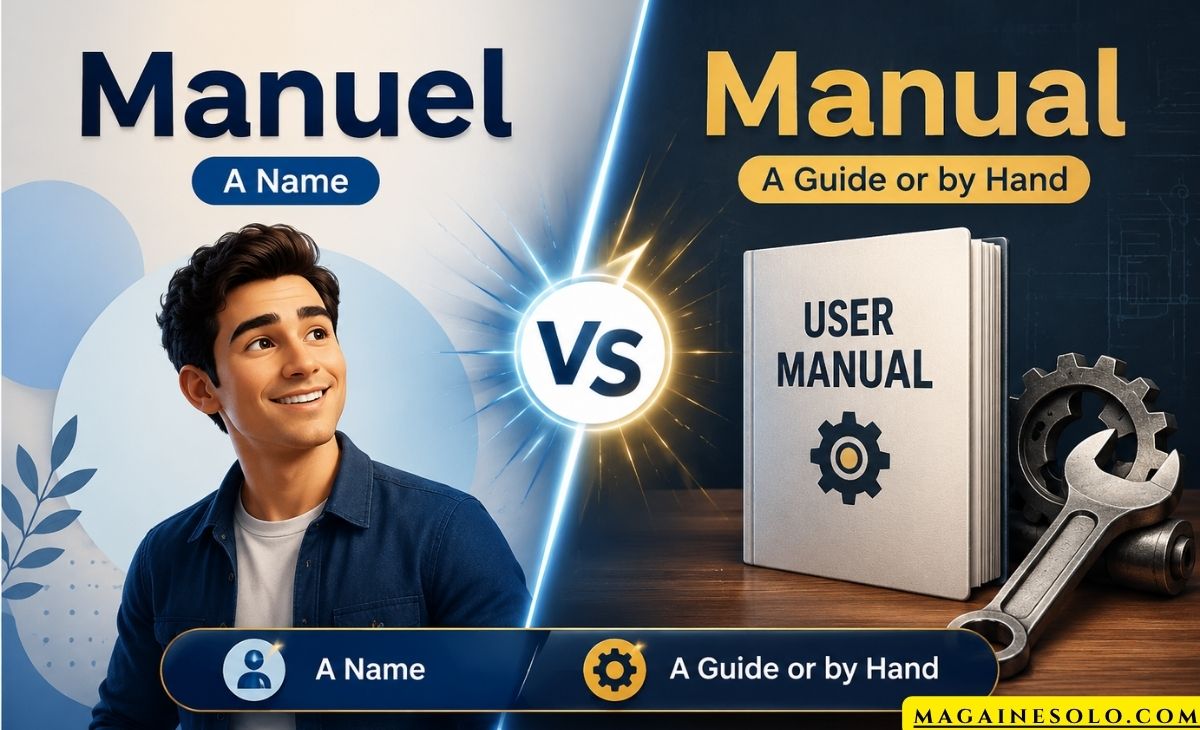
Many English learners and even native writers often get confused when they see the words manuel or manual in writing. At first glance, they look almost identical, but their meanings and usage are completely different. This confusion leads to common spelling and grammar mistakes, especially when trying to understand manual vs manuel in real sentences.
The truth is simple: manuel vs manual is not just a spelling issue, it is a meaning issue. One refers to a proper name, while the other refers to instruction guides, hand-operated systems, or tasks done manually. Understanding the difference between manual or manuel helps improve writing accuracy, clarity, and professionalism.
In this guide, we will break down everything in a simple and human-friendly way. You will learn definitions, usage rules, sentence structure, real examples, and expert writing tips so you never confuse manuel or manual again.
Definitions Of Manuel And Manual

Before diving into grammar rules, let’s look at what each word actually means. The short version: Manuel is a name, and manual is a regular English word. But the details matter, especially if English isn’t your first language or you’re a fast typist who sometimes lets autocorrect take over.
What Does “Manuel” Mean?
Manuel is a Spanish and Portuguese given name, traditionally used for boys and men. It’s the equivalent of “Emmanuel” in English, which comes from a Hebrew word meaning “God is with us.” You’ll often see it shortened to “Manny” in casual conversation.
Because Manuel is a proper noun, it follows the same capitalization rules as any other name , think “James,” “Carlos,” or “Sofia.” It refers to a specific person (or occasionally a place), never to an object or action.
A few quick facts about the name Manuel:
- It is extremely common in Spanish-speaking countries, including Mexico, Spain, and across Latin America.
- It has feminine variations such as “Manuela.”
- It appears in place names too , for example, San Manuel is a town name used in several countries.
- It is always capitalized, no matter where it appears in a sentence.
What Does “Manual” Mean?
Manual is a common English word that can function as either a noun or an adjective, depending on the sentence.
As a noun, a manual is a book or guide that explains how to use, assemble, or operate something , think of the booklet that comes with a new blender or the employee handbook at work.
As an adjective, manual describes something done by hand rather than by machine or automation. A “manual task” requires physical effort, and a “manual car” requires the driver to shift gears themselves.
Here’s a simple breakdown of how “manual” is used:
| Usage Type | Meaning | Example |
| Noun (instructions) | A guidebook or handbook | “Read the manual before assembling the desk.” |
| Adjective (by hand) | Done without machines | “She prefers manual labor over office work.” |
| Adjective (vehicles) | Gear-shift transmission | “He learned to drive a manual transmission car.” |
| Noun (music) | A keyboard on an organ | “The organist switched to the upper manual.” |
Unlike Manuel, the word “manual” is never capitalized unless it sits at the start of a sentence or appears in a title.
How To Properly Use Manuel And Manual In A Sentence
The easiest way to keep these two words straight is to ask yourself a simple question: Am I talking about a person, or am I talking about a thing, action, or book?
If the answer is “a person,” you need Manuel. If the answer is “a thing, action, or book,” you need manual. Let’s look at each one in more detail.
How And When To Use Manuel
Since Manuel is a proper noun, it slots into a sentence the same way any name would , as a subject, object, or part of a possessive phrase.
As a subject: “Manuel finished the report ahead of schedule.”
As an object: “The manager congratulated Manuel for his hard work.”
As a possessive: “Manuel’s presentation impressed the entire team.”
A few quick tips for using Manuel correctly:
- Always capitalize the first letter, regardless of where it falls in the sentence.
- Treat it exactly like any other first name , it can be combined with a title (Mr. Manuel, Dr. Manuel) or a last name (Manuel Garcia).
- If referring to more than one person with this name, the plural becomes “Manuels” (for example, “Both Manuels showed up to the meeting”).
- Don’t confuse it with “manual” just because spell-check sometimes suggests the wrong word.
How And When To Use Manual
Manual fits naturally into sentences as either a noun or a descriptive word. Since it’s a common noun/adjective, it stays lowercase unless it begins a sentence or is part of a title like “User Manual.”
As a noun (referring to a guide): “Keep the warranty card inside the manual.”
As an adjective (describing an action): “Manual entry of data takes longer than automated systems.”
As an adjective (describing a vehicle): “A manual gearbox gives drivers more control on hills.”
To make the difference even clearer, here’s a side-by-side comparison:
| Feature | Manuel | Manual |
| Word type | Proper noun (name) | Common noun / adjective |
| Capitalization | Always capitalized | Lowercase unless starting a sentence |
| Refers to | A person or place | A guidebook, action, or vehicle feature |
| Can be pluralized? | Yes (“Manuels”) | Yes (“manuals,” as in instruction books) |
| Used in everyday speech? | As a name only | As a descriptive or functional word |
READ MORE ARTICLES: https://magazinesolo.com/courtesy-vs-curtesy/
Examples Of Manuel And Manual Use In Sentences
Seeing both words used side by side in real sentences makes the distinction much easier to remember. Below are several examples for each word, organized so you can spot the pattern quickly.
Example Sentences Using Manuel
- Manuel called to confirm the appointment for tomorrow afternoon.
- The award was presented to Manuel during the ceremony.
- I borrowed Manuel’s notes to study for the exam.
- Our new coworker, Manuel, just moved here from Madrid.
- Manuel and his brother run a small bakery downtown.
- The teacher asked Manuel to lead the group project.
Example Sentences Using Manual
- The technician referred to the repair manual to fix the printer.
- This washing machine has both automatic and manual settings.
- Switching to a manual watering system saved them money on water bills.
- The training manual outlines every safety procedure step by step.
- He switched from an automatic to a manual transmission last year.
- Manual labor on the farm starts early in the morning.
A Quick Memory Trick
If you’re still unsure which word to use, try this trick: replace the word in your sentence with another common name, like “Carlos.” If the sentence still makes sense (“Carlos called to confirm the appointment”), you need Manuel. If replacing it with “Carlos” makes the sentence nonsensical (“Read the Carlos before installing the desk”), you need manual.
Common Mistakes To Avoid
Even confident writers slip up occasionally. Here are the most frequent errors people make with manuel or manual:
- Lowercasing the name Manuel. Since it’s a proper noun, it always needs a capital “M.”
- Capitalizing “manual” mid-sentence. Unless it’s part of a title (like “Owner’s Manual”), keep it lowercase.
- Letting autocorrect swap the words. Many phone keyboards default to “Manuel” because it’s a recognized name in their dictionary, even when you meant “manual.”
- Using “manual” when referring to a person. This usually happens when typing quickly , always double-check names before sending an email or message.
READ MORE ARTICLES: https://magazinesolo.com/emaculate-vs-immaculate/
Frequently Asked Questions
Is “Manuel” a name or a word?
Manuel is a name , specifically a Spanish and Portuguese given name for men. It is not a standard English vocabulary word.
What does “manual” mean in English?
Manual means either an instruction book or something done by hand instead of by machine, such as a manual task or manual transmission.
Should “manual” ever be capitalized?
Yes, but only at the start of a sentence or within a title, such as “User Manual” or “Owner’s Manual.”
Can “Manuel” refer to anything other than a person?
Occasionally. It can appear in place names, such as towns or streets named after someone called Manuel, but it always remains a proper noun.
How do I stop autocorrect from changing “manual” to “Manuel”?
Type the word slowly and check before sending, or add “manual” to your phone’s personal dictionary so autocorrect stops suggesting the name instead.
READ MORE ARTICLES: https://magazinesolo.com/dought-vs-doubt/
Conclusion
Understanding manuel vs manual is essential for clear and correct English writing. Although both words look similar, their meanings are completely different.
- Manuel is always a proper noun used for people or names.
- Manual refers to instruction guides, machines, or hand-operated actions.
Whenever you are confused between manual or manuel, just check the context. If it is a person, use Manuel. If it is a book, device, or hand-based process, use manual.
Mastering this small but important grammar difference will improve your writing accuracy, boost your confidence, and make your communication more professional and error-free.