Placque Vs. Plaque: Meaning, And Correct Way To Use Each One
When writing in English, certain words often create confusion because of their unusual spelling. One common example is placque vs plaque. Many people search online to find out whether “placque” is a real word or simply a spelling mistake.
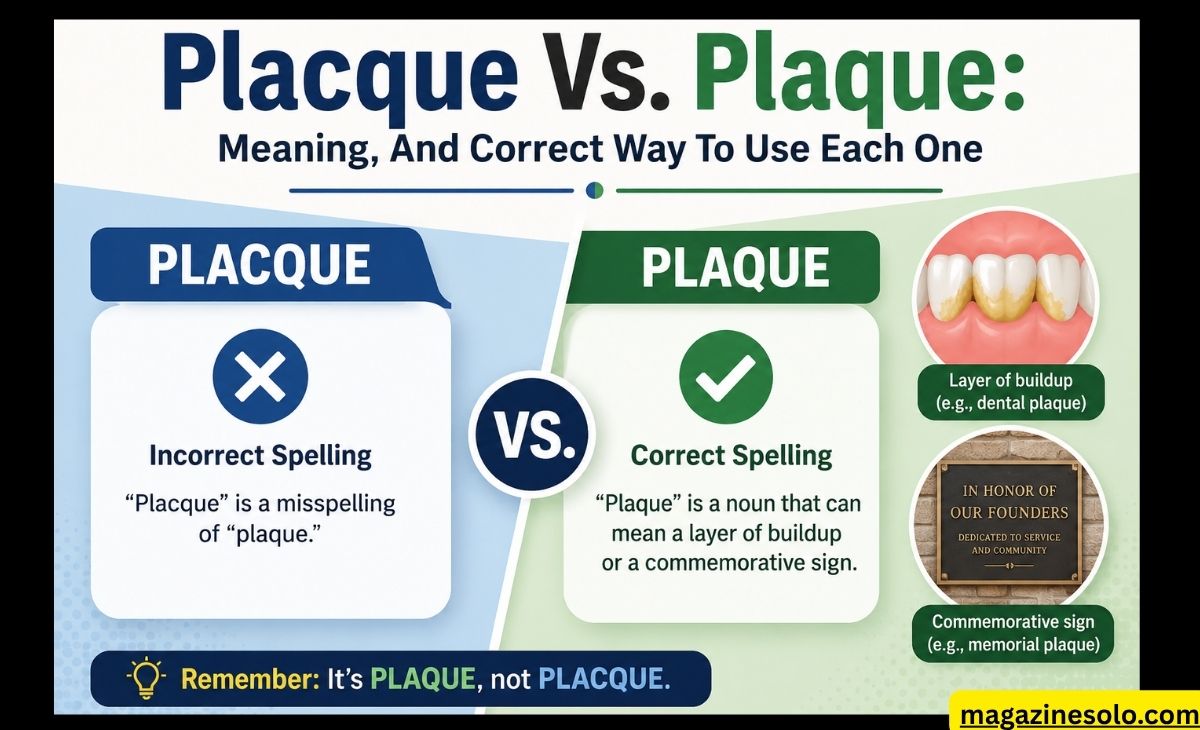
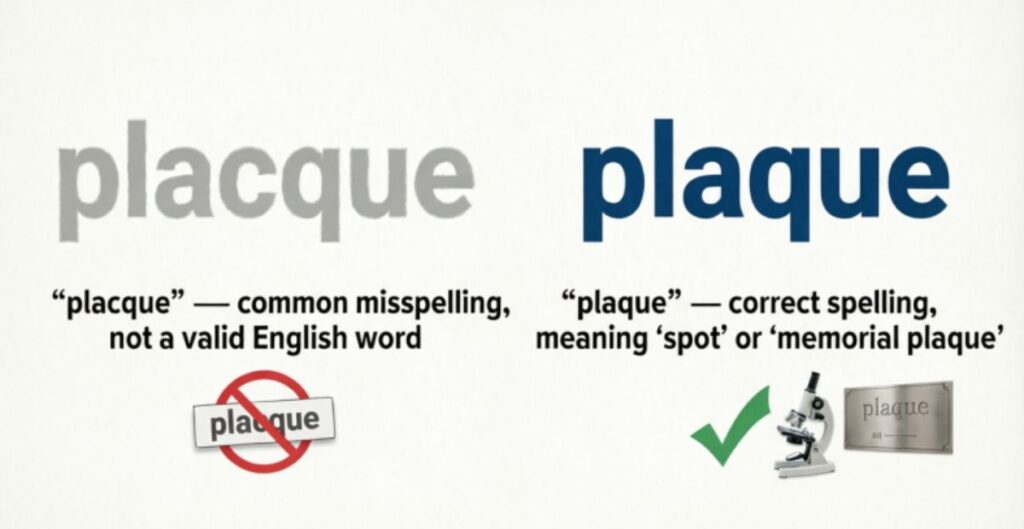
The short answer is simple: plaque is the correct spelling, while placque is considered a misspelling in standard English. Despite this, the incorrect form appears frequently in online searches, social media posts, and informal writing.
Understanding the difference between placque and plaque can improve your vocabulary, strengthen your writing skills, and help you avoid common grammar mistakes. In this guide, you’ll learn the meaning of plaque, its origin, how people use the word, examples, synonyms, antonyms, famous quotes, and frequently asked questions.
Plaque Vs. Placque: Quick Comparison
| Feature | Plaque | Placque |
| Correct English Word | Yes | No |
| Dictionary Recognition | Yes | No |
| Common Usage | Dental, medical, memorial, decorative | Misspelling only |
| Appears in Formal Writing | Yes | No |
| Recommended for Use | Yes | Never |
The comparison clearly shows that when discussing plaque vs placque, only plaque is correct.
Origin Of The Word
The word plaque has French roots, which explains a lot about its unusual spelling. It first entered the English language around 1845 to 1848, borrowed directly from the French word plaque, meaning a flat plate or thin slab. The French term itself traces back to the Middle Dutch word placke, referring to a disk or patch.
When the word arrived in English, it was used primarily to describe flat decorative objects , a thin piece of metal, wood, or ceramic bearing an inscription, mounted on a wall or given as an award. The spelling stayed true to its French origin, which is precisely why it contains the silent ending -que rather than a more phonetically intuitive -ck or -k.
The medical use of the word came later. By 1898, the term had entered dental and medical terminology to describe the sticky film of bacteria that forms on tooth surfaces. That same year, physicians and researchers began using “dental plaque” in clinical writing to describe bacterial buildup linked to tooth decay and gum disease.
The reason so many people write placque instead of plaque is simple: the pronunciation (rhyming with “black”) doesn’t match the French-influenced spelling. When people hear the word and try to write it phonetically, they sometimes insert an extra “c” before the “que,” producing the non-word placque. It feels logical but isn’t supported by any etymology or dictionary authority.
How People Use The Word
Despite its slightly unusual spelling, plaque is a versatile and widely used English noun. It appears in two main contexts in everyday life: commemorative and decorative uses, and medical and dental contexts.
Commemorative Use
In this sense, a plaque is a flat object , usually made of metal, wood, or ceramic , that bears an engraved or printed inscription. Plaques are commonly used to:
- Honor achievements in schools, universities, and workplaces
- Mark historic buildings, landmarks, or burial sites
- Commemorate public figures, events, or milestones
- Serve as formal awards at ceremonies and competitions
You’ve likely seen a memorial plaque on the wall of an old building, or a recognition plaque handed to an employee of the month. The iconic blue plaques in London mark homes where famous historical figures once lived , a tradition that dates back over 150 years.
Medical and Dental Use
In healthcare, plaque refers to a thin, sticky film of bacteria and food particles that forms on the surface of teeth. If not removed through regular brushing and flossing, dental plaque hardens into tartar, which can lead to cavities, gingivitis, and more serious periodontal disease.
The word also appears in cardiovascular medicine, where arterial plaque (atherosclerosis) describes fatty deposits that build up inside artery walls, restricting blood flow and raising the risk of heart attacks and strokes. In neurology, amyloid plaques are associated with Alzheimer’s disease.
Here’s a quick reference table showing how the word is used across different fields:
| Context | Meaning | Example |
| Awards / Recognition | Flat inscribed object given as an honor | An achievement plaque at a graduation ceremony |
| Historical / Memorial | Wall-mounted marker commemorating a place or person | A blue plaque on a Victorian building |
| Dental Health | Sticky bacterial film on teeth | Plaque buildup causes cavities |
| Cardiovascular Medicine | Fatty deposits in arteries | Arterial plaque narrows blood vessels |
| Neurology | Protein deposits in the brain | Amyloid plaques linked to Alzheimer’s |
Examples Of The Word In A Sentence
- The school presented her with a plaque recognizing ten years of dedicated service.
- The dentist warned him that his dental plaque levels were unusually high for his age.
- A bronze plaque at the entrance marks the building as a protected historic site.
- Regular flossing helps break down the plaque that brushing alone can miss.
- The mayor unveiled a commemorative plaque in the town square to honor the veterans.
- Doctors discovered significant arterial plaque buildup during his routine checkup.
- The museum installed a small plaque beside each exhibit explaining its historical significance.
What Type Of Word Is It?
Plaque is a countable noun. In grammar, a countable noun refers to something that can be counted individually , you can have one plaque, two plaques, or several plaques. It can take both the singular and plural forms:
- Singular: a plaque, the plaque
- Plural: plaques, the plaques
It does not function as a verb, adjective, or adverb. Its part of speech remains consistent across all contexts , whether you’re talking about a commemorative award or a dental hygiene concern, plaque is always a noun.
Here is a quick grammatical breakdown:
| Grammar Feature | Detail |
| Part of Speech | Noun (countable) |
| Singular | plaque |
| Plural | plaques |
| Pronunciation | /plæk/ (rhymes with “back”) |
| Language of Origin | French |
| First Recorded Use | Mid-1800s |
Synonyms Of Plaque
Depending on the context, there are several words that can substitute for plaque in a sentence. However, keep in mind that no synonym will be perfectly interchangeable in every situation , context determines which alternative fits best.
| Synonym | Best Used For |
| Tablet | Memorial or inscribed flat surface |
| Medallion | Awards and commemorative contexts |
| Panel | Flat wall-mounted sign or decorative piece |
| Badge | Small identifying or decorative plate |
| Memorial | Broader word for commemorative objects |
| Nameplate | Identifying plaques on doors or desks |
| Marker | Historical or informational plaques |
| Slab | Larger flat commemorative stones |
| Brooch | Decorative/worn badge (older usage) |
| Inscription | The text on a plaque (not the object itself) |
Examples in Sentences
- The committee installed a tablet at the site of the old school to preserve its memory.
- She wore a gold medallion engraved with her name after winning the regional competition.
- A small brass nameplate outside the office door identified the doctor’s practice.
- The park placed a marker at the trailhead explaining the area’s ecological history.
- The memorial panel in the lobby listed the names of all founding members.
Antonyms Of Plaque
Plaque doesn’t have direct antonyms in the traditional sense , it’s a concrete noun, not a quality or state. However, depending on the context in which it’s used, the following words can function as conceptual opposites:
| Antonym | Context |
| Erasure | Opposite of a lasting commemorative marker |
| Oblivion | Forgetting, as opposed to honoring with a plaque |
| Anonymity | Lack of recognition (opposite of an award plaque) |
| Cleanliness | In dental context, clean teeth free of plaque |
| Neglect | Failing to honor, as opposed to placing a memorial |
Examples in Sentences
- Rather than receiving a plaque for her contributions, her work faded into oblivion after the organization shut down.
- With proper brushing technique, achieving genuine cleanliness and eliminating plaque buildup is possible.
- He preferred anonymity over the recognition plaque his colleagues had planned to present.
- The decision to demolish the historic building was seen as an act of erasure rather than commemoration.
Famous Quotes with the Word Plaque
Real-world usage across literature, journalism, and public discourse shows just how naturally this word appears in formal and informal contexts:
“There’s a plaque on the wall of the building where I grew up. I stop and read it every time I pass.” , Common reflective observation, widely cited in personal essays
“Brushing twice daily is the most effective way to manage plaque before it becomes a problem you can’t reverse.” , General dental health guidance, frequently quoted in oral hygiene literature
“They unveiled a plaque in his honor, but what he truly left behind could never fit on any wall.” , From a eulogy reported in a regional newspaper
“The first blue plaque appeared over 150 years ago , and with it, a tradition of honoring people through the places they called home.” , Marion McMullen, chronicler of the London blue plaque heritage
“Shockwave technology uses sonic pressure waves to crack hardened plaque in arteries , a remarkable leap in cardiac care.” , George Avalos, Mercury News, May 2026
Frequently Asked Questions
Is “placque” a real word?
No. Placque is not a real word. It does not appear in any major English dictionary and is simply a common misspelling of plaque.
What does plaque mean in English?
Plaque has two primary meanings: a flat decorative or commemorative object (often engraved), and a sticky film of bacteria that forms on teeth or in arteries.
Why do people spell it “placque” instead of “plaque”?
Because the word is borrowed from French, its spelling doesn’t match its English pronunciation (/plæk/), which leads many people to insert an extra “c” , producing the incorrect form placque.
How do you pronounce plaque?
Plaque is pronounced /plæk/, rhyming with “back,” “rack,” and “track.” The “-que” ending is silent.
Can plaque refer to something other than teeth?
Yes. Plaque can refer to commemorative tablets, wall-mounted awards, arterial deposits (in cardiovascular medicine), and amyloid plaques (in neurology related to Alzheimer’s disease).
What is the plural of plaque?
The plural is plaques , pronounced the same way as the singular, with the “s” sounding like /s/.
Is plaque a noun or a verb?
Plaque is strictly a countable noun. It does not function as a verb, adjective, or any other part of speech.
What are some synonyms for plaque?
Common synonyms include tablet, medallion, panel, nameplate, marker, memorial, and badge, depending on the context in which the word is being used.
Conclusion
Understanding placque vs plaque is easier than many people think. The correct spelling is always plaque, while placque is simply a common misspelling. Whether you’re talking about a memorial plaque, dental plaque, arterial plaque, or a scientific plaque, the spelling never changes.
Learning the correct form helps improve communication, strengthens your writing, and prevents embarrassing spelling errors. The next time you encounter placque or plaque, you’ll know immediately which one belongs in professional and everyday English.

Shoaib Ahmad is a language-focused content writer and researcher at magazinesolo.com, where he explains the meaning of words, phrases, and text in a clear and reader-friendly way. His work focuses on simplifying language, uncovering context, and helping readers understand text with confidence and clarity.