Ally vs Allie: The Main Differences And When To Use Them
Have you ever stopped while writing and wondered whether you should use ally or allie? You are not alone. Since both words sound exactly the same, many people accidentally mix them up. However, even though they share the same pronunciation, their meanings are completely different.
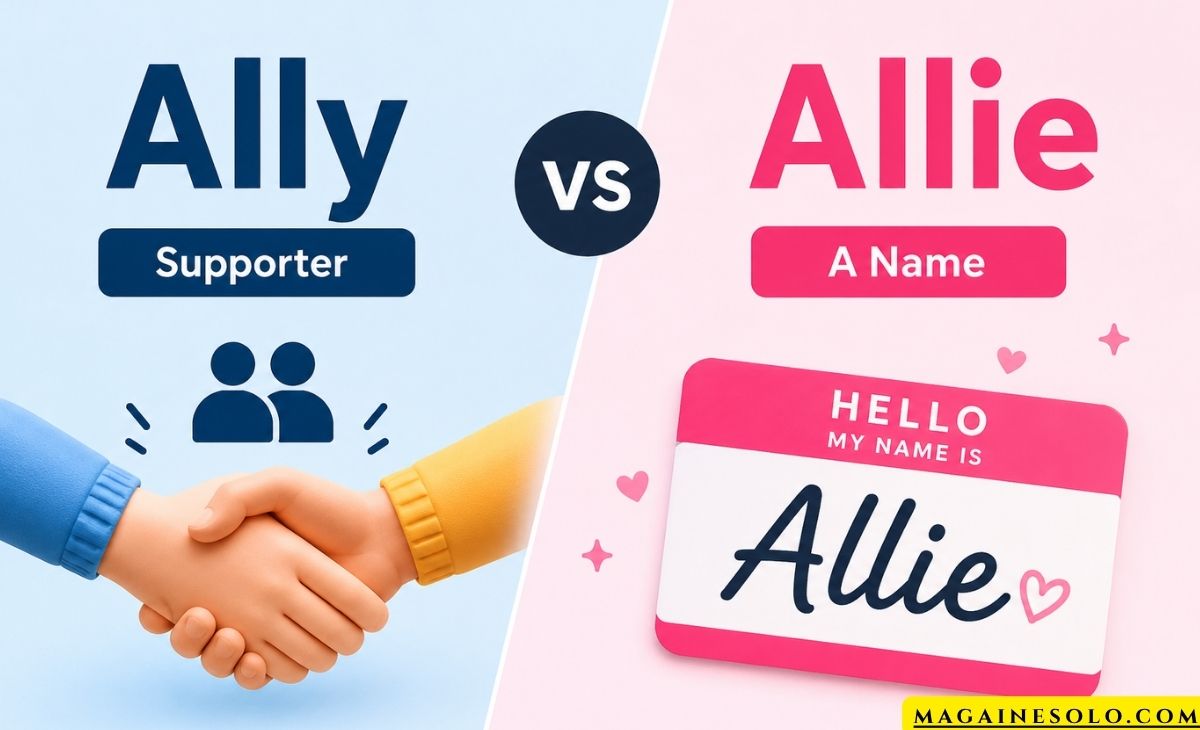
Understanding ally vs allie is important because using the wrong spelling can change the meaning of your sentence. In simple words, ally refers to a supporter, friend, partner, or someone who stands beside you. Allie, on the other hand, is usually a person’s name or nickname.
If you’ve ever searched for allie or ally, ally or allie, or even how to spell allie, this guide will explain everything in clear and simple language.
Define Ally
The word ally is a common English noun (and sometimes a verb) that has been part of the language for centuries. It comes from Old French and Latin roots that carried the idea of “binding together” or “joining forces.” That root meaning is still very much alive today.
In simple terms, an ally is:
- A person, group, or country that supports, helps, or cooperates with another for a shared goal
- Someone who stands by you during a difficult time
- A nation that joins another nation through a treaty, agreement, or partnership
Here’s a quick example: “The United States and Canada have been close allies for decades.” In this sentence, “allies” describes a relationship of support and cooperation between two countries.
The word also works as a verb, as in “to ally yourself with someone,” meaning to form a partnership or alliance with them.
In recent years, ally has taken on extra meaning in conversations about equality and social justice. An ally, in this sense, is someone who supports a group or cause they may not personally belong to, for example, a person who advocates for fairness and inclusion for communities other than their own. This usage has become especially common on social media and in workplace diversity discussions.
So whenever you’re describing support, partnership, friendship, or cooperation, ally is almost always the word you want.
Define Allie
Now let’s talk about Allie. Unlike “ally,” Allie is not a standard dictionary word. You won’t find it listed as a noun meaning “supporter” in any major English dictionary. Instead, Allie is a proper noun, typically used as a person’s name or a nickname.
Allie commonly works as a shortened, friendly version of longer names such as:
- Allison
- Alison
- Alexandra
- Alicia
- Alina
Because it sounds warm, casual, and approachable, parents and friends often use Allie as an everyday nickname. You’ll also spot it in pop culture, one of the most famous examples is Allie Hamilton, the lead character from the novel and movie The Notebook. That single example alone has made the name Allie even more recognizable and popular.
Since Allie is a proper noun, it follows the basic rule for names: always capitalize it. Whether you’re writing “Allie is coming over for dinner” or “I haven’t seen Allie since college,” the capital “A” stays in place no matter where it appears in the sentence.
So if someone asks how to spell Allie, the answer depends on context, but when referring to a person’s name, “Allie” with a capital A and an “ie” ending is the standard and most widely used spelling.
Ally vs Allie: Quick Comparison Table
Sometimes a side-by-side comparison makes everything click. Here’s a simple breakdown of ally vs allie so you can reference it whenever you’re unsure.
| Feature | Ally | Allie |
| Word type | Common noun / verb | Proper noun (name/nickname) |
| Meaning | Supporter, partner, helper, friend | A person’s name (often short for Allison, Alexandra, etc.) |
| Capitalization | Lowercase unless starting a sentence or used as a name | Always capitalized |
| Plural form | Allies | N/A (names don’t pluralize) |
| Common use cases | Politics, friendships, business, activism, international relations | Personal names, nicknames, casual conversation |
| Example sentence | “She has always been a loyal ally.” | “Allie just moved to a new apartment.” |
| British vs American spelling | Same in both | Same in both |
This table is a handy cheat sheet if you’re ever stuck wondering whether to write ally or allie in a sentence. The quickest test: if you’re talking about a person’s name, it’s Allie. If you’re talking about support, partnership, or cooperation, it’s ally.
More Examples of Ally & Allie Used in Sentences
Seeing these words in real sentences makes the difference much easier to remember. Below are several examples covering different situations.
Examples Using “Ally”
- “He proved himself to be a trustworthy ally during the negotiations.”
- “The two nations signed a treaty to become formal allies.”
- “Being an ally means showing up for people even when it’s not easy.”
- “My coworker has been my biggest ally on this project.”
- “The company decided to ally itself with a smaller startup to expand its reach.”
- “Throughout history, countries have formed alliances to protect shared interests.”
Examples Using “Allie”
- “Allie sent me a birthday card last week.”
- “I’m meeting Allie for coffee tomorrow morning.”
- “Allie has always been a nickname for Alison in our family.”
- “Happy graduation, Allie! We’re so proud of you.”
- “Allie works as a graphic designer in Chicago.”
- “My daughter wants everyone to call her Allie instead of Allison.”
Notice how every single “Allie” example refers to a person, while every “ally” example refers to support, partnership, or alliance. That’s the entire difference in a nutshell.
If you’re writing a sentence and you can replace the word with “supporter,” “partner,” or “friend” without changing the meaning, you need ally. If the word is functioning as someone’s actual name, you need Allie.
Common Mistakes to Avoid
Even confident writers slip up with allie or ally from time to time. Here are the most frequent errors people make, and why they happen.
Mistake 1: Using “Allie” Instead of “Ally” in Formal Writing
Writing something like “I am an allie of the LGBTQ+ community” is incorrect. The correct sentence is “I am an ally of the LGBTQ+ community.” This mistake often happens in activism-related posts, where the writer means “supporter” but accidentally types the name spelling instead.
Mistake 2: Using “Ally” When You Mean Someone’s Name
If a friend, coworker, or family member is named Allie, writing “I’m meeting my Ally today” looks like you’re referring to a generic supporter rather than a specific person, unless their name is actually spelled “Ally” (which does happen occasionally, though it’s less common).
Mistake 3: Forgetting Capitalization
Names always need a capital letter. Writing “i saw allie at the mall” looks unpolished and unclear. Capitalization is one of the easiest ways readers tell whether you mean a name or a common noun.
Mistake 4: Relying Too Much on Autocorrect or Spellcheck
Phones and spellcheck tools sometimes swap one word for the other automatically, especially in texting apps. Since both words are spelled correctly on their own, spellcheck won’t flag the mistake, it’s up to you to catch it.
Mistake 5: Using “Allied” or “Allie” as a Verb
Only “ally” can function as a verb (allied, allies, allying). “Allie” should never be used as a verb, since it’s strictly a name.
Tips to Avoid Mistakes
Here are some simple, practical tips to help you choose correctly every time you’re stuck between ally vs allie.
- Ask yourself: name or noun? If you’re talking about a specific person, it’s Allie. If you’re talking about a relationship of support, it’s ally.
- Remember the “alliance” connection. Ally connects directly to words like “alliance” and “allies.” If your sentence relates to teamwork, partnerships, or politics, ally is almost always correct.
- Check for capitalization. Names are always capitalized. If the word should be capitalized mid-sentence and it’s not someone’s title, it’s likely Allie.
- Read the sentence out loud and swap the word. Try replacing it with “supporter” or “friend.” If the sentence still makes sense, use ally. If it sounds odd, you’re probably referring to a name, use Allie.
- Double-check before publishing. Whether it’s a blog post, email, or social media caption, a quick proofread before hitting “send” or “publish” can save you from an awkward correction later.
- Use a search engine for spelling confirmation. If you’re unsure how to spell Allie for a specific person, a quick search (especially if they have social media) can confirm the exact spelling they use, since name spellings can vary slightly from person to person.
With a little practice, choosing between ally or allie becomes second nature. The key is training your brain to ask “Is this a name or not?” before you type.
Frequently Asked Questions
Is it “ally” or “allie”?
It depends on meaning. Use “ally” for a supporter or partner, and “Allie” when referring to a person’s name.
How do you spell Allie correctly?
The most common spelling for the name is “Allie,” always capitalized since it’s a proper noun.
Can “Allie” and “ally” be used interchangeably?
No. They have completely different meanings, so swapping them changes the message of your sentence.
Is “Allie” a real word in the dictionary?
No, “Allie” is not a standard dictionary word, it functions only as a personal name or nickname.
What is the plural form of “ally”?
The plural of “ally” is “allies,” as in “the two countries became allies.”
Why do people confuse ally and allie so often?
Because both words sound exactly the same when spoken, making the spelling easy to mix up in writing.
Is “ally” always lowercase?
Yes, unless it begins a sentence or is part of someone’s actual name spelled “Ally.”
Does British English spell these words differently than American English?
No, both “ally” and “Allie” are spelled the same way in British and American English.
Conclusion
Understanding ally vs allie is easier once you know the basic rule.
- Ally means a supporter, friend, helper, or partner.
- Allie is generally a person’s name.
Whenever you wonder about allie or ally, simply ask yourself whether you’re talking about support or a person’s name. That single question will help you choose the correct spelling every time.
By remembering this distinction, you’ll avoid common mistakes and write with greater confidence and clarity.

Shoaib Ahmad is a language-focused content writer and researcher at magazinesolo.com, where he explains the meaning of words, phrases, and text in a clear and reader-friendly way. His work focuses on simplifying language, uncovering context, and helping readers understand text with confidence and clarity.