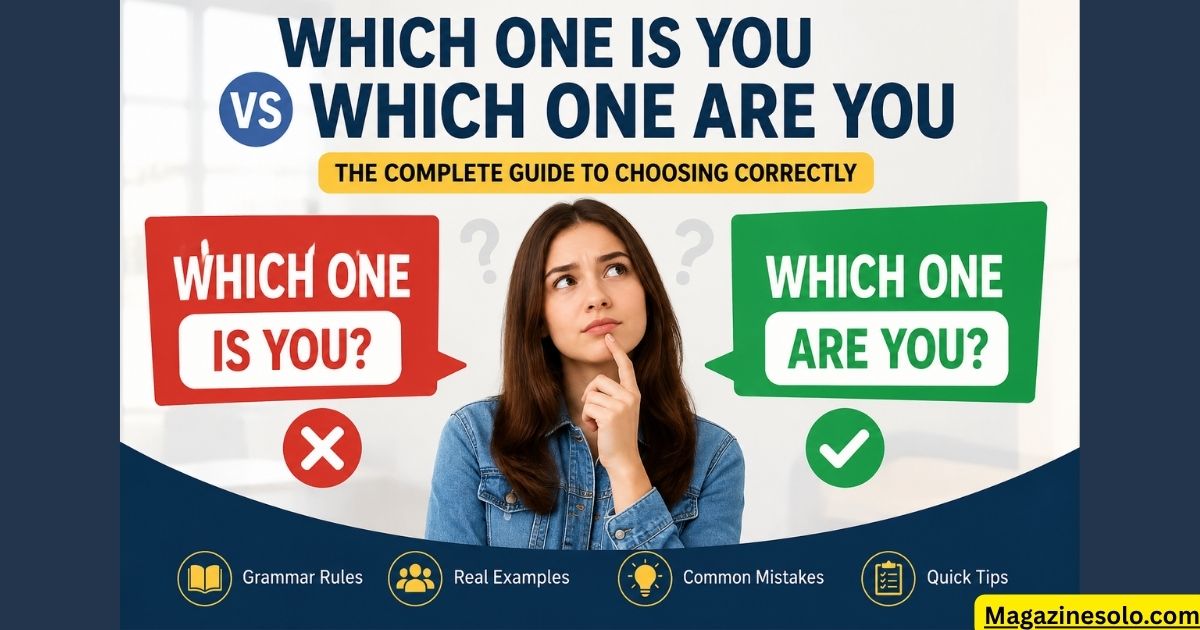
Which One Is You vs Which One Are You, The Complete Guide to Choosing Correctly
If you’ve ever typed a sentence, paused, and thought “wait, which one is you or which one are you?”, you’re not alone. This tiny phrase trips up native speakers, ESL learners, students, and even professional writers. It looks simple, but the grammar hiding inside it is sneaky.
This guide breaks the confusion down in plain English, gives you a fast decision rule, and shows you exactly when, if ever, the “wrong-sounding” version is okay.
Quick answer: Which one is correct and why
“Which one are you?” is the grammatically correct phrase.
Here’s the short reason: the pronoun “you” always pairs with “are,” never with “is,” no matter what comes before it in the sentence. This is a fixed rule in English subject-verb agreement, and it doesn’t change based on the word “which” or “one.”
So while “which one is you” might feel casual or even sound fine in fast speech, it’s not standard grammar. If you’re writing an email, a resume, an essay, or anything that needs to look polished, always go with “which one are you.”
Why this question confuses so many people
The confusion isn’t random, it’s actually a very logical mistake. Here’s why so many people second-guess themselves:
- “One” feels singular, and singular nouns usually take “is” (the dog is, the book is, the cat is).
- “You” is invisible in the sentence order, it appears at the end, so the brain sometimes agrees the verb with “one” instead of “you.”
- Regional speech patterns in casual conversation sometimes drop grammar rules entirely, so people hear “is you” more often than they realize.
- Non-native speakers translate literally from languages where verb agreement works differently, leading to mix-ups like “which one is you.”
Once you understand that “you” is the real subject controlling the verb, not “one”, the confusion disappears.
The core rule you actually need
Forget memorizing complicated grammar terms. Just remember this one rule:
The verb always agrees with the subject, not the word closest to it.
In “which one are you,” the sentence is really asking: “You are which one?” rearranged as a question. Since “you” is the subject, the verb must be “are.”
Compare it to simpler examples:
- “Which one is she?” → correct, because “she” takes “is.”
- “Which one are you?” → correct, because “you” takes “are.”
- “Which one are they?” → correct, because “they” takes “are.”
The word “one” is not the subject here, it’s part of the question phrase, similar to “which person” or “which item.” The real subject is always the pronoun that follows.
Breaking down sentence structure: What’s really being asked
Let’s slow the sentence down piece by piece:
- “Which one”, this is asking someone to identify or choose from a group.
- “are”, the verb, which must match the subject.
- “you”, the subject of the sentence.
So structurally, it’s: Which one + [verb] + you?
Since “you” is the subject, English grammar rules require “are,” not “is”, the same way we’d never say “you is happy” or “you is here.”
Subject-verb agreement table (clear and practical)
| Subject Pronoun | Correct Verb | Example Sentence |
| I | am | Which one am I? |
| You | are | Which one are you? |
| He/She/It | is | Which one is he? |
| We | are | Which one are we? |
| They | are | Which one are they? |
Notice the pattern: only “he,” “she,” and “it” pair with “is.” Every other pronoun in this list uses “am” or “are.” “You” never takes “is”, not in questions, not in statements, not ever.
Is “Which One Is You?” ever acceptable?
Technically, “which one is you” is grammatically incorrect in standard English. However, there are situations where you’ll still hear or see it:
- Casual texting and social media captions, where grammar rules relax.
- Song lyrics or informal internet slang, where rhythm matters more than grammar.
- Non-native speech patterns, especially in dialects influenced by other languages.
- Meme culture, where “which one is you” is sometimes used intentionally for a joking or exaggerated tone.
So while it exists in the wild, it should never be used in formal writing, school assignments, professional messages, or anywhere clarity and correctness matter.
Why “Which One Are You?” sounds natural to Americans
American English speakers are trained, often without realizing it, to instinctively pair “you” with “are” from a very young age. Phrases like “you are welcome,” “you are right,” and “you are late” reinforce this pattern constantly in daily conversation.
Because of that repetition, “which one are you” simply sounds right to the ear, even to someone who’s never studied grammar rules formally. This is a great real-world example of how repeated language exposure builds instinctive correctness.
Real-life examples you’ll actually hear
Here are natural, everyday examples where this phrase pops up:
- A teacher pointing to a group photo: “Which one are you in this picture?”
- A quiz result page: “Which one are you, the planner or the improviser?”
- A friend picking outfits: “I bought two shirts, which one are you wearing tonight?”
- A trivia app: “Which one are you based on your answers?”
Notice how in every case, the sentence is really identifying you as the subject, reinforcing why “are” is always the correct fit.
Common mistakes and why they happen
Here are the most frequent slip-ups people make with this phrase:
- Mixing it up with third-person questions like “which one is it,” then carrying “is” over into “you” sentences by mistake.
- Overcorrecting and using “are” even with singular subjects like “he” or “she.”
- Auto-complete and predictive text errors, which sometimes suggest the wrong verb based on common typos.
- Speed typing, where “is” gets typed simply because it’s a shorter, faster word.
Being aware of these patterns helps you catch the mistake before hitting send.
Quick decision chart: Choose “is” or “are” in two seconds
Use this simple 3-step check whenever you’re unsure:
- Look at the pronoun at the end of the sentence.
- Is it “you,” “we,” or “they”? → Use are.
- Is it “he,” “she,” or “it”? → Use is.
That’s it. No need to overthink sentence order or the word “one”, the ending pronoun always decides the verb.
How Americans actually use these phrases in daily speech
In real conversation, Americans use “which one are you” constantly, in quizzes, personality tests, group photos, and casual banter. It’s become a common conversational hook, especially in:
- Buzzfeed-style personality quizzes (“Which one are you: coffee or tea person?”)
- Social media polls and comment sections
- Classroom and workplace icebreakers
- Comparison memes and reaction posts
Because this phrase shows up so often in pop culture and online quizzes, it’s one of the most searched grammar questions today, which is exactly why getting it right matters for clear, confident communication.
Editing and proofreading: Spotting and fixing errors
When you’re proofreading your own writing, use these quick checks:
- Read the sentence backward (“You are which one?”), this often makes errors more obvious.
- Say it out loud. Incorrect verb pairings often sound “off” when spoken.
- Search for “is you” in your document using Ctrl+F, this is a fast way to catch every instance.
- Ask a second reader or use a grammar checking tool for one final pass.
Small habits like these prevent embarrassing errors in resumes, emails, and published content.
Practical alternatives that avoid the issue
If you’re still unsure or want to sidestep the grammar question altogether, try rewording:
- Instead of “Which one is you?” → “Which one represents you?”
- Instead of “Which one are you?” → “Which one describes you best?”
- Or simply: “Pick the one that’s you.”
These alternatives keep the meaning intact while avoiding any grammar hesitation.
When native speakers break the rules
Even fluent English speakers bend grammar rules on purpose, for humor, catchy slogans, or informal texting, where speed beats precision. This doesn’t make “which one is you” correct; it just means language stays flexible in casual settings, even when the formal rule doesn’t change.
Case study: Classroom confusion and teacher fix
A common classroom scenario looks like this: a teacher shows a group photo and asks students, “Which one is you?” Even trained educators slip into this pattern because it feels natural when pointing at someone directly.
A quick teacher fix that works well: encourage students to answer the question first, “I am the one on the left”, before turning it into a question. This helps them naturally hear that “I am” becomes “you are,” reinforcing the correct verb pairing through repetition rather than memorized rules.
Common pitfalls and how to correct them fast
| Mistake | Why It Happens | Quick Fix |
| “Which one is you?” | Confusing “one” as the subject | Focus on the pronoun, not “one” |
| “Which one are he?” | Overcorrecting with “are” | Match singular pronouns with “is” |
| “Which one is they?” | Mixing up plural pronouns | Remember: they = are, always |
| “Which one am you?” | Confusing “I” and “you” forms | “Am” only pairs with “I” |
Quick reference: You and verb agreement
- You are, never “you is”
- You were (past tense), never “you was” in formal writing
- You have, never “you has”
- You do, never “you does”
“You” behaves like a plural pronoun grammatically, even when referring to a single person, which is why it always takes the plural-style verb form.
Examples showing the hidden subject in similar constructions
The “which one” pattern isn’t unique, the same logic applies to other question structures:
- “Who is it?”, subject: it → is
- “Who are you?”, subject: you → are
- “What is this?”, subject: this → is
- “What are these?”, subject: these → are
Once you spot the real subject in any sentence, choosing between “is” and “are” becomes automatic.
More advanced notes: When “one” can control the verb
There’s a slightly different case worth mentioning: when “one” itself is the subject of the sentence (not paired with “you”), it does take “is.”
Example: “Which one is correct?”, here, “one” is the subject, so “is” is correct.
The key difference: in “which one is correct,” there’s no pronoun like “you” following it. But the moment “you,” “we,” or “they” enters the sentence as the true subject, the verb has to shift to match that pronoun instead.
Practice drills you can use right now
Test yourself with these quick fill-in-the-blank sentences:
- Which one ___ you wearing? (is/are)
- Which one ___ she choosing? (is/are)
- Which one ___ we picking for dinner? (is/are)
- Which one ___ correct in this list? (is/are)
- Which one ___ they talking about? (is/are)
Answers: 1. are 2. is 3. are 4. is 5. are
Common classroom error and solution table
| Grade Level | Typical Error | Suggested Teaching Fix |
| Elementary | “Which one is you?” | Practice with “I am / you are” pairs |
| Middle school | Mixing “is/are” with “they” | Use plural pronoun drills |
| ESL learners | Literal translation errors | Compare native language verb rules |
| Adult writers | Autocorrect-driven mistakes | Manual proofreading pass |
Editing tips for writers and editors
- Always double-check pronoun-verb pairs in dialogue-heavy writing.
- Use a find-and-replace check for “is you” before publishing.
- When editing others’ work, explain the fix briefly so writers retain the rule long-term.
Conclusion
At the end of the day, the grammar rule behind “which one is you or which one are you” comes down to one simple idea: the verb always follows the pronoun, not the word “one.” Since “you” always pairs with “are,” the correct phrase is always “which one are you.”
Keep the pronoun-check trick in your back pocket, and you’ll never second-guess this phrase again, whether you’re writing a casual text, a school essay, or a professional email.
Frequently Asked Questions
Which one is correct, “which one is you” or “which one are you”?
“Which one are you” is the grammatically correct phrase, since “you” always pairs with “are.”
Is “which one is you” ever grammatically acceptable?
No, it’s considered incorrect in standard English, though it’s sometimes used casually in speech, texting, or memes.
Why does “you” take “are” instead of “is”?
“You” behaves grammatically like a plural pronoun, so it always pairs with “are,” “were,” “have,” and “do.”
Can “which one is” ever be correct?
Yes, when “one” itself is the subject, such as in “which one is correct?”, there’s no pronoun like “you” changing the verb.
How can I remember this rule quickly?
Focus on the pronoun at the end of the sentence, if it’s “you,” “we,” or “they,” always use “are.”

Shoaib Ahmad is a language-focused content writer and researcher at magazinesolo.com, where he explains the meaning of words, phrases, and text in a clear and reader-friendly way. His work focuses on simplifying language, uncovering context, and helping readers understand text with confidence and clarity.