Goodmorning or Good Morning: Which is Correct?
Have you ever wondered whether you should write goodmorning or good morning? Many people type it both ways, especially in emails, text messages, and social media posts. However, only one form is correct in standard English.
If you have ever asked yourself is goodmorning one word, good morning one word or two, or is good morning two words, this guide will clear up the confusion. By the end, you’ll know the correct spelling, when to capitalize it, common mistakes to avoid, and several alternatives you can use in everyday conversations.
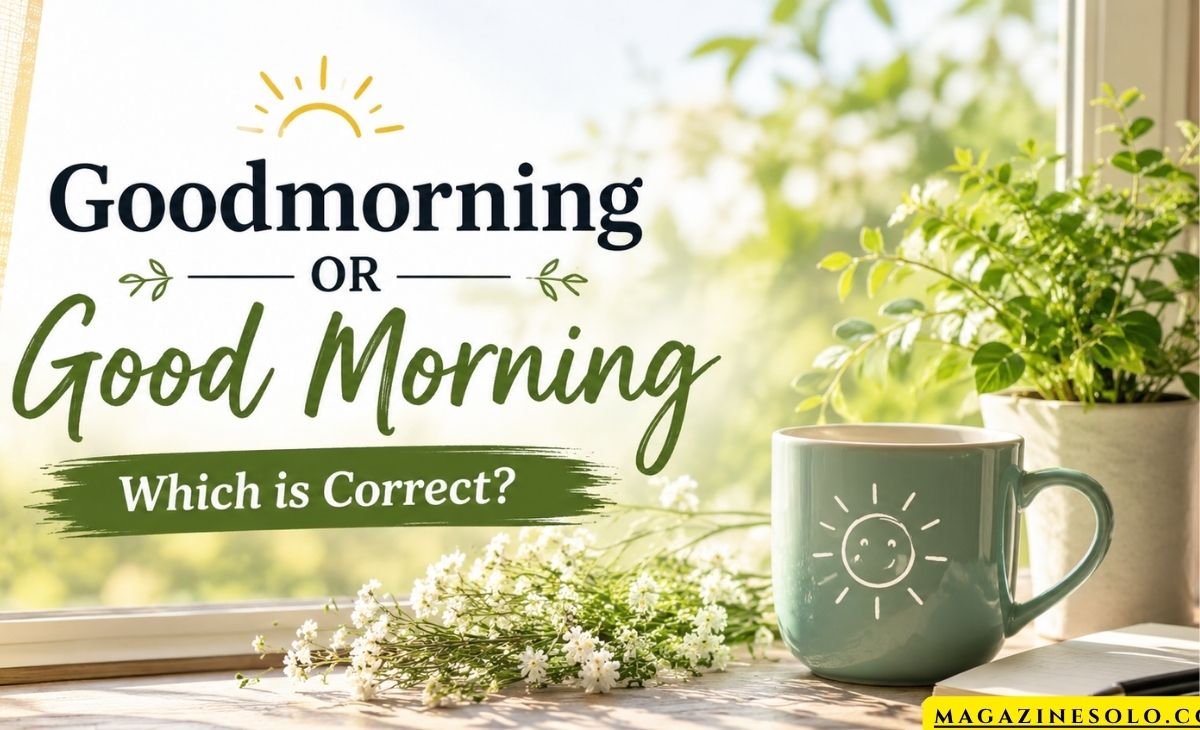
Goodmorning or Good Morning? Which is Correct?

“Good morning”, two words, is always the correct spelling.
“Goodmorning” written as one word is a spelling error. It does not appear in any major dictionary, including Merriam-Webster, Oxford, or Cambridge. Whether you are writing a casual text or a formal business email, the rule never changes: always keep a space between “good” and “morning.”
| Version | Correct? | Where It Appears |
| Good morning | Yes | Everywhere, formal, informal, digital, print |
| Goodmorning | No | Casual texts, social media typos |
| Good-morning | No | Outdated, no longer used |
Think of it like “happy birthday” or “thank you.” Nobody writes “happybirthday” or “thankyou.” The same logic applies here, two separate words, always.
READ MORE ARTICLES: https://magazinesolo.com/how-are-you-faring/
Why “Goodmorning” (One Word) Is Wrong

The one-word version pops up so often because people type fast, especially on phones. Autocorrect sometimes misses it, and social media makes it look trendy. But there is a clear grammatical reason why it is incorrect.
“Good morning” is made of two distinct parts:
“Good”, an adjective (a describing word)
“Morning”, a noun (a thing)
In English, when an adjective describes a noun as a greeting phrase, we keep them separate. We say “nice day,” not “niceday.” We say “good night,” not “goodnight.” The words work together but they stay apart.
The only reason “goodmorning” looks familiar is because of how fast we type and how often we see it in casual messaging. But familiarity does not make it correct. Spell-checkers consistently flag “goodmorning” as wrong, and it has never been accepted into formal grammar rules.
Some people point to words like “goodbye” and wonder why that one merged. The truth is that “goodbye” went through a very different historical process over hundreds of years, it is a unique exception, not a rule to follow for other phrases.
READ MORE ARTICLES: https://magazinesolo.com/dought-vs-doubt/
How to Use “Good Morning” Correctly
Using “good morning” correctly is easy once you know the basic rules. Here is how to apply it in everyday situations:
In Emails
Always start with a capital “G” and keep both words separate. Add a comma after the greeting when addressing someone by name.
Good morning, Sarah,
Goodmorning Sarah (Wrong)
In Text Messages
Even in casual texting, “good morning” is cleaner and more readable. “Goodmorning” might feel quick, but it comes across as a typo.
Good morning! Hope you slept well.
Goodmorning! Hope you slept well. (Wrong)
In Formal Writing
“Good morning” is a standard professional greeting. Use it at the start of speeches, presentations, emails, and reports.
“Good morning, everyone. Thank you for joining today’s meeting.”
In Social Media Posts
Most style guides recommend two words even on social media. It looks polished and professional.
Good morning, world! ☀️
When to Capitalize “Good Morning”
This is where people get confused. Should it be “Good morning” or “Good Morning”? Here is the simple rule:
Capitalize Only the First Word, Usually
At the start of a sentence: Capitalize “Good” because it begins the sentence.
→ Good morning! How are you?
In the middle of a sentence: Use all lowercase.
→ She said good morning before leaving.
As a title or heading: You may capitalize both words.
→ Good Morning, Vietnam (film title)
In email greetings: Capitalize “Good” only.
→ Good morning, James,
| Situation | Correct Form |
| Start of sentence | Good morning |
| Mid-sentence | good morning |
| Title / Heading | Good Morning |
| Email greeting | Good morning, [Name], |
READ MORE ARTICLES: https://magazinesolo.com/manuel-vs-manual/
Real Examples of “Good Morning”
Seeing the phrase used correctly in context is one of the best ways to lock it into your memory. Here are clear, real-life examples:
In a professional email:
Good morning, Mr. Ahmed,
I wanted to follow up on yesterday’s meeting.
In a classroom:
The teacher said, “Good morning, class. Let’s get started.”
In a text to a friend:
Good morning! Did you see the game last night?
In a speech:
“Good morning, everyone. It’s a pleasure to be here today.”
On a sign or banner:
Good Morning, London!
All of these examples show “good morning” as two words, in different settings, different tones, and different formats. The spelling rule does not change based on formality.
Different Ways to Say “Good Morning”
Sometimes “good morning” can feel a bit standard. If you want to mix things up, here are some alternatives that are perfectly correct and natural to use:
Casual alternatives:
Morning! (very common, friendly shortcut)
Hey, morning!
Rise and shine!
Wakey wakey!
Top of the morning to you! (Irish-influenced, cheerful)
Formal alternatives:
Good day
Greetings
Good morning, [Name] (with the name adds warmth)
In other languages:
Spanish: Buenos días
French: Bonjour
German: Guten Morgen
Arabic: Sabah al-khayr (صباح الخير)
Urdu: Subah Bakhair (صبح بخیر)
“Morning!” on its own is a perfectly accepted casual form. It is a shortening of “good morning” that has been part of everyday English speech for a long time.
Good Morning vs. Other Greetings
Where does “good morning” fit compared to other common English greetings? Here is a quick comparison:
| Greeting | Time of Use | Tone |
| Good morning | Before noon | Friendly, professional |
| Good afternoon | Noon to 6 PM | Polite, formal |
| Good evening | After 6 PM | Warm, formal |
| Good night | Bedtime / farewell | Parting farewell |
| Hello / Hi | Any time | Casual |
| Hey | Any time | Very casual |
| Greetings | Any time | Formal, slightly old-fashioned |
One key thing to note: “Good night” is a farewell, not a greeting. You say it when leaving or going to sleep. “Good morning,” “good afternoon,” and “good evening,” on the other hand, are all greetings, you use them when you arrive or meet someone.
Simple History of “Good Morning”
“Good morning” is not a modern invention. It has a surprisingly long and rich history.
The phrase dates back to around the 14th and 15th centuries in the English language. Earlier versions included “gode morne” and “good morwe,” both of which were used in Middle English. You can even find versions of the phrase in Geoffrey Chaucer’s writings from around 1390.
The word “morning” itself comes from the Old English word morgen, meaning the start of the day. “Good” comes from the Old English gōd, meaning something beneficial, desirable, or fitting.
Originally, the phrase was likely a shortening of something like “I wish you a good morning”, a genuine blessing for the start of someone’s day. Over time, it became the quick, friendly greeting we know today.
By the time Shakespeare was writing in the early 1600s, “good morning” appeared in his plays, including Cymbeline (1623). It has been part of the English language ever since, always as two words.
Common Mistakes to Avoid
Even native English speakers make these small errors. Here are the most common ones and how to fix them:
Mistake 1: Writing it as one word
❌ Goodmorning, everyone!
✅ Good morning, everyone!
Mistake 2: Adding a hyphen
❌ Good-morning, sir.
✅ Good morning, sir.
Mistake 3: Missing the comma when addressing someone
❌ Good morning John
✅ Good morning, John
Mistake 4: Capitalizing both words mid-sentence
❌ She whispered a quiet Good Morning.
✅ She whispered a quiet good morning.
Mistake 5: Using “goodmorning” in professional emails
❌ Goodmorning team, here is today’s update.
✅ Good morning team, here is today’s update.
The comma mistake is one of the most overlooked. When you use “good morning” directly before someone’s name, a comma is required between the greeting and the name. This is a basic punctuation rule for direct address.
How to Remember the Right Way
If you ever feel unsure, here are three easy memory tricks that work every time:
Trick 1: Think “Happy Birthday”
You would never write “happybirthday” as one word. Good morning works the same way, two words, always.
Trick 2: Break it down
“Good” = adjective. “Morning” = noun. Two different types of words = two separate words.
Trick 3: Say it slowly
When you say “good morning” out loud, you naturally pause between the two words. Your mouth tells you there are two words. Trust that.
Trick 4: The spell-check test
Type “goodmorning” into any word processor. It will underline it in red. That red line is your reminder, always two words.
FAQ’s
Is “goodmorning” one word or two?
“Good morning” is always two words. “Goodmorning” as one word is a spelling error not accepted in standard English.
Is good morning one word or two?
It is two words: “good” and “morning” are always written separately in correct English.
Is good morning one or two words in texting?
Even in casual texting, the correct form is two words. “Goodmorning” may appear in texts, but it is still a typo.
Can I write “Gm” instead of “good morning”?
In very informal chats, “gm” is a widely understood abbreviation. However, never use it in professional or formal writing.
Is “good morning” the same in British and American English?
Yes. Both British and American English use the same rule, always two separate words.
Should I capitalize “morning” in “good morning”?
Only capitalize “morning” when it appears in a title or heading. In a regular sentence or email, write “Good morning” with only the “G” capitalized.
Why do so many people write “goodmorning” as one word?
Fast typing, autocorrect errors, and social media habits lead people to merge the words. It is a very common typo, but it remains incorrect.
Is “good morning” formal or informal?
It is both. “Good morning” works perfectly in professional emails and friendly texts. Its tone depends on your context, not the phrase itself.
Conclusion
When comparing goodmorning or good morning, the correct spelling is always good morning. The one-word version, goodmorning, is a common mistake and should be avoided in formal and informal writing alike.
So, whenever you wonder is goodmorning one word, good morning one word or two, is good morning two words, or is good morning one or two words, remember one simple rule:
Good morning is always two words.
Using the correct form will make your writing look more professional, natural, and grammatically accurate.

Shoaib Ahmad is a language-focused content writer and researcher at magazinesolo.com, where he explains the meaning of words, phrases, and text in a clear and reader-friendly way. His work focuses on simplifying language, uncovering context, and helping readers understand text with confidence and clarity.