
Realist Vs. Realest: How Are These Different? When To Use
Have you ever typed a sentence and paused, unsure whether to write “realist” or “realest”? You are definitely not alone. These two words look almost identical, sound similar, and both trace back to the same root word, “real.” Yet they mean completely different things, and swapping one for the other can make your sentence sound confusing or even wrong.
Whether you are writing an essay, posting on social media, or just texting a friend, choosing the right word matters. In this guide, you will learn everything about realist vs realest, their meanings, origins, how they are used, and when to pick one over the other. By the end, the difference will feel crystal clear.
Realist
Let’s start with the older and more formal of the two words.
Meanings Of The Word Realist
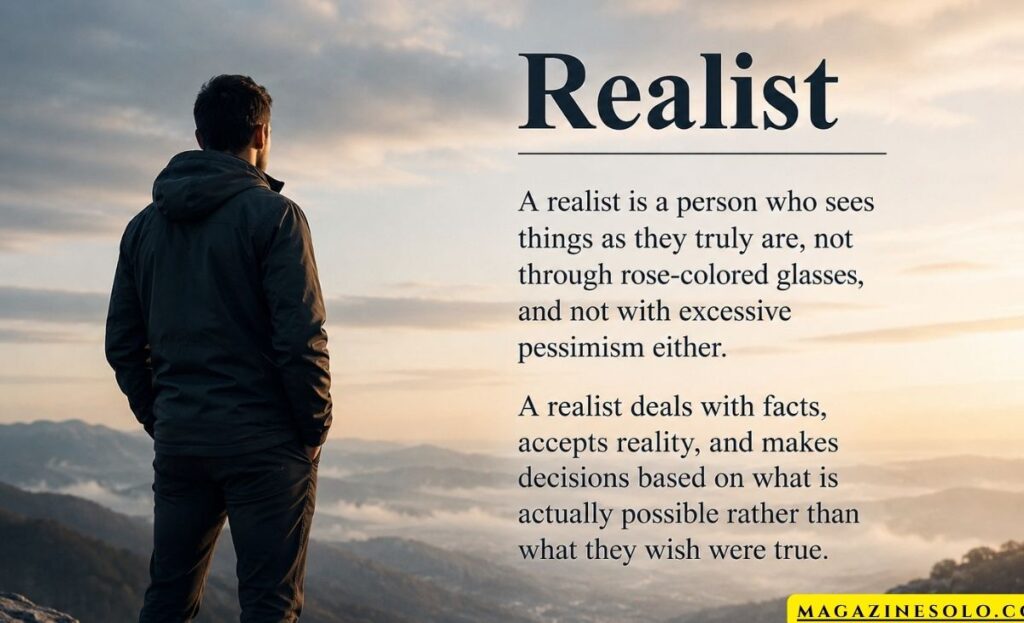
A realist is a noun that refers to a person who sees things as they truly are, not through rose-colored glasses, and not with excessive pessimism either. A realist deals with facts, accepts reality, and makes decisions based on what is actually possible rather than what they wish were true.
The word “realist” carries meaning across several different fields:
- In everyday life: A realist is someone who stays grounded when planning. Instead of dreaming about ideal outcomes, they think about realistic possibilities and practical steps. For example, if your friend reminds you to save money before quitting your job, that friend is being a realist.
- In philosophy: A realist believes that the external world exists independently of what we think or feel about it. Philosophical realism stands in contrast to idealism, which suggests that reality is shaped by the mind.
- In art and literature: A realist artist or writer tries to portray life as it actually is, with all its messy, complicated, and sometimes unpleasant details. Realist literature avoids fantasy or idealization and focuses on the everyday experiences of ordinary people.
- As an adjective: “Realist” can also describe a perspective or approach. For example, a “realist worldview” or a “realist approach to politics” means one that is grounded in practical realities rather than idealistic theories.
Here is a quick summary of what a realist is:
| Context | Meaning |
| Everyday life | A practical, grounded person |
| Philosophy | Someone who believes reality exists independently of the mind |
| Art & Literature | An artist/writer who depicts life truthfully |
| Grammar role | Noun (sometimes used as an adjective) |
Origin Of The Word Realist
The word “realist” has a long and rich history. It first appeared in the English language in the 17th century, rooted in the philosophical tradition. It comes from the Latin word realis, meaning “actual” or “relating to things,” combined with the suffix -ist, which denotes a person who practices or believes in something.
The French word réaliste and the German Realist contributed to its spread across European languages. By the 1870s, the meaning expanded to include artists and writers who followed the principles of artistic realism, a movement that rejected romantic idealization in favor of honest, everyday depictions of life.
Today, the word “realist” is firmly established in formal English and widely used across philosophy, politics, literature, and everyday conversation.
Other Words Derived From Realist
The root of “realist” has given birth to a whole family of related words that you have almost certainly used before:
- Realism, the philosophy, art movement, or general attitude of seeing things as they are
- Realistic, an adjective meaning sensible, practical, or achievable (“That’s a realistic goal”)
- Realistically, the adverb form (“Realistically, we need more time”)
- Unrealistic, the opposite; describing something that is not grounded in reality
- Surrealism / Surrealist, a 20th-century art movement that blended reality with dreamlike imagery
- Magical realist, describes a style of writing that blends realistic settings with fantastical elements (think Gabriel García Márquez)
These words all flow from the same Latin root and carry the same core idea: a connection to what is real, tangible, and true.
Realest

Now let’s talk about the other word, “realest”, which lives in a completely different world from “realist.”
Meanings Of The Word Realest
Realest is the superlative form of the adjective “real.” In standard grammar, the superlative form of “real” would technically be “most real,” but in informal speech and writing, “realest” has become widely accepted, especially in casual conversations and popular culture.
When someone calls a person “the realest,” they are saying that person is the most genuine, authentic, and honest version of themselves. It is a high compliment. It means someone who does not put on a fake persona, does not pretend, and stays completely true to who they are, no matter what.
What Does ‘Realest’ Mean?
In the simplest terms:
Realest = Most genuine + Most authentic + Most honest
Think of it this way: if “real” means genuine, then “realest” means the most genuine. It is often used to praise someone’s character, loyalty, or honesty. Here is how the word breaks down in different contexts:
- In friendship: “She’s the realest friend I’ve ever had” means she is the most trustworthy, honest, and genuine friend in your life.
- In hip-hop and music culture: Artists often call themselves or others “the realest” to show they are true to their roots, their community, and their authentic self, not influenced by fame or money.
- On social media: “Realest” shows up in captions, comments, and posts as a way to celebrate authenticity. Someone might caption a photo with “staying the realest” to mean they are keeping it honest and unpretentious.
- In everyday slang: Phrases like “you’re the realest,” “my realest,” or “that’s the realest thing I’ve heard” all express deep appreciation for someone’s honesty and authenticity.
It is important to know that “realest” is informal slang. It is not used in formal writing, academic papers, or professional settings. You would not write “realest” in a business report or college essay. But in casual speech, texting, social media, and creative writing, it is perfectly understood and widely used.
Origin Of The Word Realest
Unlike “realist,” which has a centuries-old etymology, “realest” is a much more modern invention. It grew out of African American Vernacular English (AAVE) and hip-hop culture, particularly from the 1990s and early 2000s, when authenticity became a central value in music and street culture.
The idea of “keeping it real”, being honest, staying true to your roots, and rejecting pretense, became a cultural philosophy. From that came phrases like “the realest” to describe someone who embodied those values completely.
Over time, the word spread beyond hip-hop into mainstream popular culture, social media, and everyday speech. Today, it is used by people of all backgrounds as a casual way to compliment someone’s genuine character.
How Do People Use The Word Realest?
People use “realest” in a few consistent ways:
- To praise someone’s authenticity: “My cousin is the realest person I know, she always tells the truth even when it’s hard.”
- To describe genuine emotions or moments: “That conversation we had was the realest thing I’ve experienced in years.”
- In music lyrics and pop culture: Artists use it to affirm their dedication to honesty and their community. It signals that they have not “sold out” or changed who they are.
- In social media captions: “No filters, no edits, staying the realest.”
- To express deep loyalty: “He’s my realest, been there since day one.”
Quick rule to remember:
- Talking about someone’s thinking style or philosophy? → Use realist
- Praising someone’s authenticity or genuineness? → Use realest
READ MORE ARTICLES: https://magazinesolo.com/cheer-vs-chear/
Examples Of Realist And Realest In Sentences
Seeing both words in action is the best way to lock in the difference. Here are clear, natural examples of each:
Using REALIST correctly:
- My dad is a realist, he always wants to know the facts before making any decisions.
- From a realist perspective, completing this project in one week is not possible.
- The novel takes a realist approach, showing the struggles of working-class families without any romanticism.
- She remained a realist even when everyone else was caught up in excitement about the new plan.
- As a political realist, he believed that countries act based on self-interest rather than ideals.
- Investors need to be realists during economic downturns to make smart financial decisions.
- The painter was known as a realist because his portraits looked like photographs.
Using REALEST correctly:
- She is honestly the realest person I have ever met, zero pretense, zero drama.
- That late-night conversation we had was the realest moment we’ve shared.
- He stayed the realest even after getting famous, never forgetting where he came from.
- “You’re the realest friend I have”, I said it and I meant every word.
- That speech hit different because it came from the realest place in her heart.
- In hip-hop, being the realest means staying true to your story no matter what.
- Social media is full of filters, but her page is the realest thing on my feed.
READ MORE ARTICLES: https://magazinesolo.com/dought-vs-doubt/
Side-by-side comparison:
| Sentence | Word Used | Why It’s Correct |
| “He’s a ___ who focuses on facts.” | realist | Describes a person’s practical mindset |
| “She’s the ___ person I know.” | realest | Praises authenticity and genuineness |
| “From a ___ standpoint, this is risky.” | realist | Describes a grounded perspective |
| “That moment was the ___ thing ever.” | realest | Describes something deeply genuine |
READ MORE ARTICLES: https://magazinesolo.com/courtesy-vs-curtesy/
READ MORE ARTICLES: https://magazinesolo.com/emaculate-vs-immaculate/
Quick-Reference: Realist vs Realest at a Glance
| Feature | Realist | Realest |
| Word type | Noun / Adjective | Informal superlative adjective |
| Meaning | A practical, grounded person | Most genuine or authentic |
| Register | Formal and informal | Informal / slang only |
| Origin | 17th century Latin/French | 1990s hip-hop / AAVE culture |
| Used in | Philosophy, art, business, daily life | Social media, music, casual speech |
| Example | “She’s a realist about finances.” | “He’s the realest guy I know.” |
FAQ’s
Is “realest” a real word?
Yes, “realest” is widely understood and used in informal English. It is the superlative of “real,” though it belongs to casual and slang contexts rather than formal grammar.
Can “realist” and “realest” be used interchangeably?
No, they cannot. They have different meanings, different grammar roles, and different contexts. Swapping them changes the meaning of your sentence entirely.
Which word is correct in formal writing, realest or realist?
Always use “realist” in formal, academic, or professional writing. “Realest” is informal slang and is not appropriate in essays, reports, or business communication.
What is the difference between “realistic” and “realist”?
“Realistic” is an adjective meaning practical or achievable (“That’s a realistic goal”). “Realist” is a noun or adjective referring to a person who is grounded in reality. They are related but not interchangeable.
Is “realest or realist” a common source of confusion?
Yes. Because both words share the root “real” and sound similar, many people mix them up, especially when writing quickly. Understanding the grammar role of each clears the confusion fast.
Can “realist” be used as an adjective?
Yes. While “realist” is primarily a noun, it can function as an adjective in phrases like “a realist novel” or “a realist perspective,” describing something grounded in real-life truth.
Conclusion
At first glance, realist and realest look almost the same. But dig just a little deeper, and you will find two words that serve very different purposes in the English language.
A realist is a person, or a perspective, grounded in facts, practicality, and truth. It is a formal word with centuries of history in philosophy, art, and everyday life. A realest, on the other hand, is a modern, informal compliment that celebrates authenticity, honesty, and being completely true to yourself.
The easiest way to remember the difference? Think of it this way:
- Realist = How someone thinks (practical, fact-based)
- Realest = Who someone is (genuine, authentic, unfiltered)
Use the right one, and your writing, whether formal or casual, will always land exactly the way you mean it to.

Shoaib Ahmad is a language-focused content writer and researcher at magazinesolo.com, where he explains the meaning of words, phrases, and text in a clear and reader-friendly way. His work focuses on simplifying language, uncovering context, and helping readers understand text with confidence and clarity.