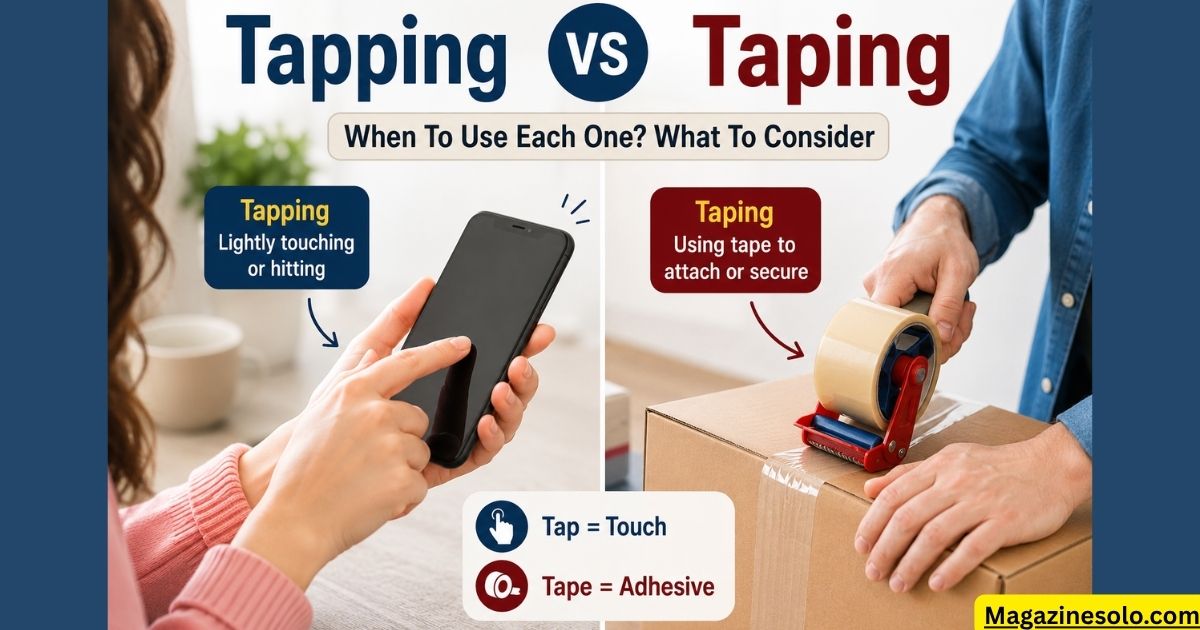
Tapping vs Taping: When To Use Each One? What To Consider
Have you ever paused while writing because you weren’t sure whether to use tapping or taping? Although these two words look almost identical, they have completely different meanings. Using the wrong one can confuse readers and change the meaning of your sentence.
The confusion usually comes from their similar spelling. However, tapping refers to lightly hitting, touching, drawing liquid, or selecting something on a screen, while taping means attaching, covering, or securing something with tape.
In this guide, you’ll learn the difference between tapping vs taping, when to use each word, common mistakes to avoid, plenty of real-life examples, and simple practice exercises. By the end, you’ll confidently know whether tapping or taping is the correct choice in any situation.
Define Tapping

Tapping is the present participle (the “-ing” form) of the verb tap. It describes the action of hitting something lightly and quickly, often repeatedly, with a light sound.
Tapping can refer to:
- Lightly striking a surface with your fingers, a pen, or your foot (tapping on the table)
- Accessing or drawing from a resource (tapping into a new market)
- Secretly listening to phone calls (phone tapping)
- Extracting liquid from a source (tapping a tree for syrup, tapping a keg)
- Making light physical contact in sports (tapping the ball)
Example: “She kept tapping her pen against the desk while she thought.”
Define Taping

Taping is the present participle of the verb tape. It refers to the act of using tape, sticky, adhesive material, to attach, seal, wrap, or secure something. It can also mean recording something using a tape or recording device.
Taping can refer to:
- Sticking two objects together with adhesive tape (taping a box shut)
- Wrapping an injury for support (taping an ankle)
- Recording audio or video (taping a podcast episode)
- Marking off an area with tape (taping off a construction zone)
Example: “He spent the afternoon taping up moving boxes for the big move.”
Tapping vs Taping: Quick Comparison Table
| Feature | Tapping | Taping |
| Base verb | Tap | Tape |
| Core meaning | Light, quick striking or accessing | Using tape to attach, seal, or wrap |
| Common uses | Tapping a table, tapping into resources, phone tapping | Taping a box, taping an ankle, taping a video |
| Sound involved | Yes (light tap sound) | No sound; physical adhesive action |
| Requires an object like tape | No | Yes, usually |
| Sports context | Tapping the ball, tapping in a goal | Taping a wrist or ankle for support |
How To Properly Use Tapping And Taping In A Sentence
The easiest way to decide between tapping and taping is to ask yourself: is something making light contact or sound, or is something being physically attached with tape?
Here’s a simple rule of thumb:
- If you’re describing a light, repeated physical action or accessing a resource, use tapping.
- If you’re describing the use of adhesive tape or recording something, use taping.
Correct usage of tapping:
- “The rain was tapping gently against the window.”
- “Investors are tapping into renewable energy funds this year.”
Correct usage of taping:
- “The physical therapist recommended taping my knee before the run.”
- “We’re taping the interview for the podcast tomorrow.”
A quick trick: if you can replace the word with “sticking tape on” and the sentence still makes sense, you need taping. If you can replace it with “lightly hitting” or “accessing,” you need tapping.
More Examples Of Tapping & Taping Used In Sentences
To fully understand the taping vs tapping difference, let’s look at more real-world examples.
Tapping examples:
- The detective suspected the line was being tapped.
- He’s been tapping his foot nervously all through the meeting.
- The company is tapping local suppliers to cut costs.
- Tapping the maple trees is an annual tradition on the farm.
- She was tapping away at her keyboard, finishing the report.
Taping examples:
- The coach was taping the players’ wrists before the match.
- I’m taping the edges of the wall before I start painting.
- The crew is taping today’s episode at noon.
- He used a whole roll taping the package for shipping.
- The nurse finished taping the bandage in place.
Notice how tapping tends to involve sound, rhythm, or accessing something, while taping almost always involves a literal roll of tape or the process of recording.
Common Mistakes To Avoid When Using Tapping & Taping
Even confident writers slip up here. Below are the most common errors people make and how to avoid them:
- Mixing up “phone tapping” with “phone taping.” It’s always phone tapping, referring to secretly listening in, not sticking tape on a phone.
- Writing “taping into” instead of “tapping into.” When you mean accessing a resource or opportunity, the correct phrase is always “tapping into,” never “taping into.”
- Using “taping” for injuries when you mean light touch. If a physiotherapist is applying strips of kinesiology tape, that’s taping. If someone is lightly tapping the injured area to test sensitivity, that’s tapping.
- Confusing “recording” contexts. When filming or recording something, “taping” is correct (a nod to old-school tape recorders), even though most modern recording is digital.
- Spelling errors under pressure. Because both words share almost identical letters, autocorrect can silently swap one for the other. Always proofread sentences with these words.
Context Matters: When to Use Tapping vs Taping
Context is everything when deciding between tapped or taped. Ask yourself these three questions before choosing:
- Is there physical adhesive tape involved? If yes, use taping.
- Is the action light, quick, rhythmic, or about accessing something? If yes, use tapping.
- Is this about recording audio or video? If yes, use taping, even for digital recordings, this usage has stuck around from the analog tape era.
Here’s how context changes meaning with the exact same setup:
- “She was tapping the box” → she was lightly knocking on it, perhaps to check what’s inside.
- “She was taping the box” → she was sealing it shut with adhesive tape.
Same object, completely different action, and completely different word.
Exceptions To The Rules: When Tapping and Taping Differ
While the general rules above cover most situations, English always has a few curveballs.
- Kinesiology taping vs medical tapping: In sports medicine, “taping” almost always wins, even though the process involves precise, careful application, it still uses physical tape, so “taping an ankle” is correct, not “tapping an ankle.”
- Tap dancing: Never becomes “tape dancing.” This is a fixed compound term referring to the dance style itself, using shoes with metal taps.
- Beer and kegs: “Tapping a keg” is correct because you’re inserting a tap (a valve) to release liquid, no tape involved at all, despite the phonetic similarity.
- Wiretapping vs videotaping: Both are legitimate compound words, but they mean opposite things, one is surveillance (tapping), the other is recording video (taping).
- British vs American English: Both dialects follow the same tapping/taping distinction, so there’s no regional variation to worry about here.
Practice Exercises: Test Your Understanding of Tapping vs Taping
Try filling in the blanks with either tapping or taping. Answers are listed below.
- The plumber was ______ into the main water line to install a new valve.
- We spent all evening ______ up posters for the school event.
- He kept ______ his fingers on the steering wheel to the beat of the song.
- The film crew is ______ the final scene this weekend.
- She’s ______ into her savings to pay for the trip.
- The trainer recommended ______ his ankle before the game.
Answers:
- Tapping
- Taping
- Tapping
- Taping
- Tapping
- Taping
If you got most of these right, you’ve got a solid grip on the tapping or taping rule. If not, revisit the comparison table above, it’s the fastest way to lock the difference into memory.
FAQ’s
Is it “tapped into” or “taped into”?
It’s always “tapped into,” as in accessing a resource, “taped into” is incorrect and not a standard phrase.
What is the past tense of tap and tape?
The past tense of tap is “tapped” (with a double p), and the past tense of tape is “taped” (single p, with an e).
Why does “tap” double the P but “tape” doesn’t?
Tap has one vowel and ends in a consonant, so the final consonant doubles before adding “-ing” or “-ed.” Tape already ends in a silent e, so you simply drop the e and add the ending.
Is phone surveillance “tapping” or “taping” a phone?
It’s “tapping” a phone, the term comes from physically tapping into a telephone line to intercept calls.
Do you say “taping a video” or “tapping a video”?
You say “taping a video,” a phrase that comes from the days of recording onto physical videotape, even though most recordings today are digital.
Is it correct to say “tapping an injury” in physiotherapy?
No, the correct term is “taping an injury,” since it involves applying physical adhesive tape for support.
Final Thoughts
The difference between tapping and taping comes down to one simple test: does it involve a light, quick action or accessing something (tapping), or does it involve adhesive tape or recording (taping)? Once you internalize this distinction, you’ll never second-guess yourself again, whether you’re writing about tapped or taped events, describing a taping or tapping situation at work, or explaining an injury to your physiotherapist.
Keep the comparison table handy, run through the practice exercises whenever you’re unsure, and soon choosing between tapping or taping will become second nature, accurate, confident, and completely mistake-free.

Shoaib Ahmad is a language-focused content writer and researcher at magazinesolo.com, where he explains the meaning of words, phrases, and text in a clear and reader-friendly way. His work focuses on simplifying language, uncovering context, and helping readers understand text with confidence and clarity.