Imply vs Infer Difference: The Table First Guide
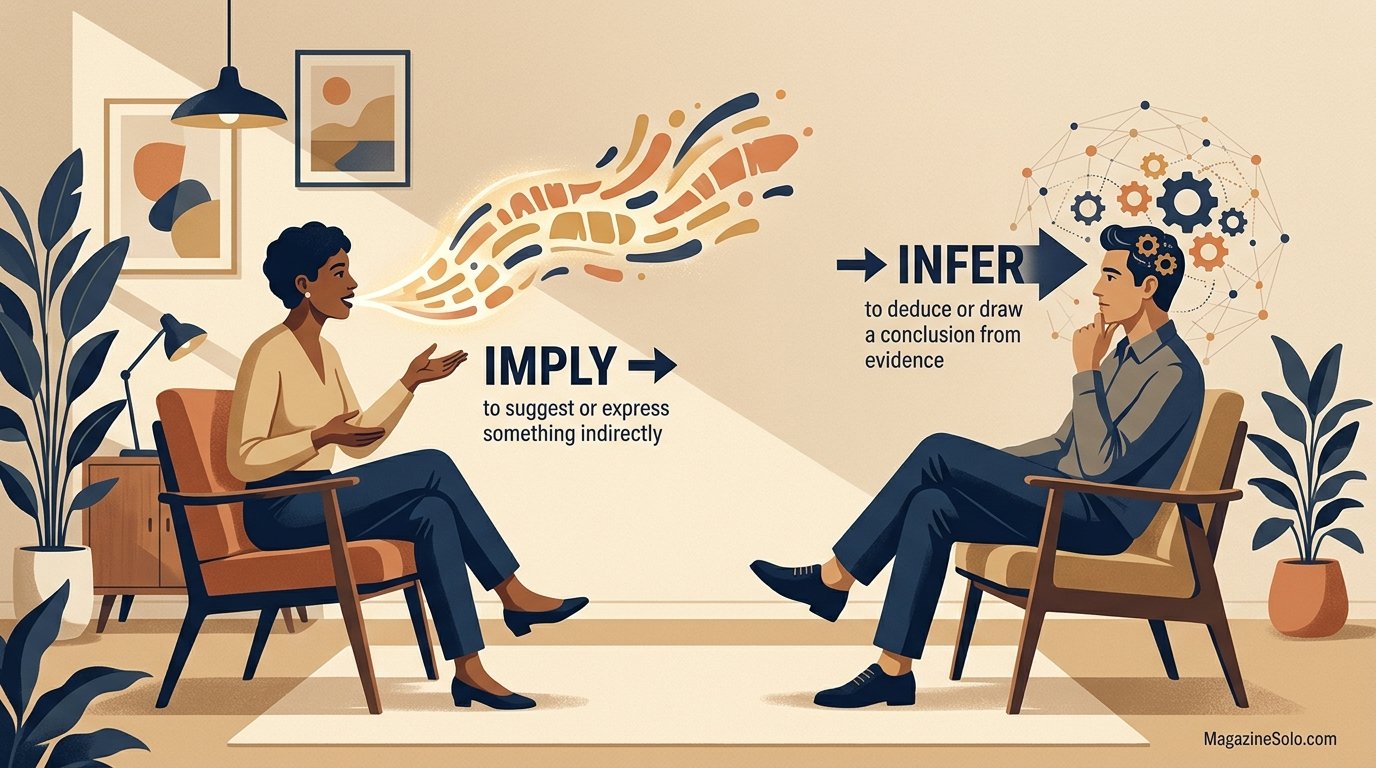
The imply vs infer difference is a difference of direction, and once you see the direction, the two words stop competing for the same sentence.
Imply travels out of the speaker or writer. To imply is to suggest something without stating it, folding meaning into a message for someone else to find.
Infer travels in to the listener or reader. To infer is to draw a conclusion out of evidence, carrying meaning out of a message someone else sent.
That one contrast organizes everything else on this page. The table comes first, then both verbs in depth, the analogies tested, and the famous debate reported honestly.
Readers who want the pair inside one longer treatment can open the imply vs infer guide after this page. This page stays on the difference itself, table first, throughout.
The Difference Table
|
Feature |
Imply |
Infer |
|---|---|---|
|
Core meaning |
Suggest without stating |
Conclude from evidence |
|
Who acts |
Speaker, writer, text, data |
Listener, reader, investigator |
|
Direction |
Out of the sender |
Into the receiver |
|
Swap word |
Suggest or hint |
Conclude or deduce |
|
Usual partner |
A that clause or an object |
The preposition from |
|
Noun form |
Implication |
Inference |
|
Adjective form |
Implied |
Inferred |
|
Failure mode |
Using infer for hinting |
Using imply for concluding |
Read the failure mode row twice. Almost every real world error is one of those two swaps, and both come from losing track of who is acting.
The Cambridge grammar guide states the rule in its shortest official form. A speaker can imply, while a listener can only infer, and infer pairs with the preposition from.
Notice what the table does not contain. There is no row for tone, topic, or formality, because none of those decide the choice. Direction decides it, every time.
A single worked moment shows all eight rows at once. Her raised eyebrow implied doubt, and from that eyebrow he inferred that the plan was dead.
Imply in Depth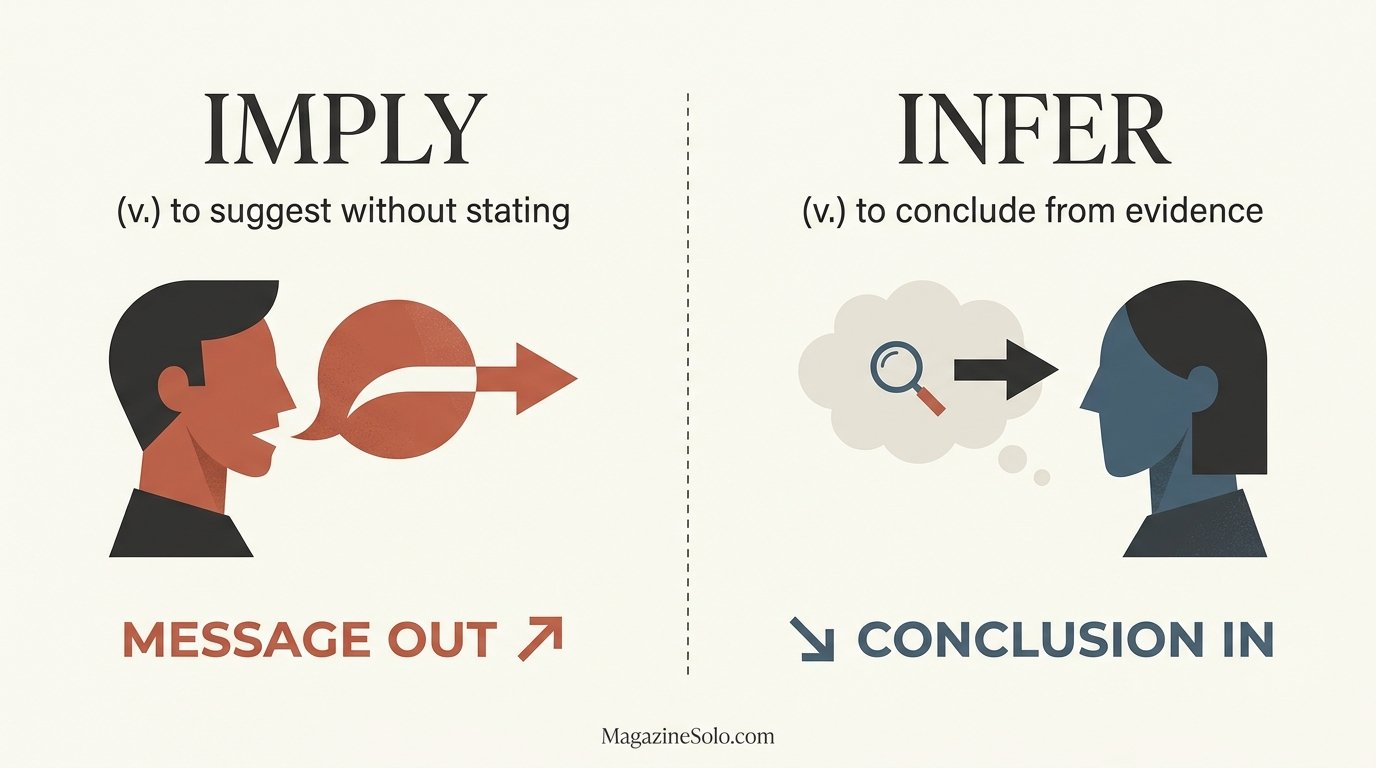
Imply is the sending verb. It belongs to whoever or whatever produces the message, and its object is the suggestion being sent.
The suggestion can ride on more than words. Tone implies, silence implies, a pause implies, and a chart implies whenever it points somewhere without saying so.
The Touro writing center tutorial collects real sentences from the Oxford English Corpus for this verb. Its examples show speakers suggesting beliefs and opinions while leaving conclusions to the receiver.
Imply has two senses, and the table only covers the first. The hinting sense dominates conversation, while the entailment sense runs logic, law, and science writing.
In the entailment sense, imply means involve by necessary consequence. Smoke implies fire, and a signed contract implies obligations, with no hinting anywhere in sight.
Keep the senses apart in your own writing. A word swap that works for hinting collapses on entailment, because hint cannot replace imply in smoke implies fire.
Imply sits inside a small family of sending verbs. Hint is its plain cousin, suggest its neutral twin, and insinuate its darker relative with a sting attached.
Infer in Depth
Infer is the receiving verb. It belongs to whoever works meaning out, and its raw material is evidence of any kind.
Evidence is a wider word than message. A listener infers from words, but a doctor infers from symptoms and a forecaster infers from clouds, with no sender present.
That width explains infer’s second career. In reading lessons, making an inference is a named skill, and in science it is the verb of results sections everywhere.
The Scribbr difference guide models the academic pattern with data sentences. The results imply that a technique works better at higher temperatures, and researchers infer conclusions from the data.
Infer takes the preposition from. You infer from a tone, from a text, from the empty chairs. The preposition is a free direction marker whenever you are unsure.
The past forms carry a spelling flag. Infer doubles its final r under stress, so its past is inferred and its gerund is inferring, a detail exams love.
Infer also has neighbors on the receiving side. Deduce is its stricter sibling, assume its careless one, and guess its evidence free relative.
The Family Table: Nouns, Adjectives, and Forms
|
Form |
Imply side |
Infer side |
|---|---|---|
|
Verb |
Imply (suggests) |
Infer (concludes) |
|
Past tense |
Implied |
Inferred |
|
Noun |
Implication |
Inference |
|
Adjective |
Implied |
Inferred |
|
Gerund |
Implying |
Inferring |
The family never crosses. An implication is the content suggested, never the conclusion drawn, and an inference is the conclusion drawn, never the hint itself.
Journalism guards this border daily. Reports write about the implications of a ruling and about the inferences readers drew, and swapping the nouns reverses the story.
The spelling rows settle a common hesitation. Imply changes its y to i in implied, while infer doubles the r, and neither form borrows the other’s pattern.
The WordsTrivia differences explainer walks through the implied meaning and inference contrast with a weather example. A friend hints at rain, and the listener infers that the windows should close.
Test the Analogies: Where Each One Breaks
Analogies teach this pair faster than definitions do. They also break at the edges, and knowing the breaking point is what separates a trick from a rule.
1. Pitcher and catcher
A widely shared food blog frames the speaker as the pitcher who throws the hint and the listener as the catcher who receives it. For conversation, the image is excellent.
It breaks the moment nobody throws anything. Dark clouds imply rain with no pitcher on the field, so the analogy covers talk and fails the weather.
2. Send and catch
Teaching sites describe meaning traveling out of the speaker and into the listener. This frame survives more cases, because texts and reports can send without a person present.
It still strains on pure evidence. A detective infers from fingerprints that nobody sent as a message, which makes catch a loose word for the act.
3. Fold in and carry out
The Latin roots give the oldest analogy. Imply folds meaning in (implicare), and infer carries meaning out (inferre), matching what each verb does to a message.
This one survives the entailment test best of the three. Smoke folds fire into itself by necessity, and the observer carries the conclusion out.
Use analogies as ladders, not laws. Climb with whichever frame clicks, then check hard sentences against the direction rule, which has no breaking point.
The Swap Test: A Ten Second Check
When a live sentence stalls you, swap before you think. Replace the verb with suggest and then with conclude, and keep the version that survives.
She implied that the meeting was over. Suggest fits perfectly, conclude collapses, so imply is right and the sentence needs no further thought.
I inferred from his email that the meeting was over. Conclude fits perfectly, suggest collapses, so infer is right, and the preposition from confirms it.
The test works because the swap words are direction pure. Suggest only sends, conclude only receives, and neither carries the historical baggage the real pair carries.
Run it silently while editing. Most writers find the hesitation vanishes within a week, because the test turns a memory problem into a mechanics problem.
The GrammarBook usage guide maps the neighborhoods the same way. Imply is akin to suggest and insinuate, while infer is akin to deduce and conclude, in its wording.
Speaker Free Inference: Evidence Beyond Messages
The deepest difference between the verbs hides in one asymmetry. Implication needs a message, while inference needs only evidence, and the two requirements are not the same.
A fossil implies nothing to anyone by itself in the hinting sense. Yet a paleontologist infers diet, gait, and habitat from that fossil all day long.
Weather makes the same point for everyone. You infer rain from a falling barometer, and no meteorologist had to hint anything at you first.
This asymmetry explains the school curriculum. Reading programs teach inference as a skill because receiving is trainable, while implying well is a matter of style and taste.
It also explains the science usage. Instruments produce evidence continuously, and infer is the verb that turns evidence into claims, with no sender in the loop.
When a sentence has no message at all behind it, imply is almost certainly wrong in the hinting sense. Reach for infer, or check whether entailment is at work.
The Debate, Honestly: Five Centuries of Overlap
No honest difference page can skip the argument. The disputed use, infer where edited prose wants imply, has been fought over for generations.
The historical record is real. Writers from Shakespeare to Austen used infer in the suggesting sense, and the overlap reaches back to the sixteenth century.
As late as 1976, the Concise Oxford Dictionary still treated the two words as interchangeable. The strict split is a modern editorial preference, not an ancient law.
Merriam-Webster holds both facts at once. Its usage guide calls infer for imply commonly identified as an error, especially with a human subject, yet a matter of preference overall.
Its Unabridged style guide is firmer for print. Infer for imply is not widely accepted in print and best avoided there, whatever conversation allows.
The Daily Writing Tips stylebook roundup gathers the stylebook chorus in one place. Chicago, the Penguin Writers Manual, and the Fowler tradition all keep the split for careful writers.
The house position is simple. Keep the split in anything edited, teach the rule without apology, and report the history without pretending it away.
Writers sometimes ask which side an exam board will take in a disputed sentence. The safe answer is the edited prose side, because boards mark against published style guides, not against Shakespeare.
That is not hypocrisy, it is register. Formal writing is a uniform, and this split is part of the uniform, whatever the same words do in conversation.
That position protects you in both directions. Examiners and editors grade by the split, while historians cannot catch you inventing a timeless law.
Worked Sentences: The Difference in Action
Pair one, the office. My manager implied that the deadline was unrealistic. From her tone, I inferred that she wanted the schedule rebuilt.
Read the pair by direction. She sent the suggestion without stating it, and the listener converted tone into a conclusion, exactly as the table predicts.
Pair two, the accusation. Are you implying that I cheated? is the correct charge, because the speaker owns the suggesting side of the exchange.
Cambridge gives that sentence as the model and rejects the inferring version. The question accuses a sender, so only the sending verb can stand in it.
Pair three, the laboratory. The results imply that the technique improves with heat. We infer from the results that the effect is real and repeatable.
Notice the same data doing both jobs. The results send in one sentence, the researchers receive in the next, and neither verb can trade places.
Pair four, the entailment trap. Smoke implies fire, and from the smoke we inferred that something was burning. Hinting is absent entirely from the first half.
That fourth pair is the page in miniature. One exchange can hold hinting, entailment, and inference at once, and direction sorts all three without effort.
Mistakes to Avoid
Mistake one: infer for imply with a human subject. Are you inferring that I lied is the classic error, because the subject is a speaker, not a receiver.
Mistake two: imply from. Writers blend the pair into imply from his tone, which mixes the sending verb with the receiving preposition and satisfies neither.
Mistake three: flattening entailment into hinting. Study guides that call every imply a hint leave students helpless before contracts, logic, and smoke implies fire.
Mistake four: trusting the analogy over the rule. Pitcher and catcher is a fine ladder for conversation and a broken one for data, reports, and weather.
Mistake five: swapping the nouns. Writing the inferences of a policy when you mean its implications reverses who suggested and who concluded in formal prose.
Mistake six: one r in inferred. The doubled r is a spelling signature of the receiving verb, and dropping it marks the sentence before its meaning is read.
The same discipline runs through the whole confused words shelf at MagazineSolo. Direction pairs reward the reader who asks one question: who is acting here?
Sibling Direction Pairs on This Site
This pair belongs to a family of direction twins, and the method that settles one of them settles all of them.
Start with the emigrate vs immigrate guide, which turns on viewpoint toward a country. One person emigrates from a place and immigrates to it, and the reference point picks the word.
Its companion, the emigrate vs immigrate difference page, lays the same contrast out as a difference table. Readers who like the table first format will feel at home there.
A three way cousin lives at the ensure, insure and assure trio guide. Ensure, insure, and assure divide by object, and the object test plays the role the swap test plays here.
Spelling twins get the same treatment at the desert vs dessert guide. Desert and dessert differ by one letter and a whole landscape, and the difference framing carries it.
Even buildings join the family at the capital vs capitol difference page. A capitol is a building and capital is everything else, and scope, like direction, settles the sentence.
The Difference at Work in Four Domains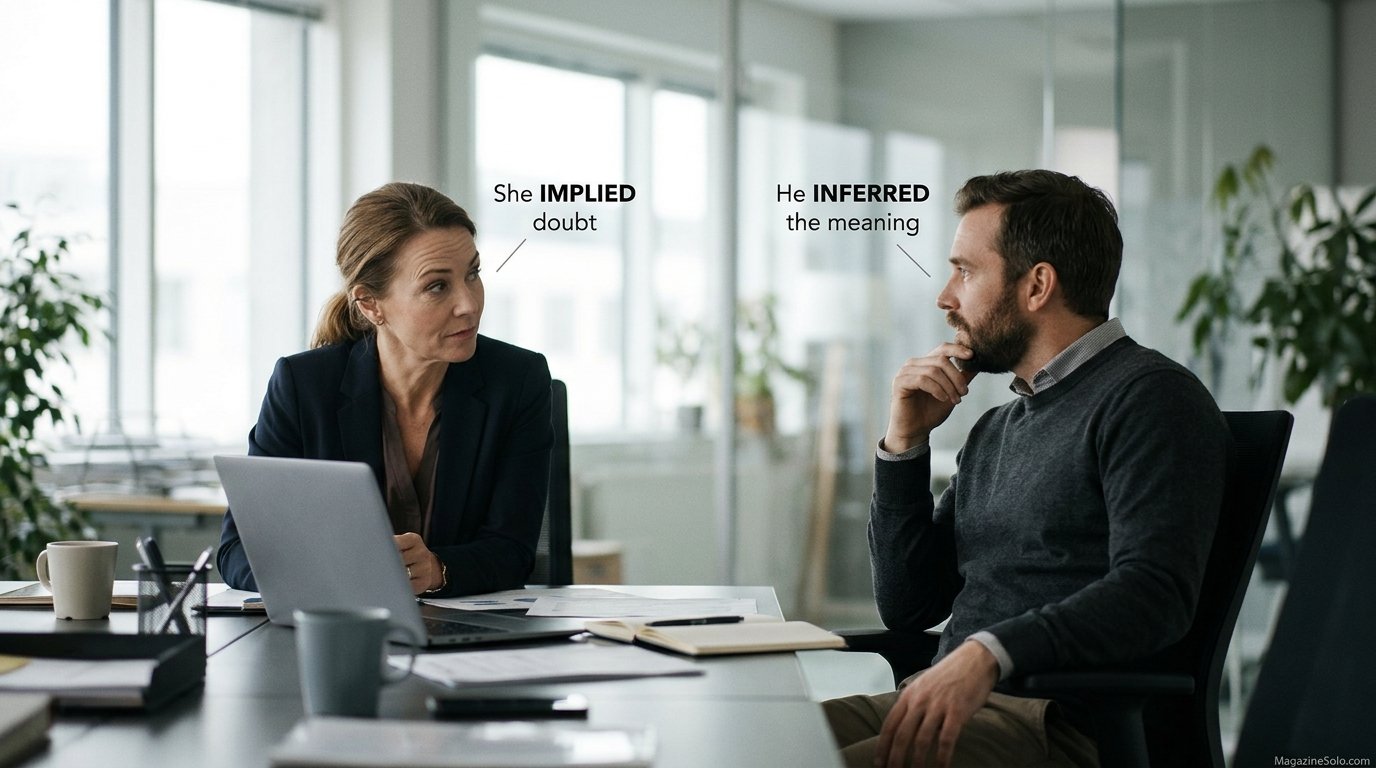
The table survives contact with real professions. Each domain leans on one side of the pair harder than the other, and the leaning is itself instructive.
In law, the entailment sense rules. Contracts imply terms, silence implies consent in narrow settings, and courts ask what a reasonable reader would infer from the record.
In science, both verbs earn their keep daily. Data imply relationships, and researchers infer mechanisms, in the same paragraph, without either verb feeling borrowed.
In classrooms, inference is the trained skill. Reading assessments score the conclusions students draw, while teachers imply expectations they never state as rules.
In journalism, the nouns do the heavy lifting. Implications belong to events and rulings, while inferences belong to analysts, and editors swap them back on sight.
Notice the pattern across all four. The professional stakes change, the direction does not, which is why one small table governs so much prose.
Writers who move between domains feel the continuity physically. The same hand that drafts a results paragraph in the morning edits a student essay at night, and one direction habit serves both desks without translation.
A Twelve Sentence Drill
Sorting sentences is the fastest way to own the difference. Read each item, name the actor, and let the direction pick the verb before you check the reasoning.
Item 1: Her silence ____ agreement. Silence sends a suggestion, so implied fits, and the entailment sense may also be argued.
Item 2: From her silence, I ____ that she agreed. The listener concludes from evidence, so inferred fits, with from as the marker.
Item 3: The data ____ a link between sleep and memory. Data send a suggestion here, so imply fits in its reporting sense.
Item 4: We ____ from the data that sleep protects memory. Researchers conclude from evidence, so infer fits, again with from beside it.
Item 5: Are you ____ that I copied the file? The accused act is suggesting, so implying fits, and Cambridge models this exact charge.
Item 6: He never said the plan failed, but he ____ it. He sent the meaning unstated, so implied fits on the speaker side.
Item 7: From the empty office, she ____ the meeting had moved. She concluded from evidence, so inferred fits on the receiver side.
Item 8: Smoke ____ fire. No hinting exists here, so imply fits only in its entailment sense of necessary consequence.
Item 9: The report ____ that costs will rise. A text sends the suggestion, so implies fits, matching newsroom usage everywhere.
Item 10: Readers ____ from the report that costs will rise. Readers draw the conclusion, so infer fits, completing the report pair.
Item 11: His shrug ____ that he did not care. A gesture sends the message, so implied fits, because messages include body language.
Item 12: From his shrug, I ____ that he did not care. The observer concludes, so inferred fits, closing the pair the drill began with.
Six pairs, twelve sentences, one rule. Every answer came from asking who acts, and none required memorizing a list of exceptions.
The Difference in One Glance
For readers who keep a note app open, the whole topic compresses into a pocket card. Copy it, and the next hesitation resolves itself.
Imply: speaker side, suggest, out of the message, Latin fold in, noun implication, past implied.
Infer: listener side, conclude, into the conclusion, Latin carry in, noun inference, past inferred with a double r.
Test: swap in suggest or conclude. Marker: infer takes from. Trap: infer for imply with a human subject.
Debate: edited prose keeps the split, history shows overlap, and both facts fit on the card without fighting.
From here, the imply vs infer guide carries the pair into its full treatment. This page remains the difference card of the cluster, the one the table belongs to.
Why the Confusion Persists: Four Causes
Understanding why a mix up survives helps writers forgive themselves and fix it. Four causes keep this pair tangled long after the rule is learned.
Cause one: the words describe one event. A hint given and a hint taken feel like a single act, so one verb tries to cover both ends.
Cause two: the words sound like relatives. Shared letters invite shared meaning in the mind, the same trap that catches emigrate and immigrate.
Cause three: history blesses the error. Centuries of respected writers used infer for imply, so the ear has heard the wrong version in good company.
Cause four: conversation forgives everything. Listeners decode intent from context, so the swap rarely breaks communication, and unbroken habits never get repaired.
Editing is where the bill arrives. What conversation forgives, examiners, editors, and clients charge for, which is why the fix belongs to the writing stage.
Five Hard Cases, Ruled
Rules earn trust at their edges. These five sentences sit near the border, and each ruling shows the direction test doing real work.
Case 1: The report inferred that costs would rise. Ruled wrong in edited prose, because reports send rather than conclude, whatever their authors intended.
Case 2: We implied from the data that the drug worked. Ruled wrong, because from belongs to the receiving verb; the sentence wants inferred.
Case 3: His contract implies a duty of care. Ruled right, and not as hinting; this is the entailment sense, where imply means involve by consequence.
Case 4: She inferred that the witness was lying, but said nothing. Ruled right; a silent conclusion is still a conclusion, drawn from testimony as evidence.
Case 5: The teacher implied a quiz, so we inferred a study night. Ruled right as a pair; one exchange, two verbs, each on its own side.
Two of the five rulings turn on grammar furniture rather than meaning. The preposition from and the human subject test catch errors the swap test might miss.
Keep all three tests in the kit. Direction decides, the swap confirms, and the furniture (from, subject, sense) settles whatever remains.
The Roots and the Lesson
The oldest teaching aid for this pair is buried in the words themselves. Latin built the direction into both verbs before English borrowed them.
Imply descends from implicare, to fold in. A speaker folds extra meaning into a message the way a letter folds into an envelope, present but not displayed.
Infer descends from inferre, to carry in or bring in. The listener carries a conclusion away from the evidence, bringing it into their own understanding.
The roots explain the prepositions for free. Meaning folded in is found in the message, while conclusions are carried from the evidence, exactly as usage demands.
Teachers can run the whole topic in five minutes with that picture. Fold a note into an envelope, have a student carry out what it means, and the class owns the pair.
Step 1: show the fold. Write a hint on paper, fold it inside a plain sentence, and ask what else the sentence now carries.
Step 2: show the carry. Have the class state the conclusion and name the evidence it was carried from, out loud, in that order.
Step 3: run the swap. Take one wrong sentence from real homework and let suggest and conclude vote on the correction publicly.
Step 4: test an analogy. Offer pitcher and catcher, then ask what happens when rain clouds do the implying, and watch the class find the edge.
Step 5: close with the card. Imply out, infer in, from beside infer, double r on inferred, and the debate saved for anyone who asks.
Parents helping with homework can borrow the same five steps wholesale. The lesson needs no worksheet, because the sentences already live in the child’s own writing.
That is the deepest service a difference page can offer. Not a ruling to memorize, but a picture that keeps ruling correctly long after the page is closed.
A last check before the questions. If a sentence resists all three tests, read it aloud and ask what a careful editor at a newspaper would print, then print that.
Editors are the living memory of the split. Their collective habit, not any single dictionary, is what edited English means in practice for this pair.
One more distinction belongs on the record before the questions. Implied and inferred also divide evidence law, where an implied admission and an inference drawn by a jury carry different weight in argument.
Writers outside law can borrow the caution anyway. Naming a conclusion an inference admits it was drawn, while calling content implied admits it was never stated, and honest prose owns both admissions.
Worth stating once, plainly: nobody is confused by the concept. Everyone understands hinting and concluding perfectly; only the labels slip, which is why mechanical tests beat memorized definitions here.
Carry one sentence out of this page if nothing else survives the week. The speaker folds meaning in, the listener carries meaning out, and every correct sentence you will ever write with this pair is that picture applied once.
File the card where you will actually see it, inside the document you edit most, and let repetition finish the teaching.
Frequently Asked Questions
1. What is the difference between imply and infer?
Direction. Imply travels out of the speaker or writer, who suggests without stating.
Infer travels into the listener or reader, who concludes from evidence.
2. What is the difference between imply and infer in simple words?
The speaker hints, the listener works it out. Imply is giving a hint without saying the thing.
Infer is figuring out the thing from the hint.
3. Imply vs infer: who does what in a conversation?
The speaker implies and the listener infers. One person puts the suggestion into the message, and the other takes a conclusion out of it.
4. What is the difference between implication and inference?
One is sent, one is drawn. An implication is the content suggested by a statement.
An inference is the conclusion a person draws from evidence.
5. What is the difference between implied and inferred?
Implied describes the hint, inferred describes the conclusion. Implied meaning is suggested but unstated.
Inferred meaning is worked out by the receiver.
6. How is imply different from infer inside a sentence?
Check the subject. If the subject is sending a suggestion, use imply.
If the subject is reaching a conclusion, use infer, and the sentence settles.
7. Can you give one example that shows the difference between imply and infer?
His tone implied criticism, so I inferred that he was unhappy. The tone sent the suggestion, and the listener drew the conclusion from it.
8. Are imply and infer synonyms or opposites?
Partners, not synonyms. The words describe opposite ends of one exchange, so they are closer to opposites in direction while belonging to the same moment.
9. Why do people confuse imply and infer so often?
They describe the same moment. One act of hinting and reading happens at once, the words sound alike, and everyday speech has blurred them for centuries.
10. What is the difference between imply and insinuate?
Insinuate is imply with a sting. To insinuate is to hint at something unflattering or sneaky.
Imply is neutral and covers any indirect suggestion.
11. What is the difference between infer and deduce?
Deduce is stricter. Deduction follows logic to a conclusion that must hold.
Inference is broader and includes conclusions that are probable rather than certain.
12. What is the difference between infer and assume?
Inference needs evidence. To infer is to conclude from clues.
To assume is to take something for granted without checking the clues first.
13. What is the difference between imply and hint?
Hint is the plain word for part of imply. Imply also covers suggestions carried by tone, situations, and data, plus its entailment sense, which hint cannot.
14. How do you remember the difference between imply and infer?
Use the swap test. Replace the word with suggest or with conclude.
The replacement that keeps the sentence standing names the correct verb every time.
15. What is the pitcher and catcher rule for imply and infer?
The speaker pitches, the listener catches. In that analogy the speaker throws the hint by implying, and the listener catches the meaning by inferring.
16. Does the pitcher and catcher analogy always work?
No, it breaks without a message. Data can imply a result and scientists can infer from measurements where nobody threw a hint, so direction outlasts the analogy.
17. What is the swap test for the imply infer difference?
Substitute and listen. Put suggest in place of imply and conclude in place of infer.
The version that collapses is the wrong choice.
18. Can a report or a set of data imply something?
Yes. Texts, reports, data, and situations imply things whenever they suggest a conclusion without stating it, because implication rides on messages, not only voices.
19. Can you infer something from silence or from weather?
Yes. Inference runs on any evidence, including silence, clouds, symptoms, and measurements.
Only implication needs a message behind it.
20. Does infer need a speaker the way imply does?
No. A speaker is required only on the imply side.
Inferring needs evidence, and evidence does not need anyone to send it.
21. What preposition shows the difference with infer?
From. Infer takes from, as in infer from his tone.
Imply usually takes a that clause or an object, never from.
22. Is the difference between imply and infer the same in British English?
Yes, the same split. British and American edited English both keep speaker implies and listener infers, and Cambridge teaches the identical rule.
23. How is the difference tested in exams?
As a direction item. Tests plant are you implying or inferring sentences and reading inference questions, and both are settled by asking who acts.
24. How is making an inference in reading different from implying?
Reading inference is the infer side at work. The reader draws conclusions the text never states, while the author side of the page is the implying side.
25. What is the difference between implied meaning and inferred meaning?
Suggested against worked out. Implied meaning is what a message carries without stating.
Inferred meaning is what a reader concludes from that message.
26. Did writers in the past treat imply and infer as the same word?
Yes, often. Writers from Shakespeare to Austen used infer where edited prose now uses imply, and dictionaries treated the words as interchangeable for centuries.
27. What do style guides say about the difference between imply and infer?
They keep the split. Chicago, the Penguin Writers Manual, and the Fowler tradition all reserve imply for suggesting and infer for concluding in edited prose.
28. What does the Chicago Manual of Style say about imply vs infer?
Keep them distinct. The Chicago position, quoted across the field, is that writers and speakers imply while readers and listeners infer, and careful writers distinguish them.
29. Is using infer to mean imply an error or an accepted use?
Both, depending on the room. Usage guides call infer for imply an error in edited writing, while dictionaries record it as a long standing use.
30. What does Merriam-Webster say about the difference?
A matter of preference, with a warning. Merriam-Webster records centuries of overlap yet notes the disputed use is commonly identified as an error, especially with a human subject.
31. What is the entailment sense of imply and how is it different from hinting?
It means involve, not hint. In smoke implies fire, imply means to indicate by necessary consequence.
No speaker is hinting, so hint cannot replace it.
32. What are the past tense forms, and how do implied and inferred differ in spelling?
Implied and inferred. Imply changes its y to i before ed.
Infer doubles its final r, giving inferred and inferring, because the stress falls there.
33. Why does inferred have a double r but implied does not?
Stress decides it. Infer is stressed on the second syllable, so the final consonant doubles before ed and ing.
Imply ends in y, which changes instead.
34. What is the difference between imply and infer in academic writing?
The split is load bearing. Papers write that results imply and authors infer from data, and examiners read the wrong verb as a reasoning error.
35. Can imply and infer describe the same event from two sides?
Yes, that is the normal case. One exchange holds both verbs: she implied the deadline was unrealistic, and he inferred that help was needed.
36. What is the difference between imply and infer in one line?
Speaker implies, listener infers. Everything else in the topic is that single line of direction applied to new sentences.
37. How do teachers explain the difference between imply and infer?
With the message journey. Teachers show a suggestion going into the message and a conclusion coming out, then drill the pair with worked sentences.
38. Which is correct: she never said it, but she implied it or inferred it?
Implied. She sent the suggestion without stating it, which is the speaker side, so imply is the only verb that fits.
39. Which is correct: from his tone I implied or inferred that he was angry?
Inferred. The conclusion was drawn from evidence, his tone, which is the receiver side, so infer is the correct verb.
40. Is are you implying or are you inferring the correct question?
Implying. The question accuses the speaker of suggesting something, and speakers imply.
Cambridge gives that exact sentence as the correct model.
41. Can data imply something, or can only people imply?
Yes. Data and results imply whenever they point to a conclusion, a use Scribbr models in academic examples, while researchers infer from the same data.
42. How is the imply infer difference like the emigrate immigrate difference?
Direction again. One person emigrates from and immigrates to, just as one speaker implies and one listener infers; the viewpoint picks the word.
Conclusion
The imply vs infer difference never changes, because it was never about the words themselves. It is about which end of the exchange your sentence is standing on.
Keep the table in reach. The speaker implies, the listener infers, implication is sent and inference is drawn, and the doubled r marks the receiving verb.
Use the analogies as ladders. Pitcher and catcher teaches the conversation case, the Latin roots survive the hard cases, and the direction rule survives all of them.
Take the sentence that brought you here and run the swap test on it once. Suggest or conclude will fit, the other will collapse, and the difference will stay learned.

Dilawar is a content writer at MagazineSolo, covering travel, home improvement, interior design, and everyday lifestyle topics. He enjoys researching practical solutions, exploring travel destinations, and sharing helpful guides that make daily life easier. His writing focuses on clear information, useful advice, and engaging stories for a wide audience.