Passed vs Past Difference: The Side by Side Table and Every Trap Pair Compared
The passed vs past difference is not a spelling preference. One word is a verb, and the other can never be one.
Lay them side by side and the contrast is total. Passed acts; past names, describes, and points beyond things.
This page is built as a comparison, because the query is one. A master table first, then the difference by dimension, then every trap pair.
The tests still matter, and they appear here as difference detectors. But the table is the product, and it starts below.
One honest footnote rides along: the sources disagree at exactly one edge of this difference, and the disagreement is printed, not hidden.
The Difference in 20 Seconds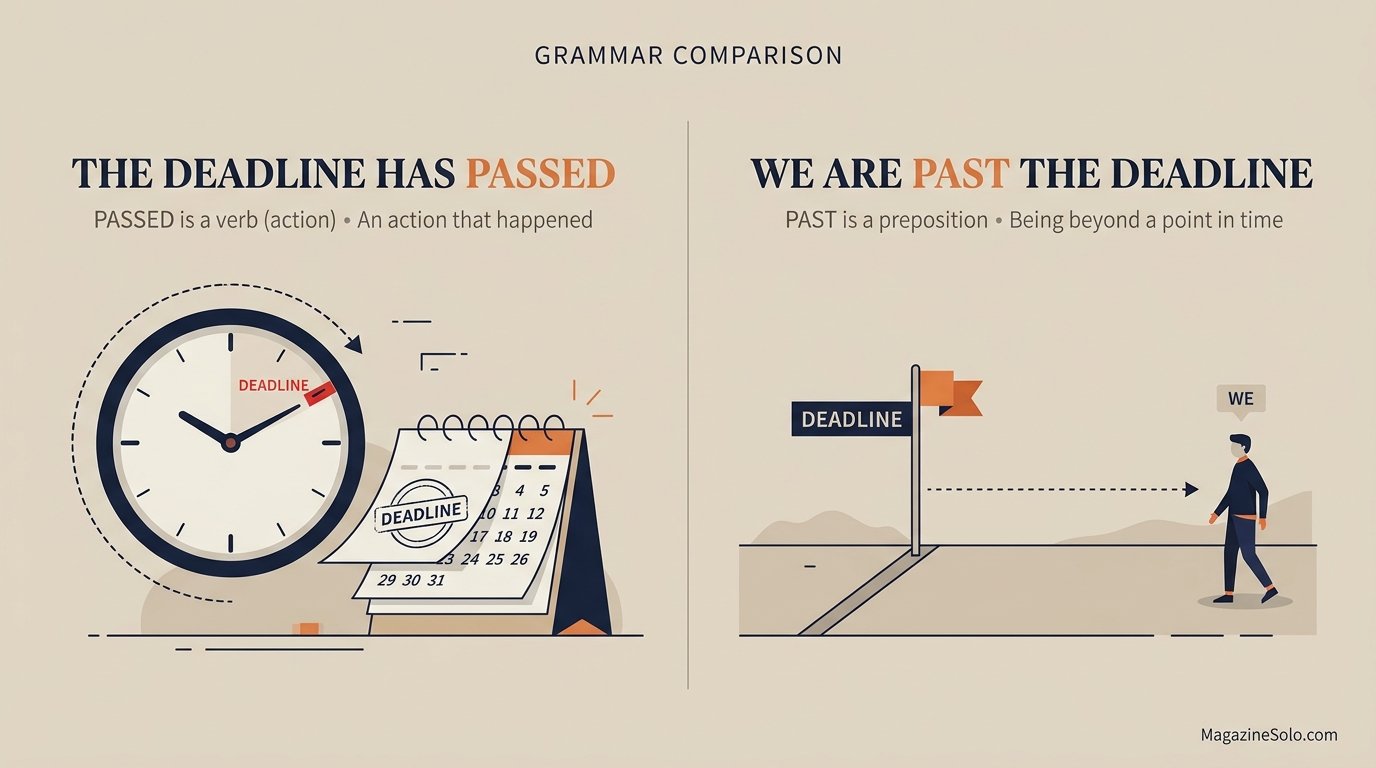
Passed is the verb system’s word. Past tense and past participle of pass: she passed, time has passed, the bill was passed.
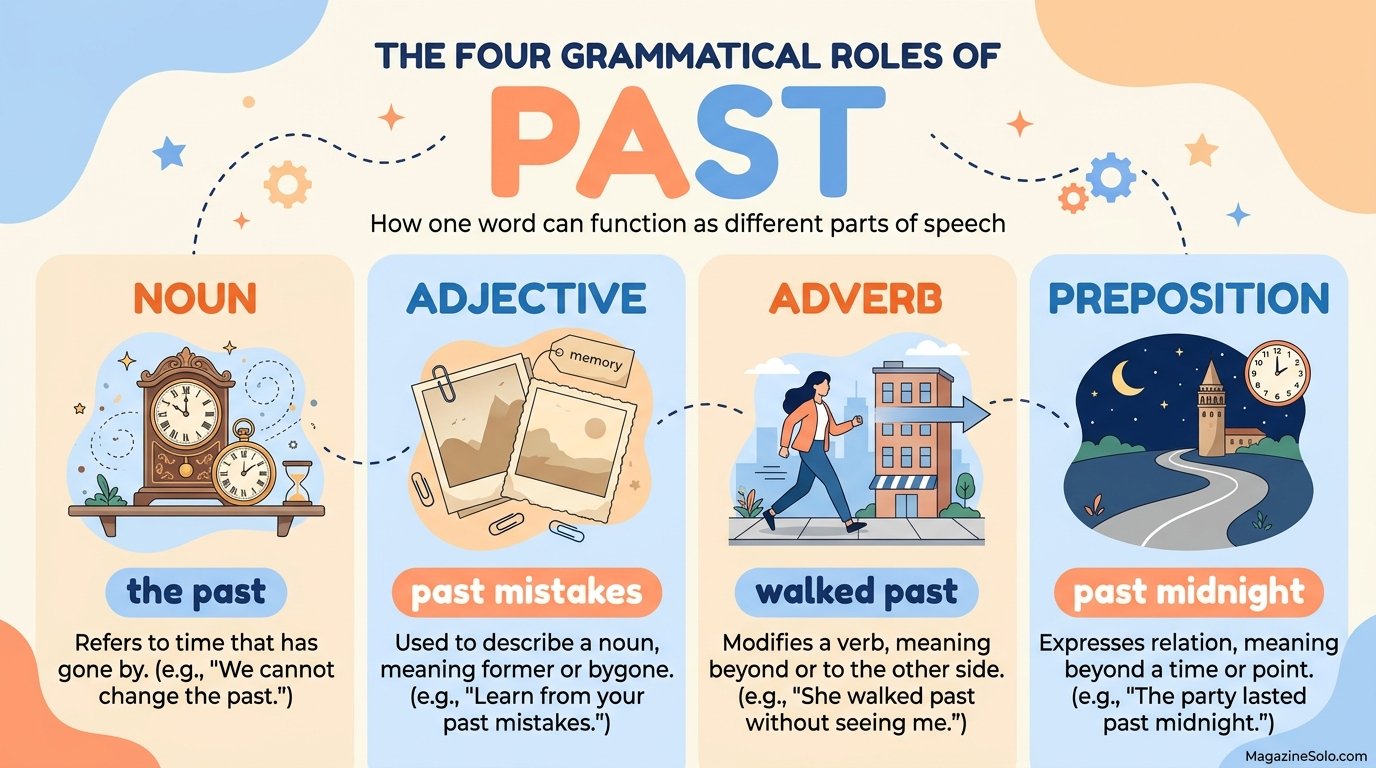
Past is the naming system’s word. Noun, adjective, adverb, and preposition: the past, past mistakes, walked past, past midnight.
The detector: rebuild the sentence in the future tense. Passed changes into will pass; past does not change at all.
If you keep only the table and those three lines, you hold the whole difference. The rest of the page is the difference, dimension by dimension.
The Master Difference Table: Passed vs Past
|
Dimension |
Passed |
Past |
|---|---|---|
|
Word class |
Verb only (past tense and participle of pass) |
Noun, adjective, adverb, preposition |
|
In the future swap |
Changes: will pass |
Never changes |
|
After has / was |
Yes: has passed, was passed |
Never |
|
Job in the sentence |
Does the action |
Names, describes, points beyond |
|
Answers |
What happened? |
When? Where beyond? |
|
Example |
The deadline has passed. |
We are past the deadline. |
|
Clock time |
Never used |
Half past ten, ten past three |
|
Sound |
Identical to past |
Identical to passed |
Read the table by rows. Each row is a complete difference on its own, and any one row can settle a doubtful sentence.
The strongest row is the swap. Form changing under time travel is a verb’s fingerprint, and past has no fingerprint to leave.
Difference by Word Class: One Job vs Four Jobs
The headline difference is arithmetic. Passed holds one job in the language; past holds four, and none of them is the verb’s.
Merriam-Webster’s framing captures it: past is a very busy word, while passed stays busy inside a much narrower role.
Passed: The Verb Family Only
Passed lives entirely inside the verb pass. Move, hand, succeed, enact, elapse, die gently: every sense is something a subject does.
A crisp statement of the same cut runs in the Grammarly past vs passed guide, built on the line that passed is always a verb.
The absolutist edge appears in the LanguageTool passed or past guide: passed can only ever function as a verb. The disagreement about that edge comes later on this page.
Past: Noun, Adjective, Adverb, Preposition
Past’s four jobs share one spelling. The noun names earlier time, the adjective marks former things, the adverb trails movement verbs, the preposition means beyond.
The entry at the Cambridge Dictionary past entry shows the structure plainly: preposition and adverb entries, a noun entry, and no verb entry at all.
|
Past’s job |
Difference marker |
Example |
|---|---|---|
|
Noun |
Takes the article the |
Learn from the past. |
|
Adjective |
Sits before a noun |
Past generations knew hunger. |
|
Adverb |
Follows a movement verb |
The bus drove past. |
|
Preposition |
Means beyond |
Just past the post office. |
One pattern reverses the adjective. In years past, the adjective follows its noun, a survival called postposed, and it matters in the trap pairs below.
Difference by Behavior: Tenses, Passives, and the Future Swap
Verbs behave; the other word classes sit still. That behavioral gap is the most usable difference in the whole comparison.
In the future swap, passed transforms. I passed the park becomes I will pass the park, Merriam-Webster’s signature demonstration of the difference.
Past refuses to transform. I drove past the park becomes I will drive past the park, with past untouched in both centuries of the sentence.
After auxiliaries, only passed appears. Has passed, had passed, was passed, will be passed: verb phrases are closed to past entirely.
In the passive, the difference is absolute. The bill was passed is English; the bill was past is not a sentence the language allows.
The learner version of the swap is taught in the Oxford International passed vs past guide, and the contrast table format in the YourDictionary passed vs past article leans on the same behavioral gap.
Difference by Position: Where Each Word Sits in a Sentence
Position is a quiet difference detector. Passed sits where verbs sit: after a subject, inside verb phrases, before objects it acts on.
Past sits in four postal addresses. Before nouns as an adjective, after the as a noun, after movement verbs as an adverb, before nouns as a preposition.
The two ed forms test is positional too. Ran passed fails because ran already occupies the verb position; the second slot cannot hold another past tense verb.
The mechanical version of this test, look for the verb already present, is one of the two tests taught in the ProWritingAid passed vs past guide.
Objects separate them as well. Passed takes objects (passed the salt, passed the exam); past’s preposition takes objects of place and time (past the station, past midnight).
Difference in Collocations: The Words Each One Keeps Company With
Company reveals identity. Passed keeps company with exams, bills, balls, time elapsing, and the phrasal verbs: away, down, out, up, on.
Past keeps company with due, tense, generations, caring, midnight, and the clock’s whole vocabulary of minutes and quarters.
The phrasal family is one sided. Every pass plus particle phrase takes passed in the past, a point a university errors page at the Washington State University common errors page anchors with passed the time.
Set phrases are learned as pairs. Because collocations are habits, not rules, the trap shelf below gives each frequent pair its own verdict line.
Trap Pairs Compared: The Differences People Actually Search
Nobody searches the rule; they search their phrase. Each pair below is a real, recurring query with a verdict and its one line reason.
|
The pair |
Verdict |
The difference in one line |
|---|---|---|
|
past due / passed due |
Past due |
Beyond the due date vs a verb that is not there |
|
past your bedtime |
Past |
The preposition of beyondness, not an action |
|
get past / get passed |
Both |
Resolve or move beyond vs be approved |
|
pastime / pass time / past time |
All three differ |
Hobby vs spending time vs the disputed third |
|
passed down / past down |
Passed down |
The handing down verb vs the school test error |
|
passed away / past away |
Passed away |
Phrasal verb vs a form that never exists |
|
past tense / passed tense |
Past tense |
Named for the noun vs the famous slip |
|
in the past / in the passed |
In the past |
The noun phrase vs the documented error |
|
years past / years passed |
Both |
Former years vs years going by |
|
past experience / passed experience |
Past experience |
Describing vs doing |
Read the verdict column as the difference map. Every passed verdict is a verb at work; every past verdict is a name, a description, or a beyondness marker.
Past Due vs Passed Due, and Past Your Bedtime
Past due wins on meaning. The phrase says the date is beyond reach, and beyondness is past’s preposition job, whatever label sources give the phrase.
The quiz tradition agrees: the spot quiz in the QuillBot past vs passed guide teaches past due for unpaid bills as a fixed verdict.
Bedtime runs on the same logic. Past your bedtime places the hour beyond the limit; nothing is passed, handed, or enacted by a sleepy child.
Get Past vs Get Passed: The Both Correct Pair
This is the comparison’s jewel. Unlike every other pair on the shelf, both forms are correct, and the difference is purely what you mean.
Get past resolves or moves beyond: get past the problem, get past the gatekeeper, get past the group stage.
Get passed receives approval: the bill got passed, the motion got passed at noon, the design got passed by the board.
The side by side treatment in the Thesaurus.com passed vs past article builds on exactly this pair, and it is the pair that proves meaning outranks instinct.
Pastime vs Pass Time vs Past Time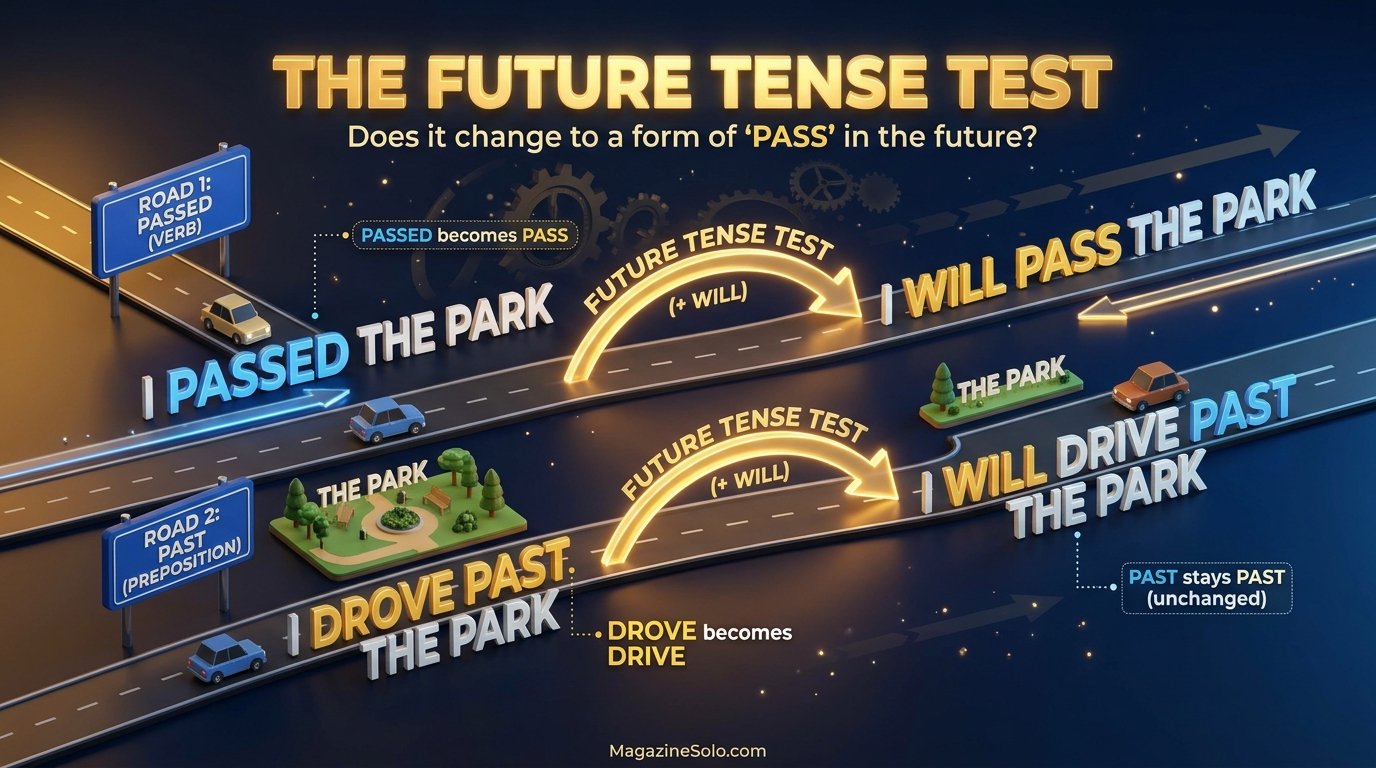
Three lookalikes, three objects. A pastime is the hobby, one word. Pass the time is the activity. Passed the time is that activity, completed.
Past time is the shelf’s argument. One guide allows adjective plus noun; another calls it often a mistake; both agree the idiom it is past time (overdue) is safe.
Keep the three apart by category: thing, activity, completed activity, with the disputed phrase quarantined to its one idiom.
Passed Down, Passed Away, Past Tense, In the Past
Passed down and passed away are verb certainties. Handing down and dying are phrasal verbs; the school platform that tests past down as an error knows it.
Past tense and in the past are noun certainties. The explainer at the Reader’s Digest passed vs past explainer names passed tense among the pair’s most common mix ups, and in the passed has its own correction pages.
The pattern across all four: ask whether anything is being done. Done things take passed; named things take past.
The substitution habit behind several of these verdicts is the Top Tip at the Grammar-Monster past and passed page: for movement, went past settles it.
Difference on the Clock: Past in Time Telling, British and American
On the clock, the difference vanishes. Only past appears: half past ten, a quarter past twelve, ten past three, at every level from beginner up.
Cambridge grades the clock pattern beginner level: five, ten, a quarter, twenty, twenty five, half past the hour.
The dialect difference replaces it. British English uses past for the first half hour, then switches to to: twenty to eight means 7:40.
American English prefers other tools. Digital style, after (ten after three), and of (a quarter of four) carry most American clock talk.
So the clock teaches a double lesson: passed is impossible here, and even past’s own territory changes its rules at the Atlantic.
Difference in the Wild: Ten Sentence Pairs, Verdict by Verdict
Pairs teach the difference at reading speed. Each pair below shares a scene and splits on the grammar, with the deciding row of the master table named.
The road pair:
- The bus passed the depot at dawn. (Verb: what happened.)
- The bus drove past the depot at dawn. (Adverb: where along the path.)
Same bus, same depot: the difference is whether passing is the event or the scenery.
The clock pair:
- Two hours have passed since lunch. (Participle after have.)
- It is past two already. (Preposition on the clock.)
Time as an event takes passed; time as a position takes past.
The office pair:
- The invoice is past due. (Fixed adjective of billing.)
- The clerk passed the invoice to legal. (Verb of handing.)
One phrase describes a state; the other reports an action.
The chamber pair:
- The motion passed by nine votes. (Verb of enactment, active.)
- In past sessions, the motion failed. (Adjective of history.)
Newsrooms write both in the same story, sometimes in the same sentence.
The family pair:
- The ring was passed down to her. (Phrasal verb, passive.)
- In years past, the ring stayed in a drawer. (Postposed adjective.)
Heritage divides neatly: the handing takes passed, the era takes past.
The feeling pair:
- She is past caring what they print. (Beyondness, degree.)
- The story passed without comment. (Verb of going unnoticed.)
Both concern indifference; only one of them is something happening.
The gate pair:
- We finally got past the checkpoint. (Moved beyond: place.)
- Our permits got passed at the desk. (Were approved: passive.)
This is the both correct pair in uniform: place chooses past, approval chooses passed.
The kitchen pair:
- He passed me the recipe card. (Handing, the verb.)
- The smell drifted past the kitchen door. (Movement path, the adverb.)
A card changes hands in one; a smell changes rooms in the other.
The school pair:
- She passed every paper this term. (Succeeding, the verb.)
- Her past papers fill a binder. (Adjective before the noun.)
Achievement is enacted; the archive is described.
The midnight pair:
- Midnight has passed. (The event, perfect tense.)
- We stayed up past midnight. (Beyond the hour, preposition.)
The same midnight anchors both halves of the difference in two short sentences.
The habit to build: read any doubtful sentence twice, once asking what happened, once asking when or where beyond. The question that fits names the word.
Difference in Formal Writing: Billing, Notices, Resumes, News
Formal writing sharpens every difference. Each professional genre has its fixed phrases, and the wrong twin reads as carelessness instantly.
Billing: past due balance, days past due, past due notice. The adjective of obligation is past, and finance English never wavers.
Notices: passed away, in the standard gentle phrasing. The verb of dying takes passed in obituaries, condolences, and HR memos alike.
Resumes: past experience, past roles, past employers, all adjectives. Achievements are ordinary verbs; a resume that verbs with past undermines its own claims.
News: passed for the vote, past for the history. The bill was passed; in past sessions it failed; two constructions, one newsroom paragraph, zero swaps allowed.
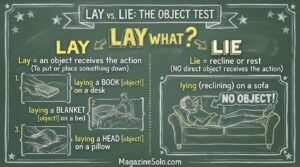
Direction differences in formal prose are a shelf wide habit. Compare the speaker listener cut in our imply vs infer difference guide and the object test in our lay vs lie difference guide.
Difference in Sound and History: Homophones From One Word
In sound, there is no difference at all. The pair are homophones, which is why ears, dictation, and spellcheckers all fail at the same task.
In history, the difference is a split. Past began in Middle English as a worn down form of the verb’s own participle, then drifted into its four non verb jobs.
Passed kept the full form and the verb. The modern difference is that ancient split, finished: doing on one side, naming and beyondness on the other.
The stubborn source disagreement echoes the history. Where one strand allows passed an adjective use, it hears the era before the split completed.
For the working writer, the moral is procedural. A seam in the language needs a test, not a memory, and the swap test is the seam detector.
The One Disagreement, Placed Inside the Difference
Every difference page should print this box. The majority of authorities state the difference absolutely; one strand qualifies it, and hiding either side misleads.
The majority: Merriam-Webster, Grammarly, LanguageTool, and QuillBot all hold that passed is only ever a verb form. Under this rule, the difference is total.
The strand: Thesaurus.com says passed is mostly a verb but can also be used as an adjective, and a long running learner forum tradition allows rare adjective and noun uses.
The ruling for practice: school, exam, and edited writing follow the majority. The difference you should write is the clean one; the debate is for knowing, not for using.
Notice what the disagreement is not. Nobody disputes past’s four jobs, the clock, the traps, or the swap: the contested territory is one narrow edge.
Difference in Errors: The Six Swaps and What Each One Reveals
Every swap fails a different row of the table. Sorting errors by the difference they missed turns a shame list into a diagnostic kit.
The class swap: in the passed. The writer reaches for the noun and grabs the verb form. The missed difference is word class itself, and the when test catches it.
The collocation swap: past down. The hand feels down belongs with past because both feel historical. The missed difference is the phrasal verb family, whose members all take passed.
The label swap: passed tense. The ed ending impersonates the topic. The missed difference is naming versus doing: the tense is named for the noun, the past.
The position swap: ran passed. Two verbs crowd one slot. The missed difference is positional: a clause holds one past tense verb per job, and ran already holds this one.
The participle swap: time has past. The perfect tense loses its participle. The missed difference is behavioral: after has, the word must be able to complete a verb phrase, and only passed can.
The billing swap: passed due. Form completion software suggests the commoner word shape. The missed difference is the fixed phrase: billing’s adjective of obligation is past, permanently.
The pattern across all six: none of them is a spelling failure. Each is a difference not yet seen (class, company, label, position, behavior), which is why contrast pages outperform rule pages.
Difference for Learners and Teachers: How the Contrast Is Taught
Classrooms teach this pair as a difference, never as two words. The unit design across school platforms and learner guides is consistent enough to copy.
Step one is the clock. Learners meet past first in time telling (half past, a quarter past), where the word is frequent, useful, and safely non verbal.
Step two is the history noun. The past arrives with its article in stories and timelines, still without any verb confusion, because the verb slot is filled by was and lived.
Step three is the contrast lesson. Only then do teachers place passed beside past, with minimal pairs, because the difference needs both words visible at once.
The memory hooks are difference shaped. Past ends in T and points at time; passed ends in ed and does the doing; the classroom chant runs: passed tells what she did, past tells where or when.
Practice is pair based. Spot quizzes built from real search questions, platform exercise sets with the famous wrong items (past down among them), and correction drills on the six swaps in the clinic above.
For self learners, the order still helps. Clock first, noun second, contrast third, traps fourth: it is the order this page follows, and the order the learner facing guides in the source set use.
One teaching honesty note: materials sometimes claim named exam boards test this pair specifically. No verified board level source appears in the research, so teach it as curriculum content, which is documented, not as a board promise, which is not.
Which Difference Matters Most: The Five Phrases That Decide
Five phrases carry most real world cases. Get these five right and the difference stops costing you corrections in daily writing.
1. Time has passed. Elapsing time is a verb event. The has passed shape is the single most searched construction in the family.
2. In the past. History as a noun phrase. Its wrong twin is so common it sustains dedicated correction pages of its own.
3. Past due. The billing adjective. Invoices, rent letters, and library notices all run on this one fixed spelling.
4. Passed away. The gentle verb of dying. Notices and condolences leave no room for the other spelling.
5. Past your bedtime. The beyondness preposition at home. The phrase children hear nightly is the grammar lesson adults keep missing.
The meta lesson of the five: three are solved by category (noun phrase, adjective, preposition) and two by verbhood. The table at the top sorts all five instantly.
More difference guides in the same series wait on the shelf: the direction pair in our emigrate vs immigrate difference guide, the building pair in our capital vs capitol difference guide, and the spelling twin pair in our desert vs dessert guide.
The whole shelf is shelved together starting from our MagazineSolo home page, where each difference gets the same table first treatment.
Keeping the Difference: A Three Line Drill
The difference survives if you rehearse it in pairs. Three lines, written from memory daily for a week, fix the contrast better than rereading any table.
Line one, the verb line: write one sentence where passed does something (the years passed, she passed the letter) and say the swap aloud.
Line two, the beyond line: write one sentence where past points beyond (past the bridge, past caring) and note that nothing in it can swap.
Line three, the both line: write one sentence containing both words (we passed the spot where the past feels close) and label each job.
By day seven the labeling happens before the writing. That is the difference, installed.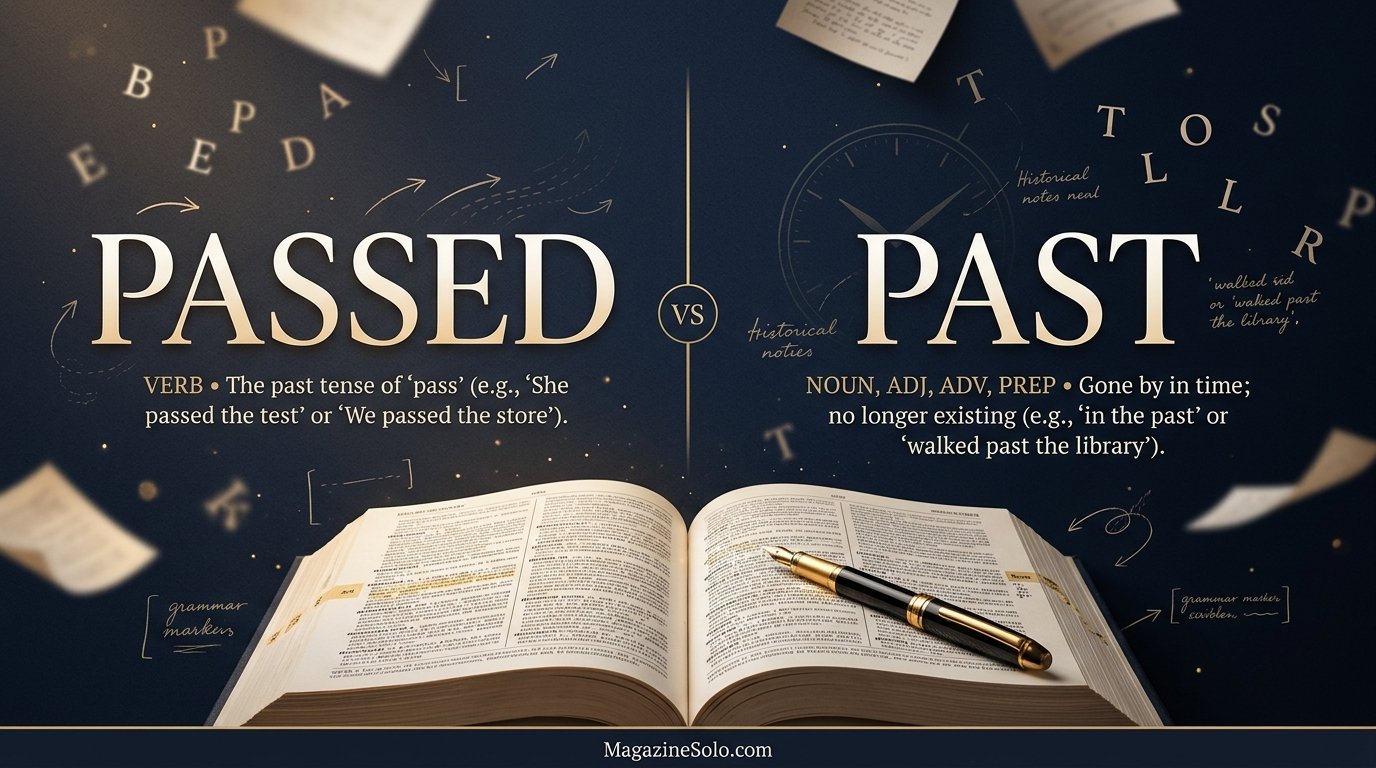
Frequently Asked Questions
1. What is the difference between passed and past in one sentence?
Word class. Passed is a verb form, the past tense and participle of pass.
Past is never a verb: it is a noun, adjective, adverb, or preposition.
That one difference explains every correct choice.
2. Passed vs past: which one is the verb?
Passed, always. It is the pair’s only verb form.
If the word is doing the sentence’s action, the spelling is passed; past cannot hold that job in any sentence.
3. What is the difference between passed and past tense?
They are not counterparts. Passed is a verb’s form, as in she passed.
Past tense is the name of a whole tense, named after the noun.
Passed tense is simply an error.
4. What is the difference between in the past and in the passed?
In the past; the other does not exist. The past is the noun naming earlier time.
In the passed is so common that checker sites keep a dedicated correction page for it.
5. What is the difference between past due and passed due?
Past due is correct; passed due is the error. The phrase means beyond the due date.
Billing English is fixed: past due balance, past due notice, days past due.
6. What is the difference between get past and get passed?
Meaning. Get past means resolve or move beyond.
Get passed means be approved, as a bill is.
Both are correct English; what you intend to say chooses between them.
7. What is the difference between pastime, pass time, and past time?
Three different objects. A pastime is a hobby.
Pass the time is the verb phrase, whose past tense is passed the time.
Past time is disputed outside the overdue idiom, it is past time.
8. What is the difference between passed down and past down?
Passed down. Handing through generations is the phrasal verb pass down, so the watch was passed down.
Past down is the error, common enough to be a school test item.
9. What is the difference between the past and passed time?
The noun phrase takes past; the event takes passed. The past names earlier time as a subject.
Elapsing is written time passed or time has passed, never passed time as a noun phrase.
10. How does the difference show up in the same sentence?
Both, doing different jobs. As we passed the courthouse, we talked about the past: passed acts, the past names.
The future swap separates them, because passed becomes will pass and past stays.
11. What is the difference between passed and past in time telling?
Time telling uses past only. Half past ten, a quarter past twelve, ten past three.
British English switches to to after the half hour; American English often goes digital or uses after.
12. What is the difference between passed away and past away?
Passed away; past away never. Dying takes the phrasal verb pass away.
The whole family agrees: passed on, passed out, and passed up all take the verb’s form.
13. What is the difference between past experience and passed experience?
Past experience. Past is the adjective describing the noun.
Passed experience is a frequent search and an error: describing takes past, doing takes passed.
14. What is the difference between a deadline that has passed and being past a deadline?
Construction, not topic. The deadline has passed makes passing an event, the verb in the perfect tense.
Being past the deadline makes past a preposition: beyond it.
15. What is the difference between walked past and walked passed?
Walked past. Walked fills the verb slot, leaving past as the adverb of movement.
Walked passed stacks two past tense verb forms in one job, the classic warning sign.
16. What is the difference between past and last?
Scope vs sequence. Past covers time gone by in general; the past week can mean the seven days just gone.
Last marks the final or most recent in a sequence.
Neither is spelled passed.
17. What is the difference between passed and past in sports writing?
Action vs location and history. Passed is the ball verb: he passed into the box.
Past covers position and history: the shot went past the post, in past seasons the fixture ended level.
18. What is the difference between passed and past in law and news?
Enactment vs context. Passed reports the vote: the bill was passed.
Past reports the background: in past sessions the bill failed, past rulings shape the case.
Swapping them changes a fact into an error.
19. Why is the difference between passed and past so hard to hear?
There is no audible difference. The words are homophones, identical in sound.
The difference lives only in spelling and grammar, so ears cannot help and spellcheckers stay silent.
20. Is the difference between passed and past just spelling?
No: the spelling records a structural difference. Passed belongs to the verb system of tenses, participles, and passives.
Past belongs to the naming and pointing system.
The spelling is the visible tip.
21. What is the difference between passed as a participle and past as an adjective?
Verb phrase vs description. A participle works inside a verb phrase: has passed, was passed.
An adjective describes a noun: past generations.
Has and was expose the participle every time.
22. Passed vs past: how do dictionaries define the difference?
The same cut. Merriam-Webster defines passed purely through the verb pass and gives past four word classes.
Cambridge makes it structural: past has preposition, adverb, and noun entries, and no verb entry.
23. What is the difference between time passed and time past?
Time passed is the normal clause. Time past survives in literary or fixed uses, like in time past meaning formerly.
For everyday writing, elapsed time is passed.
24. What is the difference between past master and passed master?
Past master is the idiom: an expert. It also carries the older sense of a former guild master.
Passed master is not the idiom; passed would need a verb reading, like a master who was passed over.
25. What is the difference between run past and run passed in the idiom?
Run it past someone. The show it for a reaction idiom takes the preposition past.
The errand’s own past tense is a verb: yesterday I ran it past him, never I ran it passed him.
26. What is the difference between well past and well passed?
Well past, almost always. Well past midnight, well past the deadline, well past caring.
Well passed survives only in a rare verb reading, like a bill well passed by the house.
27. What is the difference between gone past and gone passed?
Gone past. The bus has gone past, the deadline has gone past.
Gone passed is not standard, and the substitution test is built for exactly this slot.
28. What is the difference between years past and years passed?
Both exist, doing different jobs. In years past uses the postposed adjective: in former years.
Years passed makes passing the verb: years went by.
Context, not sound, decides.
29. What is the difference between has passed and has past?
Has passed. After has, have, or had, the participle is always passed in this family: the deadline has passed, time has passed.
Has past is the error the forums ask about weekly.
30. What is the difference between passed and past for ESL learners?
The same cut, plus the clock. Learners meet past first in time telling, then as the history noun, then the trap phrases.
British and American clock habits differ, so courses teach the dialect explicitly.
31. What is the difference between passed and past in the passive voice?
The passive belongs to passed alone. Was passed, were passed, has been passed.
Past never enters a verb phrase, so be plus the word always means the word is passed.
32. What is the difference between passed the test and past the test point?
Achievement vs position. Passed the test means succeeded, the verb.
Past the test point means beyond a location or stage, the preposition, as in the marker is past the test point.
33. How is the difference taught in schools?
As a confused words unit. The rule, a memory trick (past ends in T for time), minimal pairs, and corrected errors.
The past down mistake serves as a ready made test item in practice platforms.
34. What is the difference between passed and past in a resume or cover letter?
Stakes, mainly. Past experience, past roles, and past employers take the adjective.
Achievements are verbs in normal past tenses.
Recruiters read the error as carelessness, which is why the pair matters professionally.
35. What is the difference between the two words’ histories?
They were once one word. In Middle English, past was a worn down form of the participle.
It split off into the noun, adjective, adverb, and preposition jobs, while passed kept the verb.
36. Is there any case where passed and past are interchangeable?
No standard case. Near neighbors exist, get past versus get passed are both correct but say different things, yet swapping the words in a given sentence always changes the grammar or the meaning.
37. What is the difference between passed and past in pronunciation?
None. They are homophones in standard speech, and regional accents do not separate them.
The difference is entirely written, which is why voice typing produces this error so reliably.
38. What is the difference between past caring and passed caring?
Past caring is the idiom. Beyond caring, no longer able to care.
Passed caring is not an idiom.
The beyondness family, past it, past your prime, past the point of no return, always takes past.
39. What is the difference between a pastime and passing time?
Thing, activity, completed activity. A pastime is the hobby itself.
Passing time is the activity in progress.
Yesterday’s version is passed the time.
Three forms, three jobs.
40. How do grammar checkers treat the difference between passed and past?
As grammar, not spelling. Both words are valid, so the checker reads the sentence’s structure.
The major checkers apply the majority rule, passed is a verb only, which is why their blogs top this search.
41. What is the difference between passed and past in one table?
Passed changes; past does not. Passed is verb only, becomes will pass in the future swap, and follows has and was.
Past does four jobs, never changes form, and answers when and where beyond.
42. Which difference matters most in everyday writing?
The verb difference. It decides the most frequent real cases: time has passed, in the past, past due, passed away, past your bedtime.
Master those five phrases and the swap test, and the edits stop.
Conclusion
The passed vs past difference is structural, not cosmetic: one word belongs to the verb system, the other to the naming and pointing system, and every correct choice is that difference applied.
Keep the master table where you can see it, learn the five deciding phrases whole, and let the future swap referee anything the table does not settle.
The sibling base page goes deeper on the tests and the error clinic; this page stays your contrast reference, the one you open when two spellings are competing for one slot.
Start from our MagazineSolo home page for the wider difference shelf, and let every passed and past difference resolve the same way: by the job, never by the sound.

Dilawar is a content writer at MagazineSolo, covering travel, home improvement, interior design, and everyday lifestyle topics. He enjoys researching practical solutions, exploring travel destinations, and sharing helpful guides that make daily life easier. His writing focuses on clear information, useful advice, and engaging stories for a wide audience.