Precede vs Proceed: The Prefix Test, the 1-3-All Spelling Rule, and the Noun Traps
The precede vs proceed choice looks like a spelling coin toss, and it is not one. The prefixes decide the meaning, and one official rule decides every ending.
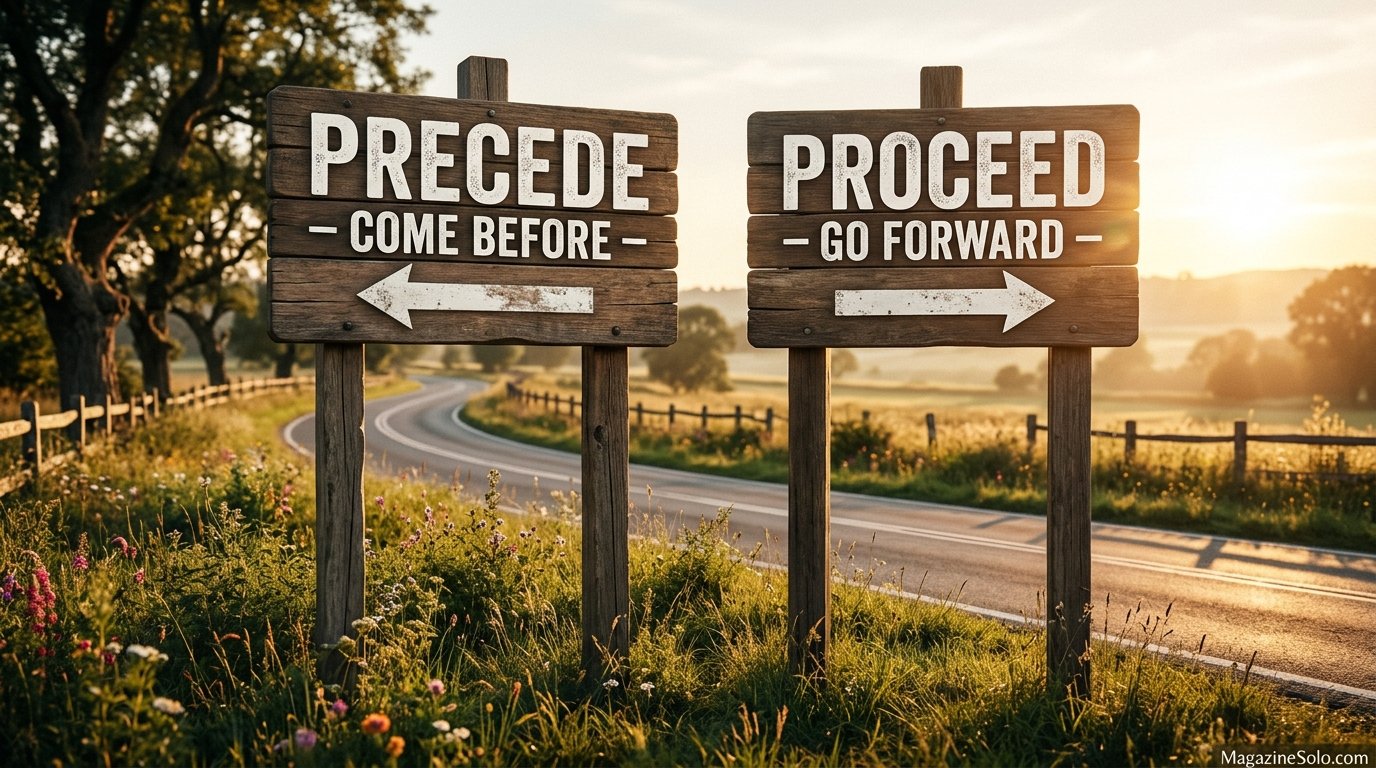
Both words grow from the same Latin root, cedere, to go. Pre points backward to what comes before; pro points forward to what keeps going.
This page stacks the help in the order it settles sentences: the core difference first, the spelling system second, the tests third, the noun traps fourth.
The noun traps matter as much as the verbs. Proceeds is money, proceedings are events and legal actions, and both sit one letter from the verbs you meant.
One warning is printed where it belongs: even a ranking guide gets the famous caution phrase wrong, and this page shows that error as an exhibit, not a source.
Precede vs Proceed in 20 Seconds
Precede means come before. In time, order, place, or rank: the trailers preceded the feature, the parade preceded the ceremony.
Proceed means go forward, continue. Begin and carry on, especially after a pause: passengers proceed to gate 21, work proceeded after lunch.
The spelling system in one line: one word ends in -sede, three end in -ceed, and everything else in this family ends in -cede.
Keep those three lines and most sentences settle themselves. The rest of the page is the system, the traps, and the disagreements, in full.
The Core Difference: Before vs Forward
Merriam-Webster states the working split. The meanings of precede are often related to time, while those of proceed tend to be concerned with movement.
Both verbs share the root, which is why they tangle. Praecedere is pre plus go; procedere is pro plus go, and the prefixes never swap jobs.
Garner’s verdict frames the stakes. Bryan Garner’s usage guide, quoted in the education press, says the words are sometimes confused even by otherwise literate people.
That quote is permission to learn the system properly. If literate writers miss this pair, the fault is in the pair, not in you.
Precede: To Come Before (Time, Order, Place, Rank)
In time: to be earlier than. The formal ceremony was preceded by a parade is the learner example at the Cambridge Learner’s entry for precede, and the passive shape is typical.
In order: to stand earlier in a sequence. A short introduction precedes each chapter; several steps should precede this one.
In place: to go in front of. She preceded him into the room; the floats will be preceded by a marching band.
In rank: to surpass in importance. He preceded me in this role is the dictionary example for the sense dictionaries list first.
As a preface: to cause something to be preceded. A rarer sense, where an author precedes a work with an introduction.
Proceed: To Go Forward and Continue
Continue after a pause is the modern center. The meeting proceeds after the break; work proceeded as planned once approval arrived.
Begin and carry on is the formal twin. Cambridge marks the word formal outright in the Cambridge Learner’s entry for proceed, and official prose is its home.
Proceed to a place runs announcements: passengers for Sydney should proceed to gate 21, proceed down the hall, proceed to the nearest exit.
Proceed to do something marks the next step in a sequence, a construction the checker guides treat with care, and one section below is devoted to it.
One older sense survives in dictionaries: to come forth from a source. The checker guides drop it; the disagreement section prints both strands.
Sentence Pairs: The Same Scene, Both Verbs
Pairs install the difference faster than definitions. Merriam-Webster’s own example puts both verbs in one scene, and this section follows its lead.
The house pair (the dictionary’s own): as we proceeded from the house to the pool, we were preceded by the children, eager to begin swimming. Forward for us, before for the children.
The ceremony pair:
- A parade preceded the ceremony. (What came first.)
- The ceremony proceeded without a hitch. (How it continued.)
Order takes precede; unfolding takes proceed, in the same afternoon.
The document pair:
- An introduction precedes each chapter. (Position in the book.)
- The argument proceeds step by step. (Movement of the reasoning.)
Books are shelved in space and read in motion, and the verbs split exactly there.
The meeting pair: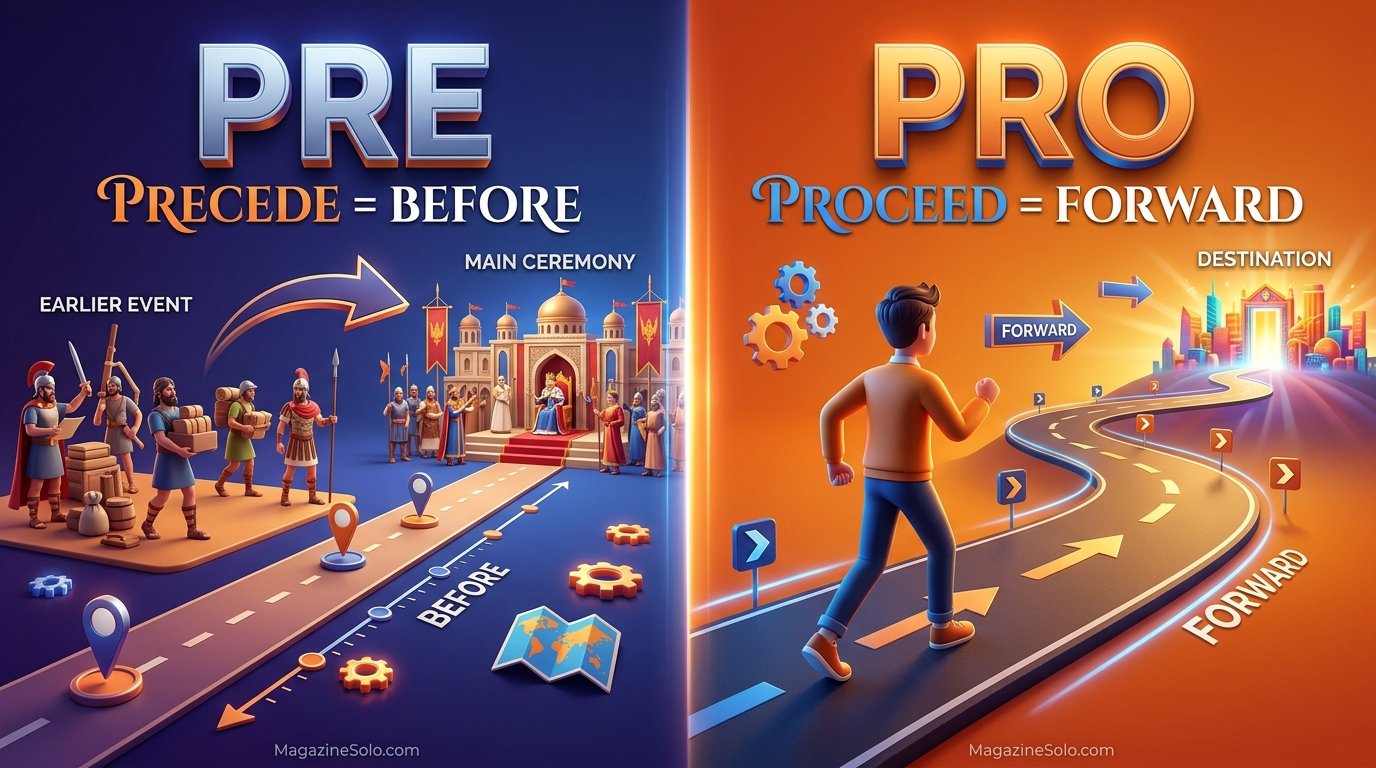
- The vote preceded the announcement. (Sequence of events.)
- After the announcement, discussions proceeded. (Continuation after a pause.)
One verb orders the agenda; the other reports that the agenda moved.
The journey pair:
- The advance team preceded the convoy. (Went in front.)
- The convoy proceeded at dawn. (Set forward.)
Same road, two relations: position ahead versus motion onward.
The money pair:
- Costs preceded the payout by a month. (Came before in time.)
- The payout’s proceeds were split three ways. (The noun, money.)
Even the trap obeys the split: time order is precede’s, the cash is proceeds.
Read the pairs for the invariant. Wherever something is positioned earlier, precede; wherever something moves or continues, proceed; wherever money appears, proceeds.
The Spelling System: The 1-3-All Rule
This rule is official, and it is quotable. The rule as printed in the US Government Printing Office Style Manual, section 5.13, settles every word in the family at once.
Only one word ends in -sede: supersede. Only three end in -ceed: exceed, proceed, succeed. All other words of this class end in -cede.
Textbook spelling appendices and university handouts print the same closed list. It is not a rule of thumb; it is a census.
The Family Table: Every -Cede, -Ceed, and -Sede Word
|
Ending |
Count |
The words |
|---|---|---|
|
-sede |
1 |
supersede |
|
-ceed |
3 |
exceed, proceed, succeed |
|
-cede |
The rest |
accede, antecede, cede, concede, intercede, precede, recede, secede |
Read the table as a map. If your word is not supersede and not one of the three, the ending is -cede, and no further thought is required.
Teachers compress the trio as EPS (exceed, proceed, succeed), and one spelling tradition hooks them to speed: like speed, these three end in -eed.
Why Supersede Is Different: Sit vs Go
Supersede does not belong to the go family. It descends from Latin sedere, to sit: to sit above, hence to replace.
That is why it alone takes -sede, and why supercede is a misspelling. The odd spelling marks a different ancestry, not an exception to memorize blindly.
Why the -ceed trio differs is a transmission story: the dictionary’s endings article explains that precede and concede passed through French, while proceed, succeed, and exceed passed through Middle English.
The Misspellings: Preceed, Procede, Supercede
Preceed is not a word. The explainer at the Dictionary.com proceed vs precede article devotes a section to the question, and an exam prep platform uses preceed as the wrong answer in a solved spelling question.
Procede is not a word either. The usage page at the Grammarist precede and proceed page is built on the verdict: writers who produce procede almost always meant proceed.
Supercede is the third regular error. Three misspellings, one system: every one of them is the 1-3-all rule not yet learned.
The Family at Work: Every Member in a Sentence
The table becomes knowledge when each member works. One sentence per word, grouped by ending, with the meaning in the margin.
The -cede eight:
- Accede: to agree or take office. The board acceded to the request; the prince acceded to the throne.
- Antecede: to go before, precede’s formal twin. The cause anteceded the effect by years.
- Cede: to yield. The treaty ceded the territory.
- Concede: to acknowledge or yield a point. She conceded the argument’s first round.
- Intercede: to plead on another’s behalf. A teacher interceded for the student.
- Precede: to come before. The trailers preceded the feature.
- Recede: to move back or grow less. The floodwaters receded by morning.
- Secede: to withdraw from a body. The province seceded from the federation.
The -ceed three:
- Exceed: to go beyond a limit. Costs exceeded the budget.
- Proceed: to go forward. Work proceeded after lunch.
- Succeed: to follow after, or to thrive. She succeeded her father as director; the plan succeeded.
The -sede one:
- Supersede: to replace. The new edition supersedes the old one, from sedere, to sit above.
Notice succeed doing double duty. It means both follow after (precede’s mirror) and do well, which is why the trio repays learning as a set.
The Test Stack: Prefix, Substitution, and Before What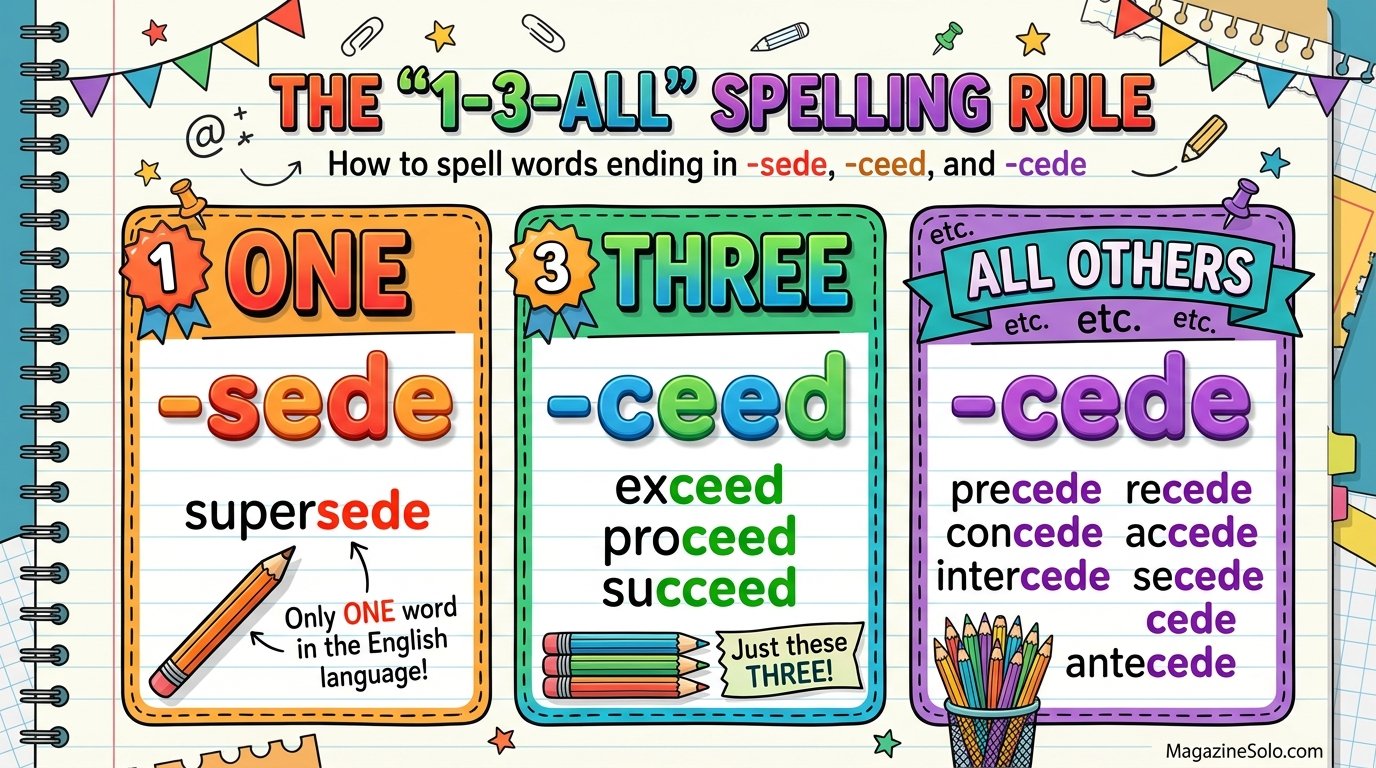
Three tests, stacked. Each is published by a ranking guide, and together they decide any sentence the pair appears in.
Test 1, the prefix test. Ask which prefix your meaning needs: before (pre) or forward (pro). It is the universal first move in the set.
Test 2, substitution. Replace the word with come before; if the sentence survives, write precede. Replace with go forward; if that fits, write proceed. The fullest ranking guide, the Nexlatic precede or proceed guide, teaches exactly this swap.
Test 3, the question test. If you can ask before what, the word is precede; if the sense is and then it kept going, the word is proceed.
The time versus action shortcut rides on top: precede leans to time, proceed to action and movement, the split both the dictionary and the checker guides print.
The Grammar Difference: Transitive vs Intransitive
The sharpest cut is grammatical. Precede typically needs an object: X precedes Y, one thing standing before another named thing.
Proceed typically needs none. We proceed, work proceeds, the talks proceeded: the verb completes itself, then adds to or with phrases as needed.
The passive belongs to precede’s world. Be preceded by is one of the verb’s commonest real shapes: the feature was preceded by trailers, the speaker was preceded by applause.
Third person traps hide here. He proceeds is a verb; the proceeds is money; and the two meet in finance sentences where context alone separates them.
The Noun Traps: Proceeds, Proceeding, Proceedings, Preceding
The verbs have noun neighbors, and the neighbors cause half the errors. The fullest treatment in the ranking set, the QuillBot proceed vs precede guide, is organized around them for a reason.
|
Form |
What it is |
Example |
|---|---|---|
|
proceeds |
Plural noun: money brought in |
The proceeds of the sale go to charity. |
|
proceeding |
Participle; also a single legal action |
We are not proceeding as planned. |
|
proceedings |
Plural noun: events, legal actions, records |
The conference proceedings are online. |
|
preceding |
Adjective: coming before |
The preceding year was stronger. |
Proceeds stresses the first syllable. PRO-ceeds the money against pro-CEED the verb, a shift teaching sites flag because the page forms are identical.
Proceedings carries three senses. What happens at an event, legal action (criminal proceedings), and the published record of a meeting or conference.
Preceding is precede’s working adjective. The preceding months, the preceding chapter, the preceding decade: report and document language runs on it, and the pair gets its own section in the LanguageTool precede vs proceed guide.
Proceed With vs Proceed To
Proceed with continues something started. Proceed with the plan, proceed with caution, proceed with the next step once approval lands.
Proceed to starts the next stage. Proceed to gate 21, proceed to checkout, then proceeded to describe the results, stage direction in verb form.
Proceed to do something can shade ironic in stories: after promising punctuality, he then proceeded to be late three meetings running, the next step nobody wanted.
The with and to line is drawn cleanly by the usage tradition, and it is worth learning as a pair, because both constructions are formal register staples.
Precedent vs Precedence: The Neighbor Pair
The pair has famous cousins. Precedent and precedence both descend from the same Latin family, and writers swap them in print regularly.
A precedent is an earlier example taken as a rule for later cases, above all a court decision: to set a precedent is the fixed idiom.
Precedence is the state of coming before in rank or importance: to take precedence is its idiom, as when safety takes precedence over speed.
The spelling hook is a gift. Because precedent belongs to the precede family, remembering the cousin reminds you precede ends in -cede, a hook a dictionary article teaches directly.
Published corrections exist for the swap: may set a precedence, printed in real media, corrected to may set a precedent. The neighbors reward the same table first treatment as the main pair.
Sorting direction and order is this cluster’s house skill. Compare the arrangement logic in our emigrate vs immigrate difference guide and the speaker listener cut in our imply vs infer difference guide.
The Trap Shelf: Fixed Phrases With Verdicts
Fixed phrases bypass the tests. Learn these whole, the way the shelf below presents them, with the verdict first.
|
Phrase |
Verdict |
The one line reason |
|---|---|---|
|
proceed with caution |
Proceed |
Moving forward carefully |
|
proceeds of the sale |
Proceeds |
The money noun |
|
criminal proceedings |
Proceedings |
Legal actions |
|
conference proceedings |
Proceedings |
The published record |
|
the preceding year |
Preceding |
The adjective of before |
|
was preceded by |
Preceded |
The passive pattern |
|
notice to proceed |
Proceed |
Contract authorization to begin |
|
set a precedent |
Precedent |
The example idiom |
|
take precedence |
Precedence |
The rank idiom |
|
proceed to gate |
Proceed |
Announcement register |
Notice the shelf’s shape. The verbs take the action rows; the nouns take the money, law, and record rows; the neighbors take the idiom rows.
Precede and Proceed in Formal Writing: Law, Money, and Announcements
Formal registers are this pair’s home turf. Cambridge’s formal mark on proceed is the tell: these words earn their keep in documents, not chat.
In law, proceed begins and carries on an action, the dictionary’s Law sense, and proceedings name the actions: criminal proceedings, court proceedings, disciplinary proceedings.
In money, proceeds is the total: the proceeds of the sale will be reinvested, the proceeds of the concert will go to charity, the proceeds from the fundraiser.
In contracts, the notice to proceed authorizes work to begin and starts the project clock, a fixed term in construction and procurement language.
In announcements, proceed to runs the building: proceed to gate 21, proceed to the nearest exit, proceed to platform four, always the forward verb.
In reports, preceding does the ordering: the preceding quarter, the events that preceded the merger, as noted in the preceding section, the document pattern at the Cambridge Learner’s entry for precede in action.
Register discipline is a shelf wide habit on this site. The object test in our lay vs lie difference guide and the building pair in our capital vs capitol difference guide run on the same care.
In Speech: Stress, Sound, and the Dictation Problem
The pair is hardest where it is heard, not read. Speech strips away the one letter that separates them, and writing tools inherit the problem.
Stress does some work. Both verbs stress the second syllable (pre-CEED, pro-CEED), while the money noun jumps to the first (PRO-ceeds), the family’s only stress signal.
First syllables blur. The unstressed opening vowels of precede and proceed reduce toward the same murmur in ordinary speech, which is why the four published homophone positions can all claim evidence.
Dictation software guesses by frequency. A spelling guide in the source set calls out speech to text mangling directly: dictate “proceed with caution” in a noisy room and the transcript may deliver either twin.
The defense is a proofreading pass with the tests. Any dictated precede or proceed gets the prefix question (before or forward) before the document ships, a ten second audit per instance.
Names and titles are the exception zone. In quotations, signage, and legal names, reproduce the source spelling exactly, even where it looks wrong, and mark it only if your house style allows notes.
Where the Sources Disagree: Homophones, Originate, Antonyms
This pair’s authorities disagree in print, and the disagreements are part of the knowledge. Four positions exist on the sound question alone.
Almost homophones, says Merriam-Webster. A first vowel difference (PRUH-seed against PRO-seed), says the Grammarly guide. Not homophones, says a usage site. Homophones in many dialects, says a spelling guide.
Hold all four as strands. The practical point survives every position: the words are close enough that ears cannot arbitrate, and grammar must.
The originate sense splits the authorities too. Dictionaries keep proceed meaning to come forth from a source; the checker guides define proceed only as continue and move forward, dropping the sense entirely.
The antonym framing is a third strand. One guide calls the pair exactly antonyms; the rest treat them as distinct, position versus motion. Counterparts, not opposites, is the safer teaching.
Even the history overlaps. A dictionary note records precede once defined as to proceed in the historical dictionary, most recent citation around 1450. The modern separation is total; the overlap is a footnote.
The Wrong Sentence Clinic
Every error below is documented in a ranking source, corrected, with the test that catches it attached.
|
Wrong |
Right |
The test that catches it |
|---|---|---|
|
Please precede with caution. |
Proceed with caution |
Prefix: moving forward takes pro |
|
The press secretary proceeded the president to the microphone. |
Preceded |
Substitution: came before him |
|
The payment will proceed the delivery. |
Precede |
Before what: the delivery |
|
She wrote preceed in the report. |
Precede |
Family table: not one of the three |
|
He typed procede twice. |
Proceed |
The trio: EPS |
|
The memo said supercede. |
Supersede |
The one -sede word, from sedere |
The clinic’s star exhibit is a guide’s own error. One ranking tutorial prints precede with caution as the correct form in its mix ups section, against every other source and the phrase itself.
That exhibit teaches the meta lesson: verify corrections against the system, because a confident wrong correction is still wrong, and the family table outranks any single page.
Error taxonomies like this one run across the difference shelf, from the spelling twins in our desert vs dessert guide to the direction pairs shelved from our MagazineSolo home page.
How to Remember It for Good
The E count hook is the famous one, from the Writing Explained precede vs proceed guide: precede means to come before and has one additional E than proceed, with the extra E echoing before.
The EPS hook covers the spelling trio: exceed, proceed, succeed, the only -ceed words, remembered by their initials or by the speed rhyme.
The precedent hook covers precede: its cousin precedent carries the -cede spelling visibly, so the family resemblance does the remembering.
The appetizer drill covers the meanings: do the appetizers precede or proceed the main course? The dictionary’s own quiz, answered precede, in one hungry image.
Build the habit in three moves. Prefix first for meaning, family table for spelling, noun map for the traps, and the pair behaves within a week of real writing.
Post the system where you write. The family table fits an index card: one sede, three ceed, the rest cede, with pre before and pro forward across the top.
Within a month, the card becomes unnecessary. The system moves from the desk into the hand, which is where spelling rules have to live to work.
Learning the Pair: A Short Practice Routine
The system installs in days, not weeks. Teachers who publish this material converge on the same small routine, and it is worth copying exactly.
Day one: the table. Copy the family table by hand once (one, three, the rest) and write the GPO sentence under it. Handwriting the census fixes it.
Day two: the pairs. Work the six sentence pairs above, covering the verbs and calling each aloud before checking which test named it.
Day three: your own traps. Search your sent mail for caution, sale, and meeting sentences; correct any precede or proceeds errors and log them on a personal clinic list.
Day four: the nouns. Write one sentence each for proceeds, proceedings (all three senses), preceding, and precedent, then check them against the noun map table.
Day five: live fire. Draft a page of formal writing (a report section, a set of minutes, an announcement) using at least four family members correctly.
Keep the family chart visible for a month. Spelling systems fade slower than meanings, and the chart’s presence during real writing is what converts knowledge into habit.
Test yourself against the doorway spellings. Once a week, write preceed, procede, and supercede deliberately, then correct each one by naming its row of the family table. Naming the row, not just fixing the letter, is what makes the correction permanent.
Frequently Asked Questions
1. What is the difference between precede and proceed?
Before vs forward. Precede means come before, in time, order, place, or rank: the trailers preceded the feature.
Proceed means go forward or continue: let us proceed.
The prefixes carry it: pre before, pro forward.
2. Is it proceed with caution or precede with caution?
Proceed with caution. You move forward carefully, so the forward verb is correct.
Precede with caution is a documented error, and one ranking guide even prints it as the correction, which is itself wrong.
3. What does precede mean?
To come before. To be, go, or come ahead of something, to be earlier than it, and to surpass in rank.
The trailers preceded the feature; he preceded me in this role.
Its past tense is preceded.
4. What does proceed mean?
To go forward and continue. To begin and carry on an action, and to continue after a pause.
Cambridge marks the word formal.
Passengers proceed to gate 21; after a break, the meeting proceeds.
5. Is preceed a word?
No. Preceed is a common misspelling of precede, rejected by dictionaries.
An exam prep platform even uses it as the incorrectly spelt answer in a solved spelling question.
Precede ends in -cede.
6. Is procede a word?
No. Procede is not a recognized word in English, as a usage site states plainly; writers who produce it meant proceed.
Proceed is one of only three -ceed verbs, with exceed and succeed.
7. What is the 1-3-all spelling rule for cede words?
One, three, all. Only one word ends in -sede (supersede); only three end in -ceed (exceed, proceed, succeed); all other words of this class end in -cede.
That is the US Government Printing Office Style Manual, section 5.13.
8. Which words end in -ceed?
Only three: exceed, proceed, succeed. Teachers remember them by the initials EPS, or the speed hook: like speed, they end in -eed.
Everything else with the sound takes -cede, except supersede.
9. Why does supersede end in -sede and not -cede?
A different Latin root. Supersede comes from sedere, to sit, not cedere, to go: to sit above or replace.
That is why it is the family’s only -sede word, and why supercede is a misspelling.
10. What is the opposite of precede?
Follow, succeed, come after. The mirror of precede is whatever comes next in the same sequence.
Appetizers precede the main course; dessert follows it.
A checker guide’s lead FAQ answers with exactly that set.
11. What is the difference between preceding and proceeding?
Before vs going forward. Preceding is precede’s adjective: the preceding year, the preceding chapter.
Proceeding belongs to proceed: the action of going forward, a single legal action, and in the plural, proceedings.
12. What does proceedings mean?
Three senses. The things that happen at an event; legal action, as in criminal proceedings; and the record of a meeting, as in conference proceedings published online.
One plural noun carries all three.
13. What does proceeds mean?
The money. The total amount brought in from a sale, performance, or fundraiser: the proceeds of the sale, the proceeds go to charity.
It is a plural noun, stressed on the first syllable, PRO-ceeds.
14. Is proceeds the same as he proceeds?
Same spelling, different word. He proceeds is the third person verb, he goes forward.
The proceeds is the money noun.
Pronunciation separates them in speech: the noun stresses the first syllable.
15. What is the difference between proceed with and proceed to?
Continue vs next step. Proceed with continues an action already started: proceed with the plan, proceed with caution.
Proceed to moves to the next stage: proceed to gate 21, then proceeded to describe the results.
16. What does proceed to do something mean?
The next action in a sequence. To do something after you have done something else, per the learner definition.
In storytelling it can carry an ironic shade: he then proceeded to be late, again.
17. How do you use precede in a sentence?
With an object, or in the passive. The ceremony was preceded by a parade; a short introduction precedes each chapter; the trailers preceded the feature.
The pattern is X precedes Y, or Y was preceded by X.
18. How do you use proceed in a sentence?
With forward motion or continuation. Passengers should proceed to gate 21; please proceed down the hall; we need approval before we can proceed with the next step; after lunch, work proceeded.
19. Is precede transitive and proceed intransitive?
Mostly, yes. Precede typically takes an object or appears as be preceded by.
Proceed is usually intransitive: we proceed, work proceeds, often followed by to or with.
It is the sharpest grammar cut in the set.
20. Are precede and proceed homophones?
The sources disagree, in four positions. Almost homophones (Merriam-Webster); a first vowel difference (Grammarly); not homophones (Grammarist); homophones in many dialects (a spelling guide).
All agree they are close enough to confuse.
21. How do you pronounce proceeds the noun?
First syllable: PRO-ceeds. The verb proceed stresses the second syllable, pro-CEED.
A teaching site flags the shift explicitly, because the money word and the verb look identical on the page.
22. What does preceding year mean?
The year before the referenced one. The preceding year, the preceding decade, the preceding months.
Preceding plus a time period is the standard pattern in reports and academic prose for earlier periods.
23. What is the difference between precedent and precedence?
Example vs rank. A precedent is an earlier example or rule guiding later cases, especially a court decision: set a precedent.
Precedence is the state of coming first in rank or importance: take precedence.
24. How does precedent help me spell precede?
Through the relative. Precedent is related to precede, and remembering the relative reminds you precede ends in -cede, not -ceed.
A dictionary article builds its spelling hook on exactly that family resemblance.
25. Can proceed mean to come from a source?
In the dictionary strand, yes. Merriam-Webster includes to come forth from a source among proceed’s meanings.
Most checker guides omit the sense and define proceed only as continue or move forward.
The sense is formal.
26. What is the past tense of precede and proceed?
Preceded and proceeded, both regular. She preceded him into the room; we proceeded with the plan.
Neither word hides an irregular form anywhere in its conjugation.
27. Do the appetizers precede or proceed the main course?
Precede. It is a dictionary’s own quiz question: the appetizers come before the main course in the meal’s sequence.
Its tip: think of the prefix pre, earlier than.
28. How is precede vs proceed used in legal writing?
Proceed acts; precede orders. Proceed begins and carries on a legal action, to go to law; proceedings are the actions themselves.
Precede handles order: the preceding paragraph, the clause that precedes the signature block.
29. What does notice to proceed mean?
Formal authorization to begin work. The notice to proceed is standard in construction and contract language: it starts the clock on a project.
Treat it as a register term of the proceed family.
30. What mnemonic helps remember precede vs proceed?
Several published ones. Precede has one more E than proceed and means before; the EPS initials for the three -ceed words; the speed hook; and the prefix test every guide teaches, pre before, pro forward.
31. Why do people confuse precede and proceed?
Sound, spelling, and a shared root. They are near identical in sound, one letter apart, and both grow from cedere.
Garner notes they are sometimes confused even by otherwise literate people.
32. Are precede and proceed antonyms?
A framing strand, not a fact. One source says exactly antonyms; others say distinct but not opposite, position versus motion.
Teach them as counterparts in sequence thinking, not as simple opposites.
33. Did precede once mean proceed?
Historically, yes; not now. A dictionary note records precede defined as to proceed in the Oxford English Dictionary, most recent citation around 1450.
Modern English separates them completely; the overlap is history only.
34. How do you remember the -cede family list?
By the rule and one table. Accede, antecede, cede, concede, intercede, precede, recede, secede take -cede; exceed, proceed, succeed take -ceed; supersede alone takes -sede.
Style manuals print the same closed list.
35. What does it mean to be preceded by something?
It came before you in the sequence. The ceremony was preceded by a parade; the floats will be preceded by a marching band.
The passive be preceded by is one of precede’s commonest shapes in real writing.
36. Is precede formal or everyday language?
Both lean formal. Proceed is marked formal outright in a learner dictionary, and precede lives in reports, documents, and ceremonies.
In casual speech, come before and keep going do most of the everyday work.
37. What is the difference between proceed and progress?
Verb of process vs noun of movement. Proceed is moving on or continuing a process.
Progress is the forward movement itself first, and as a verb stresses improvement over time.
Proceed with the plan; progress on the plan.
38. How is the pair tested in exams and spelling lists?
As spelling, mostly. A solved exam prep question uses preceed as the wrong spelling; US spelling contest materials print the ending rule as test content.
Named links to GCSE, ACT, or SAT for this pair are unverified.
39. What are common mistakes with precede and proceed?
The documented set. Precede with caution for the forward phrase; proceeded the president for preceded; the payment will proceed the delivery for precede; and the spellings preceed, procede, and supercede.
40. Can a grammar checker decide precede vs proceed for me?
Mostly. Checkers read transitivity and context, which decide this pair, and the top ranking brands are checker companies.
Learn the family table yourself, because checkers are weakest on the rare forms.
41. Which word should I use for before in a report?
Precede and preceding. The preceding quarter, the events that preceded the merger, as noted in the preceding section.
Proceed belongs to actions being carried forward, not to time order in reports.
42. What is the one line rule for precede vs proceed?
Before takes precede; forward takes proceed. If it comes first, it precedes; if it keeps going, it proceeds.
Add the spelling system, one -sede, three -ceed, all else -cede, and the family is settled.
Conclusion
Precede vs proceed resolves to direction: before takes precede, forward takes proceed, and the shared root (cedere, to go) explains why the two words travel together.
The spelling stops being a guess once the system is visible: one word in -sede, three in -ceed, everything else in -cede, printed by the government’s own style manual.
Learn the noun map with the verbs, proceeds for money, proceedings for events and actions, preceding for what came before, and the pair will cost you no more corrections.
Start from our MagazineSolo home page for the wider confused words cluster, and let the prefixes point: pre before, pro forward, every time.

Dilawar is a content writer at MagazineSolo, covering travel, home improvement, interior design, and everyday lifestyle topics. He enjoys researching practical solutions, exploring travel destinations, and sharing helpful guides that make daily life easier. His writing focuses on clear information, useful advice, and engaging stories for a wide audience.