Grammar vs Grammer Correct Spelling and the Two Traps Inside It

Grammar vs grammer correct spelling has a one-word answer: grammar, spelled g-r-a-m-m-a-r. The word carries a double M in the middle and an -ar ending, and no modern dictionary prints it any other way.
The question survives because your ear cannot settle it. Spoken aloud, grammar and grammer are the same word, so writers guess the ending and lose track of the middle.
Two separate traps produce the error. The ending is an unstressed schwa that pulls writers toward -er, and the double M is a Greek inheritance that no sound reveals.
Grammar vs Grammer in 60 Seconds
Short answer: grammar, g-r-a-m-m-a-r, seven letters and two syllables. Grammer is never the spelling of the language-system noun; it survives only as a family name, as in the actor Kelsey Grammer.
- The spelling: grammar, with a double M and an -ar ending, identical in American and British English.
- Trap one: the ending is an unstressed schwa, heard as “er,” so writers reach for the -er of teacher and writer.
- Trap two: the double M comes from Greek gramma, “letter of the alphabet,” and no English rule creates it.
- The one exception: Grammer with a capital G is a surname, spelled as its bearers spell it, not a variant of the noun.
Five dictionaries print the same headword for this word, and none of them lists grammer or any other form as a variant. The verdict is unanimous; only the reasons need teaching.
Keep the fenced sentence whole, because it is the one competitors get wrong. Grammer is never the noun’s spelling, and it is a real name; both halves of that sentence are true at once.
The Verdict: Grammar, g-r-a-m-m-a-r
Short answer: the correct spelling of grammar is grammar, in every variety of English. Any page suggesting both forms are correct spellings of the noun is wrong, as the surname section below shows.
|
Item |
The fact |
|---|---|
|
Spelling |
grammar |
|
Letter by letter |
g-r-a-m-m-a-r |
|
Letters |
7 |
|
Syllables |
2: gram-mar |
|
Stress |
First syllable |
|
US pronunciation |
/ˈɡræmər/ |
|
UK pronunciation |
/ˈɡræmə(r)/ |
|
Double letters |
Double M, positions 3 and 4 |
|
Ending |
-ar, never -er |
|
Variants listed by dictionaries |
None |
Notice what the profile quietly tells you. Both vowels in the word are a, and there is no letter e anywhere in grammar, which is exactly the letter the error inserts.
|
The form |
What it is |
|---|---|
|
grammar |
The noun: the rules system, a person’s usage, or a book of rules |
|
Grammer |
A capitalised family name, as in Kelsey Grammer |
|
grammer |
The misspelling, when the word meant is the noun |
The Word Profile: Letters, Syllables and Stress
Say the word slowly: gram-mar. The beat lands on the first syllable, and the second syllable shrinks to a flat murmur, which is the schwa examined in Trap One below.
The Oxford Learner’s Dictionary prints the American form as /ˈɡræmər/ and the British form as /ˈɡræmə(r)/. The letters never change between the two; only the final r sound fades in British speech.
Same Spelling in the US and the UK
Short answer: there is no British spelling of this word to learn. Grammar is grammar in London, New York, Toronto and Sydney alike, and no dictionary prints a regional variant.
The Cambridge Dictionary entry carries one headword serving both its UK and US listings. A learner belief that grammer is the British form circulates in classrooms, but it is a belief, not a spelling.
Trap One: The Ending Is a Schwa
Short answer: the final syllable of grammar is unstressed, and its vowel collapses to the schwa, the flat “uh” sound. An ending you cannot hear is an ending you must remember, and memory reaches for -er.
Why Your Ear Hears “Grammer”
The schwa is the commonest vowel sound in English and the least informative. Any unstressed vowel can shrink into it, so the end of grammar gives the ear no clue about its letters.
That is why spelling this word by ear fails completely. The sound at the end could be written -ar, -er, -or, -ir or -ur, and the error gallery below shows writers trying every one of them.
The -er Analogy: Teacher, Writer, Hammer, Computer
English trains one strong habit: a word ending in that flat “er” sound usually ends in -er. Teacher, writer and driver name people who do things; hammer, printer and computer name tools that do things.
Grammar names neither an agent nor an instrument. Its -ar is not a suffix at all, but the fossilised tail of the word’s Greek and Latin history, so the habit misfires here every time.
The trap even compounds itself. The tool writers open to fix the word is a grammar checker, and checker ends in -er, quietly rehearsing the wrong ending at the moment of correction.
The Ending Map: -ar, -or and -er Words That All Sound the Same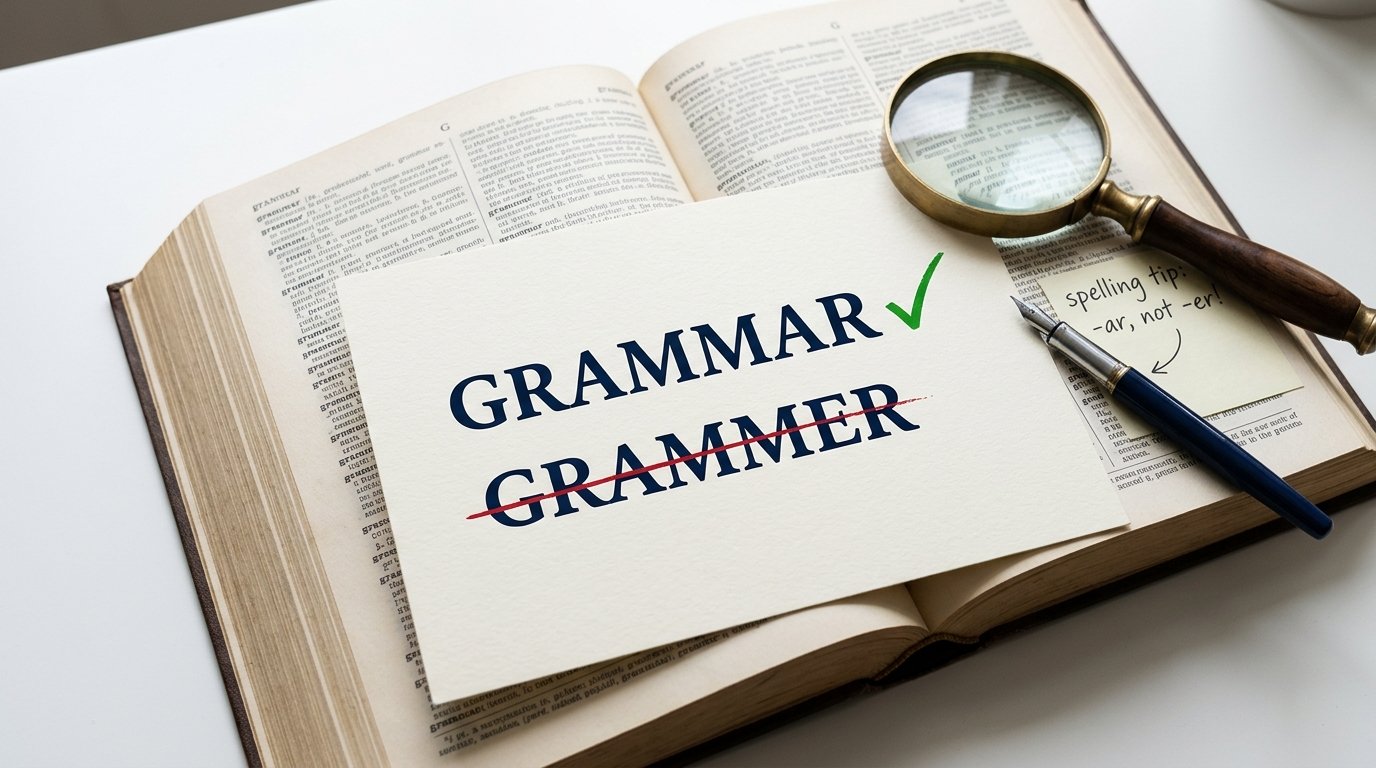
|
Ending |
Words that carry it |
What the ear hears |
|---|---|---|
|
-ar |
grammar, collar, dollar, scholar, cellar, calendar |
“er” |
|
-or |
actor, doctor, editor, author |
“er” |
|
-er |
teacher, writer, hammer, computer |
“er” |
Read the map as the transferable skill of this page. Any unstressed final syllable that sounds like “er” is a coin flip between -ar, -er and -or, and each word must be verified on its own.
The same trap runs in reverse elsewhere. Wikipedia’s documented list of commonly misspelled words carries calender as an error for calendar, the mirror image of the grammer error: an -ar word respelled with -er.
Trap Two: The Double M Is Greek
Short answer: the double M is not produced by any doubling rule. It was already written in Greek gramma, “letter of the alphabet,” and every descendant of that word has carried both Ms ever since.
Gramma, the Letter Word
Greek gramma meant a letter of the alphabet, a thing written. The art built on letters was grammatike, “(art) of letters,” and the MM sat inside the root before Latin, French or English touched it.
The Oxford Learner’s Dictionary traces the word to gramma, grammat-, “letter of the alphabet, thing written.” Learn the root and the middle of the word stops being a guess: grammar is gramma plus r.
Pages that treat the word as if its ending ran unchanged through its whole history miss this. The word’s own etymology, set out below, shows grammatica, gramaire and gramere on the road to grammar.
Why the Family Check Works: Grammatical, Grammarian
When the ending leaves you unsure, check the family, not the sound. Grammatical and grammarian both display the stem grammat-, with the -a- of gramma visible in the middle of each form.
The necessary spelling page on this site teaches the same habit with a different word. Its double S is also an inheritance to be learned with the word, never a pattern the ear can recover.
The Error Gallery: Every Wrong Way, by Mechanism
Short answer: every error in this word is one of two pressures applied once: the schwa ending guessed, or one of the silent Greek Ms dropped. The gallery sorts all ten forms by that mechanism.
A note on honesty first. No dictionary or published source ranks these misspellings by frequency, and any page that orders them by popularity without naming a source is guessing.
Each form is labelled attested, meaning it appears in a fetched dictionary note, teaching page or reference list, or constructed, meaning it is a plausible product of its mechanism but was not found in a fetched source.
|
# |
Wrong form |
Mechanism |
Status |
|---|---|---|---|
|
1 |
grammer |
The -er swap: the schwa ending respelled with the agent-noun ending |
Attested |
|
2 |
gramar |
Dropped M: one of the silent Greek pair lost |
Attested |
|
3 |
gramer |
Dropped M plus the -er swap: both pressures at once |
Attested |
|
4 |
grammor |
The -or swap: the ending guessed as -or |
Attested |
|
5 |
grammir |
The -ir swap: the schwa vowel guessed as i |
Attested |
|
6 |
grammur |
The -ur swap: the schwa vowel guessed as u |
Attested |
|
7 |
grammat |
Truncated ending: the stem of grammatical with its tail cut |
Attested |
|
8 |
grammarr |
Doubled final R: overcorrection by a writer who learned letters double here |
Constructed |
|
9 |
graammar |
Doubled A: the wrong vowel doubled |
Constructed |
|
10 |
gramma |
The stem alone: a real word, but a different one |
Attested as a word, wrong as this noun |
Rows one to three carry the gallery. Grammer is the pure ending error, gramar the pure middle error, and gramer stacks both pressures into a single five-letter failure.
Rows four to six prove the ending is a pure guess zone for the ear. Er, or, ir and ur all sound alike when unstressed, yet only -ar is ever written in the real word.
Row ten needs its fence. Gramma exists in dictionaries as its own word, an informal name for a grandmother and the Greek stem itself; it is a different word, not a spelling of this one.
Is Grammer Ever Right? The Surname Exception
Short answer: yes, exactly once: as a capitalised family name. Grammer is never the spelling of the language-system noun, and as a name it is a name, not a variant spelling.
Wikipedia’s own maintenance list of common misspellings makes the point in its G section. Its entry reads “grammer (grammar, except Kelsey Grammer),” printing the exception inside the misspelling entry itself.
So the flat claim that grammer is not a word, full stop, is one clause short of true. The fenced claim is stronger: wrong for the noun everywhere, right for the name wherever a bearer carries it.
Kelsey Grammer and the Name That Is Not a Variant
The famous bearer is Allen Kelsey Grammer, born February 21, 1955, the actor known worldwide as Dr. Frasier Crane in Cheers and Frasier. His surname is Grammer, and it is spelled with -er because that is his name.
Names are not variants. A surname is spelled as its bearers spell it, and the capital letter is the only difference print shows between the actor’s name and the commonest misspelling in this gallery.
When Autocorrect Gets the Name Wrong
The surname exception has a practical corollary. Tools trained on the noun try to “fix” Grammer into grammar, which is why the actor’s name is so often misprinted in the opposite direction.
Check names by hand before you publish anything. A spellchecker knows the noun’s frequency, not the person’s name, and it will correct a right spelling into a wrong one without asking.
Was Grammer an Old Spelling? The Middle English Record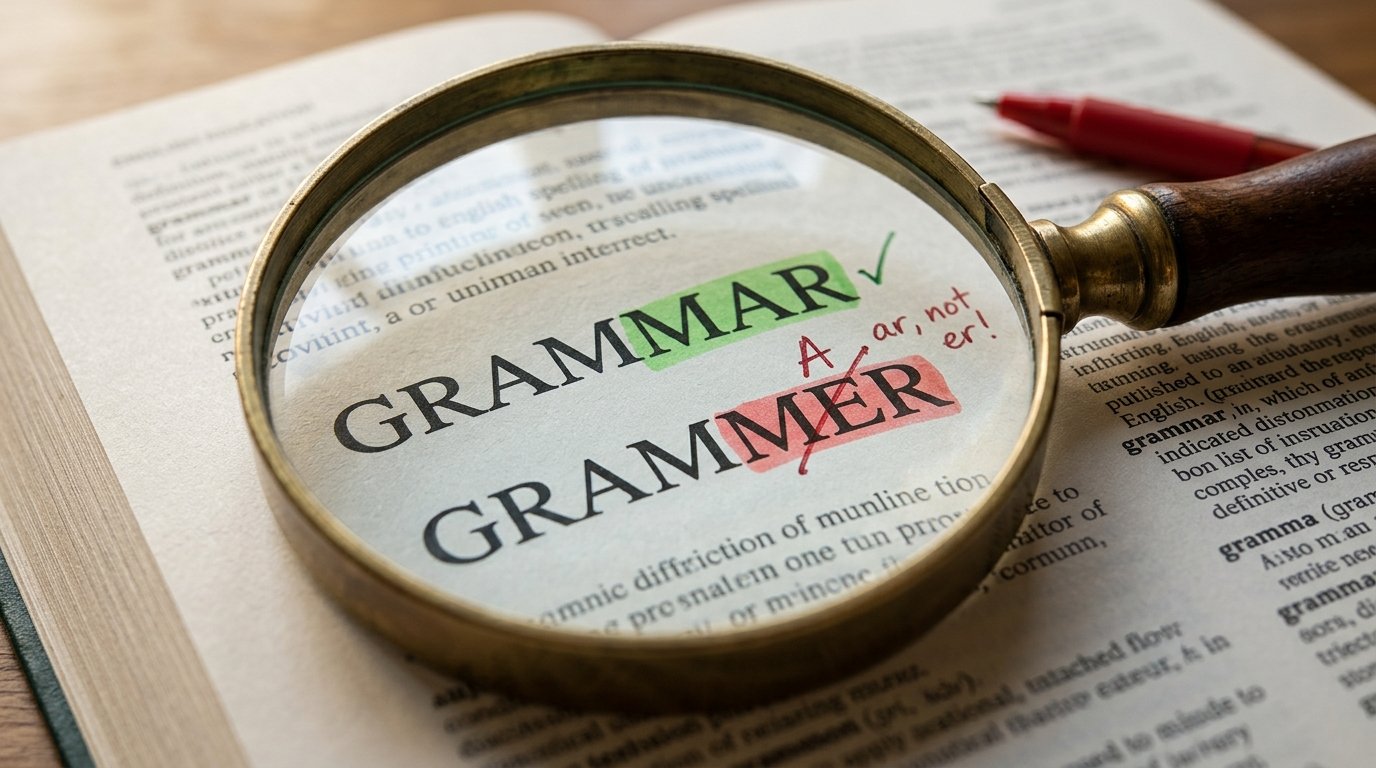
Short answer: a form identical to grammer appears among the unstandardised Middle English spellings of this word. That narrow fact is the only basis for “old spelling” claims, and it licenses no modern use.
Merriam-Webster’s etymology prints Middle English grammer and gramere among the historical forms of grammar. English spelling was not yet standardised, and the same word wore several shapes at once.
The other dictionaries do not even agree on one old form. Dictionary.com prints Middle English gramery, and the American strand at Collins prints gramer, three sources preserving three different medieval shapes.
The fence is this: no modern dictionary, American or British, lists grammer as a variant, an archaic spelling or an entry of its own. In modern English it has exactly two lives, a misspelling and a surname.
Where Grammar Comes From: Letters, Latin and a Book of Sorcery
Short answer: grammar descends from Greek gramma, a letter, through Latin grammatica and Old French gramaire. The three dictionary accounts agree on that chain and differ only in the Middle English forms, so each is printed under its own name.
The Chain, Strand by Strand
|
Stage |
Form |
The strand |
|---|---|---|
|
Greek |
gramma; grammatike (tekhne), “(art) of letters” |
Oxford: from gramma, “letter of the alphabet, thing written” |
|
Latin |
grammatica, “study of literature and language” |
Merriam-Webster, from Greek grammatike |
|
Old French |
gramaire, “rules of Latin, the Latin language” |
Merriam-Webster; Old French also “book of sorcery” |
|
Middle English |
grammer, gramere (Merriam-Webster); gramery (Dictionary.com, dated 1325 to 1375); gramer (Collins American) |
Three sources, three preserved shapes |
|
Modern English |
grammar |
First known use in the 14th century, per Merriam-Webster |
Merriam-Webster’s grammar entry gives the fullest chain: Middle English grammer and gramere, borrowed from Anglo-French gramaire, from Latin grammatica, from Greek grammatike, from gramma. It dates the first known use of grammar to the 14th century.
The Dictionary.com grammar entry dates its strand 1325 to 1375 and gives Middle English gramery from Old French gramaire. Its syllabification, gram-er, also shows how the word’s own dictionary entry rehearses the misleading sound.
Notice the constant through every strand. Languages, endings and centuries change, but the double M never does, because it belongs to gramma itself and travels inside the root.
Grammar and Glamour: The Doublet
Short answer: glamour is grammar’s own doublet. In Scotland, a form of grammar worn down by speech became glamer, then glamour, and carried the old sense of learning into a new sense of magic, then of allure.
In the Middle Ages, grammar meant learning in general, not only language rules. Learning was couched in Latin the unschooled could not read, so magic and astrology were popularly believed to be part of it, and scholars were viewed with awe and suspicion.
Merriam-Webster’s glamour entry states the descent plainly: glamour comes from Scots glamer and glamour, altered from grammar in its sense of “learning, erudition,” popularly associated with occult practices. It dates the first known use of glamour to 1720, in the sense “a magic spell.”
From spell to allure was one more step. As glamour passed into wider English use, the mysterious excitement around forbidden learning softened into the word’s modern sense of elusive, fascinating attractiveness.
Gramarye, the Magic Word
The same road produced gramarye, the archaic noun for occult learning and magic. It is a real word with its own meaning, a doublet of grammar from the same Old French source, not a variant spelling of it.
The Collins grammar entry preserves the whole trail in its American strand: the medieval term covered “the occult sciences as associated with this learning,” and the entry cross-references gramarye and glamour side by side.
Even the French stage keeps the trace. Merriam-Webster’s grammar etymology notes that Old French gramaire also meant “book of sorcery,” the learning-and-magic sense sitting inside the word’s own history.
The Word Family: One Root, Every Form
Short answer: every form built on this root keeps the double M, and most display the stem grammat- where you can see it. Learn the family once and each form checks the others.
|
Form |
Part of speech |
Spelling note |
|---|---|---|
|
grammar |
Noun |
The verdict: double M, -ar ending |
|
grammars |
Noun, plural |
A regular -s plural, for the book and system senses |
|
grammatical |
Adjective |
Stem grammat- plus -ical; the -a- of gramma shows |
|
grammatically |
Adverb |
Grammatical plus -ly; the double M and double L both survive |
|
grammarian |
Noun |
An expert in grammar; the stem stays visible |
|
ungrammatical |
Adjective |
Un- prefix; means not conforming to the rules of grammar |
|
grammar school |
Compound noun |
Historically a school for teaching Latin; in modern British use, a selective secondary school |
|
grammarless |
Adjective |
A derived form printed at Collins and Dictionary.com |
|
grammaticality |
Noun |
A linguistics term for whether a sentence counts as grammatical |
The plural deserves one line of its own. Grammar is countable in its book and system senses, so grammars is a real plural, and uncountable in its rules and usage senses, where no plural exists.
The family check is the free spelling tool hidden in this table. If a draft shows a form without the MM, or without the -a- inside the stem, the form is wrong before any dictionary opens.
Grammar or Spelling: Two Different Jobs
Short answer: grammar and spelling are different school subjects that share a classroom. Grammar is the system of rules for building sentences; spelling is the letters chosen to write each word down.
Grammar governs word forms, word order and agreement: why “she goes” is right and “she go” is not. Spelling, the subject dictionaries call orthography, governs whether that word is written grammar or grammer.
The distinction lands neatly on this page’s own error. Writing grammer is a spelling mistake, not a grammar mistake: the sentence can be perfectly grammatical while the one word is misspelled.
Memory Hooks That Actually Encode the Facts
Short answer: the strongest hook is the root hook: write gramma, the Greek word for a letter, then add r. It encodes the double M and the -ar in a single move, because both are already inside the build.
The Arts Hook, the Mirror Hook and the Root Hook
Hook one: the arts hook. Grammar ends in -ar, like the ar in arts, and the hook is honest, because the word’s Greek parent, grammatike tekhne, literally means the art of letters.
Hook two: the mirror hook. Split the word at its syllables, gram-mar, and rehearse the two halves as a pair. The hook fixes the shape of the word, though it says nothing about why the letters are there.
Hook three: the root hook. Build the word from gramma plus r. This is the only hook of the three that encodes both traps at once, which is why it is the one worth keeping.
Test every hook against the two mechanisms before trusting it. A sentence mnemonic that mentions the word but encodes neither the MM nor the -ar teaches nothing, however charming it sounds.
For paper drills, the look, cover, write, check method pairs well with the root hook: look at gramma plus r, cover it, write grammar from the root, then check the pair of Ms.
Grammar in Sentences: The Example Bank
Short answer: the word works in three everyday senses: the rules system, a person’s own usage, and a book that describes the rules. The bank below shows each sense in plain sentences.
- Good grammar makes a resume easier to trust.
- The teacher marked two grammar errors in the essay.
- English grammar can be hard to master.
- He bought a grammar of Latin at the book sale.
- Her grammar improved with every draft she edited.
- Comparing the grammars of English and Japanese shows how differently languages build sentences.
- The grammar of the theater has its own rules and rituals.
- His grammar was excellent even in casual messages.
- A good grammar sits on the desk beside the dictionary.
- Students learn grammar by building sentences, not by memorising labels.
Read the bank for the senses at work. Sentences one, three and ten use the rules system; two, five and eight judge a person’s usage; four and nine name the book on the desk.
Practice: Spot the Correct Spelling
Short answer: five quick items built from the gallery and the fences. Knowing how to spell grammar is the whole drill; pick the correct form in each set, then check the answers printed under it.
- a) grammer b) grammar c) gramar
- a) gramer b) grammor c) grammar
- The surname of the Frasier actor: a) Grammar b) Grammer c) Gramar
- a) gramatically b) grammaticaly c) grammatically
- a) graammar b) grammar c) grammarr
Answers: 1 b, 2 c, 3 b, 4 c, 5 a. Item three is the fence in action: the name takes -er, the noun never does, and the capital letter carries the difference.
For paper practice, this drill and the error gallery above print cleanly together as a one-page practice sheet: the ten wrong forms on one side of the lesson, the five questions on the other.
The MagazineSolo Spelling Cluster
Short answer: grammar joins a small family of spelling verdicts on this site. Each page owns one word and its mechanism, and the pages link to each other rather than repeating each other.
The definitely spelling page settles the cluster’s schwa vowel word, where an unstressed middle syllable tempts writers toward definately. Its trap is a sound-alike vowel; this page’s ending trap is its close cousin.
The occurrence spelling page pairs a working rule with an inheritance, as this page does. Its double R obeys a stress rule while its double C descends from Latin, two mechanisms kept apart.
The separate spelling rule page teaches a root-based verdict: separate keeps its middle A because its root is par. Grammar’s verdict is likewise settled by its root, the Greek word gramma.
More verdicts, galleries and word family tables live on the MagazineSolo spelling rail, where each new word is added with its mechanism stated and its sources named.
Frequently Asked Questions
Is it grammar or grammer?
Grammar. The noun is spelled g-r-a-m-m-a-r in every modern dictionary, in every variety of English. Grammer survives only as a capitalised surname and as the misspelling this page corrects.
How do you spell grammar, letter by letter?
G-r-a-m-m-a-r. Seven letters: g, r, a, then the double m, then a, then r. Both vowels are a, and there is no letter e anywhere in the word.
Is grammer a word?
Not as the name of the language system: no modern dictionary lists it as a noun or as a variant. It lives in modern English only as a misspelling of grammar and as the surname Grammer.
Is grammer ever correct?
Yes, in exactly one setting: as a capitalised family name, spelled as its bearers spell it. As the spelling of the noun, in a sentence about language rules, grammer is never correct.
Does grammar end in -ar or -er?
It ends in -ar. The -er forms are the error, produced because the unstressed ending sounds like “er” and English trains writers to spell that sound with the agent-noun ending.
Why is grammar spelled with -ar and not -er?
Because the ending is a fossil, not a suffix. It is the worn-down tail of Latin grammatica and Old French gramaire, carried with the word rather than chosen by any English spelling rule.
Why do people write grammer so often?
Because the two forms sound identical and -er feels like the default ending for that sound. Teacher, writer and computer train the habit; grammar is one of the words where the habit fails.
Why does grammar sound like it ends in -er?
Its final syllable is unstressed, so its vowel reduces to the schwa. An unstressed “uh” plus r is what -er, -or and -ar endings all sound like, and the ear cannot separate them.
What is the schwa at the end of grammar?
The schwa is the flat “uh” sound, written ə, that unstressed vowels collapse into. Grammar’s second syllable is all schwa, which is why the ending carries no spelling information at all.
Why does grammar have two Ms?
Because Greek gramma, “letter of the alphabet,” already had them. The double M passed through grammatike and grammatica into English unchanged; it is an inheritance, not the output of a doubling rule.
How many letters are in grammar?
Seven: g, r, a, m, m, a, r. The count is a fair quick check, because the commonest error forms in the gallery have six letters or carry the wrong ending.
How many syllables does grammar have?
Two: gram-mar. The stress falls on the first syllable, and the second syllable is unstressed, which is why its vowel shrinks and misleads anyone spelling by ear.
How do you pronounce grammar?
In American English, /ˈɡræmər/; in British English, /ˈɡræmə(r)/. The Oxford Learner’s Dictionary prints both forms, with the stress on the first syllable in each.
Is grammar spelled the same in British and American English?
Yes, identically. Dictionaries print one headword for both varieties, and Australian and Canadian English follow the same spelling. Only the sound of the final r differs across accents.
Is grammer the British spelling of grammar?
No. No variety of English spells the noun grammer, British included. The idea circulates as a learner belief, but no British dictionary lists it, as a current spelling or as a variant.
Where does the word grammar come from?
From Greek gramma, a letter, through grammatike, “(art) of letters,” then Latin grammatica and Old French gramaire. Each dictionary strand agrees on that chain, as the etymology section sets out.
What does the Greek word gramma mean?
A letter of the alphabet, a thing written. It is the root inside grammar, and its own double M is the reason the modern word carries two Ms in the middle.
When was the word grammar first used in English?
Merriam-Webster dates the first known use to the 14th century, in the sense “the study of the classes of words.” Dictionary.com dates the word’s arrival to the years 1325 to 1375.
Was grammer ever an old spelling of grammar?
A form identical to grammer appears among the Middle English spellings Merriam-Webster lists, alongside gramere, from an age before spelling standardised. No modern dictionary lists it as a variant, so it licenses no modern use.
Do any dictionaries list grammer as a variant spelling?
No. Merriam-Webster, Oxford, Cambridge, Dictionary.com and Collins all print the single headword grammar with no variant. The only grammer in their neighbourhood is the Middle English form inside etymologies.
Is Grammer a surname?
Yes. Grammer is a genuine family name, spelled with -er and a capital G. Wikipedia’s misspelling list itself prints the exception: “grammer (grammar, except Kelsey Grammer).”
Who is Kelsey Grammer?
Allen Kelsey Grammer, born February 21, 1955, the American actor famous as Dr. Frasier Crane in Cheers and Frasier. His surname is the standing example of the name that is not a variant.
Why does autocorrect change the name Grammer to grammar?
Because the tools are trained on the noun’s frequency, not on people’s names. They “fix” the rare string into the common word, which is why names must always be checked by hand before publishing.
Why are grammar and glamour related?
They are doublets: glamour descends from Scots glamer, a worn-down form of grammar in its old sense of “learning.” Because that learning was popularly tied to magic, glamour first meant a spell.
What is gramarye?
An archaic noun for occult learning and magic, from the same Old French source as grammar. Collins cross-references it from the grammar entry; it is a real word, but a different one.
What does grammar mean?
The system of rules for a language: how words are formed and combined into sentences. It also names a person’s own usage, judged against those rules, and a book that describes them.
What part of speech is grammar?
A noun. It names a system, a quality of writing, or a book. In compounds like grammar school and grammar book it works as a modifier in front of another noun.
Is grammar countable or uncountable?
Both, by sense. The rules and usage senses are uncountable: good grammar, her grammar. The book and system-description senses are countable, which is why the plural grammars exists.
What is the plural of grammar?
Grammars, a regular -s plural: the grammars of English and Japanese. It belongs to the countable senses only; nobody pluralises the rules sense or a person’s usage.
What is the adjective form of grammar?
Grammatical. It is built on the stem grammat- plus -ical, so the -a- of gramma shows in the middle: a grammatical sentence, a grammatical error.
How do you spell grammatically?
G-r-a-m-m-a-t-i-c-a-l-l-y. The adverb is grammatical plus -ly, and it keeps both doubles of the family: the double M from gramma and the double L where -ical meets -ly.
What is a grammarian?
An expert in grammar: a scholar who studies or writes about the rules of a language. The word keeps the family spelling on display, with the stem grammat- visible before its ending.
What does ungrammatical mean?
Not conforming to the rules of grammar. An ungrammatical sentence breaks the system the noun names, the way “she go” breaks agreement; the word is the adjective form with the un- prefix.
What is a grammar school?
Historically, a school for teaching Latin, the original grammar subject. In modern British use it names a selective secondary school; Collins discusses the term in its British usage material.
What are the most common misspellings of grammar?
The attested gallery forms are grammer, gramar, gramer, grammor, grammir, grammur and grammat. No dictionary or published source ranks them by frequency, so this page lists them by mechanism, not popularity.
Is gramar a correct spelling?
No. Gramar drops one of the two Ms the word inherited from Greek gramma. The pair produces a single m sound, which is why the loss happens, but the written word needs both.
Is gramer a correct spelling?
No. Gramer makes both errors at once: it drops one M from the Greek pair and swaps the -ar ending for -er. It is the two traps of this page stacked in one form.
What is the difference between grammar and spelling?
Grammar is the rule system for building sentences; spelling is the choice of letters for each word. Writing grammer is a spelling error inside a sentence whose grammar may be perfect.
Is it grammar check or grammer check?
Grammar check. The phrase names a check of the noun, so it takes the noun’s spelling. Checker ends in -er, which is exactly the analogy that keeps pulling writers the wrong way.
What is a good mnemonic for spelling grammar?
Use the root hook: gramma plus r. It rebuilds the word from the Greek root, so the double M and the -ar ending arrive together instead of being memorised as separate facts.
Are there other words that end in -ar but sound like -er?
Yes: collar, dollar, scholar, cellar and calendar all end in -ar and all sound like -er when unstressed. The ending map in Trap One shows the -ar, -or and -er families side by side.
How can I stop writing grammer in my own writing?
Run the three-part self-check: search the document for grammer before submitting, check the family form grammatical in your head, and test the ending against the map. Seconds of checking catch the error every time.
Conclusion
Grammar vs grammer correct spelling ends where it started: grammar, g-r-a-m-m-a-r, with the answer carried by two facts instead of one guess. The ending is a schwa that sound cannot settle, and the middle is Greek gramma, whose double M no rule creates and no ear can hear.
Keep the fences with the verdict and the page stays exact. Grammer is a surname and a misspelling, never a variant; the Middle English shape is history, not permission; and glamour, improbably, is this word’s own doublet, the magic that learning once seemed to hold.

Dilawar is a content writer at MagazineSolo, covering travel, home improvement, interior design, and everyday lifestyle topics. He enjoys researching practical solutions, exploring travel destinations, and sharing helpful guides that make daily life easier. His writing focuses on clear information, useful advice, and engaging stories for a wide audience.