What Is Grammar in Simple Words?

What is grammar in simple words? Grammar is the set of rules that puts words in the right order, so a sentence makes sense to the person who hears or reads it.
Big grammar books use hard words for these rules. This page uses small words instead, and it proves every rule on one short sentence you can read aloud.
You will meet the rules one at a time: word order first, then the parts of speech by their simple names, then the mistakes beginners make most.
Grammar in One Sentence
Grammar is the rules that put words in the right order so sentences make sense. That is the whole answer in one line, and the rest of this page just opens it up slowly.
Simple English Wikipedia gives the same answer in plain words: grammar is the study of words, how they are used in sentences, and how they change.
The British Council, which teaches English to learners, calls grammar an instruction manual for speaking and writing. A manual does not sound grand, and that is the point: grammar is a tool, not a test.
Wordsmyth, a dictionary made for children, adds a warm fact. Some of these rules are already in your head, because you learned them by listening long before school named them.
The big dictionaries agree underneath. Oxford Learner’s Dictionary calls grammar the rules for changing the form of words and joining them into sentences.
Cambridge Dictionary says the same in learner words, and Merriam-Webster calls it a system of rules that defines how a language is built.
Dictionary.com adds the friendliest line of all: grammar is the set of rules you use most of the time without thinking when you speak or write.
So the simple answer and the dictionary answer match. Grammar is rules for words: which order they stand in, and how they change their shape to fit the sentence.
See It Work: The Sentence That Falls Apart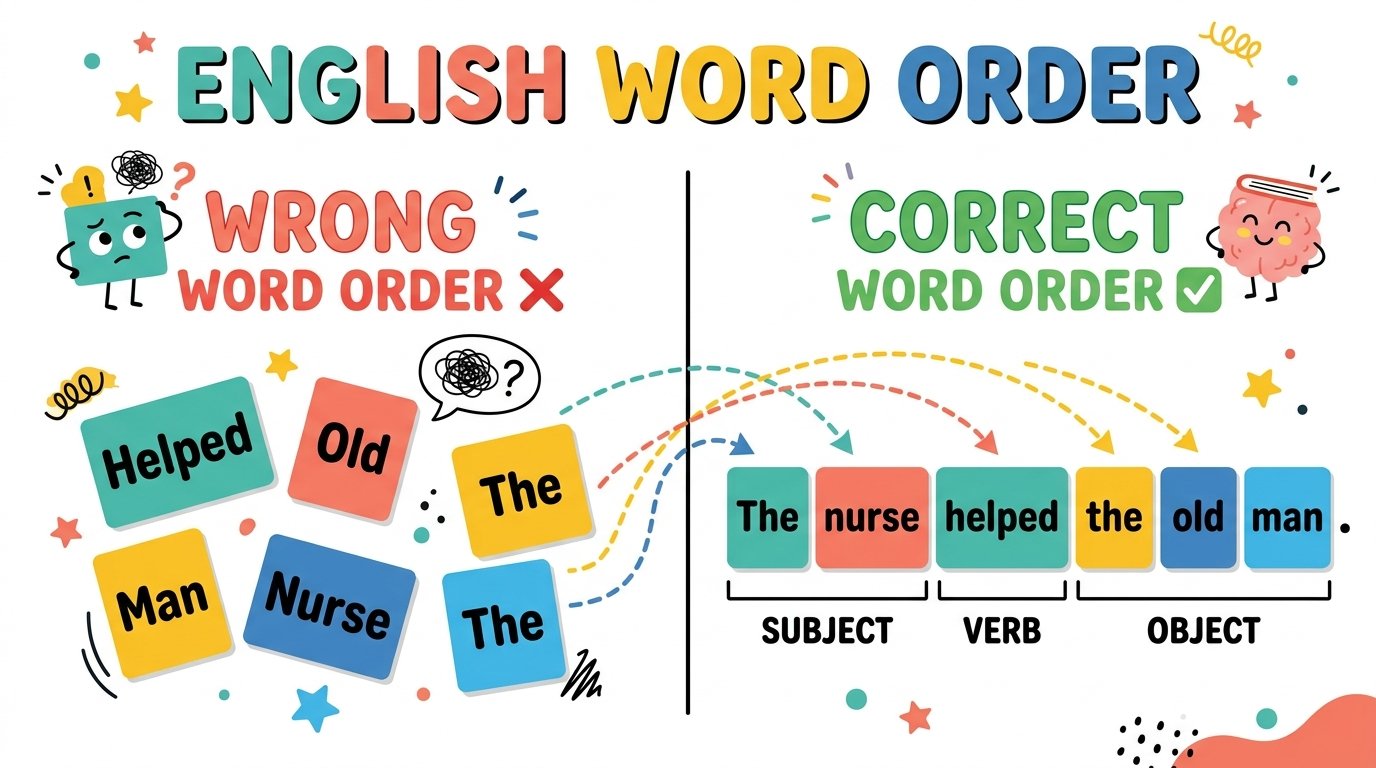
Take six plain words: nurse, the, helped, man, old, the. In the right order they say something kind and clear: The nurse helped the old man.
Now mix them up: Helped old the man nurse the. The words are the same, but the sentence falls apart, and no one can say what happened.
Nothing about the words changed. Only their order changed, and order is grammar. Fixing that jumble is the first grammar act every speaker performs.
The Same Words in a Different Order Mean a Different Thing
Order does more than make sense. It can swap the meaning: The farmer chased the sheep and The sheep chased the farmer use the same words and tell opposite stories.
That is why English leans on order so hard. The word that stands first does the action, and the word that stands after receives it.
A learner who masters order has mastered the biggest rule in the language. The smaller rules on this page all hang from that one.
The Rules You Already Know Without Studying
A small child says throw the ball to me and never ball the me to throw. Nobody taught the rule; the child picked it up by living in the language.
Simple Wikipedia puts it plainly: grammar is the rules about how to speak and write in a language. You follow most of them before you can name one.
Study does not install grammar. Study adds names to machinery you already run, and names make the machinery easier to fix when a sentence goes wrong.
The First Rules, One at a Time
Five small rules carry most beginner sentences. Each rule below is shown on one sentence, in the order a learner meets them in real speech.
Rule One: Words Go in an Order
English sentences mostly run doer, doing, receiver: someone does something to someone or something. The cook tasted the soup follows the pattern exactly.
Move the pattern and the sense moves with it. That is why word order is rule one, and why the jumbled sentence at the top failed before any other rule was tested.
Rule Two: A Sentence Needs a Doing Word
The bell alone is just a naming phrase, a label with nothing happening. Add a doing word and it stands up: The bell rang at noon.
Every full sentence needs a doer and a doing word working together. If one of them is missing, you have a phrase, not a sentence.
Rule Three: She Goes, They Go
Say she goes to school, but they go to school. The doing word changes its end to match the doer, and English does this in a few set places.
Teachers call this match subject verb agreement, but the simple name is enough: the verb fits its subject. It is the rule beginners break most, and the easiest to hear once named.
Rule Four: Words Change Their Clothes
Words change their shape to fit their job. Walk becomes walked for yesterday and walking for right now, and child becomes children when there is more than one.
These shape changes are not decoration. They carry time and number, so a listener knows when something happened and how many people or things are involved.
Rule Five: Time Words
Tense is the grammar word for time in a verb. In simple words: the verb tells you if the action sits in yesterday, today or tomorrow.
We planted seeds is finished time. We plant seeds is habit time. We will plant seeds is future time, and the small word will does the heavy lifting.
Writing Marks: Capital Letters and Full Stops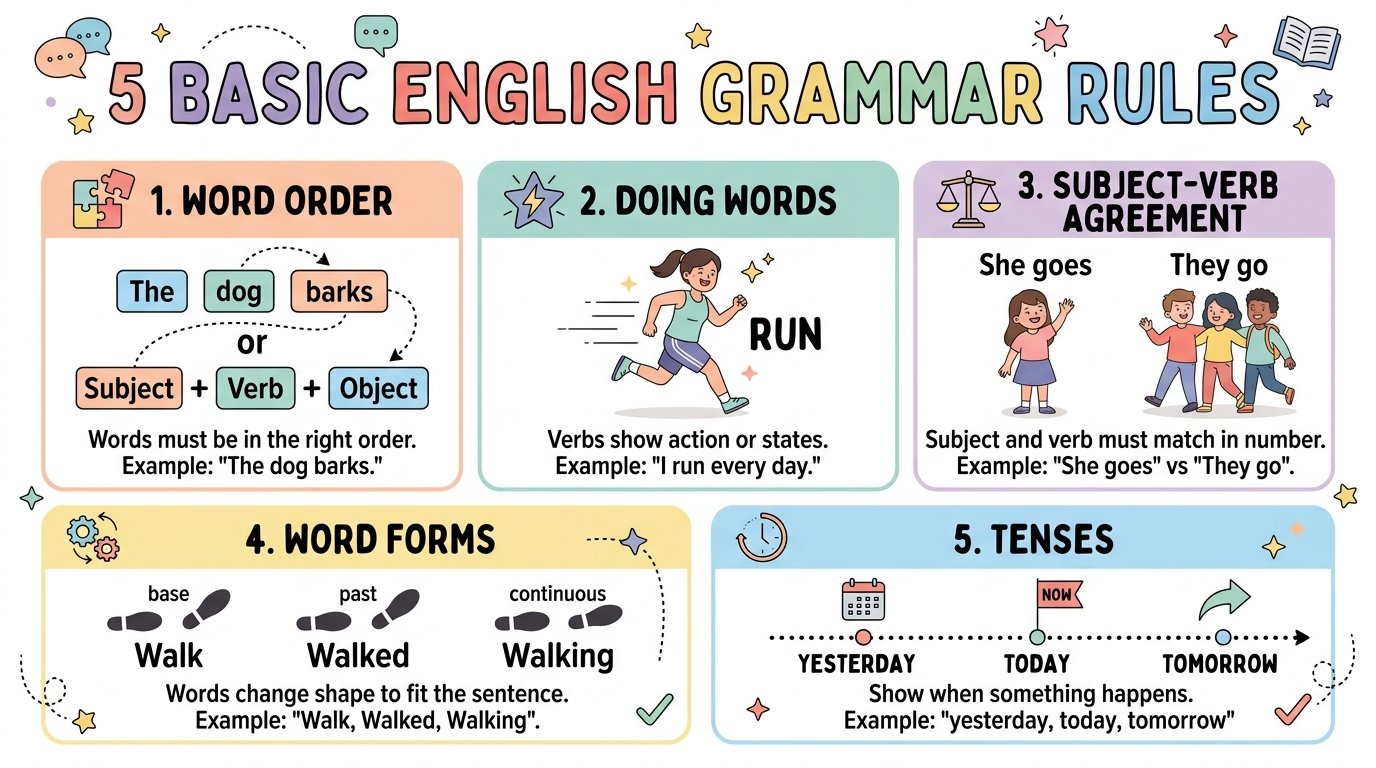
A sentence starts with a capital letter and ends with a full stop, a question mark or an exclamation mark. These marks show the reader where one sentence stops and the next begins.
Strictly, these marks belong to punctuation, grammar’s close neighbour. They sit in this list because beginners meet them together, and the honest split is explained further down this page.
The Parts of Speech by Their Simple Names
Every word in a sentence does one job. School gives the jobs hard names, but each job is simple, and the table below gives the simple name first.
|
Simple name |
School name |
What it does |
Home example |
|---|---|---|---|
|
Naming word |
Noun |
Names a person, place, thing or idea |
The ladder leans on the wall |
|
Doing word |
Verb |
Says what happens, or what something is |
Birds sing at dawn |
|
Describing word |
Adjective |
Tells more about a naming word |
She wore a green coat |
|
How word |
Adverb |
Tells how, when or where a doing word happens |
The train moved fast |
|
In place of word |
Pronoun |
Stands in place of a naming word |
They took the bus home |
|
Place word |
Preposition |
Shows place, time or direction |
The cat sleeps behind the sofa |
|
Joining word |
Conjunction |
Joins words or parts of a sentence |
I called, and she answered |
|
Feeling word |
Interjection |
Shows a sudden feeling, standing alone |
Oh, I dropped my keys |
|
Little word |
Article |
Points to a naming word: a, an, the |
A dog barked at the gate |
One honest note: this table is a simple register list for learners. It names the jobs so the rules feel small; it is a teaching tool, not a dictionary count.
Naming Words and Doing Words
Two jobs build nearly every sentence. Naming words say who or what we talk about, and doing words say what happens to them.
Try the test on The baker opened the shop. Baker names a person, opened says the action, and shop names the thing the action lands on.
Describing Words and How Words
Describing words paint the naming words: a tired baker, a small shop. How words paint the action instead: he opened the shop early, she sang softly.
The test is one question. If the word tells more about a thing, it is a describing word; if it tells more about the action, it is a how word.
In Place Of Words, Joining Words and Little Words
In place of words save breath: she, they, it stand in for names already given. Joining words link ideas: and, but, because. Place words show where things sit: under, behind, before.
Little words look tiny and work hard. A, an and the point at naming words and tell the listener if the thing is new or already known.
Feeling words stand alone and carry a burst: wow, oh, ouch. They are the smallest group, and children usually spot them first because they sound like real speech.
Is Punctuation Part of Grammar? The Honest Simple Answer
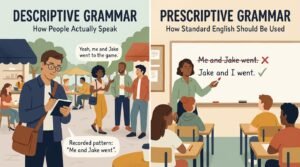
Honest answer: it depends who you ask, and both sides have a reason. This page prints both in simple words instead of picking a winner in secret.
The school answer says punctuation travels with grammar. Lessons, tests and marks treat them together, because a sentence needs its capital letter and full stop to look finished.
The language science answer says punctuation is separate. Grammar is the rules of words and their order; punctuation is the set of marks the writing system adds on top.
Use the school answer in class and the science answer when you read about language. Knowing both labels is the real skill, and it costs one short paragraph.
Spelling sits beside both, as a third neighbour. Even the word grammar is often spelled wrong, and our grammar spelling page will cover that trap in full once it is published here.
Common Simple Mistakes
Every beginner makes the same handful of mistakes. Each row below shows the slip, the fix, and the one line rule worth keeping in your pocket.
|
Mistake |
Fix |
One line rule |
|---|---|---|
|
She don’t like rice |
She does not like rice |
With she, he or it, use does, not do |
|
I have two childs |
I have two children |
Some naming words change their whole form |
|
He is more taller than me |
He is taller than me |
Pick one way to compare, never both |
|
Me and Sara went to the shop |
Sara and I went to the shop |
At the start of a sentence, use I, not me |
|
They was happy |
They were happy |
They pairs with were, not was |
|
I goed to school |
I went to school |
Some doing words change their whole form in the past |
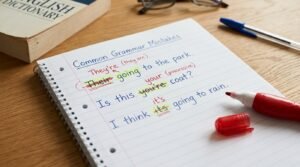
Read each fix out loud once. Most of these slips sound wrong the moment you hear them, because the rules are already in your head from listening.
Pick one row a week and hunt for it in your reading. Small, steady fixes beat a long list of rules learned once and forgotten by Friday.
How to Explain Grammar to a Child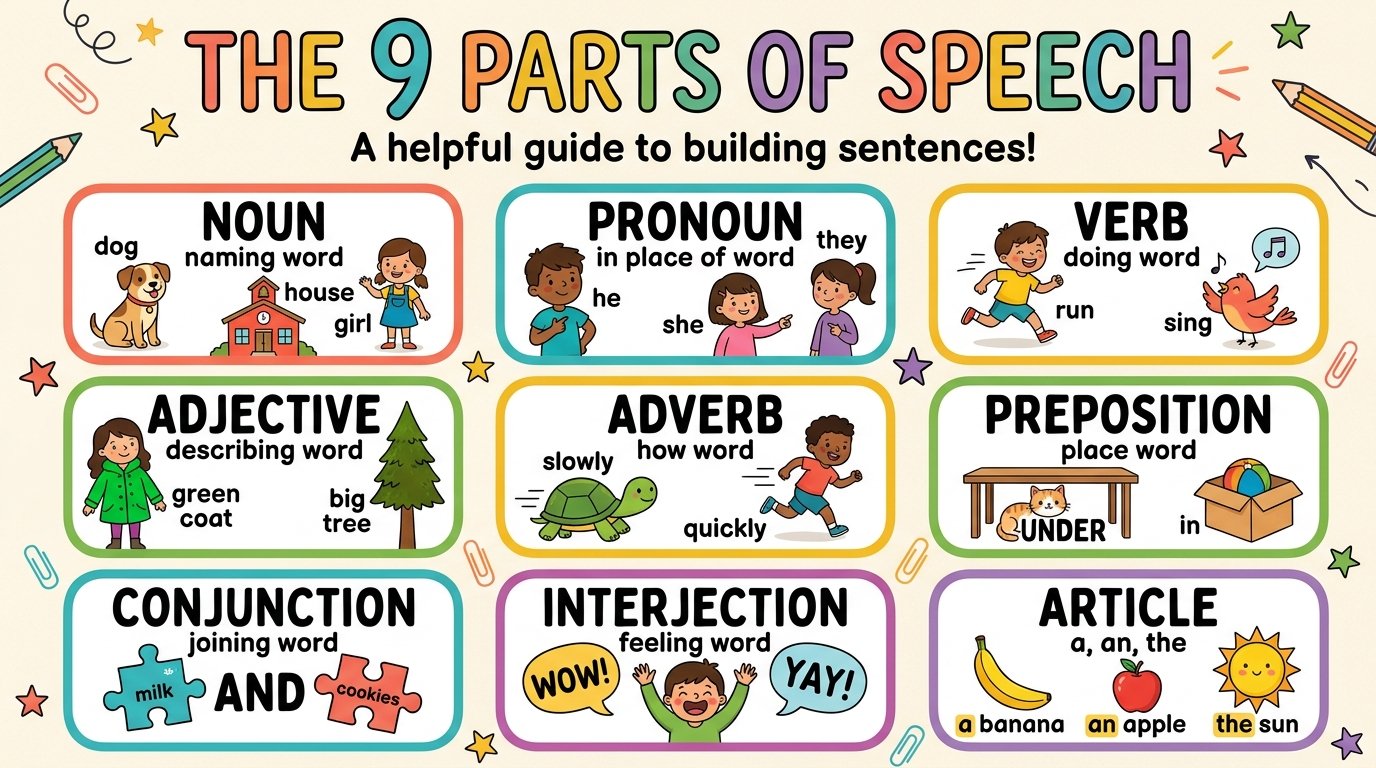
Start with three word cards: dog, ran, the. Mix them up, read the jumble aloud, and let the child laugh at the nonsense before you fix it together.
Then say the one line that matters: grammar is putting words in the right order so they make sense. That sentence, at a kitchen table, is a complete first lesson.
Build from there in tiny steps. Name one naming word in a story, then one doing word, and stop while the game is still fun.
Keep the hard names for later. A child who can spot a doing word today will accept the school name verb tomorrow without fear.
Why Grammar Matters, in Simple Words
Grammar is what lets a stranger understand you exactly. The words carry the facts, but the order and the endings tell the listener who did what, and when.
It also saves effort. A speaker with clear grammar is believed faster, in class, at work and in a note left on the fridge.
Words themselves are the other half of the job: grammar is the plan, and vocabulary is the bricks. Our page on what does literally mean shows how one single word can carry two senses at once.
Figurative words need the same care, as what does irony mean explains. Grammar holds the frame steady while words like those do their clever work inside it.
Where to Start: The Gentle Path Onward
Start with order, because order is the rule every other rule hangs from. Build one plain sentence, then change one thing at a time and watch the meaning move.
Learn naming words and doing words next, then the she goes match, then time words. That short ladder covers most of the sentences a beginner says in a day.
Grammar and vocabulary grow side by side: learn the words for your life, and fit each new word into a sentence the same day you learn it.
When you are ready for the full picture, the complete meaning of the word, with all its senses set out from the dictionaries, is in our page on the full meaning of grammar. That page is this page’s deeper partner.
More plain English explanations live across MagazineSolo, written the same way: the short answer first, the detail after, and no hard word left unexplained.
Grammar in Simple Words: The Read Aloud Summary
Grammar is the set of rules that puts words in the right order so sentences make sense. Every sentence needs a doer and a doing word.
Words change their shape to show time and number. She goes, but they go. Naming words name things, describing words paint them, and joining words link ideas together.
Marks like capital letters and full stops belong to punctuation, grammar’s close neighbour. You already use most grammar rules without thinking, every time you speak.
Print this block, read it aloud once, and you hold the whole page in your hand.
Frequently Asked Questions
What is grammar in one sentence?
Grammar is the set of rules that puts words in the right order and the right shape, so sentences make sense when we speak and write. If you remember only that one line, you already hold the heart of the subject.
How do you explain grammar to a child?
Use three word cards and a laugh. Mix up dog, ran, the, read the jumble aloud, then fix it together: The dog ran. Then say the simple line: grammar is putting words in the right order so they make sense.
What is a sentence in simple words?
A sentence is a complete thought in words. It has a doer and a doing word, starts with a capital letter, and ends with a full stop or a question mark, like The baby is sleeping.
Why does word order matter in a sentence?
Order tells the listener who did what. English puts the doer first and the receiver after the action, so swapping the order swaps the story: The dog bit the man is not the same news as the man biting the dog.
What happens when words are in the wrong order?
The sentence falls apart. The words still exist, but no clear picture forms, and the listener must guess or give up. Went shop to morning this Anna carries the same words as a good sentence and none of its meaning.
What is an example of grammar for kids?
The bird sang is grammar at work: bird names, sang does. Change one rule and watch: Birds sang adds more than one bird, and The bird sings moves the song to now. Each small change is a rule.
What is the subject of a sentence in simple words?
The subject is who or what the sentence is about, usually the doer. In The bus stopped, the bus is the subject. Ask who or what before the doing word, and the answer is the subject every time.
Why do words change their form in simple words?
Words change shape to carry extra news. An added ending can show time, as in walk and walked, or number, as in book and books. The change is small, but it tells the listener when, and how many, without extra words.
Why do we say “she goes” but “they go”?
Because the doing word fits its doer. With she, he or it, the present verb takes an s: she goes, he runs, it rains. With they, we or I, it stays plain: they go. One small match, learned by ear.
What is tense in simple words?
Tense is time inside the verb. It tells you if the action is finished, happening now, or still to come: we cooked, we cook, we will cook. Three time slots, shown mostly by changing the doing word or adding will.
What are the parts of speech in simple words?
They are the jobs words do in a sentence. Naming words name things, doing words say actions, describing words paint things, and joining words link ideas. The table on this page lists all nine jobs with simple names and one example each.
What is a noun in simple words?
A noun is a naming word. It names a person, place, thing or idea: teacher, park, cup, courage. If you can point at it, hold it, visit it or feel it, the word that names it is a noun.
What is a verb in simple words?
A verb is a doing word. It says what happens or what something is: jump, cook, sleep, is. Every full sentence needs one, because without an action or a state, nothing in the sentence actually happens.
What is an adjective in simple words?
An adjective is a describing word for a naming word. It answers which one, what kind, or how many: a red bus, a kind teacher, three dogs. It sits near the noun it paints and adds the picture’s colour.
What is an adverb in simple words?
An adverb is a word that tells how, when or where a doing word happens. She sings sweetly tells how, we left early tells when, and he waited outside tells where. Many how words end in ly, but not all.
What is a pronoun in simple words?
A pronoun is a word that stands in place of a naming word, so we do not repeat it. Lena lost her pen, so she borrowed one: she and her do the standing in, and the sentence stays light.
What is a preposition in simple words?
A preposition is a place word. It shows where or when one thing sits against another: the cup is on the table, the cat hid under the bed, we eat before school. It always travels with a naming word.
What is an article in simple words?
An article is a little pointing word: a, an or the. A points at any one thing, the points at the one we already know, and an is just a before a vowel sound, as in an apple.
What is the difference between a phrase and a sentence in simple words?
A phrase is a group of words without a complete thought: under the old bridge. A sentence finishes the thought with a doer and a doing word: We hid under the old bridge. The phrase is a part; the sentence is the whole.
What is the difference between grammar and punctuation in simple words?
Grammar is the rules of words and their order. Punctuation is the marks writing adds: full stops, commas, question marks. Grammar builds the sentence; punctuation shows the reader where its parts begin and end on the page.
Are capital letters and full stops grammar or punctuation?
They are punctuation. Schools often teach them inside grammar lessons, which is why the two get mixed up. The marks belong to the writing system, while grammar itself is the word rules underneath, in speech as much as on paper.
What is good grammar in simple words?
Good grammar means your words stand in the right order with the right shapes, so the listener gets your meaning first try. Bad grammar is simply the reverse: the order or shape fights the meaning, and the listener has to guess.
What are the most common grammar mistakes beginners make?
The same small set: she go instead of she goes, two childs, I goed, they was, and word order slips from a first language. The mistakes table on this page shows each one with its fix and its one line rule.
Why is grammar important in simple words?
Grammar makes you understood exactly. It tells the listener who did what, when it happened, and how many were there. Clear grammar saves questions, avoids mix ups, and makes your speaking and writing sound calm and sure.
Is English grammar hard to learn?
The start is easier than it looks. The word order is steady, verbs change in only a few set places, and you already use most rules when you speak. The hard parts come later and one at a time.
Where should a beginner start learning grammar?
Start with word order and one plain sentence: doer, doing word, receiver. Then learn naming words and doing words, then the she goes match. That small ladder covers most everyday sentences and builds confidence fast.
What is the first grammar rule to learn?
Learn that words go in an order, and the order carries the meaning. Build The cat drank the milk, then swap the ends and feel the story change. Every later rule is a helper standing on that one.
Should I learn grammar or vocabulary first?
Learn them together, in small turns. Words without grammar are a pile of bricks; grammar without words is an empty plan. Learn a word, put it in a sentence the same day, and both sides grow at once.
How can parents help a child with grammar at home?
Read aloud together and play the fix the jumble game with word cards. Name one naming word and one doing word in each story, keep it short, and praise the fix. Ten happy minutes beat an hour of worksheets.
Do children learn grammar without studying it?
Yes. Children absorb the rules by listening and copying, which is why a five year old orders words well without knowing any names for the rules. Study later adds the names and helps fix the few places where the ear needs help.
Is grammar used in speaking or only in writing?
Both. Grammar is the rules of the language itself, so it runs in speech first and writing second. Writing adds punctuation marks on top. A person with no writing at all still speaks with full grammar every day.
Does grammar change over time?
Yes, slowly. Words change shape, old endings drop away, and new habits become the rule, as the history strand in Humanities LibreTexts sets out for students. The grammar in your grandparents’ school books is close to yours, but not identical in every rule.
How many grammar rules are there in English?
Nobody can give one true count, because rules split and join depending on how you count them. The expert David Crystal is quoted as saying there are, by one count, some 3,500 rules. Treat any exact number as one person’s way of counting.
Can a sentence be correct but silly in simple words?
Yes. The spoon drank the purple idea follows every rule: right order, right shapes, full stop. It is correct grammar saying a silly thing, which proves grammar guards the shape of a sentence, not whether the sense is wise.
Conclusion
What is grammar in simple words comes down to one friendly line: grammar is the rules that put words in the right order, so people understand each other exactly.
Start where this page started, with one jumbled sentence fixed. Add the simple names, the five small rules and one mistake fix a week, and the subject shrinks to a size anyone can hold.
The read aloud summary above doubles as a printable practice card: print it, keep it near the homework spot, and let it answer the question the next time it is asked at your table.

Dilawar is a content writer at MagazineSolo, covering travel, home improvement, interior design, and everyday lifestyle topics. He enjoys researching practical solutions, exploring travel destinations, and sharing helpful guides that make daily life easier. His writing focuses on clear information, useful advice, and engaging stories for a wide audience.