Well Deserved or Well-Deserved? Which is Correct? (Updated 2026)
Understanding whether to write well deserved or well-deserved is a common grammar confusion in English writing. Many writers, students, bloggers, and even professionals struggle with this small but important detail. The good news is that the rule is simple once you understand how compound adjectives work in English.
In this guide, we will break down the correct usage of well deserved, explain when to use a hyphen, show clear examples, and help you confidently decide between well deserved or well-deserved in your writing. This article is fully updated for 2026 and optimized for clarity, SEO, and real-world usage.
Well Deserved or Well-Deserved? Which is Correct?

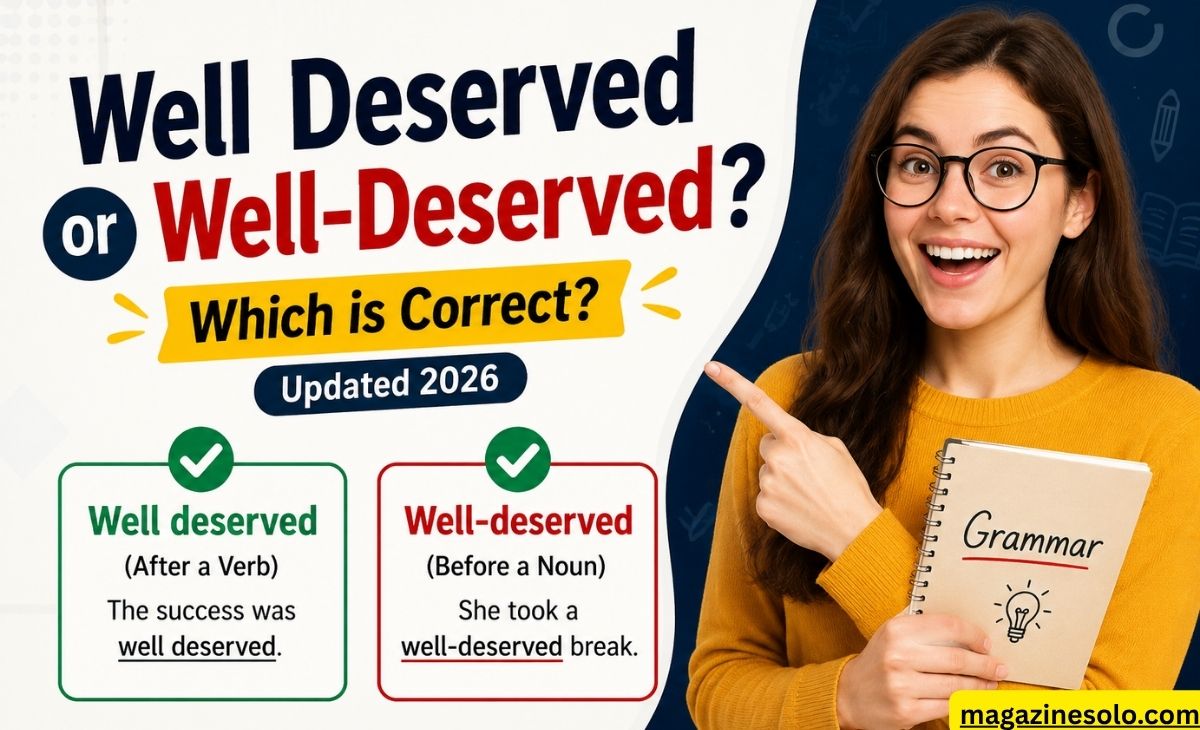
Here is the short answer: both are correct, but they serve different grammatical roles depending on where they appear in a sentence.
The key is position. When the phrase comes before a noun, use the hyphenated form: well-deserved. When it comes after a linking verb (such as is, was, seems, or appears), drop the hyphen and write well deserved.
| Form | Position in Sentence | Example |
| well-deserved | Before a noun (attributive adjective) | She earned a well-deserved promotion. |
| well deserved | After a linking verb (predicate adjective) | The promotion was well deserved. |
This rule comes directly from standard English grammar guidelines, including the AP Stylebook, which teaches that hyphens link two or more words when they together modify the same noun. When “well” and “deserved” work as a team to describe a noun standing right in front of them, a hyphen is necessary. When the noun has already been named and the phrase follows a verb, the hyphen is no longer needed.
The well deserved meaning stays the same in both cases: something that was genuinely earned, fairly given, or rightfully received based on effort, merit, or quality. Only the punctuation and the grammatical function changes.
Well Deserved: Meaning and Usage
Well deserved (without a hyphen) describes a reward, recognition, or outcome that someone has fully and fairly earned. When you call something well deserved, you are saying that the person receiving it genuinely merited it with no luck, no favoritism, just hard work and results.
This form functions as a predicate adjective. In grammar terms, a predicate adjective comes after a linking verb and describes the subject of the sentence rather than sitting right next to a noun. Common linking verbs you will see paired with well deserved include is, was, were, seems, appears, looks, and feels.
Think of it this way: if you can replace the phrase with the word “merited” or “earned” and the sentence still flows naturally after a verb, you are looking at the no-hyphen version.
When to use “well deserved”:
- After linking verbs like is, was, were, seems, or appears
- When the noun being described has already been mentioned
- In casual conversation and informal writing
- When the phrase stands alone as a comment or response (e.g., “That award was well deserved.”)
Common mistakes to avoid:
Many writers mistakenly hyphenate well deserved even when it comes after a verb. For example, writing “The recognition was well-deserved” is technically incorrect according to standard grammar rules. The correct version is “The recognition was well deserved,” with no hyphen, because the phrase follows the linking verb was and modifies the subject in the predicate position.
Well-Deserved: Meaning and Usage
Well-deserved (with a hyphen) carries the exact same well deserved meaning, something genuinely and fairly earned but it plays a different grammatical role. Here, the hyphenated form works as a compound adjective that directly modifies a noun placed immediately after it.
This is called the attributive position in grammar. When two or more words team up to describe a noun that follows them directly, a hyphen is required to show they function as a single unit of meaning. Without the hyphen, “well” would read as an adverb modifying “deserved” on its own, and the connection to the noun would feel loose and potentially unclear.
So when you write “a well-deserved vacation,” the hyphen signals that well and deserved work together as one idea, a compound modifier to describe vacation.
When to use “well-deserved”:
- Directly before a noun
- When forming a compound adjective (two words acting as one)
- In professional, formal, or polished writing
- With nouns like promotion, rest, recognition, award, praise, break, vacation, tribute, honor, and win
Is well deserved hyphenated in titles?
If you are writing a title where all major words are capitalized, you may write it as Well-Deserved, capitalizing both parts. This is consistent with standard title capitalization conventions.
Examples of Using “Well Deserved” in a Sentence
The no-hyphen form appears after a linking verb. Notice in each example below that the noun being described has already been named, and the phrase follows the verb rather than preceding the noun.
- After all the extra hours she put in, the promotion was absolutely well deserved.
- The standing ovation he received at the end of the concert was well deserved.
- Your vacation is well deserved. You have been working non-stop for months.
- The gold medal felt well deserved after years of training and sacrifice.
- The praise from her manager seemed well deserved given how flawlessly she handled the project.
- Every compliment the chef received that evening was well deserved.
- His retirement party was well deserved after 30 years of dedicated service.
- The scholarship she received was well deserved, considering her outstanding academic record.
- That award is well deserved; nobody works harder than she does.
- The recognition appeared well deserved to everyone who had witnessed his effort.
Quick pattern check: In every sentence above, you can spot a linking verb (was, is, felt, seemed, appeared) followed by “well deserved.” This is your signal no hyphen needed.
Examples of Using “Well-Deserved” in a Sentence
The hyphenated form appears directly before a noun. In each example below, the compound adjective well-deserved sits right in front of the word it describes.
- She finally took a well-deserved break after completing the demanding project.
- The committee presented him with a well-deserved award for his contributions to the community.
- After a grueling season, the team enjoyed a well-deserved victory celebration.
- His well-deserved promotion came with a significant salary increase.
- The documentary received well-deserved praise from critics around the world.
- After years of research, Dr. Ahmed finally received well-deserved recognition for her groundbreaking work.
- The students threw a well-deserved party after passing their final exams.
- Her well-deserved reputation as a skilled negotiator opened many doors in her career.
- The retiring principal was honored with a well-deserved tribute from parents and students alike.
- He spent a well-deserved weekend at the cabin, away from all the noise and pressure.
Quick pattern check: In every sentence above, “well-deserved” comes before a noun break, award, victory, promotion, praise, recognition, party, reputation, tribute, weekend. Noun directly after? Hyphen goes in.
A Quick Memory Trick
If you ever get stuck in the moment, try this simple two-step test:
- Find the noun being described.
- Ask: Does “well-deserved” come right before that noun, or does it come after a verb?
- Right before the noun → well-deserved (hyphen)
- After a linking verb → well deserved (no hyphen)
You can also swap in a similar phrase to test it. Try replacing “well deserved / well-deserved” with “hard-earned.” If the sentence still reads naturally, you have the right structure. If it sounds off or awkward, re-examine where the phrase sits in the sentence.
Well Deserved vs Well-Deserved: A Side-by-Side Comparison
| Feature | Well Deserved | Well-Deserved |
| Hyphen | No | Yes |
| Grammatical role | Predicate adjective | Compound/attributive adjective |
| Position | After a linking verb | Before a noun |
| Example | The award was well deserved. | She earned a well-deserved award. |
| Formality | Informal to semi-formal | Formal and professional |
| Common linking verbs used with it | is, was, were, seems, appears | N/A (no linking verb; directly before noun) |
American English vs British English
The hyphenation rule is consistent in both American and British English: hyphenate before a noun, drop the hyphen after a verb. That said, British publications tend to use fewer hyphens in compound adjectives overall, so you may occasionally see “well deserved promotion” in UK writing where American editors would always hyphenate it. However, the predicate rule, “it was well deserved” remains consistent everywhere.
For professional or international writing, following the standard hyphenation rule is always the safest choice.
Why This Grammar Rule Matters
You might wonder whether anyone actually notices. The answer is: more people than you think. Grammar signals professionalism. A misplaced hyphen before a noun or a missing one can make writing look rushed or careless, especially in resumes, performance reviews, award citations, or any formal document.
Beyond professionalism, the hyphen also serves clarity. In the phrase “well-deserved praise,” the hyphen tells the reader immediately that well and deserved are working together to describe praise. Without it, a reader might momentarily parse “well” separately before catching up. The hyphen removes that pause and keeps reading smooth.
Frequently Asked Questions
Is “well deserved” hyphenated?
It depends on position. Use well-deserved (with a hyphen) before a noun and well deserved (without a hyphen) after a linking verb like is or was.
What does “well deserved” mean?
Well deserved means that a reward, recognition, or outcome was genuinely and fairly earned through merit, effort, or hard work. The meaning is the same whether you write it with or without a hyphen.
Is it correct to say “well deserved or well-deserved”?
Both are correct depending on sentence structure. “Well-deserved” acts as a compound adjective before a noun; “well deserved” functions as a predicate adjective after a linking verb.
Can I use “well deserved” as a standalone compliment?
Yes. Saying “That is well deserved!” in conversation is completely natural and correct. The phrase functions as a predicate adjective with an implied linking verb.
What are some synonyms for “well deserved”?
Common alternatives include well-earned, merited, justified, rightful, fitting, warranted, and due. These follow the same hyphenation rules when used as compound adjectives.
Does the hyphen rule apply to similar phrases like “well known” or “well earned”?
Absolutely. Phrases like well-known, well-earned, long-awaited, and hard-earned all follow the same rule: hyphenate before a noun, drop the hyphen after a verb.
Conclusion
The confusion between well deserved or well-deserved is common, but the rule is actually simple once understood. Both forms are correct, but their usage depends entirely on sentence structure.
- Use well-deserved when it comes before a noun.
- Use well deserved when it comes after a verb.
Mastering this small grammar detail improves clarity, professionalism, and writing quality. Whether you are writing essays, blogs, or professional content, understanding well deserved meaning ensures your English remains accurate and polished.
By applying these rules consistently, you will never again be confused about whether it is welldeserved hyphenated or not.

Shoaib Ahmad is a language-focused content writer and researcher at magazinesolo.com, where he explains the meaning of words, phrases, and text in a clear and reader-friendly way. His work focuses on simplifying language, uncovering context, and helping readers understand text with confidence and clarity.