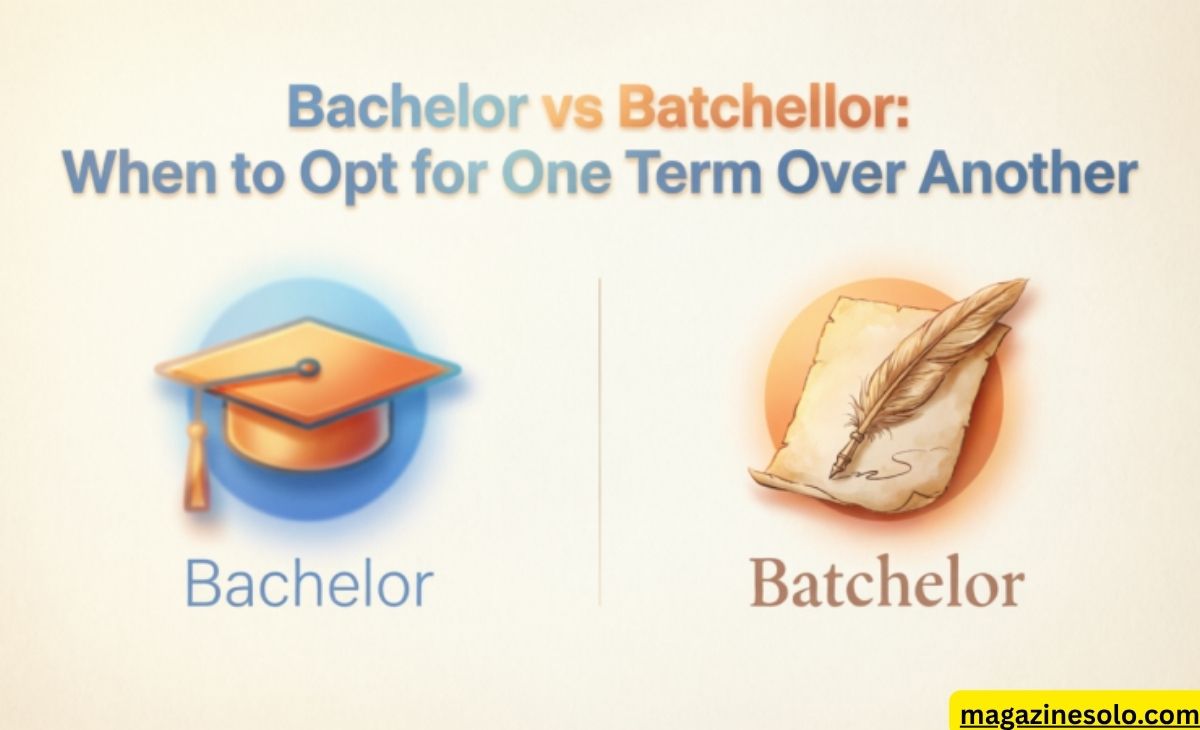
Bachelor vs Batchelor: When to Opt for One Term Over Another
Have you ever stopped while writing and wondered whether the correct spelling is bachelor or batchelor? You’re not alone. Many English learners, students, and even native speakers often get confused between these two terms because they sound exactly the same when spoken.
The truth is simple: “bachelor” is the correct modern English spelling, while “batchelor” is generally considered an outdated spelling or a common misspelling. However, understanding the difference goes beyond just spelling. The context, historical usage, and proper grammatical application all matter.
In this guide, you’ll learn the meaning of both terms, how to use them correctly, common mistakes to avoid, examples, practice exercises, and important exceptions. By the end, you’ll never confuse batchelor or bachelor again.
Bachelor vs Batchelor: Understanding the Core Difference
At a glance, these two words look almost identical. But their correct usage and whether they are even valid in the first place could not be more different.
| Term | Status | Meaning |
| Bachelor | Correct Standard Spelling | An unmarried man; a holder of an undergraduate degree |
| Batchelor | Misspelling (in most contexts) | Historically archaic; valid only as a surname or proper noun |
The confusion is understandable. Both words are pronounced the same way, and the extra “t” in batchelor slips in easily when you are typing quickly. But in standard modern English whether American, British, or Australian “bachelor” is the only accepted general spelling.
Define Bachelor
Bachelor is a noun with several well-established meanings in modern English. It traces its roots back to Old French and Middle English, and its definition has evolved considerably over the centuries.
Today, “bachelor” is primarily used in two main contexts:
1. An unmarried man
The most traditional use of the word refers to a man who has never been married or is not currently in a committed relationship. This meaning is deeply embedded in popular culture think of phrases like “confirmed bachelor,” “bachelor pad,” or the reality TV franchise The Bachelor.
Example: Marco has lived as a bachelor in the city for over a decade.
2. An academic degree
In an educational context, a bachelor’s degree is the first undergraduate qualification awarded by a college or university after completing a course of study, typically lasting three to four years. Common examples include:
- Bachelor of Arts (BA)
- Bachelor of Science (BSc)
- Bachelor of Engineering (BEng)
- Bachelor of Commerce (BCom)
When used in the context of a formal degree title, “Bachelor” is always capitalized.
Example: She graduated with a Bachelor of Science in Computer Engineering.
3. A young male animal without a territory
Less commonly known, “bachelor” also appears in zoology. A bachelor male such as a young sea lion or elephant is one that has not yet established a territory or mating group
Define Batchelor
Here is where things get interesting. Batchelor is not a standard dictionary word in modern English. It does not appear in Merriam-Webster, Oxford, or Collins with a distinct definition of its own. In nearly every context, writing “batchelor” is a spelling error a variant that looks plausible but fails any grammar or spell-check test.
That said, “Batchelor” does have legitimate uses as a proper noun:
- As a surname: John Batchelor is a well-known broadcaster. The name Batchelor appears in British history and records. When someone’s last name is spelled this way, that spelling must be respected and preserved.
- In historical texts: Older documents and records from the 17th to 19th centuries occasionally used “batchelor” as an alternative spelling. These are archaic forms and should not be replicated in contemporary writing.
- In brand or company names: Certain legacy brands or businesses may carry the “Batchelor” spelling in their registered name. In such cases, the proper noun spelling takes priority.
Key Rule: Unless you are referring to someone’s surname or citing a historical document, never use “batchelor” in your writing. It is not recognized as a standard word.
How To Properly Use Bachelor and Batchelor in Sentences
Understanding the definition of a word is only half the battle. Knowing how to place it correctly in a sentence is what separates clear, professional writing from error-prone text. Here are the guidelines:
Using “Bachelor” in a Sentence
- Always use “bachelor” (lowercase) when referring to an unmarried man.
- Use “Bachelor” (capitalized) when it is part of a formal degree title.
- Never add a “t” to the word in general usage.
Correct Usage Examples:
- He has been a bachelor his entire adult life and seems perfectly happy.
- She completed her Bachelor of Arts in Philosophy at the University of Edinburgh.
- The nature documentary featured a group of bachelor elephants roaming the savanna.
Incorrect Usage:
- He has been a batchelor his entire adult life.
- She earned her Batchelor of Arts degree last year.
Using “Batchelor” in a Sentence
“Batchelor” is correct only when it functions as a proper noun specifically a surname or part of a named entity.
Correct Usage Examples:
- Mr. Batchelor delivered the keynote address at the annual journalism conference.
- The Batchelor family has owned this estate since the early 1800s.
- According to Batchelor’s records, the company was founded in 1902.
Incorrect Usage:
- He just earned his Batchelor’s degree in accounting.
- Tom is a confirmed batchelor.
More Examples of Bachelor & Batchelor in Sentences
Sometimes seeing more examples in different contexts helps the usage click into place naturally.
Examples Using “Bachelor”
- After years of the bachelor lifestyle, Daniel finally proposed to his long-term girlfriend.
- The university offers a three-year bachelor program in International Relations.
- Completing a bachelor’s degree in nursing opens the door to advanced clinical roles.
- His bachelor apartment was small but meticulously organized.
- She threw her brother a bachelor party at a rooftop venue downtown.
- A Bachelor of Laws (LLB) is required before applying to law school.
- Young bachelor seals are often found in separate groups away from the breeding colony.
Examples Using “Batchelor”
- Dr. Batchelor’s research on marine biology was cited in over fifty academic papers.
- The original deed was signed by one Robert Batchelor in 1874.
- Sarah Batchelor accepted the award on behalf of the entire team.
- As the Batchelor estate records show, the property changed hands three times before 1900.
Common Mistakes To Avoid
Even careful writers stumble over this word. Here are the four most frequent errors and exactly how to sidestep them.
1. Using “Batchelor” Instead of “Bachelor”
This is the number one mistake. The extra “t” in “batchelor” feels natural because of how similar it looks to words like “batch” or “hatchery.” But it is simply wrong in standard writing.
Fix: Before submitting any document, run a spell-check and also manually search for “batchelor.” Replace every instance unless it is a proper noun.
2. Using “Bachelor” Alone for a Degree
Saying someone “has a bachelor” can sound incomplete in formal writing. The standard phrasing is “a bachelor’s degree” or the full title like “a Bachelor of Science.”
Correct: She holds a bachelor’s degree in mechanical engineering.
Awkward: She holds a bachelor in mechanical engineering.
3. Confusing “Bachelor” with “Bachelorette”
“Bachelor” traditionally refers to a man, while “bachelorette” refers to an unmarried woman. In modern usage, the term “bachelorette party” has become widely recognized, particularly in North America. Using “bachelor” as a gender-neutral term can lead to confusion in social contexts.
Tip: Use “single” or “unmarried” as a gender-neutral alternative when needed, and reserve “bachelor” for its traditional and academic senses.
4. Overlooking Context
Context determines not just which spelling to use, but also capitalization and phrasing. “A bachelor’s degree” uses lowercase and a possessive apostrophe. “Bachelor of Science” is a formal title and is capitalized throughout. Treating these as interchangeable creates inconsistency in professional documents.
Context Matters
The word “bachelor” functions differently depending on where it appears. Getting the context right is just as important as getting the spelling right.
| Context | Correct Usage | Example |
| Marital status | bachelor (lowercase) | He is a lifelong bachelor. |
| Formal degree title | Bachelor of [Subject] | She earned a Bachelor of Commerce. |
| Possessive degree reference | bachelor’s degree | He has a bachelor’s degree in history. |
| Surname | Batchelor | Mr. Batchelor chairs the committee. |
| Historical document | batchelor (archaic) | Record shows one William batchelor. |
| Zoology | bachelor (lowercase) | A bachelor herd of bison was spotted. |
Exceptions to the Rules
While the rule is simple use “bachelor,” not “batchelor” a few genuine exceptions are worth acknowledging:
Surnames and proper names:
If someone’s legal name is spelled “Batchelor,” that spelling is always correct. Changing it would be an error, not a correction.
Historical or archival quotations:
When quoting directly from old documents or manuscripts that used the archaic spelling, preserve the original text as written. Changing it would misrepresent the source.
Regional dialect or informal writing:
Some older British and Australian informal texts used “batchelor” in the 19th and early 20th centuries. These are historical artifacts and do not justify using the variant in modern writing.
Brand names:
If a company or product is officially registered as “Batchelor,” always spell it as intended by the brand.
Outside these specific situations, there are no valid exceptions. “Bachelor” is the correct spelling in all modern, standard English contexts.
Practice Exercises: Bachelor vs Batchelor
Put your knowledge to the test with these two practice sets.
Exercise 1: Fill in the Blank
Choose the correct word , bachelor or Batchelor, for each sentence.
- James has been a confirmed ________ for most of his adult life.
- She graduated with a ________ of Science in Environmental Studies.
- According to the historical record, one Thomas ________ purchased this land in 1856.
- The company was originally founded by the ________ family in Lancashire.
- He completed his ________ degree before pursuing a master’s in finance.
Answers: 1. bachelor, 2. Bachelor, 3. Batchelor, 4. Batchelor, 5. bachelor’s
Exercise 2: Sentence Correction
Identify and correct the error in each sentence below.
- He is studying for a Batchelor of Engineering at the local university. Corrected: He is studying for a Bachelor of Engineering at the local university.
- My uncle is a wealthy batchelor who lives in a penthouse downtown. Corrected: My uncle is a wealthy bachelor who lives in a penthouse downtown.
- The award was accepted by Dr. Bachelor on behalf of the department. Corrected: The award was accepted by Dr. Batchelor on behalf of the department. (if that is the person’s actual surname)
- She applied for a Bachelors Degree in nursing. Corrected: She applied for a bachelor’s degree in nursing. (lowercase, apostrophe included)
FAQ’s
Is “batchelor” ever correct?
Yes, but only as a proper noun, specifically a surname like “Mr. Batchelor” or in a historical document where the archaic spelling appears.
How do I spell “bachelor’s degree” correctly?
The correct form is “bachelor’s degree” lowercase, with an apostrophe before the “s.”
Are “bachelor” and “batchelor” pronounced the same way?
Yes, both are pronounced identically: BACH-uh-lur. The spelling difference has no effect on pronunciation.
Can “bachelor” refer to a woman?
Traditionally, no. “Bachelor” refers to men, and “bachelorette” refers to women. In modern usage, many prefer gender-neutral terms like “single” or “unmarried.”
Why do people spell it “batchelor” in the first place?
The confusion likely arises from the influence of similar words like “batch” and “hatchery,” as well as fast typing on smartphones and keyboards where predictive text can insert extra letters.
Does Google rank content that uses “batchelor” as a keyword?
Search engines may index pages that target common misspellings for SEO traffic, but professional, authoritative content always uses the correct spelling which is what Google’s helpful content guidelines reward in the long run.
Conclusion
The bachelor vs batchelor question seems minor on the surface it is just one letter, after all. But that single “t” marks the line between correct and incorrect writing, and in professional or academic contexts, that line matters enormously.
Key Takeaways
- “Bachelor” is always the correct spelling for an unmarried man or an academic degree.
- “Batchelor” is not a standard English word. It is almost always a misspelling.
- The only valid use of “Batchelor” is as a proper noun a surname, a historical reference, or a registered brand name.
- When writing “batchelor or bachelor” in a professional document, the answer is always bachelor.
- Context shapes usage: capitalize “Bachelor” in formal degree titles, use lowercase in casual references, and always include the apostrophe in “bachelor’s degree.”
- Spelling errors like this one can quietly undermine credibility, especially on resumes, academic papers, and published content.
- Use grammar tools and manual proofreading together to catch this mistake before it reaches your reader.
One small habit pausing to double-check the spelling of “bachelor” can make a meaningful difference in how your writing is perceived. Clear, accurate language is a mark of professionalism, and mastering even the smallest details is part of that.

Shoaib Ahmad is a language-focused content writer and researcher at magazinesolo.com, where he explains the meaning of words, phrases, and text in a clear and reader-friendly way. His work focuses on simplifying language, uncovering context, and helping readers understand text with confidence and clarity.