Adverse vs Averse Difference the Debate, and the Compounds

Adverse vs averse difference questions always come down to one test: look at the subject of your sentence. Adverse describes things, the harmful conditions, effects and outcomes that work against someone. Averse describes people, the feeling of disliking something and wanting to avoid it.
That rule answers most sentences in a second. The drug had an adverse effect, because an effect is a thing. She is averse to needles, because she is a person with a feeling. If you only keep one line from this page, keep that one.
But the honest picture has three more layers, and this page teaches all of them. There is a narrow zone where the experts themselves argue. There is a formal use of adverse to that is correct in law and wrong in conversation. And there is an older form, averse from, that is neither a free choice nor a flat invention.
You will also get the layers most pages skip: how the two words sound, where they come from, and the atlas of fixed phrases, from adverse events in medicine to risk averse in finance. Readers who like this kind of pair work will find the same treatment in this site’s Passed vs Past and Affect vs Effect pages.
The Rule in One Screen: Things Harm, People Feel
The Subject Test
Ask what the word is describing. If it describes a thing, event, condition or result, the word is adverse. Weather, side effects, market conditions, rulings and reactions cannot feel anything, so the feeling word is closed to them.
If it describes a person or a group and their attitude, the word is averse, and it brings the preposition to with it. Investors are averse to risk. A board can be averse to publicity. The feeling always belongs to someone who can hold it.
Position Confirms the Choice
Grammar backs the test up with position. Adverse usually stands directly before a noun: adverse effect, adverse weather, adverse conditions. Averse usually stands after a linking verb: is averse to, seems averse to, was never averse to.
So the neighbour word settles most ties. A noun immediately after your gap points to adverse. The word to immediately after your gap points to averse. Two checks, subject and neighbour, and the pair stops being a coin toss.
|
The rule at a glance |
Adverse |
Averse |
|---|---|---|
|
Describes |
Things, conditions, effects, outcomes |
People and groups, and their feelings |
|
Core meaning |
Harmful, unfavourable, opposed |
Strongly disliking, reluctant |
|
Usual position |
Before a noun |
After a linking verb |
|
Usual partner |
A noun |
The preposition to |
|
Noun form |
Adversity (hardship) |
Aversion (the dislike itself) |
|
Flagship phrases |
Adverse effect, adverse weather |
Averse to risk, risk averse |
|
The error to avoid |
Adverse to helping (for reluctance) |
An averse effect |
Adverse in Depth: Position, Collocations, Registers
What Adverse Modifies
The Cambridge entry for adverse and every major dictionary agree on the territory: effects, reactions, conditions, events, outcomes, consequences, impact. These are all things that happen to people, plans and results, and push against them.
The word’s oldest sense, listed first by Merriam Webster, is acting in a contrary direction: adverse winds hindered the ship. The harm sense grew out of that opposition. Something adverse stands facing you, working against the direction you wanted to go.
The Registers Adverse Lives In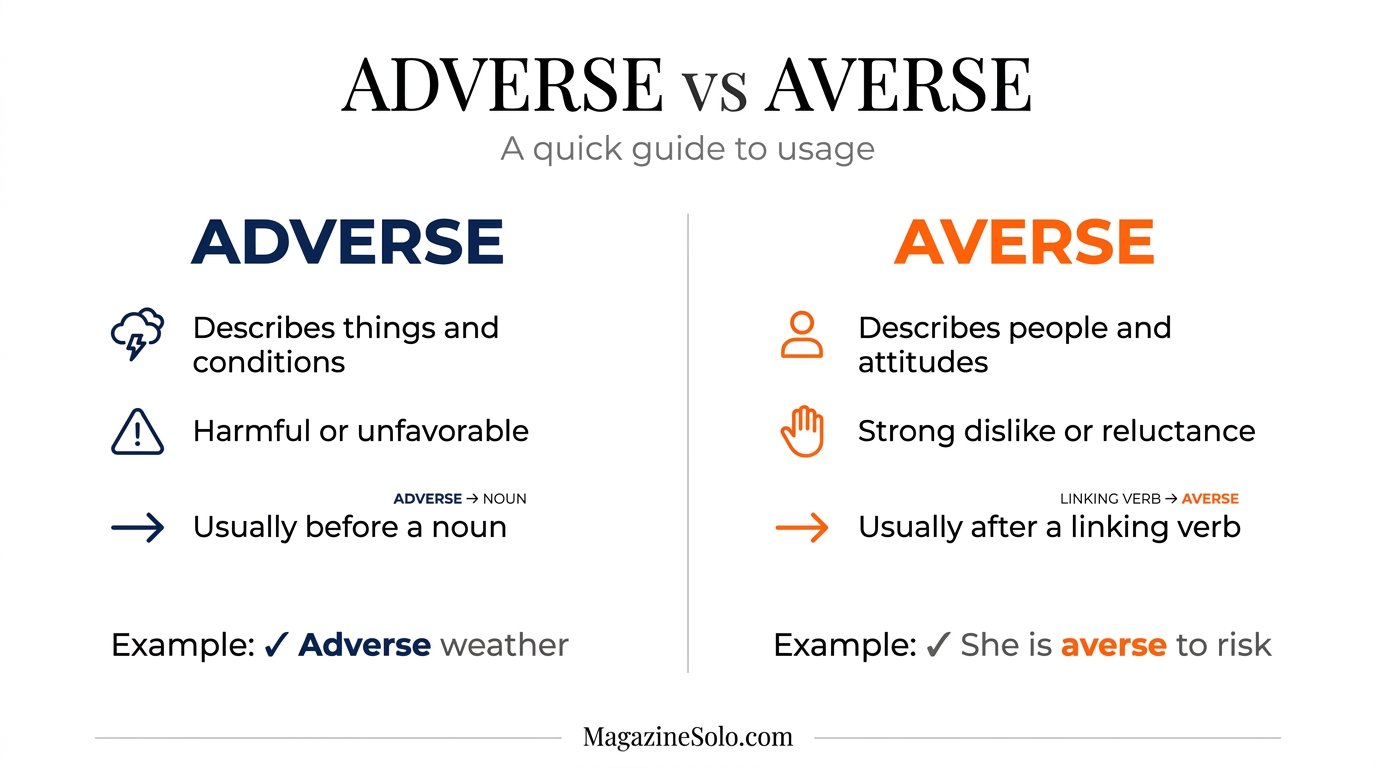
Adverse is a formal, technical word at home. Medicine reports adverse events. Courts issue adverse rulings. Insurers record adverse determinations. Weather services warn of adverse conditions. Everyday speech usually picks bad or harmful instead, which is why adverse in a casual sentence can sound like a report wearing a suit.
That register fact helps editors. If your sentence is a clinical note, a legal filing or an official summary, adverse is probably the word already expected. If your sentence is a text message, the pair is probably not in it at all.
The Dictionary Senses, Plainly
Merriam Webster’s senses run: acting against or in a contrary direction; opposed to one’s interests, as in an adverse verdict; and causing harm, as in adverse drug effects. Three senses, one family resemblance: something positioned against you or your interests, doing damage by position or by effect.
Hold those senses apart and the hard cases get easier. The verdict sense explains adverse to in law. The harm sense explains the medical phrases. The contrary direction sense explains the technical strays, adverse yaw and adverse camber, waiting in the atlas below.
Averse in Depth: The To Pattern and the Compounds of Caution
Averse To Is One Unit
The Cambridge entry for averse builds the preposition into the pattern: averse to something, averse to doing something. Treat averse to as a single piece of vocabulary. What follows the to is a noun, risk, change, debt, or an ing form: averse to working weekends, averse to being photographed.
That to is a preposition, not an infinitive, which is why the gerund follows it. Writers who produce averse to work weekends are hearing the pattern of reluctant to, a different adjective with a different grammar. Averse never takes the bare infinitive.
The Compounds of Caution
Averse builds the vocabulary of caution. Risk averse is the giant: investors, lenders, savers and whole cultures described by their avoidance of risk. Loss averse comes from behavioural economics, where people feel losses more strongly than equal gains. Debt averse and conflict averse follow the same build.
In these compounds the word order flips: averse stands after its noun partner inside the compound, and the compound then behaves like an ordinary adjective. Risk averse investors. A loss averse consumer. Hyphenate before a noun if your house style asks; the meaning never changes.
Not Averse To: The Understatement
English loves this word in the negative. Not averse to a second slice, a short walk, another drink: the phrase means quite willing, said with deliberate restraint. Merriam Webster calls it a pointedly understated way to express interest, and stylists call the figure litotes.
The joke only works on the feelings side. Not averse to understates a willingness, which is a feeling a person can hold. Not adverse to tries to understate with the harm word, which has no feeling to understate, and lands as the pair’s most famous error instead.
Adverse To: The Error and the Instrument
The Error, and Why It Is Famous
Used for a person’s reluctance, adverse to is simply wrong in modern English. He is adverse to helping should be he is averse to helping. She is adverse to risk should be averse. The error is so established that Theodore Bernstein flagged a version of it in The Careful Writer in 1965: a man who reads the morning papers and is not adverse to reading about himself.
Bernstein’s sentence is worth remembering because it shows the error’s disguise. It appears in fluent, confident prose, written by people who know adverse is the commoner word. Frequency is the trap: adverse appears far more often in print, so the ear reaches for it even when the subject is a feeling.
The Instrument: Formal and Legal Adverse To
Now the other life, which flat rule pages deny. In formal and legal writing, adverse to is correct and precise, meaning harmful or opposed to something’s interests. Merriam Webster’s own example: testimony adverse to their position. Court writing adds rulings adverse to the company, a position adverse to the interests of the estate, conditions adverse to growth.
The subject test still governs. Instrument adverse to never describes a person’s feelings; it describes a thing, a ruling, testimony, a policy, standing against an interest. The moment the subject becomes a person reporting reluctance, the instrument closes and averse is the only door.
|
Adverse to, judged |
Sentence |
Verdict |
|---|---|---|
|
Reluctance |
He is adverse to helping |
Wrong: a feeling needs averse |
|
Reluctance |
She is adverse to taking risks |
Wrong: averse to taking risks |
|
Formal opposition |
Testimony adverse to their position |
Correct: a thing against an interest |
|
Formal opposition |
A ruling adverse to the company |
Correct: legal register |
|
Understatement |
I am not adverse to a walk |
Wrong: not averse to a walk |
How to Decide in Practice
If you are writing everyday prose, treat adverse to as an error and move on; the flat rule serves you. If you are writing or reading legal and formal prose, check the subject: things against interests may be adverse to, people with feelings may not. The Linguix correction page for this pair runs the same split through workplace examples, which is where most writers meet the question.
Averse From: Grading an Archaic Variant
What the Record Shows
Averse from is not an invention. Older English allowed it, and careful usage writers recorded it as the rare partner of the standard form. Kenneth Wilson’s Columbia Guide phrasing, quoted in teaching notes for decades, runs: we are averse to, rarely from, the things we dislike.
June Casagrande’s Grammar Underground essay on this pair walks the same evidence through Garner: averse chiefly takes to, and from survives at the margins. The historical picture is consistent across sources that bother to look.
The Grade to Give It Today
For anything you write now, averse to is the only safe form. Averse from will read as an error to nearly every living editor, whatever the archives say. Grade it as archaic: correct in a nineteenth century novel, a liability in a modern report.
Grading honestly matters because both lazy verdicts fail. Calling averse from a flat error is historically false. Calling it an equal variant is practically false. The pair has several of these graded cases, and a reference page earns trust by grading instead of flattening.
The Usage Debate: Bernstein, Merriam Webster, Garner
The Overlap Nobody Puts on the Poster
Merriam Webster’s Dictionary of English Usage examined the record and found something the posters omit. Used of people, the two words have been essentially synonymous, divided by nuance rather than territory: adverse pointing to opinion or intention, averse to feeling or inclination.
A 1934 Literary Digest line, preserved in that usage note, states the nuance perfectly. We are adverse to that which we disapprove, but averse to that which we dislike. Disapproval is a judgement; dislike is a feeling. For one narrow generation of formal prose, the pair split along exactly that seam.
Why the Flat Rule Still Wins
Modern usage has walked away from the overlap. Outside the people plus to corner, the words never meet, and inside it, contemporary editors overwhelmingly choose averse for people. Garner’s modern ruling reflects the settlement: adverse to usually refers to things, averse to to a person’s attitude.
So the classroom rule survives, not because the record is simple, but because the record has simplified. Teach the rule as the rule. Teach the debate as the reason an old book on your shelf may disagree with it. Both statements are true, and a reader who knows both stops being confused by either.
Sound and Origin: Stress, and Two Ways of Turning
The Stress Split
The words do not even sound alike once you listen. Adverse is AD-vurs, stress on the first syllable. Averse is uh-VURSS, stress on the second. Say them in a pair and the difference is unmistakable, which is more than the spelling offers.
The stress split doubles as a memory device. The word that leans forward onto its first syllable stands in front of nouns. The word that falls back onto its second syllable belongs to the person leaning away. It is a hook, not a law, but hooks are what survive into the next draft.
Two Ways of Turning
Both words descend from the Latin verb vertere, to turn, and the prefixes do the teaching. Adverse comes from adversus, turned toward and facing, hence turned against. Averse comes from aversus, turned away. One root, two directions.
The etymology is the distinction in miniature. What is adverse faces you in opposition: the wind, the ruling, the reaction. What you are averse to, you turn away from: the risk, the change, the needle. A writer who pictures the turn rarely swaps the words again.
The Compound Atlas: Medicine, Law, Money, Machines
Why an Atlas Belongs on This Page
Most real encounters with adverse are not choices at all. They are fixed terms of art where the word is welded in, and the only skill is recognising the weld. No averse variant exists for any row in this atlas, because every row names a thing in a system.
|
Field |
Fixed term |
What it names |
|---|---|---|
|
Medicine |
Adverse event |
An untoward occurrence during treatment, cause not yet judged |
|
Medicine |
Adverse reaction |
Harm where a link to the drug is suspected or established |
|
Public health |
Adverse childhood experiences |
The ACEs framework of early trauma and later health |
|
Law |
Adverse possession |
Title claimed through long, open occupation against the owner |
|
Law |
Adverse inference |
Permission to assume hidden evidence would have hurt its holder |
|
Law |
Adverse party, adverse witness |
The opposing side; a witness treated as hostile |
|
Insurance |
Adverse selection |
Higher risk customers buying cover at higher rates |
|
Health plans |
Adverse benefit determination |
A denial or reduction that triggers appeal rights |
|
Employment |
Adverse impact |
A practice that screens out a protected group unevenly |
|
Audit |
Adverse opinion |
The strongest negative verdict on financial statements |
|
Lending |
Adverse action notice |
The formal letter explaining a credit decision |
|
Compliance |
Adverse media |
Negative public information screened about a client |
|
Aviation |
Adverse yaw |
The nose swinging away from the direction of a turn |
|
Roads |
Adverse camber |
A slope falling the wrong way for the bend |
Two rows deserve a second look. Adverse event versus adverse reaction is a working distinction in drug safety, not pedantry: events are reported first and judged later, reactions carry the judgement. And adverse possession shows the opposed to interests sense in its purest form, occupation against the owner, which is why the law never reaches for averse anywhere in the atlas.
The averse side has its own small atlas of caution: risk averse, loss averse, debt averse, conflict averse. Every one describes an attitude held by people or institutions. Two atlases, two worlds, and the subject test drawn across the whole map. This site’s MagazineSolo home collects the other word pairs built the same way.
The Frame Method and the Five Second Check
Learn Frames, Not Word Lists
Learners fail this pair by studying two words when the unit is really two sentences. Frame one: a noun, plus adverse, plus a noun. The drug has adverse effects. Frame two: a person, plus be, plus averse to, plus a noun. She is averse to risk.
Frames carry the position and the preposition with them automatically. Word lists drop exactly those two things, which is why list learners can define both words perfectly and still write averse effects in the next sentence. If you teach, test or learn English, drill the frames.
The Five Second Check
Second one: name the subject. A person or group with an attitude means averse to. A thing, event or condition means adverse. Second two: glance at the neighbour. A noun next means adverse; to next means averse, with the one formal exception filed above.
Seconds three to five: run the noun check if doubt survives. Would the noun be aversion, the feeling? Then averse. Would it be adversity, the hardship? Then adverse. Five seconds, three checks, and the pair stops costing you edits, marks or credibility.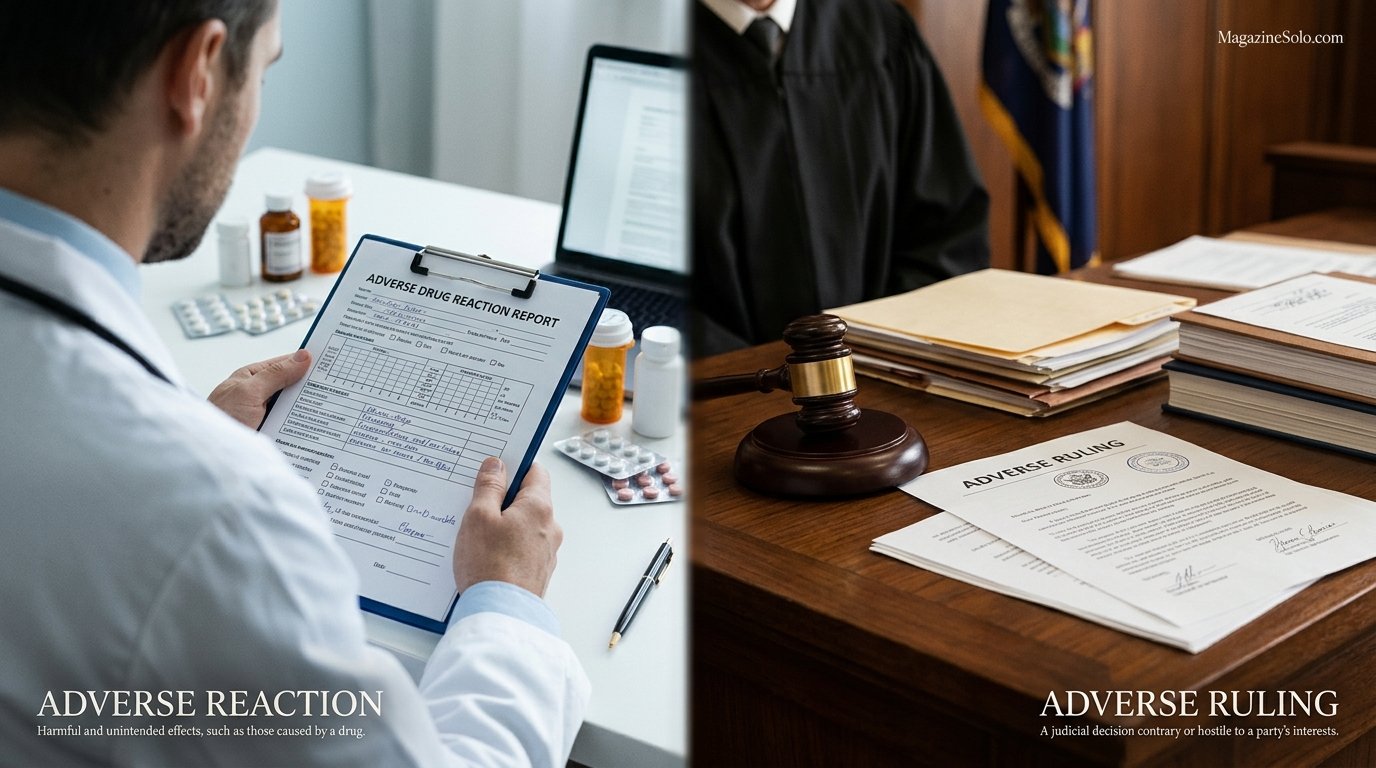
Frequently Asked Questions
What is the difference between adverse and averse?
Adverse describes things: harmful or unfavourable conditions, effects, reactions and outcomes, as in adverse weather or an adverse effect. Averse describes people and their feelings: strongly disliking or reluctant, as in averse to risk. The shortest test is the subject. If the subject is a thing or event, adverse; if it is a person or group with an attitude, averse to.
Which one means harmful, adverse or averse?
Adverse. Harm lives entirely on the adverse side of the pair: adverse effects, adverse reactions, adverse conditions, adverse outcomes. Averse never means harmful; it means unwilling. Any sentence where the word carries harm and the word is averse is wrong, which makes averse effect the pair’s most useful error to recognise.
What does averse to mean?
Having a strong dislike of something or being unwilling to do it. She is averse to confrontation; the committee was averse to changes. The word needs a feeler, a person or a group whose attitude is being reported, and it is followed by to plus a noun or a gerund: averse to risk, averse to working weekends.
Is it risk averse or risk adverse?
Risk averse. The compound describes people, investors, lenders, cultures, whose attitude toward risk is avoidance, so it takes the people word. Risk adverse is a common error in business writing precisely because adverse is the more frequent word overall. In finance the compound is a set term: a risk averse investor, risk averse behaviour, a risk averse market.
Can you say adverse to?
Yes, in formal writing, with a different meaning. Adverse to means harmful or opposed to something’s interests: a ruling adverse to the company, testimony adverse to their position, a policy adverse to growth. What adverse to cannot mean is a person’s reluctance. He is adverse to helping is wrong in modern usage; he is averse to helping is the sentence. Merriam Webster’s usage evidence adds the nuance: used of people with to, the two have historically overlapped, with adverse pointing at opinion and averse at feeling.
Is averse from wrong?
It is dated rather than invented. Older usage allowed averse from, and usage guides from Kenneth Wilson onward record averse to (rarely from). Modern standard English has settled on to, and Garner’s guidance treats to as the choice, with from surviving as an archaism. In anything you write today, averse to is the only safe form; in older texts, averse from is a period feature, not a typo.
Why do usage experts argue about this pair?
Because the historical record is messier than the classroom rule. Merriam Webster’s Dictionary of English Usage found the two essentially synonymous when used of people, split only by nuance: adverse for opinion or intention, averse for feeling or inclination, a distinction a 1934 Literary Digest line captured as adverse to what we disapprove, averse to what we dislike. Theodore Bernstein’s Careful Writer policed the boundary hard; modern guides keep the things versus feelings split because real usage overwhelmingly follows it outside that one narrow overlap.
What does not averse to mean?
It is an understatement, technically litotes: not averse to a drink means quite willing to have one, said with deliberate restraint. Merriam Webster notes the pattern as a pointedly understated way to express interest. The joke only works with averse; not adverse to is simply an error, because adverse has no feeling to understate.
What are the noun forms of adverse and averse?
Adversity and aversion, and they are not interchangeable either. Adversity is hardship, the bad circumstances themselves: he overcame adversity. Aversion is the feeling of dislike: she has an aversion to spiders. The noun check is a reliable editing test: if your sentence’s noun would be aversion, the adjective is averse; if adversity, the adjective is adverse.
How do you pronounce adverse and averse?
Adverse is AD-vurs, stress on the first syllable, in its common adjective use. Averse is uh-VURSS, stress on the second syllable. The stress split is a genuine memory aid: the word that leans forward onto its first syllable names the thing in front of the noun, and the word that falls back onto its second syllable names the person leaning away.
Where do adverse and averse come from?
Both descend from Latin turning words. Adverse comes through French from Latin adversus, turned against or facing, from ad (toward) plus vertere (to turn). Averse comes from aversus, turned away, from a (away) plus the same vertere. The etymology is the distinction in miniature: adverse faces you in opposition; averse turns away from you in dislike.
Can adverse describe a person?
Rarely, and only in the opposed sense, never the reluctant sense. Formal prose can call a party adverse, meaning opposed in interest, and law has the adverse party and the adverse witness. But a person who dislikes something is averse, and everyday sentences like she is adverse to change are the pair’s commonest person error.
Can averse describe a thing?
No. Things cannot feel, and averse is a feeling word. Weather, drugs, markets and rulings are adverse when they harm, and none of them can be averse to anything. The one apparent exception is metonymy: a risk averse market means the people in it, which is why the compound still belongs to the feelings side.
What is an adverse event in medicine?
An untoward medical occurrence during treatment, whether or not the treatment caused it. An adverse reaction is narrower: harm where a causal link to the drug is suspected or established. The event versus reaction distinction is regulatory, used in trial reporting and drug safety, and both terms take adverse, never averse. Patients can be averse to needles; the needle’s effects are adverse.
What is adverse possession?
A legal doctrine under which someone who occupies land openly, continuously and against the owner’s interest for a statutory period can claim title to it. It is a fixed legal compound, always adverse, built on the opposed to interests sense. The same family includes adverse inference, a court’s permission to assume hidden evidence would have hurt the side hiding it, and adverse party, the opposing side in a case.
What are the strongest collocations for adverse?
Effect, reaction, event, conditions, weather, impact, outcome, consequences, publicity, ruling, verdict, criticism and selection. Adverse lives in front of nouns, attributive position, in formal registers: medicine, law, insurance, weather and markets. If the word after your choice is a noun naming a thing that can harm, the choice has already been made.
What are the strongest collocations for averse?
Averse to plus risk, change, conflict, debt, publicity, loss, and gerunds like working, paying, waiting. Plus the compound family: risk averse, loss averse, debt averse, conflict averse. Averse lives after linking verbs, predicative position, reporting an attitude. If your sentence has is, are, was or seems in front of the gap, averse is the favourite.
How common is the confusion?
Common enough that Merriam Webster builds the distinction into the adverse entry itself, Grammarly and every usage guide maintain a page on it, and editors treat not adverse to as a signature error in otherwise clean copy. The confusion is structural: the words differ by one letter, share a Latin root, and overlap in the single narrow case of people with to, which is just enough overlap to keep the error alive.
What is a fast memory trick for adverse vs averse?
Two questions, in order. Can it feel? If yes, averse: people are averse to things. Can it harm? If yes, adverse: things have adverse effects. The letter hooks help some writers: averse pairs with aversion and attitude, adverse pairs with adversity and the additional bad thing that arrives. Use whichever hook survives your own writing; the subject test underneath both is the part to keep.
Is adverse a formal word?
Yes, its home registers are formal and technical: clinical reports, court filings, insurance determinations, audit opinions, weather summaries. Everyday speech usually reaches for bad, harmful or unfavourable instead. Averse is neutral to formal and appears happily in ordinary prose about attitudes. Register is a secondary signal only; the subject test decides first.
What does adverse mean in insurance and health plans?
An adverse benefit determination is a denial, reduction or termination of a benefit, a defined term in US health plan rules that triggers appeal rights. Adverse selection is the insurance pattern where higher risk customers are likelier to buy cover, straining the pool. Both are fixed adverse compounds; neither has an averse variant, because both name conditions in a system, not anyone’s feelings.
What does adverse mean in employment and audits?
Adverse impact is the employment law term for a selection practice that disproportionately screens out a protected group. An adverse opinion is the auditor’s strongest negative conclusion, that financial statements are materially misstated. Add adverse action notices in lending, the formal letter explaining a credit decision, and adverse media in compliance screening: a whole professional vocabulary sits on the adverse side.
Can averse take a gerund?
Yes, naturally: averse to working weekends, averse to paying fees, averse to being photographed. The to in averse to is a preposition, not an infinitive marker, so what follows is a noun or an ing form. Writers who feel the pull toward the bare infinitive, averse to work weekends, are hearing the infinitive pattern from reluctant to; averse does not share it.
Is averse stronger than reluctant?
Somewhat. Reluctant is unwilling in the moment; averse names a settled disposition of dislike. He was reluctant to sign covers hesitation before one act. He is averse to signing things covers a standing attitude. Dictionaries gloss averse as having a strong dislike or disinclination, and strong is the load bearing word: averse is reluctance with roots.
What is the difference between averse and aversion in use?
Grammar, not meaning. Averse is the adjective and needs a subject and a linking verb: she is averse to noise. Aversion is the noun and takes articles and possessives: her aversion to noise, a strong aversion. Sentences fail when the forms swap jobs: she has an averse to noise mixes both errors at once.
Adverse or averse: the drug had an ___ reaction?
Adverse reaction. A reaction is an effect, a thing that happens to a body, and effects take the harm word. The same patient, one clause later, can be averse to taking the drug again. Test writers love this pair because both words fit the sentence’s sound and only one fits its subject.
Adverse or averse: she is not ___ to trying again?
Averse. A person, a feeling, and the not averse to understatement pattern all point the same way. Not adverse to trying again is the error Bernstein flagged in print generations ago, in a sentence about a man reading newspapers, and it remains the single most corrected sentence shape in this pair’s history.
Does adverse ever come after the noun or verb?
In its opposed sense, yes: testimony adverse to their position, conditions adverse to growth, a climate adverse to reform. That predicative adverse to construction is formal and always means harmful or contrary to interests. It never reports reluctance. Position is a clue, not a rule: adverse before a noun is harm, adverse after a verb with to is opposition, averse after a verb with to is feeling.
What do dictionaries say, in one line each?
Merriam Webster: adverse is acting against, opposed to one’s interests, or causing harm; averse is having an active feeling of dislike or opposition. Cambridge ties averse to the preposition to in its entry pattern. The dictionaries agree on the split; they differ only in how much of the historical people overlap they report, which is why usage notes, not definitions, are where this pair is really decided.
Why does adverse appear in weather reports?
Because weather is the everyday harm condition: adverse weather delays flights, closes roads and cancels fixtures. Forecasters and airlines use adverse conditions as the set phrase for weather working against an operation. Nobody in a control tower says averse weather, because the sky has no attitude; it has effects.
Is loss averse a real term?
Yes, from behavioural economics: people feel losses more strongly than equivalent gains, and loss averse describes that disposition in investors and consumers. It follows the risk averse pattern exactly, a feelings compound built on averse. The research vocabulary of Kahneman and Tversky made loss aversion, the noun, one of the field’s central terms.
Can a company be averse?
Yes, by the ordinary metonymy of attitudes: a company averse to debt, a board averse to publicity, a culture described as risk averse. Groups of people hold attitudes in English without strain. What a company cannot be is adverse in the feeling sense; a company can only be adverse to a rival’s interests in the formal opposed sense, as an adverse party.
What is the adjective for someone who hates risk in one word?
Risk averse, written open after a noun (investors who are risk averse) and hyphenated before one (risk averse investors) in most house styles. It is the pair’s most frequent compound by a wide margin in business text, and the one whose wrong twin, risk adverse, appears most often in drafts that otherwise read clean.
How do I check my own sentence in five seconds?
Underline the subject. Person or group with an attitude: averse to. Thing, event, effect or condition: adverse. Then check the neighbour word: a noun immediately after points to adverse; to immediately after points to averse, unless the sentence is formal prose about interests, where adverse to is the rare legal pattern. Five seconds, two checks, and the pair stops costing edits.
What is adverse yaw and adverse camber?
Technical adverse compounds outside the usual registers. Adverse yaw is the aviation tendency of an aircraft’s nose to swing away from a turn; adverse camber is a road slope that falls the wrong way for the bend. Both use adverse in its oldest sense, acting in a contrary direction, the sense Merriam Webster lists first and everyday usage has mostly handed to the harm sense.
What are adverse childhood experiences?
ACEs: a defined public health term for potentially traumatic events in childhood, including abuse, neglect and household dysfunction, studied for their long term health effects. The phrase is a fixed term of art in medicine and social research. It is also a useful register marker: when adverse starts a multi word term of art, the term is a thing in the world, never a feeling.
Is it ever correct to write an averse effect?
No. There is no register, period or dialect in which effects are averse. It appears in drafts as a pure slip, sound winning over subject, and it is the error teachers circle first because it proves the writer chose by ear. The fix is mechanical: effects, reactions, events and outcomes are adverse, full stop.
What is the opposite of adverse and of averse?
Adverse pairs against favourable or beneficial: favourable conditions, a favourable ruling. Averse pairs against inclined, willing or keen: not averse to is the bridge phrase, since English prefers understating the positive of averse rather than naming it. The antonym split mirrors the meaning split: outcomes have favourable twins; attitudes have willing ones.
How should ESL learners approach this pair?
Learn them as two sentence frames, not two words. Frame one: noun plus adverse plus noun, the drug has adverse effects. Frame two: person plus be plus averse to plus noun, she is averse to risk. Frames carry the preposition and the position with them, which are exactly the two things word list study drops. Most learner errors with this pair are frame errors, not vocabulary gaps.
Adverse vs averse in one table, what does it show?
Subject, position, partner word, noun form, home registers and the flagship error for each side. Adverse: things, before nouns, followed by a noun, adversity, medicine law and weather, flagship error adverse to helping. Averse: people, after linking verbs, followed by to, aversion, attitudes and finance compounds, flagship error averse effect. If a table cannot show the subject row first, it is teaching the pair backwards.
What will the fresh article do that the existing page does not?
Three things the live MeaningVibe page leaves out. It prints the usage debate honestly, including the narrow people overlap and the 1934 disapprove versus dislike line, instead of a flat never. It gives adverse to a full, fair hearing as formal and legal English. And it adds the layers no vs page in the set carries: pronunciation and stress, etymology as a memory device, the fixed compound atlas across medicine, law, insurance, audits, aviation and public health, and the frame method for learners.
How do I remember which noun goes with which adjective?
By the feeling test at noun level. Aversion is felt: an aversion to spiders lives in a person. Adversity is undergone: adversity lives in circumstances. If you can feel it, the family is averse, aversion, aversely. If you can suffer it, the family is adverse, adversity, adversely. The adverbs follow the same split and appear mostly in formal prose.
Conclusion
The adverse vs averse difference is one test with honest footnotes. Things that harm are adverse; people who feel are averse to. Around that rule sit a formal adverse to that belongs to law, an averse from that belongs to history, and a debate that explains both. Learn the subject test, keep the compounds welded as you find them, and the next time the pair appears in your sentence, the choice will already be made.

Dilawar is a content writer at MagazineSolo, covering travel, home improvement, interior design, and everyday lifestyle topics. He enjoys researching practical solutions, exploring travel destinations, and sharing helpful guides that make daily life easier. His writing focuses on clear information, useful advice, and engaging stories for a wide audience.