Loot vs Lute: The Complete Guide to These Confusing Homophones
Ever read a sentence like “he played a beautiful loot” and felt something was off? You weren’t imagining things. Loot and lute are two of English’s sneakiest homophones, words that sound exactly alike but mean completely different things. One belongs in a crime report. The other belongs on a concert stage.
If you’ve ever paused mid-sentence wondering which spelling you actually need, you’re not alone. This guide breaks down everything: definitions, origins, real examples, common mistakes, and memory tricks that make the difference impossible to forget, even for a ten-year-old.
What Are Homophones? (And Why Loot vs Lute Causes Problems)
Homophones are words that sound identical when spoken but differ in spelling and meaning. English is packed with them, think, “flour” and “flower,” or “write” and “right.” Your ears can’t tell them apart. Only your eyes, and the context of the sentence, can.
Loot and lute are both pronounced the same way: /luːt/, rhyming with “boot” or “suit.” That single shared sound is where all the trouble starts.
Here’s why the mix-up happens so often:
- Both words are short and simple, which makes them easy to mistype or mishear.
- Spellcheck usually won’t catch the error, because both “loot” and “lute” are real, correctly spelled English words.
- Non-native speakers learning by ear often pick up the sound before they ever see the spelling.
- Autocorrect and voice-to-text tools frequently swap one for the other without warning.
The result? A sentence about stolen jewelry accidentally becomes a sentence about a musical instrument, or vice versa. Getting this pair right isn’t just a grammar nitpick, it changes the entire meaning of what you’re saying.
Loot vs Lute: Quick Comparison Table
Before diving deeper, here’s a snapshot you can scan in seconds.
| Feature | Loot | Lute |
| Part of speech | Noun / Verb | Noun |
| Meaning | Stolen goods; to steal or plunder | A pear-shaped stringed musical instrument |
| Category | Crime, theft, conflict | Music, history, art |
| Pronunciation | /luːt/ | /luːt/ |
| Origin | Hindi/Sanskrit “lūṭ” (to plunder) | Arabic “al-ʿūd” via French |
| Example | “The gang split the loot.” | “She played a haunting tune on the lute.” |
| Common form | Used casually, in slang and news | Used in music, history, literature |
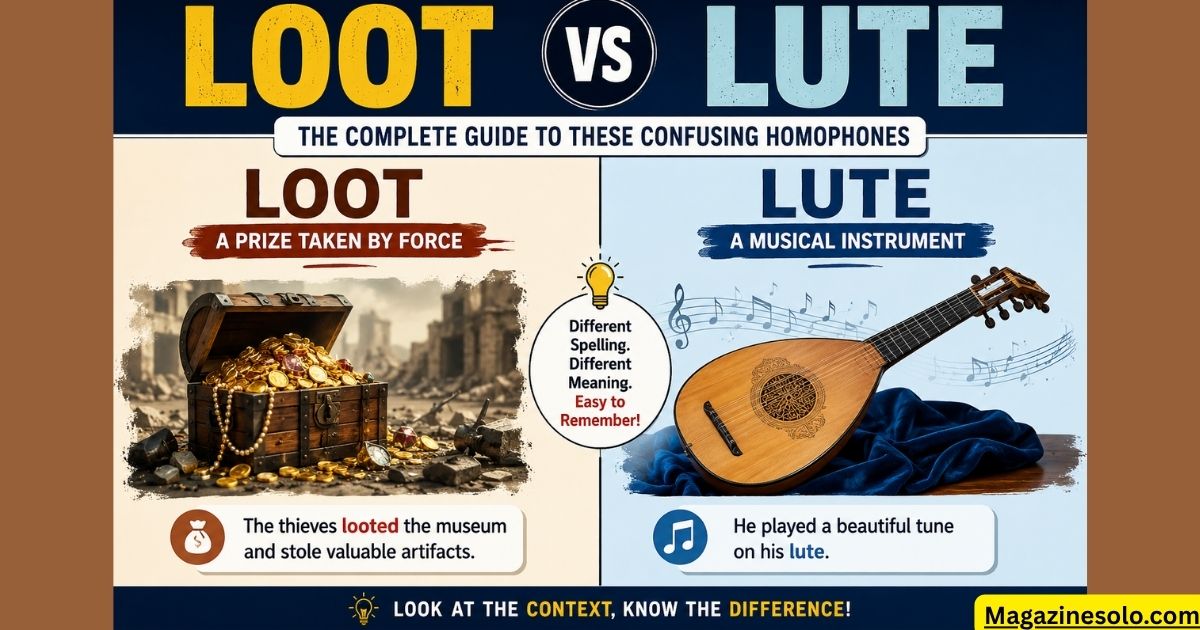
LOOT Meaning, Usage, and Real Examples
Loot works as both a noun and a verb, and both uses carry the same core idea: something taken unlawfully.
As a noun, loot refers to stolen goods, treasure, or valuables seized by force, through robbery, war, or civil unrest.
- The burglars fled with a bag full of loot.
- Archaeologists later confirmed the tomb’s loot had been sold on the black market.
- Video games often reward players with “loot” after defeating enemies, a slightly softened, informal use of the word.
As a verb, to loot means to steal or plunder, typically in a chaotic or lawless setting.
- Rioters looted several stores downtown.
- The invading army looted the palace before retreating.
- Looters were caught on security cameras breaking into the warehouse.
A few things to notice:
- Loot almost always implies wrongdoing. You wouldn’t say someone “looted” a gift they were legally given.
- It’s frequently paired with words like stores, warehouse, riot, mob, and plunder, a pattern that signals danger or lawlessness.
- In casual and gaming slang, “loot” has softened into meaning any collection of rewards or valuable items, even when nothing was technically stolen.
Interesting bit of trivia: the word loot actually comes from the Hindi word lūṭ, meaning “to plunder,” which itself traces back to Sanskrit. It entered English during the era of British colonial rule in India and has stayed in everyday use ever since.
Case Study: News Headlines and the Power of the Word “Loot”
Nowhere is the word’s punch more obvious than in journalism. Headlines use “loot” precisely because it’s short, dramatic, and instantly understood.
Consider a typical headline: “Thieves loot luxury stores in coordinated overnight raid.”
In just six words, readers know:
- A crime happened.
- Property was stolen.
- It likely involved a group, urgency, or chaos.
That’s the power of one correctly spelled word. Now imagine the same headline with the wrong homophone: “Thieves lute luxury stores in coordinated overnight raid.” Suddenly it reads like a bizarre story about burglars serenading a shopping mall. The sentence collapses into nonsense, proof that one letter swap can turn a serious news story into an accidental joke.
This is exactly why writers, editors, and journalists are trained to double-check homophones like these before publishing. A single typo can undercut credibility in seconds.
LUTE Meaning, History, and Examples
Lute is almost always a noun, and it refers to a stringed musical instrument with a rounded, pear-shaped body and a fretted neck, often bent slightly near the tuning pegs.
- He gently tuned the lute before the performance began.
- The lute was one of the most popular instruments in Renaissance Europe.
- Medieval paintings frequently show musicians playing the lute at royal courts.
The lute has serious historical weight. It’s considered an ancestor of the modern guitar, and it dominated European music for centuries, especially between the 1400s and 1700s. The word itself traces back to the Arabic al-ʿūd, which passed into French and eventually into English as “lute.”
There’s also a lesser-known technical meaning: in engineering and plumbing, “lute” (or “luting”) refers to a substance like clay or cement used to seal pipe joints and make surfaces watertight. This use is rare in everyday conversation but occasionally appears in technical writing.
So, unlike loot, lute has zero connection to theft, crime, or wrongdoing. It lives entirely in the world of music, craftsmanship, and history.
Loot vs Lute Explained Simply
If you strip away everything else, here’s the one-line version:
Loot = something stolen, or the act of stealing. Lute = a musical instrument.
One belongs to a crime scene. The other belongs to a concert hall. They share nothing but sound.
A simple test: ask yourself whether the sentence involves theft, crime, or unlawful gain. If yes, you need “loot.” If the sentence involves music, an instrument, or a performance, you need “lute.”
The Most Common Mistakes People Make
Even confident writers slip up here. The most frequent errors include:
- Writing “lute” when describing stolen goods, e.g., “The robbers took the lute and ran,” when the sentence actually means stolen valuables, not a musical instrument.
- Writing “loot” in a musical context, e.g., “She played a soft melody on the loot,” which instantly confuses the reader.
- Relying on autocorrect without proofreading, since both spellings pass a basic spellcheck.
- Mixing them up in voice-to-text transcription, since speech recognition software can’t distinguish identical sounds.
- Assuming context will always save you, in short sentences or headlines, there may not be enough surrounding words to signal which meaning is intended, so the correct spelling matters even more.
The safest habit: whenever you type either word, pause for half a second and ask, “Am I talking about theft or music?”
Memory Tricks That Lock It In Forever
You don’t need to memorize a dictionary definition, you just need one image that sticks.
- Loot = a pirate’s treasure chest. Picture a pirate hauling a sack of gold coins. Loot and loot both start the same as “loose,” as in loosely grabbed treasure.
- Lute = think “flute’s cousin.” Both “lute” and “flute” rhyme and both are instruments. If you can remember “flute,” you can remember “lute.”
- Visual flashcard trick: imagine a masked thief next to a bag labeled “LOOT,” and a Renaissance musician next to an instrument labeled “LUTE.” Two pictures, two totally different worlds.
- Letter trick: “loot” has two O’s, just like the two round eyes of someone caught stealing (a slightly silly but memorable image). “Lute” has a U, like the curved body of the instrument itself.
Repetition is what really cements it. Use each word in one sentence a day for a week, and the mix-up disappears for good.
Quick Quiz (30-Second Test)
Fill in the blank with the correct word, loot or lute.
- The pirates buried their _______ on a hidden island.
- She learned to play the _______ as part of her Renaissance music class.
- Police recovered stolen _______ worth thousands of dollars.
- The museum displayed a 500-year-old _______ from the 1600s.
- Rioters attempted to _______ the electronics store.
Answers: 1. loot, 2. lute, 3. loot, 4. lute, 5. loot
If you got all five right, you’ve officially mastered this pair.
Related Confusing Word Pairs
Loot vs lute isn’t the only homophone duo that trips people up. A few others worth reviewing:
- Flour vs Flower, baking ingredient vs a blooming plant
- Right vs Write, correct/direction vs to compose text
- Pair vs Pear, two matching items vs the fruit
- Appal vs Appall, British vs American spelling of the same word (to shock or horrify)
- Leased vs Least, rented property vs the smallest amount
Learning these in small batches, the same way you learned loot vs lute, makes English spelling far less intimidating.
FAQ’s
Are loot and lute pronounced the same?
Yes. Both are pronounced /luːt/, rhyming with “boot,” which is exactly why they’re classified as homophones.
Can “loot” ever be used in a positive way?
Yes, informally. In gaming and casual slang, “loot” often just means rewards or valuable items, without implying an actual crime.
Is a lute the same as a guitar?
Not exactly. A lute is considered an ancestor of the modern guitar, with a rounded, pear-shaped body and a different tuning system.
What part of speech is “loot”?
Loot can be both a noun (stolen goods) and a verb (to steal or plunder), depending on the sentence.
Where does the word “loot” come from?
It comes from the Hindi word “lūṭ,” meaning to plunder, which entered English during British colonial rule in India.
Is “lute” a common word in modern English?
Not especially. It mostly appears in historical, musical, or literary contexts rather than everyday conversation.
Final Thoughts
Loot and lute prove just how tricky English spelling can be, one small letter swap, and a sentence about music turns into a sentence about a crime scene. The good news is that once you connect loot with theft and lute with music, the confusion disappears almost instantly.
Next time you’re writing and your fingers hesitate over which spelling to use, just ask yourself: is this about stealing, or is this about strings? Get that one question right, and you’ll never mix up loot and lute again.

Shoaib Ahmad is a language-focused content writer and researcher at magazinesolo.com, where he explains the meaning of words, phrases, and text in a clear and reader-friendly way. His work focuses on simplifying language, uncovering context, and helping readers understand text with confidence and clarity.