Imply vs Infer: Follow the Message
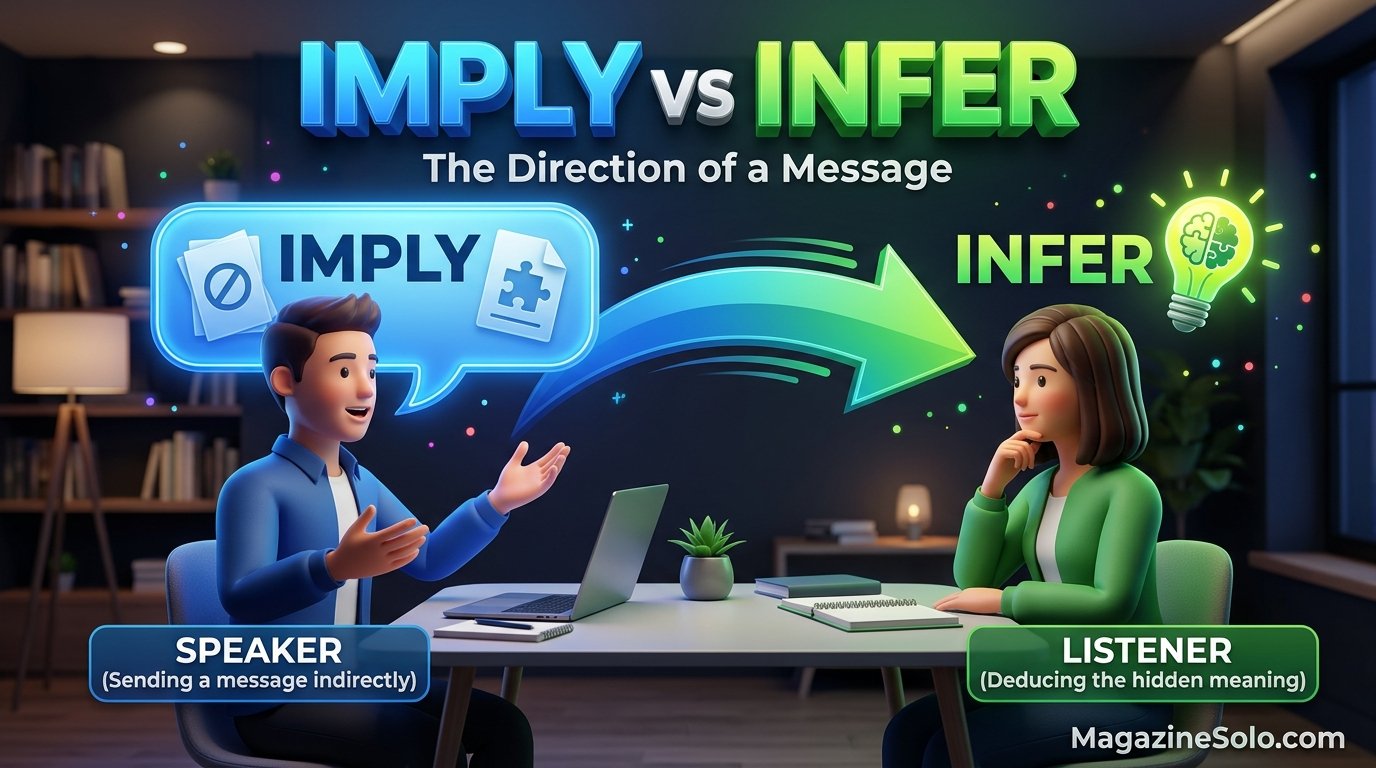
Imply vs infer questions always come down to one thing: which end of the message are you standing on?
The speaker implies. A speaker or writer implies by suggesting something without stating it outright, tucking the meaning inside the words.
The listener infers. A listener or reader infers by drawing a conclusion from evidence, pulling the meaning out of the message.
Follow the message and the pair separates itself. Every section below works that single direction, through the swap test, the family table, and an honest account of the famous debate.
The Rule in One Line
Imply is send side. The source of a message does the implying: a person, a text, a tone, a raised eyebrow held a second too long.
Infer is receive side. The audience does the inferring: whoever hears, reads, watches, or examines and then concludes something from what arrived.
The verbs are partners, not synonyms. One exchange uses both, in sequence. First a meaning is folded in, then the same meaning is drawn out.
Direction decides before meaning does. Ask who holds the meaning at the moment the verb fires, and the correct word is already chosen.
The rule survives every example below. Speeches, silences, datasets, and detective work all sort the same way once the direction question is asked first.
The Pair at a Glance
|
Feature |
Imply |
Infer |
|---|---|---|
|
Core meaning |
suggest without stating |
conclude from evidence |
|
Who acts |
the speaker or writer |
the listener or reader |
|
Direction |
puts a meaning in |
takes a meaning out |
|
Swap word |
suggest, hint |
conclude, deduce |
|
Usual partner |
that |
from |
|
Latin root |
implicare, to fold in |
inferre, to carry in |
Read the table down the direction row. Every other row is a consequence of that one. The person who puts in suggests, and the person who takes out concludes.
The partner row is the quiet giveaway. Imply introduces a clause with that, while infer reaches back with from, toward the evidence the conclusion rests on.
Roots make the table permanent. Fold in and carry in are not decorations. They are the original job descriptions, still accurate after five centuries.
The Swap Test
Substitute and watch the sentence. Replace imply with suggest and infer with conclude. The verb whose replacement keeps the sentence standing is the right one.
Test one. “Her tone suggested that the meeting had gone badly” stands, so the verb was implied, because the tone did the sending.
Test two. “From her tone, we concluded that the meeting had gone badly” stands, so the verb was inferred, because the listeners did the concluding.
The famous question passes the test instantly. “Are you suggesting that I cheated?” is the natural challenge, which is why careful writers say implying there.
The test needs no grammar vocabulary. A learner who knows only suggest and conclude can sort examination sentences reliably, which is why teachers reach for it first.
Keep the test beside the desk. It settles the pair in seconds, and it works because it rebuilds the direction instead of recalling a definition.
Imply in Depth
Imply is expressing indirectly. Merriam-Webster’s first sense is to express indirectly, as when her remarks implied a threat she never actually made.
The implier controls the message. Speakers imply deliberately or accidentally, through word choice, emphasis, timing, and everything the sentence leaves politely unsaid.
Texts and tones imply too. A report can imply a conclusion its authors never wrote, and a silence at the right moment implies more than a paragraph could.
Imply takes a that clause. The standard shape is imply that, followed by the suggested content: “The email implied that the deadline had moved.”
Accusations ride on imply. “Are you implying that I lied?” is the standard challenge because it names the sender’s act, and naming it is what the argument is about.
Implication is the noun of the act. An implication is the content suggested, the thing folded into the message, waiting for a listener to unfold it.
The Second Sense of Imply: Entailment
Imply also means to involve by consequence. Merriam-Webster’s second sense covers indicating by inference, association, or necessary consequence rather than by direct statement.
The classic example is a contract of logic. Rights imply obligations is the dictionary’s own illustration: nothing is hinted, yet the connection holds by necessity.
Nobody hints in this sense. A price rise can imply tighter budgets, and a signature can imply consent, with no speaker performing anything at all.
Keep the senses apart in careful writing. The hinting sense answers to a sender. The entailment sense answers to logic, and confusing them muddies both.
Examinations test the hinting sense. The entailment sense appears in law, philosophy, and contracts, where implied terms and implied consent carry real weight.
Infer in Depth
Infer is deriving a conclusion. The verb means to reach a judgment from facts or premises, as Merriam-Webster phrases the receiving act.
The inferrer does the work. Where implying is quick, inferring is labor: noticing, weighing, and only then concluding, which is why good inference is a taught skill.
Infer takes the preposition from. “I infer from your comments” is the dictionary style guide’s own model shape, the from pointing back at the evidence.
An inference can be wrong. Senders are responsible for their implications, but inferences belong to their makers, and a hasty inference is the inferrer’s error, not the speaker’s.
Inference is the noun of the act. An inference is the conclusion drawn, portable into essays, reports, and examinations, where conclusions must show their evidence.
Inferred doubles its r. The past and participle are inferred and the gerund is inferring, because the stress stays on the final syllable, a spelling trap worth drilling.
Evidence Beyond Speakers
Implication needs a message. Nothing can be implied without something that carries meaning: words, a gesture, a document, a pointed silence.
Inference needs only evidence. A reader infers from a frost on the window that the night was cold. No sender folded that meaning in. The world simply left it readable.
Detectives live on this half. From a footprint and a broken lock, an investigator infers a sequence of events nobody described, and the inference stands or falls on the evidence.
Scientists infer professionally. From measurements and patterns, researchers infer structures too small or distant to observe, which is why methods sections guard the verb so carefully.
Weather readers infer daily. Darkening clouds, a falling barometer, and a shifting wind let anyone infer rain, a conclusion drawn from the sky’s evidence, not its statement.
The asymmetry explains the word’s range. Because infer answers to evidence rather than senders, it travels into laboratories, archives, and crime scenes where imply cannot follow.
Making Inferences in Reading
Reading programs name the skill. To make an inference in a text is to combine what the page states with what you know, and conclude what the page leaves unsaid.
Authors imply, readers infer. A novelist implies a character’s fear through a shaking hand, and the reader infers the fear, performing the second half of the exchange.
The curriculum pairing is exact. Comprehension questions ask what can be inferred from a passage, never what the passage infers, because passages send and readers receive.
Corpus examples teach the shape. A university writing center tutorial builds its lesson on sentences drawn from real published English, including its same event, two perspectives demonstration.
Weak inferences get challenged properly. A teacher asks what in the text supports the conclusion, which is the from question, the preposition doing quiet disciplinary work.
Strong readers show their working. Citing the evidence first and the inference second is the habit examinations reward, in literature and in science alike.
The Word Family
|
Form |
Imply side |
Infer side |
|---|---|---|
|
Verb |
imply |
infer |
|
Past |
implied |
inferred |
|
Noun of content |
implication |
inference |
|
Adjective |
implied |
inferred |
|
Gerund |
implying |
inferring |
Every form keeps the direction. An implication is still send side content, and an inference is still a receive side conclusion, whatever the sentence shape.
Implied meaning against inferred meaning. The implied meaning is what the sender folded in. The inferred meaning is what a particular reader took out, and the two can differ.
That difference is where arguments live. “That is not what I implied” against “That is what I inferred” is the whole misunderstanding, stated in family forms.
The doubled r is the family’s spelling toll. Inferred and inferring double the r, while implied simply trades its y for an i, and examinations collect both errors happily.
The Debate, Honestly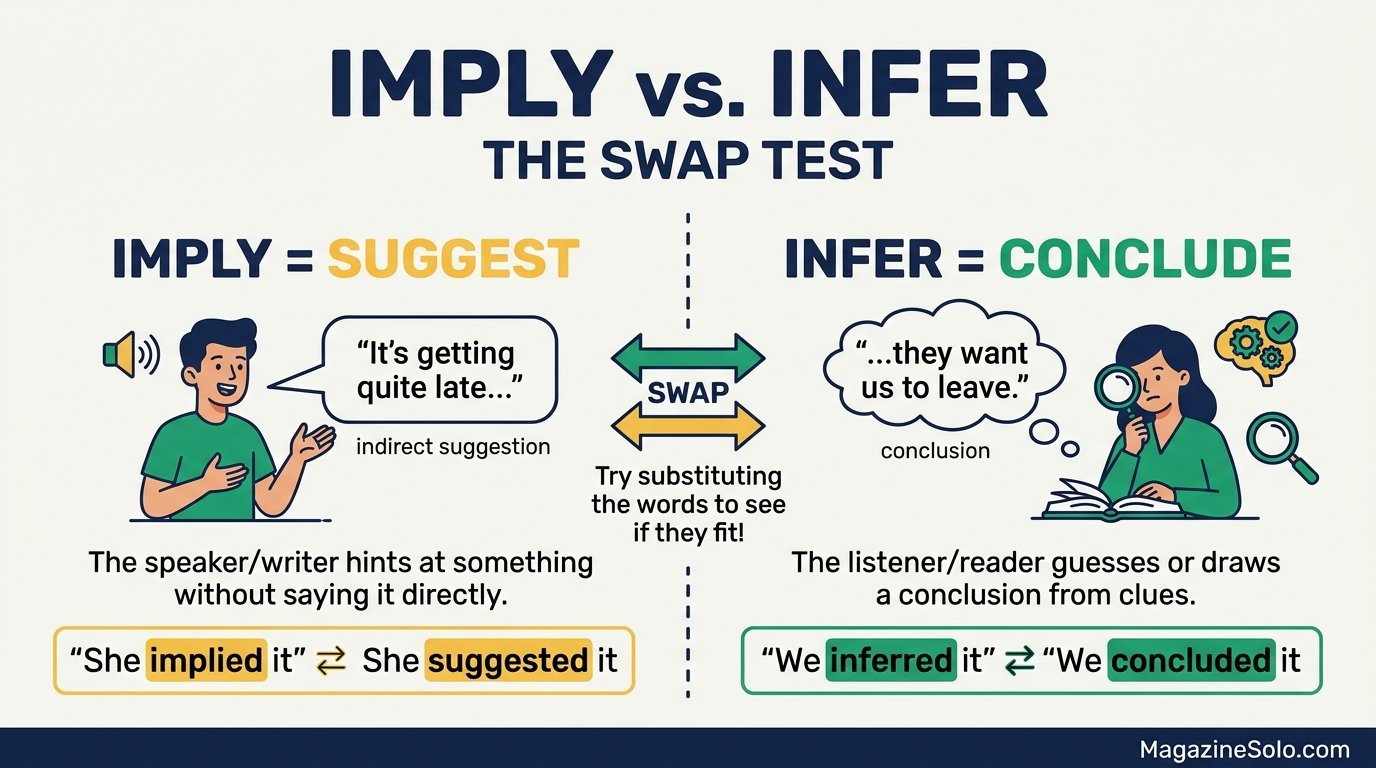
The disputed use is everywhere. Speakers say infer when they mean imply daily, in phrases like “Are you inferring that I am at fault,” and editors correct it just as daily.
Merriam-Webster holds both halves. Its usage guide records that the use is commonly identified as an error, especially with a human subject doing the suggesting.
The same guide reports the overlap. In truth, the meanings of infer and imply have overlapped since the sixteenth century, the dictionary says, making the distinction a matter of preference.
Literary history backs the overlap. Writers from Shakespeare to Austen used infer where modern edited prose uses imply, a record summarized in the standard usage literature.
Dictionaries once merged them. As late as 1976, the Concise Oxford Dictionary still treated the two words as effectively interchangeable, within living editorial memory.
Print still keeps the split. The Unabridged style guide advises that infer for imply with a personal subject is not widely accepted in print and is best avoided.
The house position follows the print ruling. Keep the distinction in edited writing, teach the debate with its dates, and never pretend the disputed use was invented last week.
The Latin Engine
Imply is built from folding. The word descends from Latin implicare, to fold in or involve, through Middle English forms like implien and emplien.
A folded meaning is a hidden meaning. The image is exact: the suggestion sits inside the message, creased into the words, visible only when a listener unfolds it.
Infer is built from carrying. The word descends from Latin inferre, to bring in or carry in, the receiver transporting the conclusion home from the evidence.
Cambridge teaches the same picture. The Cambridge grammar guide puts it as putting the suggestion into the message against taking it out, with infer underlined by its from.
Two verbs, one journey. The meaning travels out of a folded message and into a conclusion, and the Latin pair maps the whole trip without a gap.
Anatomy predicts usage again. A verb built from folding in belongs to senders, and one built from carrying in belongs to receivers, which is why the rule feels inevitable once seen.
Tone Neighbors: Hint, Suggest, Insinuate
Suggest is imply’s neutral twin. To suggest an idea is to put it forward openly or indirectly, and it is the swap test’s stand-in precisely because it overlaps so safely.
Hint is imply in miniature. A hint drops a smaller, deniable suggestion, the lightest form of implying, often designed to be caught by exactly one listener.
Insinuate is imply with a smear. To insinuate is to suggest something unpleasant indirectly, slipping a damaging idea in sideways, and the word always accuses its user.
Intimate is the formal cousin. In careful prose, to intimate a preference is to imply it with unusual politeness, a register choice rather than a different act.
Choose neighbors by tone, not direction. All four verbs stay on the send side. The difference among them is manners and malice, never the direction of the message.
Grammar brands chart the same shelf. The Grammarly explainer keeps the core pair at two clean definitions, a fair starting shelf before the tone neighbors complicate it.
Reasoning Neighbors: Deduce, Conclude, Assume
Deduce is infer with a proof. To deduce is to reach a conclusion by strict logical steps from premises, the most rigorous member of the receiving family.
Conclude is the general finisher. To conclude is simply to arrive at a judgment, by evidence, argument, or exhaustion, and it names the ending rather than the method.
Assume is infer without the evidence. To assume is to take something as true without proof, which is why “you assumed” is an accusation and “you inferred” is a compliment.
Gather is the informal receiver. “I gather that the office is closing” reports an inference drawn from atmosphere and fragments, honestly labeled as soft evidence.
Surmise is the guess with manners. To surmise is to conclude with slight evidence, more than a guess and less than an inference, and careful writers keep it for exactly that band.
Sort receivers by evidence strength. Assume has none, surmise has a little, infer has some, and deduce has a chain. The verb you choose reports your evidence to the reader.
Worked Exchange: One Conversation, Both Verbs
The manager speaks first. Reviewing the quarter, she says, “Some of us have been carrying this team.” Her words imply that effort is unevenly shared.
The analyst hears the fold. From her phrasing and the glance at the rota, he infers that schedule changes are coming, and he quietly updates his plans.
The challenge names the sender’s act. A colleague asks, “Are you implying the night shift is lazy?” The question is about what was folded in, so imply is its verb.
The defense names the receiver’s act. The manager answers, “You inferred more than I implied,” the classic settlement: sender and receiver each audited on their own half.
Every form appears once. One short exchange used implied, implying, inferred, and an unspoken implication and inference, the whole family earning its keep in four lines.
Write your own exchange. Take any workplace sentence with a hidden barb, then write the listener’s conclusion beneath it, and label each verb by its side.
Sentence Surgery
Case one: the wrong challenge. “Are you inferring that I broke it?” fails the swap test, because suggesting fits and concluding does not. The repair is implying.
Case two: the wrong report. “From the muddy footprints, the guard implied a break-in” reverses the direction. Nobody sent a message; the guard concluded, so inferred repairs it.
Case three: the data sentence. “The figures infer a slowdown” misassigns the act. Figures imply by entailment, or analysts infer from them; choose the sentence’s real subject.
Case four: the reading answer. “From the passage, we can imply the narrator is unreliable” hands the reader’s job to the text. Readers infer; the passage only implied.
Case five: the doubled r. “He infered the answer” loses a letter as well as the argument. The stress sits on the final syllable, so the r doubles: inferred.
Surgery follows one question. Who is sending and who is concluding in this sentence? Answer that, and every case above repairs itself in a single pass.
Registers: Where the Pair Is Judged
Examinations judge the split strictly. Test items are built on the distinction itself, so in assessed writing the house position is simply the scoring position.
Newsrooms judge by style guide. Wire and broadsheet guides keep imply for senders, which is why public corrections of infer for imply cluster in media columns.
Courtrooms judge by consequence. Implied consent, implied terms, and implied admissions carry legal weight, and loose swapping in testimony summaries invites real disputes.
Science writing judges the receiver. Methods and results sections live on infer, because conclusions from data are the discipline’s core product, stated with its evidence.
Everyday speech judges nothing. Friends say infer for imply constantly and are understood perfectly, which is the debate’s fuel: intelligibility was never the point at issue.
Magazines keep both shelves stocked. Usage pairs and their debates fill MagazineSolo weekly, each treatment separating what careless writing merges.
Sorting the Shelf: House Method
One job per word is the house discipline. Exact sorting is the skill behind the desert vs dessert guide, where two spellings divide a landscape from a dessert course.
Difference pages pair with base guides. The same architecture stands behind the capital vs capitol difference page, where a comparison treatment sits beside its deeper base guide for one word pair.
Capitals test names, not messages. A different sorting altogether lives in the capital vs capitol guide, where one letter divides a city from a dome, proof the shelf rewards exact reading.
Trio sorting uses the identical muscle. Assigning one job to each of three near twins is the training in the ensure, insure and assure trio guide, and it transfers directly to the tone neighbors shelf here.
Direction pairs form their own family. Today’s earlier pair sorted by viewpoint against a country, and this pair sorts by direction in a message, two shapes of one idea.
Ten Sentences to Sort
Sort each sentence by side. Name whether the verb should be imply or infer, then check the key inside each item, as in the house drills.
1. The challenge. “Are you ___ that the error was mine?” A sender is accused of suggesting: implying.
2. The conclusion. “From the empty desk, she ___ that he had resigned.” Evidence drawn into a conclusion: inferred.
3. The report. “The audit ___ that controls were weak.” The document does the suggesting: implied.
4. The passage. “Readers can ___ the ending from the second chapter.” The audience performs it: infer.
5. The silence. “His pause ___ consent more clearly than words.” A message sent without speech: implied.
6. The dataset. “From the samples, the team ___ a contamination source.” Evidence, method, conclusion: inferred.
7. The entailment. “Membership ___ acceptance of the rules.” No hinting, pure consequence: implies.
8. The weather. “From the falling glass, sailors ___ a storm.” The sky offered evidence only: infer.
9. The accusation. “Do not ___ that I agreed to this.” The classic challenge shape: imply.
10. The doubled r. “She ___ the answer from two clues.” Past tense, final syllable stress: inferred.
Score by the misses. Errors cluster on the debate sentence and the spelling, so a miss there sends you to those two chapters, not back to the start.
The Pair for Children and New Learners
Tell it as a parcel story. One child wraps a present and hides it in a sentence. That wrapping is implying. The other child unwraps it. That unwrapping is inferring.
The parcel never changes hands twice. The wrapper cannot unwrap her own parcel in the same breath, and the unwrapper cannot claim he wrapped it. Roles are the whole lesson.
Add the faces test. A frowning face implies displeasure without a word. A watcher who concludes “she is annoyed” has inferred it, and children sort the pair instantly this way.
Then add the evidence question. Ask what did you see before accepting any inference, and the from habit forms years before the preposition is ever named.
Graduate to the table when ready. The glance table is the parcel story with its sleeves rolled up, and learners who started with the story read it without fear.
Decision Card: Three Questions at the Point of Writing
Question one: am I sending or receiving? If the subject puts a meaning in, the verb is imply. If the subject takes a meaning out, the verb is infer.
Question two: does suggest or conclude fit? Run the swap test on the doubtful sentence. The substitution that survives is the answer, with no further theory required.
Question three: where is the evidence? If the sentence can name its from, evidence, text, or data, it is performing an inference. If it cannot, it is probably an implication wearing the wrong verb.
Run the card on the hard sentence. “The minister inferred that cuts were coming,” said by a journalist about a speech: the minister sent, so implied is the repair.
Trust the card over memory. Examination rubrics, style guides, and careful editors all grade by this card, because it recreates the distinction instead of recalling it.
Tape the card above the desk. Three questions, asked in order, settle the pair faster than any chart, the same discipline the viewpoint card brought to the emigrate vs immigrate difference page.
The Viewpoint Cousin
English owns a second direction pair. The companion treatment, the emigrate vs immigrate guide, sorts two verbs by which country a sentence stands in, the same architecture as this pair.
The resemblance is structural. Emigrate and immigrate divide one journey by viewpoint. Imply and infer divide one message by direction. Both pairs punish writers who ignore the split.
The error shapes rhyme. Saying immigrated within one country and saying are you inferring both hand a verb the wrong end of its own event.
Learn one pair, inherit the other. A writer who asks where is this sentence standing for the journey pair will ask which end of the message for this pair unprompted.
The shelf keeps both treatments adjacent. Direction pairs repay being taught together, each one reinforcing the other’s single question.
Mistakes That Survive the Rule
Knowing the rule is not the finish. Most errors happen while writers know the distinction perfectly, because speed and habit outrun knowledge at the keyboard.
Mistake one: the polite upgrade. Writers reach for infer because it sounds more educated than the suggesting they mean, and formality quietly reverses the direction.
Mistake two: the mirrored sentence. A sentence that reports both halves often copies its first verb into its second half, producing “he inferred that she inferred” nonsense.
Mistake three: the subject swap mid sentence. Long sentences drift: the text starts as the sender and the reader finishes it, and the verb chosen early stops matching late.
Mistake four: trusting the spellchecker. No checker flags this pair, because both words are real verbs with plausible grammar in either slot. Only the direction question catches them.
The repair is procedural, not mental. Slow down for one second at each verb, ask who is sending, and the error rate collapses. Knowledge was never the bottleneck.
Inference in History and Headlines
Historians infer from survivals. A tax roll, a letter, and a repaired wall let scholars infer a famine’s severity centuries later, with the evidence named before the claim.
Headlines imply for a living. A headline implies a scandal it never states, because suggestion travels further than assertion and defamation law prices the difference.
Reading headlines is inference practice. Ask what the headline folded in beyond its facts, and the inferring reader becomes much harder to steer.
Obituaries imply by selection. Which achievements make the first paragraph implies a verdict on a life, and families argue about implications precisely because everyone infers them.
Advertisements imply by design. A product beside a mountain implies ruggedness no claim states, which is why regulators police implied claims as seriously as stated ones.
The pair audits public language. Half of media literacy is sorting what was implied from what was merely inferred, a skill this page’s card rehearses.
Frequently Asked Questions
1. What is the difference between imply and infer in one line?
Direction inside one message. The speaker or writer implies, suggesting without stating.
The listener or reader infers, concluding from evidence.
Follow the message and the pair separates itself.
2. Who implies and who infers in a conversation?
The sender implies, the audience infers. One person puts the meaning in, the other takes it out.
A single exchange uses both verbs in that order.
3. What does imply mean?
To suggest without stating. Imply means expressing something indirectly, through words, tone, or circumstance, leaving the content present but unspoken for the listener to unfold.
4. What does infer mean?
To conclude from evidence. Infer means deriving a judgment from facts or premises.
The conclusion is built by the receiver, who also owns it if the evidence was misread.
5. Is it are you implying or are you inferring?
Implying. Are you implying that I cheated is the standard challenge, because suggesting is the sender’s act.
Inferring there hands the speaker’s job to the wrong verb.
6. Can infer ever mean imply?
Historically yes, carefully no. Infer for imply is recorded for centuries, yet edited print still treats it as an error and avoids it, especially with a human subject.
7. Why do people say infer when they mean imply?
Because it sounds close and feels formal. The disputed use blurs two ends of one exchange, and formality makes it feel safer than it is in careful writing.
8. What is the difference between implication and inference?
Content against conclusion. An implication is what a message suggests, send side.
An inference is what a receiver concludes, receive side.
The nouns keep the verbs’ directions exactly.
9. What is the difference between implied and inferred?
Folded in against drawn out. Implied meaning is what the sender tucked into the message.
Inferred meaning is what a particular listener took out, and the two can differ.
10. How does the swap test work for imply and infer?
Substitute and watch. Replace imply with suggest and infer with conclude.
The verb whose replacement keeps the sentence standing is correct, and the collapsing one exposes the error.
11. Can a text imply something, or only a person?
Texts imply constantly. A report, a headline, or a silence can imply without any person performing in the sentence.
Anything that carries meaning can do the sending.
12. Can data imply something?
No, figures send nothing. Data implies only in the entailment sense.
Strictly, analysts infer from data, because concluding from evidence is the receiver’s act, whoever performs it.
13. What can you infer from data or evidence?
Whatever the evidence supports. Temperatures, patterns, samples, and results all feed inferences.
State the evidence first and the conclusion second, and the inference earns its verb.
14. Does infer always need a speaker?
No sender is required. Inference runs on any evidence, including frost, footprints, and silence in a dataset.
Implication is the half that needs a message to ride on.
15. What preposition goes with infer?
From. Infer is commonly followed by from, pointing back at the evidence: I infer from your comments.
Imply instead introduces its content with that.
16. What does it mean to make an inference in reading?
Concluding what the page leaves unsaid. A reading inference combines stated facts with the reader’s knowledge to reach an unstated conclusion, and the skill is taught and tested by that name.
17. How is infer used in science?
As disciplined concluding. Scientists infer structures and causes from measurements, guarding the verb because the conclusion must show its evidence.
Loose evidence earns weaker verbs, like suggest.
18. What is the difference between infer and deduce?
Rigor divides them. Infer reaches a conclusion from evidence of any strength.
Deduce reaches one by strict logical steps from premises, the most rigorous member of the receiving family.
19. What is the difference between infer and assume?
Evidence divides them. Infer builds on evidence, however modest.
Assume takes something as true without proof, which is why being told you assumed is an accusation.
20. What is the difference between imply and insinuate?
Malice divides them. Imply is neutral suggesting.
Insinuate suggests something unpleasant indirectly, slipping a damaging idea in sideways, and the word itself accuses the suggester.
21. What is the difference between imply and hint?
Size and openness divide them. A hint is the smallest, most deniable form of implying.
Imply covers the whole range, from a raised eyebrow to a structured suggestion.
22. Does imply have a meaning besides suggesting?
Yes, the entailment sense. Imply also means to involve or indicate by necessary consequence rather than statement.
It answers to logic, not to a hinting speaker.
23. What does rights imply obligations mean?
Consequence, not hinting. The sentence says obligations follow from rights by necessity.
Nothing is suggested by anyone; the connection simply holds, which is the entailment sense at work.
24. Why is inferring spelled with two r letters?
The stress keeps it. Inferred and inferring double the r because the stress stays on the final syllable of infer.
Preferred follows the same doubling law.
25. What are the past tense forms of imply and infer?
The forms split cleanly. Imply gives implied and implying, trading y for i.
Infer gives inferred and inferring, with the doubled r in both stressed forms.
26. Did Shakespeare really use infer to mean imply?
The record says yes. Writers from Shakespeare to Austen used infer where modern edited prose uses imply, a strand of the overlap Merriam-Webster documents from the sixteenth century.
27. What does Merriam-Webster say about infer for imply?
Both halves at once. Its usage guide calls infer for imply commonly identified as an error, yet records the overlap since the sixteenth century and calls the distinction a matter of preference.
28. Is the imply infer distinction just a matter of preference?
For careful writers, yes. Dictionaries describe the overlap honestly, while print style keeps the split.
Preference governs tolerance; the distinction still governs edited prose.
29. Is imply vs infer the same in British and American English?
The split is shared. British and American usage agree: senders imply, receivers infer, infer takes from, and the disputed use draws the same corrections on both sides.
30. How do I explain imply vs infer to a child?
Use the parcel story. One child wraps a meaning inside a sentence, which is implying.
The other unwraps it, which is inferring.
Roles are the whole lesson.
31. What is a simple mnemonic for imply and infer?
Speakers imply, listeners infer. The field’s shortest hook assigns each verb its person.
Add suggest and conclude beneath it and the swap test is memorized too.
32. Which is correct, I inferred from his tone or I implied from his tone?
Inferred from his tone. The tone is evidence and the listener is concluding, so infer with its from is correct.
Implied would need the tone itself doing the suggesting.
33. Which is correct, her silence implied agreement or inferred agreement?
Implied agreement. The silence sends the message, so imply is correct.
Inferred would require a watcher in the sentence drawing the conclusion from that silence.
34. Can silence imply something?
Yes, pointedly. A silence at the right moment is a message with the words removed.
Listeners infer volumes from it, which is exactly why it was chosen.
35. Can you infer something nobody implied?
Yes, and it happens daily. Evidence supports conclusions nobody intended: a frost supports inferring a cold night.
The inference belongs to its maker, intended or not.
36. What is an example sentence using both imply and infer?
One exchange, both verbs. Her raised eyebrow implied the answer was no, and from her eyebrow he inferred that the deal was off.
Sender first, receiver second.
37. How is imply vs infer tested in exams?
On the distinction itself. Exams ask for definitions, one example of each, or a correction where the wrong end of the message was named.
The glance table covers all three.
38. What is the most common imply infer mistake?
The debate sentence. Are you inferring that I am at fault is the classic error, handing the sender’s act to the receiver’s verb.
Implying repairs it instantly.
39. Where does imply come from in Latin?
Implicare, to fold in. Imply descends from the Latin verb for folding or involving, through Middle English forms.
The suggestion sits folded inside the message’s words.
40. Where does infer come from in Latin?
Inferre, to carry in. Infer descends from the Latin verb for bringing or carrying in.
The receiver carries the conclusion home from the evidence, completing the journey.
41. Is infer a new word made from inference?
No, it is centuries old. Infer looks like a back formation from inference, which feeds the doubt, but dictionaries list it plainly as the standard receiving verb.
42. How is this pair like emigrate and immigrate?
Both split one event by direction. Emigrate and immigrate divide a journey by viewpoint, and imply and infer divide a message the same way.
Learn one pair, inherit the other.
Conclusion
Imply vs infer questions end the moment you ask which end of the message the sentence is standing on, because the whole pair hangs on that one direction.
Hold the swap test. Suggest belongs to the sender and conclude to the receiver, and the substitution that collapses is the error, found in seconds.
Keep the debate honest. The disputed use is centuries old and print still keeps the split, and knowing both facts is what separates careful writers from lucky ones.
Take the sentence that brought you here and follow its message out loud. The right word is already waiting at the correct end of it.

Dilawar is a content writer at MagazineSolo, covering travel, home improvement, interior design, and everyday lifestyle topics. He enjoys researching practical solutions, exploring travel destinations, and sharing helpful guides that make daily life easier. His writing focuses on clear information, useful advice, and engaging stories for a wide audience.