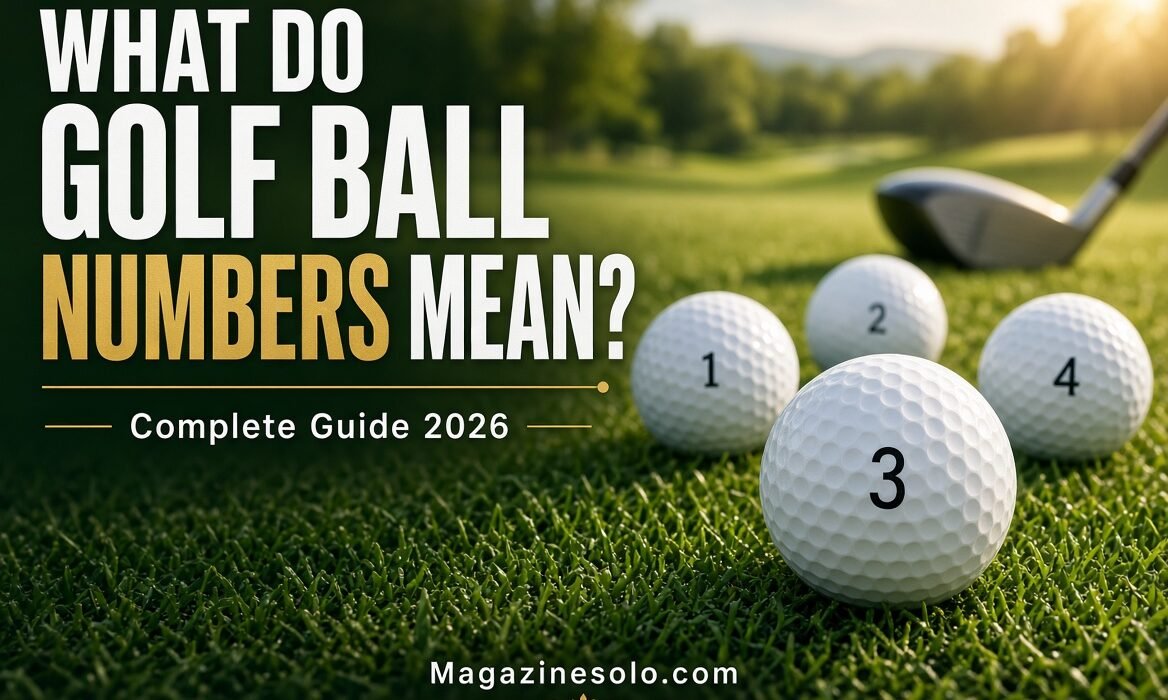
You open a fresh sleeve of golf balls and notice a small number printed beneath the logo. Maybe it is a 1, a 3, or a 7. Another ball in your bag says 90. A third has 332 stamped on it. Are they secret codes? Do they predict distance, spin, or luck?
The answer surprises many golfers. The most common number on a ball tells you almost nothing about how it flies, yet it can save you from a penalty. Other numbers do reveal real information, such as softness or dimple count, but only on certain balls.
Understanding what the numbers on the golf balls mean helps you identify your ball, follow the Rules of Golf, and choose gear with confidence.
Why Do Golf Balls Have Numbers?
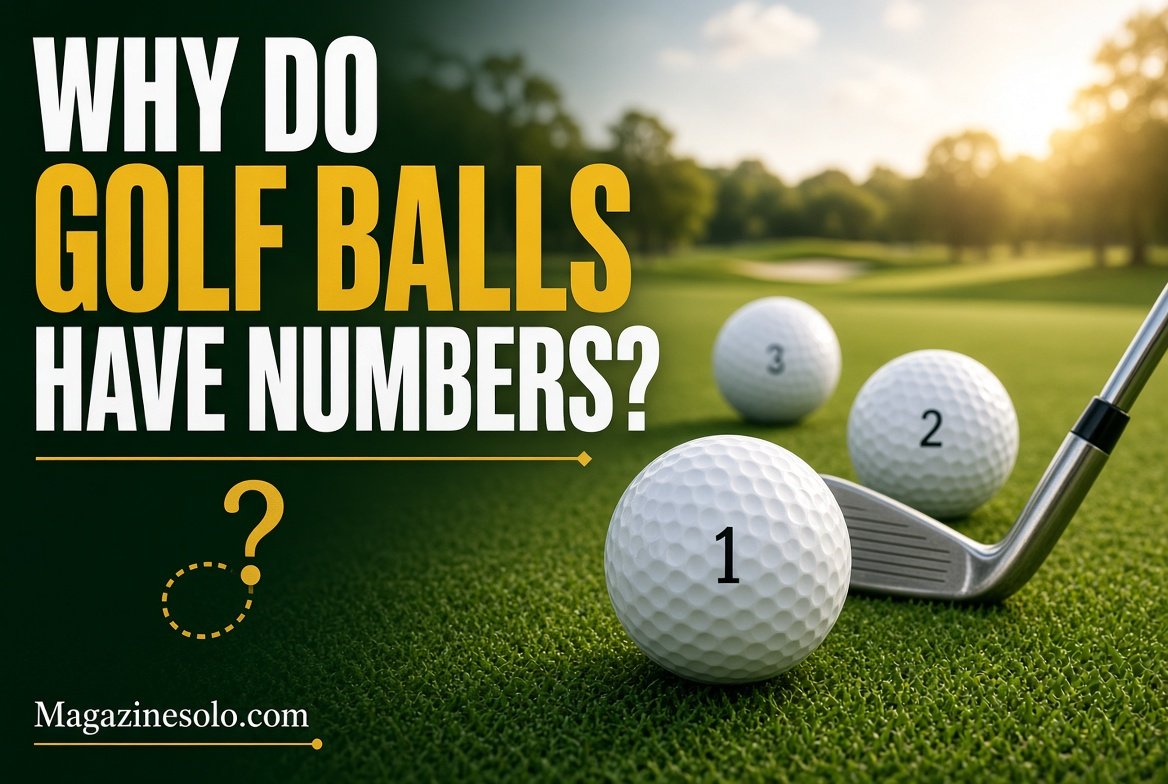
The main reason is simple identification. In a typical round, several players use the same brand and model, such as a Titleist Pro V1 or a Callaway Chrome Soft.
Without a number, two identical balls in the rough look the same. A number gives you a quick way to tell yours apart.
The Rules of Golf Connection
The Rules of Golf require you to play your own ball throughout a hole. If you hit someone else’s ball by mistake, you face a penalty.
In stroke play, playing a wrong ball generally costs two strokes, and you must go back and play your own ball. In match play, it generally costs the hole. A clear number or mark helps you avoid this.
More Than a Number Is Smart
A number alone may not be enough. If your playing partner also uses a 2, the two balls are still identical.
That is why many golfers add a personal mark with a permanent marker. This turns an ordinary ball into one that is clearly yours.
What Do the Single-Digit Numbers on Golf Balls Mean?
Single-digit numbers, usually 1 through 4, are the ones you see most often. They are identification numbers and nothing more.
A ball with a 1 and a ball with a 4 from the same model are built the same way. They have the same core, cover, and performance.
How Numbers Are Packaged
Most dozen packs contain four sleeves, and each sleeve holds three balls with the same number. That is why a dozen often includes a 1, 2, 3, and 4.
You can then pick the number you prefer or share numbers with friends to keep them organized.
Do Higher Numbers Fly Farther?
No. This is one of the most persistent myths in golf. A higher printed number does not mean more distance, more spin, or a better feel.
Equipment guides and retailers agree that within the same model, the number is only a label. Any difference you feel is almost certainly in your head.
Why Most Balls Use 1 to 4
Four numbers cover a standard foursome. Each player can pick a different number and keep things simple.
Brands also package balls in sleeves of three, so four numbers per dozen makes natural sense.
What Do High Numbers (5 to 8) on Golf Balls Mean?
Some models are sold in high numbers, commonly 5 through 8. Titleist, for example, sells Pro V1 and Pro V1x in high-number packs.
These work exactly like low numbers. They only change the digit printed on the ball.
Why Golfers Choose High Numbers
If everyone in your group plays low numbers, a high number makes your ball stand out. It reduces the chance of a mix-up.
Some golfers also like high numbers for lucky-number reasons or simply for a different look.
Do High Numbers Cost More or Perform Differently?
Performance is the same as the low-number version of the same model. Prices can vary by retailer and season, so compare before you buy.
Availability also varies. Not every model or color is offered in high numbers, so check the product page.
What Do the Two-Digit Numbers on Golf Balls Mean?
If you see a number like 70, 80, or 90 on an older ball, it is probably a compression rating. Compression describes how much a ball deforms at impact.
Compression ratings commonly range from about 30 to 120, according to equipment guides. Lower numbers mean a softer ball, and higher numbers mean a firmer one.
A Quick History
Printing compression on the ball was common from the 1970s into the early 2000s. In those days, a rating of 70 to 80 was often marketed to women or slower swingers, while 100 or higher was marketed to stronger players.
Today, many modern balls no longer show a compression number at all. Manufacturers often describe feel in marketing instead.
Does Compression Still Matter?
Yes, but it is only one factor. Cover material, core design, and layers also shape feel and spin.
A professional ball fitting is the best way to find the right match for your swing speed and preferences.
Two-Digit Numbers That Are Not Compression
Sometimes a two-digit number is a custom number. Brands such as Callaway allow numbers up to 99 in custom orders.
If a ball is new and shows a number like 07 or 23, it is likely a personalized choice rather than a compression rating.
What Do the Three-Digit Numbers on Golf Balls Mean?
Three-digit numbers such as 332, 352, or 392 are usually the dimple count. This is how many tiny dimples cover the surface of the ball.
Most golf balls carry between about 300 and 500 dimples. Some makers printed the count right on the ball, though that is less common on modern balls.
Why Dimples Matter
Dimples create a thin layer of air that helps the ball fly farther and more steadily. A smooth ball would lose distance quickly.
Without dimples, a ball would experience much higher drag and drop out of the air sooner.
More Dimples Does Not Mean Better
It is tempting to think a higher count means better performance. In reality, the pattern, depth, and shape of the dimples work together.
Designers tune these features for the ball’s intended flight and spin.
When a Three-Digit Number Is Something Else
Some sources note that a few balls use three-digit numbers for other purposes, so check the manufacturer if you are unsure. When in doubt, look up the model name online.
What Do Red and Black Numbers on Golf Balls Mean?
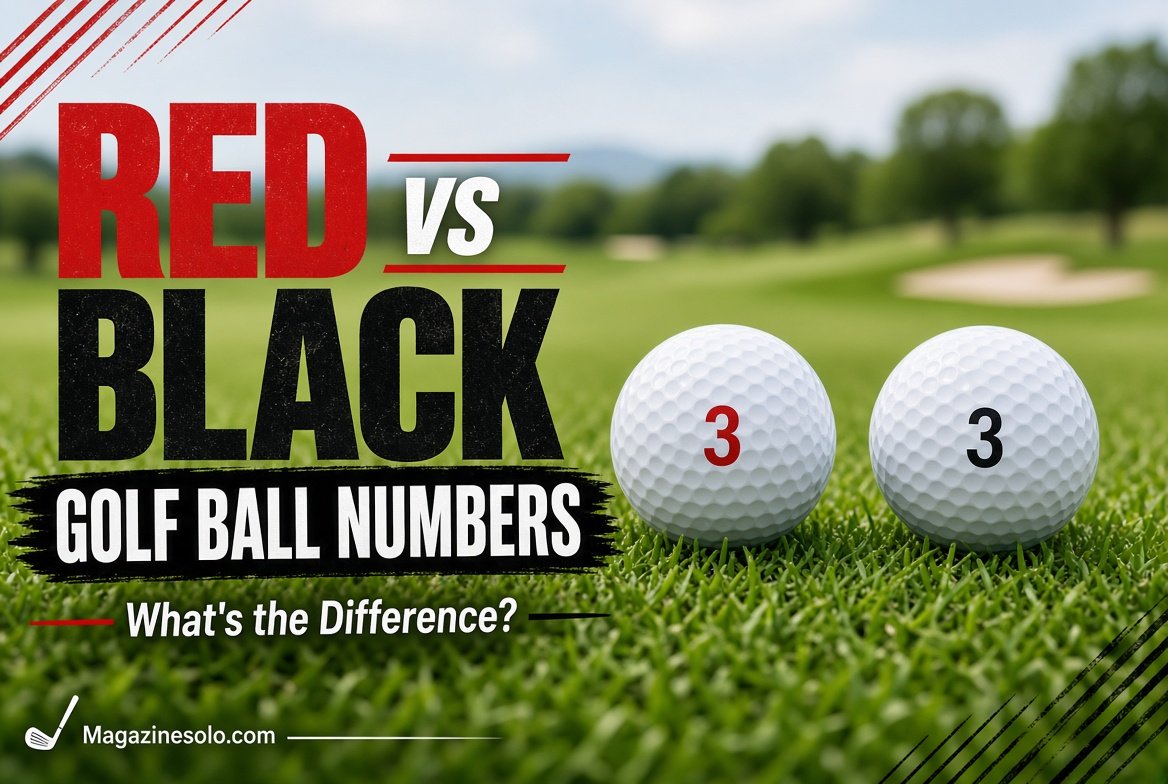
You may have noticed that some balls print the number in red and others in black. Historically, color often hinted at compression, with red linked to softer balls and black to firmer ones.
Today the color is mostly brand specific. It can help distinguish models in a lineup, but it does not follow a universal code.
Why Color Helps With Identification
If your playing partner uses the same model with black numbers and you use red, you can spot your ball instantly. Some golfers choose their ball partly for that reason.
Does Color Change Performance?
A ball with a red 1 and a black 1 from the same model plays the same. Color is a print choice, not a performance feature.
What Do the Numbers on Titleist Golf Balls Mean?
Titleist is the brand many golfers ask about. A typical dozen of Pro V1 or Pro V1x comes in sleeves numbered 1 through 4.
Those numbers are for identification only. A Pro V1 with a 1 and a Pro V1 with a 4 have the same construction.
Pro V1 vs Pro V1x Is Not About the Number
The difference between these two models is in their design, not their number. Both are offered in numbers 1 through 4.
One golf resource describes the Pro V1 as a three-piece ball and the Pro V1x as a four-piece ball. Check Titleist’s current specs, since models update regularly.
Titleist High Numbers and Special Play Numbers
Titleist sells high-number versions of Pro V1 and Pro V1x. A Titleist staff reply on its community forum notes that high numbers and special play numbers are limited to certain white models.
Check Titleist’s site or your retailer for current options.
What Do the Numbers on Callaway Golf Balls Mean?
On Callaway balls such as the Chrome Soft, the number works the same way. It helps players tell identical balls apart.
Retailers note that Callaway numbers often run from 1 to 4 but can go up to 99 through custom options. These numbers do not indicate compression, construction, or performance.
Custom Numbers and Logos
Many brands now let you order balls with personalized numbers, names, or logos. This is popular for gifts, tournaments, and corporate events.
A custom number such as a birth year or jersey number can double as a unique identifier.
What Do the Numbers on TaylorMade, Bridgestone, and Other Brands Mean?
Numbers in a model name, such as the 5 in TP5 or the e5 in Bridgestone’s e5, are simply part of the product name. They are not compression ratings or identification numbers.
This is a major source of confusion. A number printed in the name is a branding choice, while the digit printed separately is usually the identification number.
How to Tell the Difference
Look at where the number appears. If it sits in the model name beside the logo, it is a brand name. If it is a separate digit, it is likely an identifier.
Do Golf Ball Numbers Affect Performance?
In nearly every case, no. Single-digit identification numbers have no effect on flight, spin, or feel.
Performance depends on the ball’s core, layers, cover, and dimple design, not the digit stamped on the side.
| Factor | Does It Change Performance? |
|---|---|
| Identification number (1 to 4) | No |
| High number (5 to 8) | No |
| Number color | Usually no |
| Compression | Yes |
| Cover material | Yes |
| Core and layer design | Yes |
| Dimple pattern | Yes |
How the Rules of Golf Treat Golf Ball Numbers
Numbers matter because of how the Rules handle ball identity. Knowing a few basics can save strokes.
Play Your Own Ball
Under the Rules, you must play your own ball. If you play a wrong ball, a penalty applies.
In stroke play, you generally add two penalty strokes and must correct the mistake by playing the right ball. Failing to correct it before your next tee shot can lead to disqualification.
Identifying Your Ball
When you reach your ball, you need to be able to tell it is yours. If you cannot see enough of it, the Rules allow you to lift it to identify it, as long as you mark the spot first.
Take care not to clean it more than needed to identify it. A unique mark makes this process much easier.
Lost Ball Rules
If you cannot find your ball within three minutes of starting to search, it is lost. The usual penalty is one stroke, and you must play again from where you last hit.
Being able to quickly recognize your ball can help you find it before time runs out.
Provisional Balls
If your ball may be lost or out of bounds, you can play a provisional ball. It helps a lot to make the provisional different from your original.
Many golfers use a different number for provisionals. That way, if both land close together, you know which is which.
What If You Cannot Tell Which Is Which?
Older rulings address cases where a provisional ball cannot be told apart from the original. These situations can get complicated and may require treating one ball as the provisional.
Avoiding the problem with a different number or mark is far easier.
How to Make Your Golf Ball Uniquely Yours

A number is a good start, but a personal mark is better. Here are practical ways to do it.
Use a Permanent Marker
Draw a dot, line, or small shape on the ball. Choose a spot that is easy to see from any angle.
Pick a Unique Pattern
Try two dots on either side of the logo, a short line near the number, or a small symbol. The more distinct the better.
Mark Before Every Round
Make it a routine on the first tee. Do the same for your provisional balls with a different pattern.
Combine Number and Mark
A number plus a mark gives you double protection. If a partner has the same number, your mark still sets your ball apart.
How to Choose Which Number to Play
Because numbers do not affect performance, the choice is personal. Here are common ways golfers decide.
Choose a Number Your Group Does Not Use
If everyone plays low numbers, try a high number. If one friend always plays a 3, avoid it.
Pick a Lucky or Meaningful Number
Birthdays, anniversaries, and jersey numbers are popular. Custom numbers make this possible on many models.
Use Numbers to Rotate Balls
Some golfers use a 1 until it is scuffed, then switch to a 2. It is a simple system for tracking ball condition.
Consider Visibility
If you play late in the day, a number or color that stands out may help you track your ball. Low light makes any ball harder to see.
Playing Late in the Day: Why Visibility Matters
Evening rounds are popular, but fading light makes identification harder. A clear mark and an easy-to-see number help you find your ball quickly.
Planning also matters. A tool such as How Long Until 8 PM? can help you count the time left before dusk, and a guide like How Long Until 5 PM? is handy for fitting a quick nine holes after work.
Golf Ball Specifications Every Golfer Should Know
Beyond printed numbers, golf balls must meet strict equipment standards set by The R&A and the USGA. These numbers are not printed on the ball, but they define what is allowed.
| Specification | Limit |
|---|---|
| Maximum weight | 1.620 ounces (45.93 grams) |
| Minimum diameter | 1.680 inches (42.67 mm) |
| Minimum weight | None |
| Initial velocity | Must not exceed the limit on file with The R&A and USGA |
| Overall distance | Must not exceed the standard on file |
| Symmetry | Must behave like a spherically symmetrical ball |
Why These Limits Exist
Rule makers want a consistent game where skill matters more than equipment. Standard limits keep balls fair for all players.
Manufacturers must submit samples to confirm a ball conforms before selling it for use in rules-governed play.
Conforming Ball Lists
Competitions can require balls from an approved list. If you play in a tournament, check that your model is on the list.
What Is Golf Ball Compression?
Compression measures how much a ball compresses under force. A softer ball compresses more, and a firmer ball compresses less.
It affects feel, launch, and sometimes spin. Golfers often connect lower compression with slower swing speeds, though fitting data is the best guide.
| Compression Range | General Feel | Often Associated With |
|---|---|---|
| Lower (around 30 to 70) | Softer | Slower swing speeds, preference for soft feel |
| Mid (around 70 to 90) | Moderate | Many recreational golfers |
| Higher (90 and above) | Firmer | Faster swing speeds |
These ranges are general guides, not strict rules. Individual preferences vary.
Why Compression Numbers Disappeared
Modern multi-layer balls blend many design features. A single compression number can oversimplify performance.
Brands now emphasize overall construction and feel.
What Are Golf Ball Dimples?
Dimples are small indentations on the cover. They are a key part of how golf balls fly.
They reduce drag and help generate lift, letting the ball travel farther and more stably.
Dimple Count vs Dimple Design
Count is only part of the story. Depth, shape, and arrangement matter just as much.
That is why two balls with different dimple counts can perform similarly, and why engineers keep refining patterns.
Common Myths About Golf Ball Numbers

Misunderstandings about numbers are everywhere. Here are the most common ones.
Myth: A Higher Number Means More Distance
False. Identification numbers do not change distance.
Myth: Number 1 Is Better Than Number 4
False. Within the same model, all numbers are built the same.
Myth: High Numbers Are Premium Balls
Not necessarily. They are a numbering option, and performance matches the same model with a low number.
Myth: Red Numbers Always Mean Soft Balls
Not anymore. Color once hinted at compression but is now mostly brand specific.
Myth: Every Number on a Ball Is a Compression Rating
Only certain two-digit numbers on older balls were compression ratings. Others are identifiers, dimple counts, or model names.
Why Do Golfers Care About Numbers Anyway?
Besides rules and identification, numbers add a little personality to the game. Many golfers have favorites and routines.
Some choose numbers for luck. Others use numbers to track how many balls they have lost or how worn a ball is.
The Psychology of a Lucky Number
Confidence matters in golf. If seeing your number on the tee helps you relax, that small boost may be worth it, even if the ball itself is the same.
Practical Tips for Using Golf Ball Numbers
Keep these simple tips in mind on your next round.
- Announce your ball model and number on the first tee.
- Add a personal mark in permanent marker.
- Use a different number or mark for provisional balls.
- Check the model name before assuming a number is compression.
- Remember that numbers do not change distance.
How to Read Everything Printed on a Golf Ball
A golf ball can carry several pieces of text at once. Knowing which is which prevents wrong assumptions.
| What You See | Where It Appears | What It Usually Is |
|---|---|---|
| Brand name and logo | Largest print on the ball | Manufacturer and model branding |
| Model name with a number (TP5, e5) | Near the logo | Part of the product name |
| Single digit below the logo | Close to the model name | Identification number |
| Two-digit number | Often near the number or logo | Older compression rating or custom number |
| Three-digit number | Smaller print on the cover | Often the dimple count |
| Alignment lines or arrows | Around the equator | Putting aid, not a number |
Alignment Marks Are Not Numbers
Some balls include lines or arrows to help you aim putts. These are useful, but they have nothing to do with identification numbers.
Numbers on Used, Lake, and Range Balls
Recycled and used balls often have worn or faded numbers. Wear can make a single digit hard to read.
This is another reason a personal mark helps. Ink on a clean ball stays visible longer than a faded factory print.
Range Balls
Range balls usually carry stripes, bands, or a facility name instead of an identification number. They are designed for practice and are not meant for rounds on the course.
Buying Used Balls
If you buy used balls, check the model name rather than relying on a number. The number tells you nothing about condition or quality grade.
How to Choose a Golf Ball Beyond the Number
Because the identification number does not change performance, spend your attention on factors that do. These are the main considerations golfers weigh.
Feel
Some golfers prefer a soft feel off the clubface, while others like a firmer response. Try a few models and notice which feels best on putts and short shots.
Spin and Control
Premium multi-layer balls are often chosen for more spin around the green. Value balls tend to emphasize durability and distance off the tee.
Swing Speed
Swing speed influences how a ball compresses. A ball fitting can match your speed to a suitable model.
Budget and Durability
Premium balls cost more per dozen. If you lose several balls a round, a less expensive option may make more sense.
Visibility
White is the traditional choice, but some golfers prefer brightly colored balls for easier tracking. Pick what you can see best in your usual conditions.
A Simple Checklist for Beginners
New golfers can follow this short routine before every round.
- Choose a model and keep it consistent so you learn how it feels.
- Pick a number that stands out in your group.
- Add a personal mark with a permanent marker.
- Use a different mark or number for provisional balls.
- Carry a few extra balls with the same model so a loss does not change your feel.
Why Consistency Helps
Switching models often can make it harder to judge distances and feel. Using the same model gives you a reliable baseline.
Why Understanding Ball Numbers Helps Your Game

Knowing what numbers mean builds confidence on the first tee. You avoid rules mistakes, save time looking for balls, and make smarter buying choices.
It also keeps you from paying attention to myths. A higher number will not add yards, but a good fitting and a smart routine might.
Key Takeaways
- Single-digit numbers identify your ball and do not change performance.
- High numbers are extra identification options on some models.
- Two-digit numbers can be older compression ratings or custom numbers.
- Three-digit numbers are often dimple counts.
- Red and black colors are mostly brand specific today.
- Marking your ball makes identification easier and helps you follow the Rules.
Also Read:
- How Long Until 8 PM? Instant Countdown, Calculation Tricks & Time Zone Guide
- How Long Until 5 PM? Quick Time Calculator & Countdown Guide
- How Long Until 10:15? Complete Time Calculator & Countdown Guide
- How Long Until 1:50? The Complete Time Countdown Guide
- Stent vs Stint: What’s the Difference?
- Loot vs Lute: The Complete Guide to These Confusing Homophones
- Gluing or Glueing: The Correct Spelling
- Separate vs. Seperate: The Complete Guide to the Correct Spelling
- Per Say or Per Se? Which Is Correct?
- Which One Is You vs Which One Are You, The Complete Guide to Choosing Correctly
- Thats or That’s: Which Is Correct?
- Thank You Everyone or Thank You All: Which Is Correct
- What Do You Call Someone Who Loves Music? 10+ Simple Terms
- QuoteBless.com USA: Discover Heartfelt Quotes & Blessings 2026
- Morgan Wallen Singer Height, Weight, Age, Family, Bio, & Net Worth
- Riley Green Singer Height, Weight, Age, Family, Bio, & Net Worth
- Benson Boone Singer Height, Weight, Age, Family, Bio, & Net Worth
- D4vd Singer Height, Weight, Age, Family, Bio, and Net Worth
- Ella Langley Singer Height, Weight, Age, Family, Bio, & Net worth
- David Zaslav and Conor McGregor: Careers, Influence, and Their Connection
- Peter Orszag Bald Biography 2026: Is He Bald? Facts Revealed
- Bianca Nobilo Net Worth 2026: How Rich Is She Now?
- Layla Jenner Biography 2026: Age, Height, Net Worth & Family
- Brooke Daniells: Life, Career and Relationship Story 2026
Frequently Asked Questions (FAQs)
What do the numbers on golf balls mean?
Most numbers are for identification. Single digits like 1 to 4 help you tell your ball from identical ones, while some two- and three-digit numbers may show compression or dimple count.
Why do golf balls have numbers 1 to 4?
Four numbers match a standard group of four players and the four sleeves in a dozen. Each sleeve usually carries the same number.
Do higher numbers on golf balls go farther?
No. Identification numbers do not affect distance, spin, or feel.
Is a number 1 golf ball better than a number 4?
No. Within the same model, every number has the same construction and performance.
What do high numbers like 5 to 8 mean on golf balls?
They are extra identification options sold on some models, such as Titleist Pro V1. They perform the same as low numbers of the same model.
What do two-digit numbers on golf balls mean?
On older balls, they often showed compression ratings such as 70, 80, or 90. On newer balls, they may be custom numbers.
What do three-digit numbers on golf balls mean?
They are often the dimple count, such as 332 or 352. Dimples typically number between 300 and 500.
What does golf ball compression mean?
Compression describes how much a ball deforms at impact. Lower numbers mean a softer ball, and higher numbers mean a firmer one.
Do red and black numbers mean different things?
Historically, color hinted at compression. Today it is mostly brand specific and often helps distinguish models.
What do the numbers on Titleist Pro V1 balls mean?
The single digit is an identification number, usually 1 to 4, or 5 to 8 in high-number packs. It does not affect performance.
Do Titleist Pro V1 and Pro V1x use different numbers?
Both commonly come in numbers 1 to 4. The models differ in design, not in the printed number.
What do the numbers on Callaway balls mean?
They are identification numbers and do not show compression or performance. Callaway offers custom numbers up to 99 through personalization.
Is the 5 in TP5 a compression rating?
No. It is part of the model name, not a compression or identification number.
Can I choose my own number on golf balls?
Many brands offer custom numbers, names, and logos. Availability depends on the brand and model.
Do the Rules of Golf require numbered balls?
No specific number is required. You must be able to identify your ball and play your own ball throughout a hole.
What happens if I play the wrong ball?
In stroke play, you generally receive a two-stroke penalty and must correct the mistake by playing your own ball. In match play, you generally lose the hole.
Can I lift my ball to identify it?
Yes, if you cannot identify it otherwise. You must first mark its spot and avoid cleaning it more than needed.
How long do I have to search for a lost ball?
You have three minutes. If the ball is not found in that time, it is lost, and the usual penalty is one stroke with replay from the previous spot.
Why should I use a different number for a provisional ball?
It lets you tell the provisional apart from your original if both end up in the same area. A different mark works as well.
How can I mark my golf ball?
Use a permanent marker to add a dot, line, or small symbol. Combine it with the number for the clearest identification.
How much can a golf ball weigh?
Under the equipment rules, a ball must not weigh more than 1.620 ounces, or 45.93 grams. There is no minimum weight.
What is the minimum size of a golf ball?
The diameter must not be less than 1.680 inches, or 42.67 millimeters.
How many dimples does a golf ball have?
Most golf balls have between about 300 and 500 dimples. The exact count varies by model.
Do more dimples make a golf ball better?
Not necessarily. Pattern, depth, and shape matter as much as the count.
Which golf ball number should I pick?
Choose any number that is easy to see and different from your playing partners. Because numbers do not affect performance, the choice is personal.
Conclusion
The numbers on golf balls are far less mysterious than they seem. Single digits identify your ball, high numbers give you extra choices, and some two- and three-digit numbers reveal compression or dimple count on certain balls. None of the identification numbers change how the ball flies.
What does matter is knowing your ball when you find it. The Rules of Golf expect you to play your own ball, and a clear number plus a personal mark makes that easy.
Next time you open a sleeve, pick a number that suits your group, add a quick mark, and head to the first tee knowing exactly what that little digit is for.