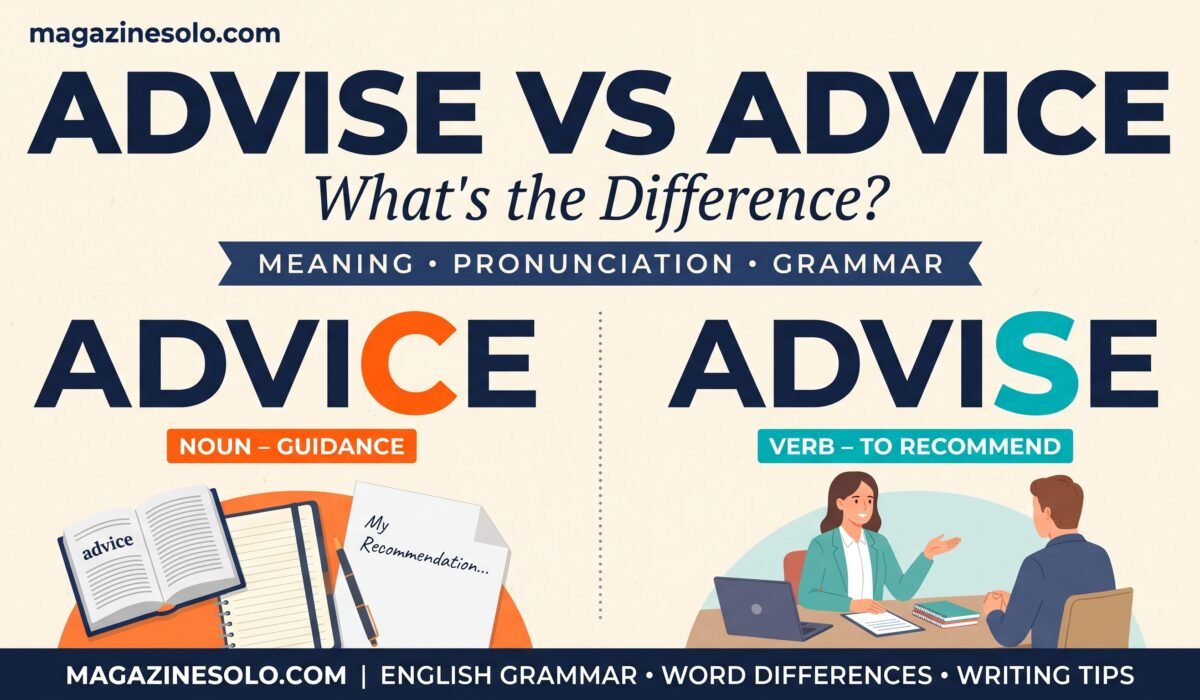
The advise vs advice difference is one letter, one sound, and one counting rule: advise is the verb that does the guiding, and advice is the noun that names the guidance itself.
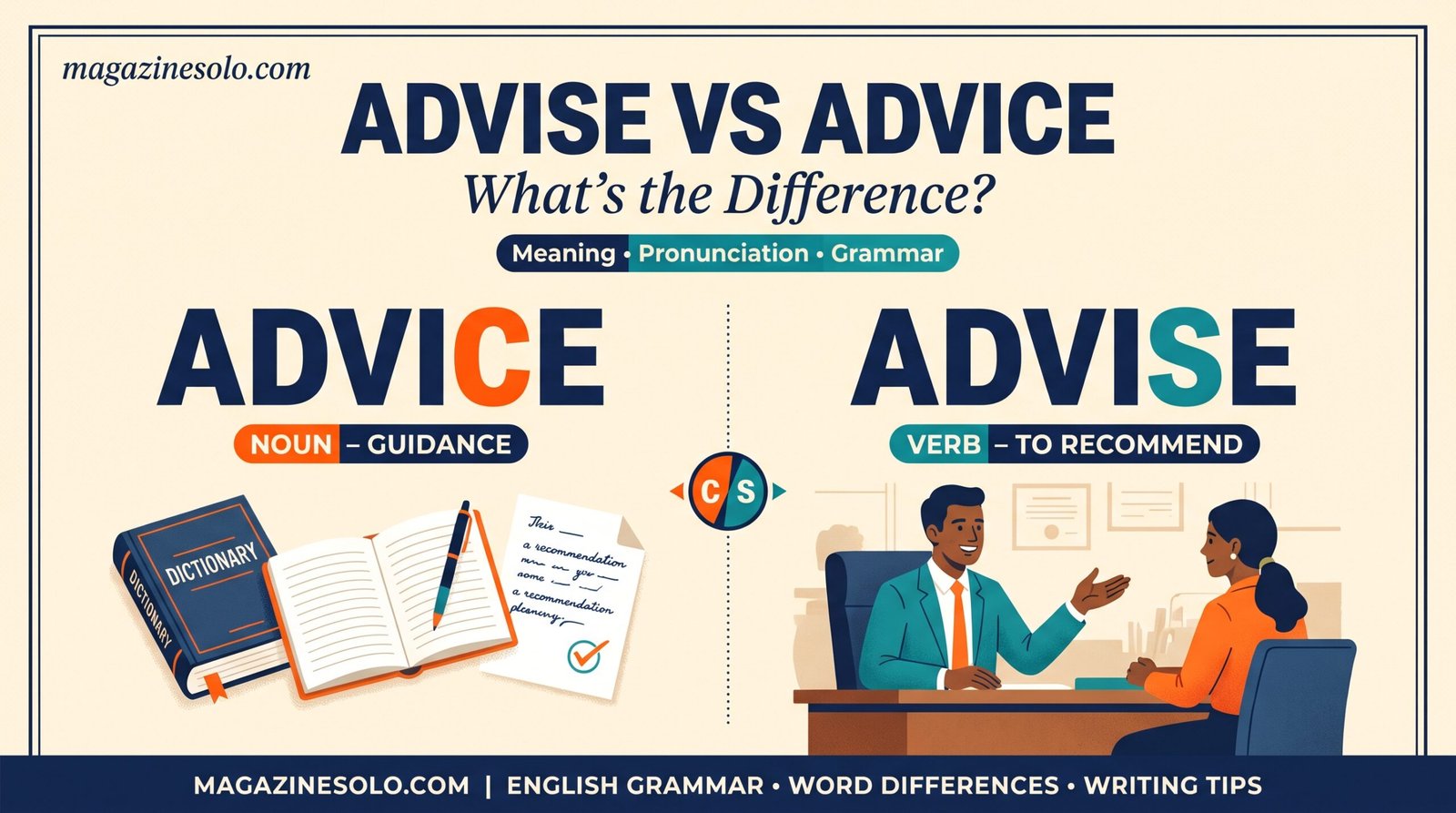
Here is the whole distinction in one breath. Advise, spelled with s, is an action: to recommend, to counsel, to tell someone what you think they should do. Advice, spelled with c, is a thing: the recommendation you received.
The hook is hiding inside the noun. Advice contains ice, a solid thing you can hold in your hand, and nouns name things. Advise is the action, and its final s buzzes like the z in wise, the quality you need to give advice at all.
This pair catches more writers than almost any other in the cluster.
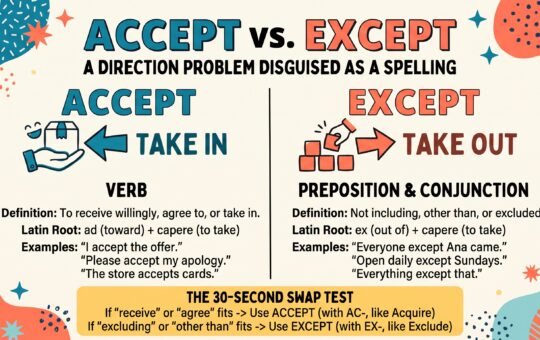
It sits beside the direction swap in our guide to accept vs except difference and the sound pair in our guide to lose vs loose difference, and it appears in job applications, school essays, and business email every single day.
Advise vs Advice at a Glance
|
Word |
Letter |
Sound |
Job |
Counting |
Example |
|---|---|---|---|---|---|
|
Advice |
c |
s, like ice |
Noun |
Uncountable, no plural |
Thank you for the advice |
|
Advise |
s |
z, like wise |
Verb |
Conjugates normally |
I advise you to wait |
|
A piece of advice |
c |
s, like ice |
Counting unit |
One item of guidance |
One piece of advice |
Read the table as a division of labour. Advise is something a person does; advice is something a person has, gives, takes, or ignores. The letter, the sound, and the job never disagree, which is what makes this pair learnable in one sitting.
The Three Witnesses: Letter, Sound, and Job
Witness One: The Letter
In this family, the c names the thing and the s performs the action. Advice with a c is the guidance, the product, the thing that exists after someone has spoken. Advise with an s is the speaking itself.
The pattern is older than the modern spellings.
Both words descend from Old French avis, meaning opinion, from a phrase meaning it seems to me. Early printers standardized the modern split, using c for the noun and s for the verb across a whole family of pairs.
Witness Two: The Sound
Say the two endings out loud. Advice ends in a hiss, the s sound of ice, twice, and price: ad-VICE. Advise ends in a buzz, the z sound of wise, prize, and rise: ad-VIZE.
Both words stress the second syllable, and the first syllable shrinks to the same uh in both. That is why some pages loosely call them homophones. They are not, and the difference matters: the final sound is a free spelling check hiding in your own voice.
The sound test carries real weight in this cluster. The pair in our guide to lose vs loose difference is settled by exactly this kind of listening, and advise against advice gives you the same gift: if it rhymes with ice, it is the noun.
Witness Three: The Job
Ask what the sentence needs. If it needs an action performed by a subject, the word is advise, because advise is a verb and nothing else. If it needs the guidance itself, a thing that can be given or followed, the word is advice.
Grammarly’s advise vs advice guide states the foundation flatly: advise is only used as a verb and advice is only used as a noun. There are no exceptions to that split in standard English, which makes this pair stricter, and simpler, than most.
The possessive test is the job witness in disguise. Your, my, his, and good can only stand in front of a noun, so your advice and good advice are forced. Your advise is not a possible phrase, however often it appears in drafts.
Advice: The Noun You Cannot Count
The Count Rule
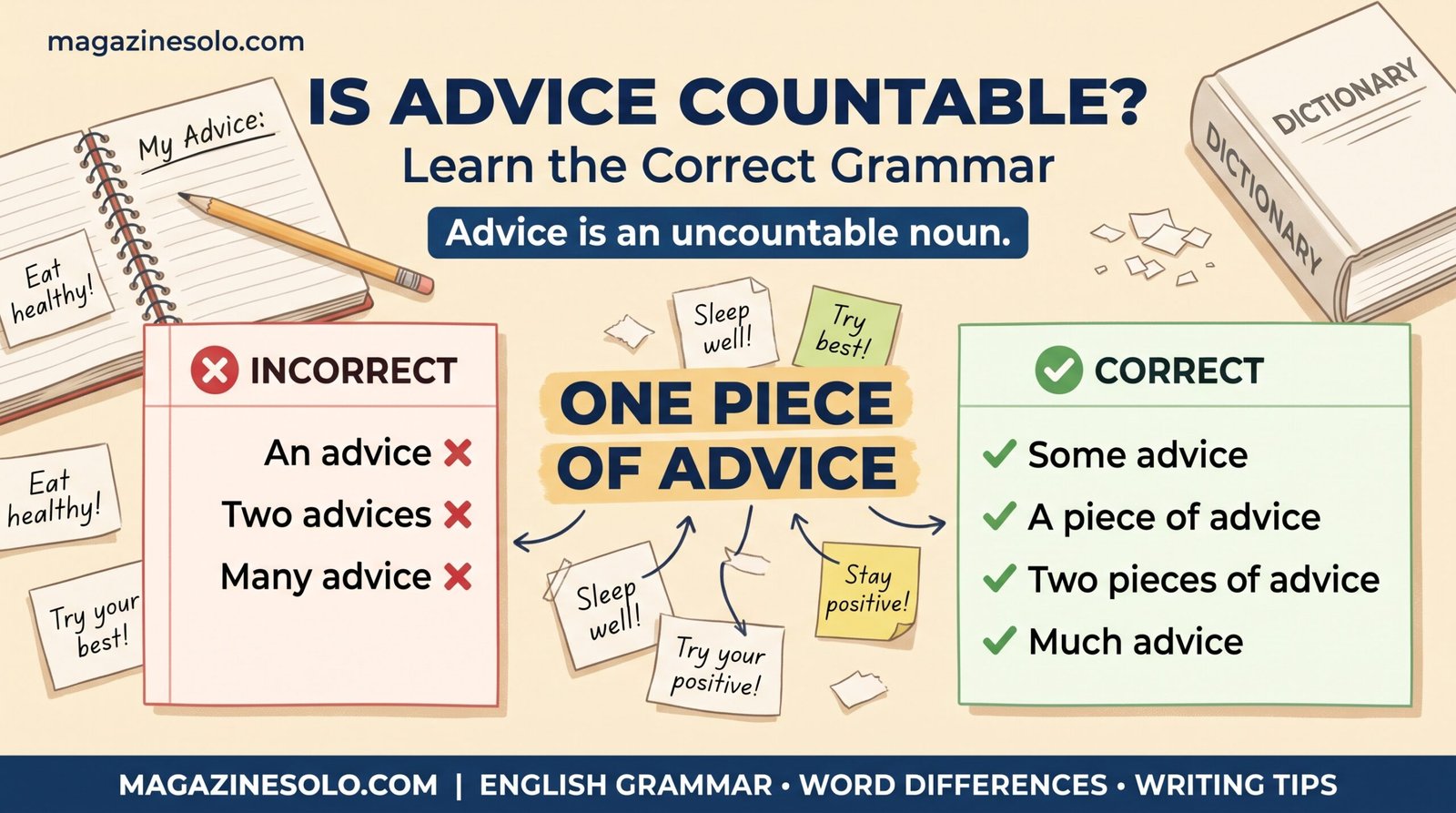
Advice is an uncountable noun, a mass noun like water, information, and furniture. Merriam-Webster’s entry for advice and the dictionary tradition list it as the guidance itself, and Cambridge Dictionary marks it uncountable in its entry.
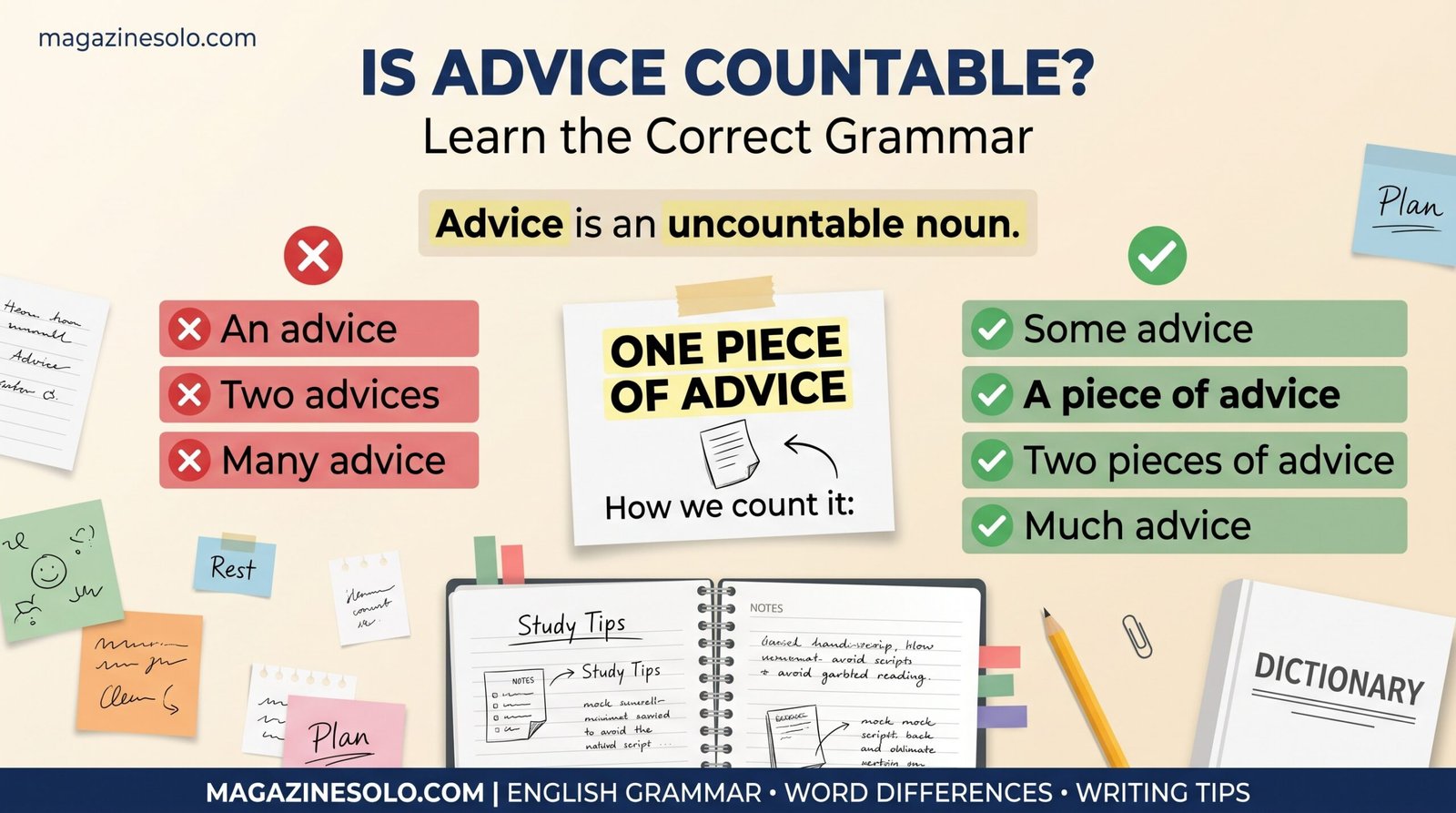
Uncountable means three bans. No a or an directly in front: an advice is ungrammatical. No plural s: advices does not exist for guidance. And singular agreement: this advice is helpful, never these advice are.
This is the rule the other two witnesses cannot give you, and it is where learners lose the most marks. A writer can choose the right word and still break the sentence by trying to count it.
The Repair Kit: How Counting Actually Works
|
Error |
Why It Fails |
Repair |
|---|---|---|
|
An advice |
Uncountable nouns take no a or an |
Some advice, a piece of advice |
|
Two advices |
No plural in the guidance sense |
Two pieces of advice |
|
Many advice |
Many needs a countable noun |
Much advice, many pieces of advice |
|
I need some advise |
Need takes a thing, a noun |
I need some advice |
|
Thank you for your advise |
Your attaches to nouns only |
Thank you for your advice |
The device English uses is the partitive: a countable unit word carries the number, and advice stays uncountable behind it. A piece of advice, two pieces of advice, a word of advice, a little advice, some advice.
Memorize the repair, not just the ban. Every counting error in this family is fixed by the same move: put piece in front and let it do the counting.
The Verbs That Keep Advice Company
Advice lives inside a small set of partner verbs, and learning them teaches the noun’s whole behaviour at once.
- Give advice: the adviser hands over the guidance.
- Take advice: the listener accepts it and acts on it, the heart of the idiom take my advice.
- Follow advice: the guidance is obeyed over time.
- Seek advice: the guidance is hunted before a decision, as in seek legal advice.
- Ask for advice: the request form, always with for.
- Ignore advice: the guidance is heard and set aside.
Every partner treats advice as a thing that moves between people. When your sentence is built on one of these verbs, the word that follows is advice with a c, every time.
Advise: The Verb That Does the Guiding
The Forms of Advise
Advise conjugates like any regular verb, and its forms are listed in full in Merriam-Webster’s entry for advise.
- Advises is the third person singular: she advises the board; the doctor advises rest.
- Advised is the past tense and past participle: they advised caution; we were advised to leave.
- Advising is the ing form: advising clients, an advising session.
- Advise itself serves the base and imperative forms: I advise patience; advise me.
LanguageTool’s advise vs advice guide makes the useful technical point: advise is a dynamic verb, an action verb, working both transitively (advise someone) and intransitively (the committee met to advise). Actions are what this word is for.
The Three Sentence Patterns
1. Advise someone to do something. The recommendation pattern: I advise you to wait; the lawyer advised her client to appeal. A person, then a to infinitive carrying the recommended act.
2. Advise against something. The warning pattern: doctors advise against smoking; I would advise against signing today. Against is followed by a noun or an ing form, never a to infinitive.
3. Advise on a topic. The expertise pattern: she advises the board on tax policy; can you advise me on visas? On is the standard preposition for subjects; advise about is heard informally, but on is the dictionary backed choice.
The Formal Sense: Advise as Notify
Advise carries a second, official sense: to inform or notify formally. The company advised staff of the closure; please advise us of any change of address.
This sense is not a curiosity. It is the engine inside the business formulas below, and it explains why advise appears in letters where no recommendation is being given at all. The word reports, officially, and the reader is notified.
The Whole Family in One Table
|
Word |
Role |
Meaning in One Line |
Example |
|---|---|---|---|
|
Advise |
Verb, present |
Give guidance or notify |
I advise caution |
|
Advises |
Verb, third person |
He or she advises |
She advises the board |
|
Advised |
Verb, past |
Gave guidance |
They advised waiting |
|
Advising |
Verb, ing form |
In the act of guiding |
Advising clients |
|
Advice |
Noun |
The guidance itself, uncountable |
Sound advice |
|
Adviser |
Noun, person |
One who advises, traditional spelling |
A legal adviser |
|
Advisor |
Noun, person |
One who advises, title spelling |
Financial advisor |
|
Advisory |
Adjective, noun |
Giving guidance; an official notice |
An advisory board, a travel advisory |
|
Well-advised |
Adjective |
Wise, prudent |
You would be well-advised to wait |
|
Ill-advised |
Adjective |
Unwise, poorly judged |
An ill-advised remark |
Read the table by jobs. One verb does the guiding in four forms. One uncountable noun names what the guiding produces. Two spellings name the person, one adjective family judges the quality, and advisory does official duty.
Role splitting of this kind is the cluster’s house pattern. The pair in our guide to who vs whom difference splits its forms by job, actor against receiver. This family splits by function too: action, product, person, and judgment each get their own shape.
Adviser vs Advisor: Both Right, Titles Decide
The person who advises can be spelled adviser or advisor, and both are correct. Adviser is the older form, the traditional preference in British English, in academic writing, and in style guides.
Advisor is the spelling of American institutional titles: financial advisor across the industry, and National Security Advisor in government. American law itself keeps the older form: the statute is the Investment Advisers Act.
The writer’s rule is simple. When you name a real role, copy its official spelling exactly. In generic text, either form is safe, and consistency inside one document matters more than the choice itself.
Well-Advised and Ill-Advised: The Adjectives in Hiding
Two adjectives grow from the verb’s past participle. Well-advised means wise or prudent, usually in the frame you would be well-advised to wait, meaning waiting is the smart move.
Ill-advised means unwise or poorly judged: an ill-advised comment, an ill-advised investment. Both keep the verb’s s and a hyphen, and both judge decisions, which is why well-adviced and ill-adviced are not words.
Advisory: The Family’s Official Member
Advisory works as an adjective (an advisory board, an advisory role) and as a noun naming an official notice: a travel advisory, a weather advisory. It is the family’s formal dress, and it never substitutes for the plain noun advice in ordinary sentences.
The Pattern Family: Same Split, Other Pairs
Device and Devise, Prophecy and Prophesy
This pair is not an orphan. A device is a noun, a thing, pronounced with the s sound: a listening device. To devise is a verb, to invent or plan, pronounced with the z sound: devise a strategy.
Prophecy and prophesy repeat the system exactly: the prophecy is the thing foretold, and to prophesy is the act of foretelling. Learn the pattern once, letter, sound, and job together, and three pairs settle at the same time.
The British Cousins: Licence and Practice
British spelling extends the pattern further. British English writes licence for the noun and license for the verb, and practice for the noun against practise for the verb.
American English merged those two pairs, using license and practice for both jobs. Advice and advise never merged, in either variety. That is what makes this pair the reliable one: its split holds in London and in New York alike.
Comparison traps of this kind run through the whole cluster.
The pair in our guide to than vs then difference separates comparing from sequencing with one letter, and the family in our guide to affect vs effect splits a cause from its result.
Each pair falls to its own small test, and this pair’s test is the ice inside the noun.
The Email Formulas
Please Advise: The Polite Fossil
Please advise closes thousands of business emails a day. It means please give me your guidance, instruction, or next step: the invoice is short by two units, please advise.
The verb works without an object here, a fossil of formal letter writing.
It is correct, and it always takes advise with an s, because it asks for the action. Some readers find it abrupt, and plain alternatives (how should we proceed) soften it, but no one may call it an error.
Please Be Advised and As Advised
Please be advised that is the notify sense in its formal dress: please be advised that the office closes Friday. It signals official information and a little distance, which is why agencies and airlines use it and friendly emails avoid it.
As advised points backward: as advised in our letter of May 3, the fee has changed. Both formulas run on the verb advised, and both belong to the register of notices, not of recommendations.
The Honest Corner: Advices and the Remittance Advice
One corner must be taught honestly, or the count rule looks false to anyone who works in an accounts office. In commercial English, advices survives as a plural for formal notices: shipping advices, remittance advices.
The same corner gives countable documents with advice in their names: a remittance advice is the paper that notifies a payment, a delivery advice accompanies goods. Australian and British business usage keeps this sense alive.
File it as a separate, specialized sense, the vocabulary of notices. It does not license an advice for guidance, and the exam room, the essay, and ordinary business writing all follow the count rule without exception.
Common Mistakes and Corrections
1. I need some advise. “I need some advise on my career.” Need is followed by a thing, and the thing is the noun. Correction: I need some advice on my career. The swap is this pair’s most common written error.
2. Thank you for your advise. “Thank you for your advise on the contract.” Your can only possess a noun, and verbs cannot be possessed. Correction: thank you for your advice. The possessive in front settles the word before meaning is consulted.
3. An advice and advices. “She gave me an advice and several advices.” Guidance cannot be counted directly, singular or plural. Correction: she gave me a piece of advice and several more pieces. Piece does the counting; advice never changes shape.
4. My advise is. “My advise is to sell now.” A possessive plus a verb is not an English phrase. Correction: my advice is to sell now, or I advise you to sell now. Pick one shape; the error tries to be both.
5. Can you give me an advise? “Can you give me an advise about pricing?” Give asks for a thing, so the sentence needs the noun, repaired. Correction: can you give me some advice about pricing, or can you advise me on pricing.
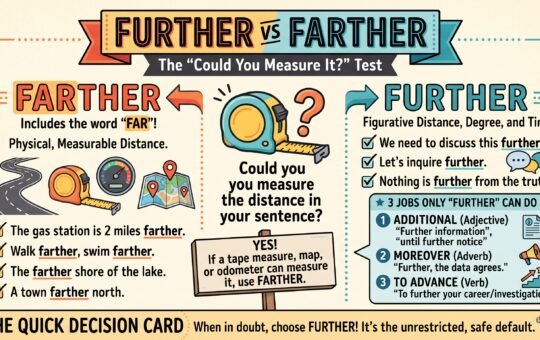
The discipline behind all five corrections is the same one that runs through our guide to fewer vs less difference and our guide to further vs farther difference: a small test, applied once, beats a page of memorized examples.
Its companions live in our guide to your vs you’re difference and our guide to its vs it’s difference, where a small difference likewise decides whether the sentence you wrote is the sentence you meant.
Practice: Ten Sentences
Choose advise, advice, advised, or a piece of advice for each sentence. The key follows, with the reasoning compressed to the witnesses.
1. I need some ___ on choosing a course.
2. The doctor ___ him to rest for a week.
3. Thank you for your ___ about the contract.
4. Can you ___ me on visa rules?
5. She gave me ___ that I still use today.
6. They strongly ___ against travelling tonight.
7. His ___ was to save first and spend later.
8. Please ___, the delivery has not arrived.
9. You would be well-___ to book early.
10. The committee ___ the board on tax policy.
Key: 1 advice (a thing needed). 2 advised (the action, past tense). 3 advice (your takes the noun). 4 advise (the action requested). 5 a piece of advice (one counted item).
Key, continued: 6 advise (the warning pattern, a verb). 7 advice (his plus the thing offered). 8 advise (the email formula asks for action). 9 advised (the adjective well-advised). 10 advises (third person verb, on pattern).
Score it honestly: most misses cluster on sentences 5, 8, and 9, the counting unit, the formula, and the adjective. That is normal, and it is exactly what the repair kit and the formulas sections above are for.
The 30 Second Decision Card
Action. Is someone guiding, recommending, warning, or notifying? Advise, with s, buzzing like wise.
Thing. Is it the guidance itself, given, taken, followed, ignored? Advice, with c, hissing like ice.
Count. Are you reaching for a, an, or a plural? Stop. Use a piece of advice.
Person. Naming who guides? Adviser or advisor, and copy the official title’s spelling.
Four checks, thirty seconds, and the pair never costs you a second thought again. What it should cost you is one read of the family table, because adviser spelling and the counting unit are where the second errors breed.
Frequently Asked Questions
What is the difference between advise and advice?
Letter, sound, and job at once. Advise is the verb, to give guidance, spelled with s and pronounced with a z sound like wise. Advice is the noun, the guidance itself, spelled with c and pronounced with an s sound like ice.
To advise is to give advice. The two halves of that sentence carry the whole pair.
How do you remember advise vs advice?
Three hooks cover almost everyone. Advice contains ice, a solid thing you can hold, and nouns name things. Advise is the action, and its s buzzes like the z in wise, the quality you need to give it.
The count rule backs both up: advice cannot be counted, so anything you can count or do is never advice.
Is it ‘I need some advise’ or ‘I need some advice’?
I need some advice. Need is followed by a thing, a noun, and the noun is advice with a c.
I need some advise puts a verb where the sentence needs an object. If give, take, need, or want stands before the word, the word is advice.
Is it ‘thank you for your advice’ or ‘thank you for your advise’?
Thank you for your advice. The your points at a possessed thing, and things take the noun.
Your advise attaches a possessive to a verb, which English does not allow. The same test settles good advice and sound advice: an adjective or possessive in front means the noun, spelled with c.
What does advise mean?
Advise is a verb meaning to give someone a recommendation or guidance about what to do: I advise you to wait; the doctor advised rest.
It has a second, formal sense: to inform or notify officially, as in advise the client of the delay. In both senses it is an action, never a thing.
What does advice mean?
Advice is a noun meaning an opinion or recommendation offered as guidance: her advice was to save first. It names the guidance itself, the thing produced when someone advises.
It is uncountable in standard English, like water or information: some advice or pieces of advice, never an advice or two advices.
Is advice a noun or a verb?
A noun, always. Advice only ever functions as a noun in standard English; every dictionary entry agrees on this point.
The verb of the family is advise. If the sentence needs an action, someone giving or recommending, the word is advise. If it needs the guidance itself, the word is advice.
Can advise be used as a noun?
No. Advise is only a verb. Sentences like I need your advise are errors, however common they are in drafts and comments. The noun slot belongs to advice.
The confusion persists because counsel, the close synonym, works as both noun and verb. Writers import counsel’s flexibility into a pair that does not share it.
Is advice countable or uncountable?
Uncountable, a mass noun like information, water, and furniture. It takes no a or an directly, no plural s, and singular agreement: this advice is helpful.
To count individual recommendations, English uses a partitive: a piece of advice, two pieces of advice, a word of advice, some advice.
Can I say ‘an advice’?
No, not in standard English. Because advice is uncountable, an advice is ungrammatical; write some advice, a piece of advice, or a recommendation instead.
The error is extremely common among learners whose first languages count the equivalent word, which is why this pair is a fixture of ESL teaching and exam marking.
Is ‘advices’ ever correct?
Only in a narrow, formal corner. In commercial and legal English, advices has been used as a plural meaning formal notices: shipping advices, remittance advices, a different sense from guidance.
For guidance, advices is simply wrong: two pieces of advice is the correct form. Treat advices as an error unless you work with notices.
What is a piece of advice?
The standard counting unit for the uncountable noun: one recommendation treated as a single item. He gave me a piece of advice I still use.
Piece is a partitive, the same device English uses for a piece of furniture. Any time you catch yourself writing an advice, piece of advice is the repair.
How do you pronounce advise and advice?
Differently, and the difference is a free spelling check. Advice ends in an s sound and rhymes with ice, twice, and price: ad-VICE. Advise ends in a z sound and rhymes with wise, prize, and rise: ad-VIZE.
Both words stress the second syllable. They are near neighbours in sound, not homophones.
Are advise and advice homophones?
No. They are near homophones whose final sounds differ: advice closes with a hiss, s, and advise with a buzz, z.
Pages that call them homophones flatten the one audible clue the pair offers. In careful speech the ear settles the pair completely; in writing, the letter c or s carries the same information.
What is the past tense of advise?
Advised. Advise is a regular verb: advise, advised, advised, with advises for the third person and advising for the ing form. She advised caution; we were advised to leave.
There is no past tense of advice, because nouns do not conjugate. If a form ends in d after advis, it belongs to the verb family.
Adviser vs advisor: which spelling is correct?
Both are correct; they are spelling variants of the noun for a person who advises. Adviser is the older form, preferred in British English, academic writing, and style guides, and it is the statutory spelling in the Investment Advisers Act.
Advisor is common in American titles, like financial advisor and National Security Advisor. Follow the official spelling of the title you are naming.
What does ‘please advise’ mean in an email?
It is a business formula meaning please give me your guidance, instruction, or next step: the invoice is short, please advise. Advise works without an object here, a polite fossil from formal letter writing.
Some readers find it abrupt, and alternatives exist, but it is not an error, and it always takes advise with an s.
What does ‘please be advised’ mean?
Please be advised that is a formal notice formula: it means I am officially informing you, using the passive of advise in its notify sense. Please be advised that the office closes Friday.
It signals formality and distance, which is why contracts and agencies use it. It is correct, if stiff, and its verb is advised, never adviced.
What does advise against mean?
To recommend not doing something: doctors advise against smoking; I would advise against signing today. It is followed by a noun or an ing form, never by a to infinitive.
Advise against is one of the pair’s highest frequency patterns in health, legal, and financial writing, and it takes the verb, because recommending is an action even when the recommendation is negative.
Advise on or advise about: which is right?
Advise on is the standard pattern for topics: she advises the board on tax policy; can you advise me on visas? Advise about appears informally, but on is the safer, dictionary backed choice.
When a person is the focus, the pattern is advise someone on something, or advise someone to do something.
What does well-advised and ill-advised mean?
They are adjectives built from the verb’s past participle. Well-advised means wise or prudent: you would be well-advised to wait. Ill-advised means unwise or poorly judged: an ill-advised remark.
Both keep the verb’s s and the hyphen, and both describe decisions, which is why they never appear as well-adviced or ill-adviced.
Can you advise me: is that correct?
Yes, completely. Can you advise me asks someone to perform the action, so the verb advise is right, with the person as its object: can you advise me on pricing?
The matching error is can you give me an advise, which asks for a thing: can you give me some advice, or a piece of advice.
Is it ‘seek legal advice’ or ‘seek legal advise’?
Seek legal advice. Seek takes a noun object, the guidance, so the c form is required.
The same logic runs through take my advice, follow her advice, and ask for advice. A lawyer advises clients and gives legal advice: both forms, each in its own job, inside one workflow.
What does ‘take my advice’ mean?
It is an idiom meaning do what I recommend: take my advice and book early. Take means accept and follow, the standard partner verb for the noun, alongside give, follow, and ignore.
The phrase often carries a gentle warning, as if the speaker has already made the mistake. It is always advice with a c.
What is a word of advice?
A set phrase meaning one brief recommendation, often a warning: a word of advice, never lend to friends. It works like a piece of advice but sounds warmer and more personal.
Word is the partitive, letting a single countable unit stand for the uncountable noun, exactly as piece does.
Advise vs advice in British and American English: any difference?
No difference in the pair itself: in both varieties advise is the verb and advice the noun, with the same sounds.
The contrast worth teaching is the neighbours: British English splits practice from practise and licence from license, while American English merged them. Advice and advise keep their split everywhere, which makes this pair the reliable one.
What is the c and s pattern in word pairs like this?
English keeps a small family of noun verb pairs where the noun ends in c with an s sound and the verb ends in s with a z sound: advice and advise, device and devise, prophecy and prophesy.
British spelling extends the pattern to licence and license, practice and practise. Learn the pattern once and several pairs settle together.
Device vs devise: is it the same pattern as advice and advise?
Yes, the closest cousin. A device is a noun, a thing, pronounced with an s sound: a listening device. To devise is a verb, to invent or plan, pronounced with a z sound: devise a strategy.
Same letters, same sounds, same jobs as advice and advise. Prophecy and prophesy repeat it.
What is the formal ‘notify’ sense of advise?
Dictionaries record advise meaning to inform or notify officially: you are advised that payment is due; please advise us of any change of address.
This sense explains please advise, please be advised, and as advised. It is the verb at its most official; everyday advising usually means recommending, but the notify sense runs business correspondence.
How do you use advise in a sentence?
Place advise where a subject performs the action of guiding, with the person guided as object or the topic after on: the consultant advises small firms; she advised him to appeal.
Frames that work: advise someone, advise someone to do something, advise against something, advise on a topic. If no one is guiding, advise is the wrong word.
How do you use advice in a sentence?
Place advice where the guidance itself is the thing talked about: his advice saved us money; she asked for advice; ignore their advice at your peril.
It follows verbs like give, take, follow, seek, need, and offer, and adjectives like good, sound, and expert. It never follows a subject as an action, and it never takes a plural.
What is an advice column?
A newspaper or magazine feature where an adviser answers readers’ personal problems in print: the advice column, written by an advice columnist. The noun is advice because the column prints the guidance.
The person writing it performs the verb: the columnist advises readers. One workplace holds both family members: she advises, in an advice column, giving advice.
Who gives advice: adviser, advisor, or advicer?
Adviser or advisor, never advicer. English builds the person noun from the verb: advise becomes adviser, with advisor as the accepted variant spelling.
Advicer is not a word in standard English. The absence teaches the family’s shape: person nouns come from the verb advise, because you must advise before you can be an adviser.
Is ‘my advise is’ ever correct?
No. My advise is tries to make the verb carry a possessive and a noun’s job, and it fails both tests: possessives attach to nouns, and the thing offered is guidance.
The repairs depend on meaning: my advice is to wait, the guidance, or I advise you to wait, the action.
Much advice or many advice: which is correct?
Much advice. Uncountable nouns pair with much, little, and some, never with many or few: much advice, a little advice, how much advice did they give you?
Many belongs to countable nouns, and advice reaches countability only through its partitive: many pieces of advice is correct, because pieces is the countable word.
What are synonyms of advise and advice?
For the verb advise: recommend, suggest, counsel, urge, and in the formal sense notify or inform. For the noun advice: recommendation, suggestion, counsel, guidance, and tip in informal use.
Counsel is the interesting synonym because it works as both noun and verb, which is one reason writers expect advise and advice to swap jobs too. They cannot.
Why do people confuse advise and advice?
Three pressures combine. The words differ by one letter in a weak final syllable, easy to mistype. Their meanings are twins, the act of guiding against the guidance, so the wrong form often still feels right.
And English offers misleading neighbours: counsel swaps jobs freely, and British pairs change by variety. The defense is the triple check: letter, sound, and count.
Advise and advice in exams: why do markers care?
Because the pair tests three things at once: part of speech, countability, and spelling under time pressure. IELTS and school examiners meet an advice and advise as a noun daily, and both are standard deductions.
The pair also hides inside high value sentences, seek advice, advise against, be well-advised to, so one learned system pays off across an entire script.
What does ‘as advised’ mean in letters?
As advised means as I or we informed or recommended earlier: as advised in our letter of May 3, the fee has changed; as advised, the shipment left Tuesday.
It belongs to the formal notify sense of advise and to business correspondence. It points backward to a previous communication and takes the verb form advised.
Can advice be used in legal and financial notices with a different meaning?
Yes, at the margins. In commercial English, an advice can appear as a formal notice document: a payment advice, a remittance advice, a delivery advice, naming the paper that notifies a transaction.
This specialized sense does not license an advice for guidance. It is vocabulary of the accounts office, best learned separately from the count rule.
How do you spell advise and advice correctly every time?
Anchor on the last letter and its sound. Advice ends in c and sounds like ice, a thing: nouns name things, and this one is uncountable. Advise ends in s that buzzes like the z in wise, the action of guiding.
Then proofread by searching your draft for both words and testing each one: doing means s, thing means c.
What is the fastest test to choose between advise and advice?
Three questions, in order. Is the word doing an action, someone guiding or recommending? Then it is advise, with s. Is it the guidance itself, a thing that can be given, taken, or followed? Then it is advice, with c.
Are you trying to count it or put a or an before it? Then stop: the answer is a piece of advice.
Conclusion
The advise vs advice difference is three agreements at once: the letter, the sound, and the job all point the same way, and the count rule stands guard over the noun.
Advice is the thing, spelled with c, hissing like the ice inside it, and it cannot be counted without a piece in front of it.
Advise is the action, spelled with s, buzzing like wise. Run the witnesses once and the pair stops being a coin toss.
The neighboring calls live throughout the MagazineSolo word pair library, where every pair gets the same treatment: a test first, the exceptions named, and no claim the evidence cannot carry.

Dilawar Mughal is an SEO expert with 8 years of hands-on experience helping websites grow their organic traffic, rankings, and revenue. He specializes in content-driven SEO, local SEO, and Pinterest SEO, and builds practical, results-focused strategies for businesses and publishers.