Grammar Meaning in English: What Grammar Is, Its Senses, Branches and Types
Grammar meaning in English starts with one line: grammar is the system of rules a language uses to change the forms of its words and join those words into sentences that carry meaning.
That line is only the first of five jobs: grammar also names the study of the system, a book describing it, and a person’s usage judged against the standard.
The fifth job reaches beyond language: the grammar of the theater names the basic principles any craft runs on, and dictionaries record that sense too.
Grammar Meaning in English in 60 Seconds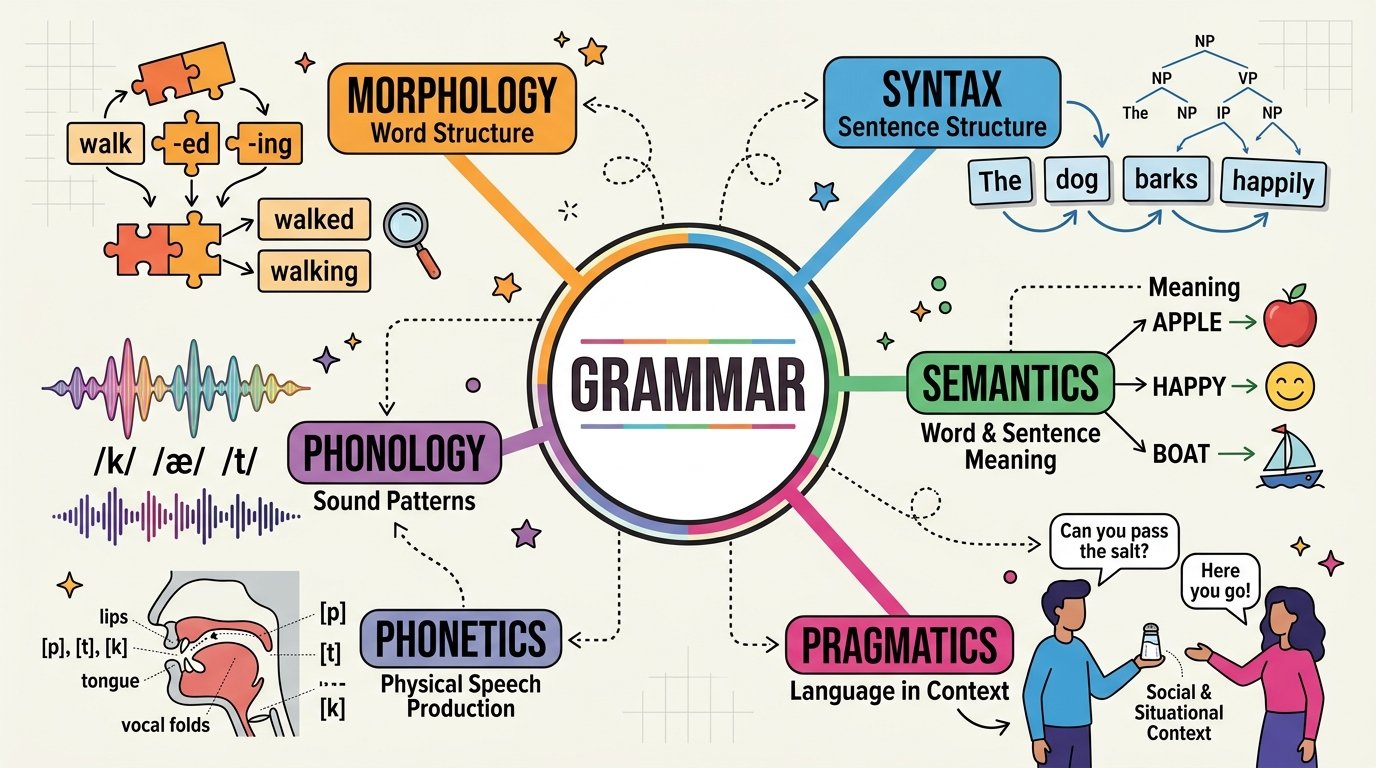
Short answer: grammar is the rule system that governs word forms and sentence building in a language, and the word also names the study and a book describing it.
- The system: the rules for changing word forms and joining words into sentences.
- The study: the branch of learning that describes those rules.
- The book: a description of the rules, as in a French grammar.
- The usage: a person’s grammar, judged good or bad against the standard.
- The principles: the grammar of any craft, as in a grammar of the theater.
One countability note belongs here: the system and the usage are uncountable, the book and the theory countable, a split the senses section teaches properly.
The Definition: What Grammar Means
Short answer: grammar is the set of rules for how words change their form and how they combine into sentences. Every major dictionary agrees on that core.
The Core Definition
The Oxford Learner’s Dictionary puts the core in one sentence: grammar is “the rules in a language for changing the form of words and joining them into sentences.” Both halves matter equally.
The Cambridge Dictionary prints the same core for learners: “the study or use of the rules about how words change their form and combine with other words to express meaning.”
Word forms changing is the first half: walk becomes walked, child becomes children. Words combining is the second half: the same words in a different order can reverse who did what to whom.
Merriam-Webster frames the study itself as its first sense: “the study of the classes of words, their inflections, and their functions and relations in the sentence.”
Grammar in Simple Words
Short answer: grammar is the set of language rules you already use without thinking, every time you build a sentence others understand.
Dictionary.com opens its usage essay with that point: grammar is “the set of language rules that you use, most of the time unconsciously, to create phrases and sentences that convey meaning.”
That is why a child still says “throw the ball to me” and never “ball the me to throw”: the system is learned by living in the language, and study later adds names for machinery you already run.
The Five Meanings of Grammar
Short answer: the word grammar does five jobs: it names the rule system, the study of it, a book describing it, a person’s judged usage, and the principles of any field.
The five jobs are a teaching synthesis of the dictionary record, labelled as such; each job names its dictionary strand.
|
Job |
The sense in plain words |
Countable? |
Example |
|---|---|---|---|
|
1 |
The rule system of a language |
Uncountable |
English grammar can be hard to master |
|
2 |
The study of that system |
Uncountable |
She studies grammar at university |
|
3 |
A book or description of the rules |
Countable |
A French grammar, the grammars of English and Japanese |
|
4 |
A person’s usage, judged against the rules |
Uncountable |
My grammar isn’t very good |
|
5 |
The principles of an art, science or technique |
Countable in use |
A grammar of the theater |
Sense 1: The Rule System of a Language
Short answer: the system itself, the characteristic pattern of inflections and syntax that makes English English and Japanese Japanese.
Merriam-Webster prints it as senses 2a and 2b: “the characteristic system of inflections and syntax of a language,” and “a system of rules that defines the grammatical structure of a language.”
The Humanities LibreTexts text states the same job structurally: the set of structural rules governing clauses, phrases and words in any natural language.
Unwritten languages have grammars in this sense too: the system exists wherever speakers change word forms and build sentences by shared patterns.
Sense 2: The Study of That System
Short answer: grammar is also the discipline that studies the system, the oldest sense in the record.
Merriam-Webster’s sense 1a is the study: the classes of words, their inflections, and their functions in the sentence. Its first known use, in the 14th century, carries this meaning.
The branches section divides it up: morphology takes word forms, syntax sentence building, wider strands more.
Sense 3: A Book or Description of the Rules
Short answer: a grammar can be a physical book or a written description. This is the countable job: one grammar, two grammars.
Oxford’s third sense is “a book containing a description of the rules of a language,” with the example a French grammar. Merriam-Webster’s sense 3a is simply “a grammar textbook.”
The Longman Dictionary draws the contrast in one line: “A dictionary lists the words, a grammar states the rules.” Longman bands the word S3 W3, top 3,000 in speech and writing.
A description is not the system itself: two grammars of English can disagree about a rule while describing the same system.
Sense 4: A Person’s Grammar, Judged Usage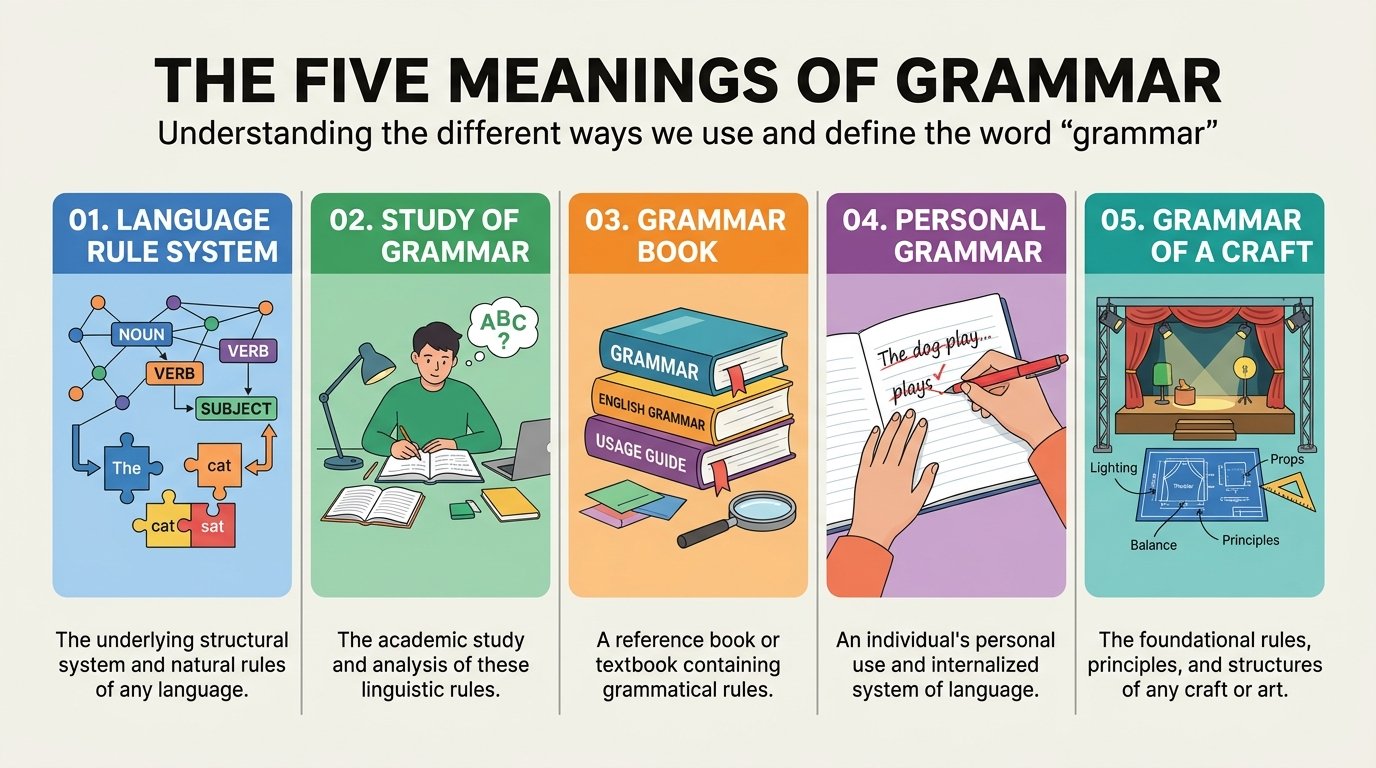
Short answer: your grammar is how your speaking and writing measures up against the rules. This is the sense inside “good grammar,” “bad grammar” and “check your grammar.”
Merriam-Webster’s sense 3b is “speech or writing evaluated according to its conformity to grammatical rules,” and its own example is blunt: “Him and I went” is bad grammar.
Oxford’s second sense matches: “a person’s knowledge and use of a language,” uncountable, as in “I know some German, but my grammar isn’t very good.” The Collins COBUILD entry prints the same job in learner words.
Sense 5: The Grammar of Anything
Short answer: grammar also names the basic principles of any art, science or technique. A grammar of the theater is not about sentences at all; it is about the rules the craft runs on.
Merriam-Webster’s sense 4 is “the principles or rules of an art, science, or technique,” with the example a grammar of the theater.
Collins prints a job most learner pages miss: its fourth COBUILD sense makes a grammar a theory, “a particular theory that is intended to explain the rules of a language,” as in transformational grammars.
So a transformational grammar is not a textbook; it is one linguist’s model of the whole system, offered to be tested.
Countable or Uncountable? The Sense Decides
Short answer: grammar is uncountable for the system and a person’s usage, and countable for a book, a description or a theory. The sense chooses.
When Grammar Takes No Article
Use no article for the system and the usage: English grammar can be hard to master; my grammar isn’t very good. Oxford and Longman mark these senses uncountable.
The test is substitution: if “the rules” or “my usage” fits the slot, the sense is the system or the person, and no article belongs there.
When a Grammar Takes an Article and a Plural
Use a grammar for the book, the description and the theory: a French grammar on the desk, the grammars of English and Japanese compared, transformational grammars competing.
The matched frames make the split visible. “Grammar is hard” talks about the system, uncountable. “A grammar of English” talks about one description of it, countable.
Learners lose marks on this split because dictionaries bury it in entry furniture. Only Oxford labels it sense by sense, which is why this page teaches it as a meaning fact.
The Branches of Grammar
Short answer: every source agrees on morphology and syntax as the core branches. Wider linguistics strands add phonology, semantics and pragmatics.
|
Branch |
What it studies |
One line example |
|---|---|---|
|
Morphology |
How words are built and how their forms change |
Walk, walks, walked, walking are one word in four forms |
|
Syntax |
How words join into phrases, clauses and sentences |
The dog chased the cat says who chased whom |
|
Phonology |
The sound system of a language |
English hears the difference between pat and bat |
|
Semantics |
Meaning in words and sentences |
A bachelor is unmarried by definition |
|
Pragmatics |
Meaning in context, beyond the literal words |
“Can you pass the salt?” is a request, not a question about ability |
|
Phonetics (companion) |
The physical sounds of speech themselves |
How the tongue and lips actually produce a t sound |
The table carries six rows because the broad strands do; the scope note explains why other lists stop at two.
Morphology: The Grammar of Word Forms
Short answer: morphology studies morphemes, the smallest meaningful parts of words, and the rules that build words and change their forms for tense, number and case.
Walk plus ed makes walked; un plus happy plus ness makes unhappiness. Cummings defines the field through morphemes; Springer pairs it with syntax as the framework.
Inflection lives here: past tense, plurals and comparisons are grammar at the word level.
Syntax: The Grammar of Sentence Building
Short answer: syntax studies word order and arrangement: how words combine into phrases and clauses, and how the arrangement itself carries meaning that the words alone do not.
The classic demonstration needs one swap: “She appreciates all his many talents” is grammatical; “She appreciates his many all talents” is not, and only the order changed.
EBSCO notes the trap: everyday use associates grammar with syntax alone, but syntax is one branch inside grammar.
Phonology: The Sound System Strand
Short answer: phonology studies the sound system of a language, which sounds contrast and how they pattern. Broad definitions include it; restricted ones leave it out.
Encyclopaedia Britannica lists the features a grammar describes as phonology (sound), morphology (word formation), syntax (word arrangement) and semantics (meaning): the four feature strand.
EBSCO counts three subsystems: syntax, morphology and phonology. Phonetics rides as a companion, not a branch.
Semantics and Pragmatics: The Meaning Strands
Short answer: semantics studies meaning itself, in words and sentences; pragmatics studies meaning in context, what speakers do with sentences beyond the literal words.
The Wikipedia grammar article prints the widest strand: phonology, morphology and syntax, together with phonetics, semantics and pragmatics.
Collins American adds the same pair cautiously: morphology and syntax, and now often phonology and semantics. The caution is the strand difference, printed rather than hidden.
The Scope Note: Why Some Lists Stop at Two Branches
Short answer: traditional and restricted definitions cover morphology and syntax only. Britannica’s restricted sense excludes vocabulary and pronunciation, keeps exactly those two, and says so openly.
Cummings agrees: for most linguists, grammar is two disciplines, morphology and syntax. Springer prints the same pair.
So the honest answer is two core branches, three extended ones, source named each time. Six as uncontested, or two as complete, hides half the record.
Types of Grammar
Short answer: the pair learners actually meet is descriptive versus prescriptive: describing how the language is used, against prescribing how the standard says to use it.
|
Type |
What it does |
Who uses it |
|---|---|---|
|
Descriptive |
Records how speakers actually use the language, without judging |
Linguists, dictionary makers |
|
Prescriptive |
Lays down rules for correct usage against a standard |
Teachers, editors, style guides |
|
Traditional |
The school tradition: parts of speech, parsing, sentence analysis |
Classrooms for centuries |
|
Theoretical |
Builds explicit theories of the rule system |
Linguists |
|
Generative |
A rule device that generates every permissible sentence and no impermissible one |
Linguists, after Chomsky |
Descriptive Grammar: How the Language Is Used
Short answer: descriptive grammar observes and records real usage. If native speakers consistently say a form, it writes the form down and studies its pattern, without calling it wrong.
Britannica’s conceptions passage names the three approaches: prescriptive, descriptive, generative. Description is the evidence gathering half.
Here the native speaker point lands: Britannica calls one contemporary definition the structure any native speaker knows intuitively; descriptive work makes it explicit.
Prescriptive Grammar: How the Standard Says to Use It
Short answer: prescriptive grammar sets the standard and judges usage against it. It is the grammar of the classroom rule, the style guide and the exam mark scheme.
Dictionary.com prints “prescriptive grammar” as American sense 5, a bare cross reference, then covers it in sense 6: usage of the preferred or prescribed forms.
Prescription is not villainy: shared standards make formal writing portable, and every learner asking about correct English is asking a prescriptive question.
Descriptive Versus Prescriptive, in One Sentence Pair
Short answer: take one sentence and watch the two grammars work. “Me and Jake went to the match” is the test case.
The descriptive grammarian records it: coordinate subjects commonly appear as me and Jake in informal speech, in a stable pattern speakers follow without instruction. Data first, judgment withheld.
The prescriptive grammarian judges it: the standard requires “Jake and I went,” and Merriam-Webster’s example makes the same call when it labels “Him and I went” bad grammar.
Neither answer cancels the other. Description tells you what the language does; prescription tells you what formal writing expects, and a good learner holds both.
Traditional and Theoretical Grammar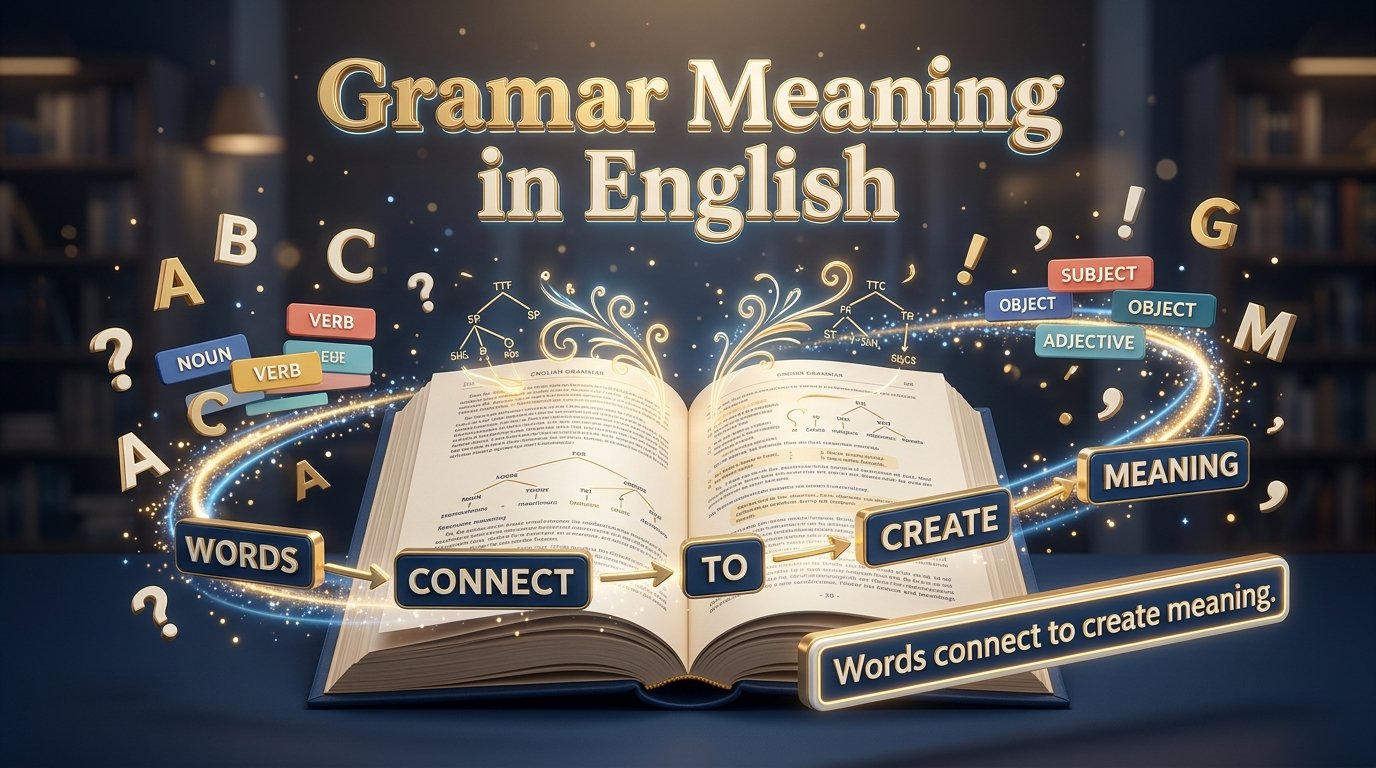
Short answer: Wikipedia’s framing splits the study two ways: traditional grammar, the school tradition of parts of speech and parsing, and theoretical grammar, the linguistics tradition building explicit theories.
Traditional grammar is the inventory below: eight parts of speech, subject and predicate, parsing, the form most adults met at school.
Theoretical grammar asks a deeper question: what rule system, stated exactly, would generate every sentence a native speaker accepts and none they reject?
Generative and Universal Grammar, in Brief
Short answer: a generative grammar is a formal device whose output is all the permissible sentences of a language and none of the impermissible ones, in Dictionary.com’s fourth American sense.
Behind it stands Noam Chomsky, whose work asked how speakers produce sentences never heard before: rules with infinite reach from finite means.
Universal grammar is the hypothesis behind that work: children are born with an inborn concept of grammar, a template every language fits. Oxford cross references the term from its entry.
A third name completes the picture: ThoughtCo notes that teachers follow pedagogical grammar with language learners, the system repackaged in learnable order.
Grammar and Its Neighbours
Short answer: grammar borders four neighbours it is confused with: syntax, spelling, punctuation and vocabulary. Three are not parts of grammar at all; the fourth is a branch inside it.
|
Neighbour |
Inside grammar? |
The boundary |
|---|---|---|
|
Syntax |
Yes, a branch |
Syntax is the sentence building part of grammar, not a synonym for the whole |
|
Spelling (orthography) |
No |
Spelling is the convention for writing words down; grammar is the system the words obey |
|
Punctuation |
No |
Punctuation marks writing; it belongs with orthography, the written conventions |
|
Vocabulary (lexis) |
No |
Vocabulary is the stock of words; grammar is the rules that combine them |
Grammar Versus Syntax
Short answer: syntax is one branch inside grammar, the word arrangement branch. Grammar is the whole system; syntax is its sentence building part.
Morphology is the standing counterexample: choosing walked over walk is grammar with no sentence building involved, a word form decision syntax never touches.
Grammar Versus Spelling
Short answer: spelling, whose technical name is orthography, is the convention for writing a language down. Grammar is the system itself, and it exists in speech before any writing.
Wikipedia states the boundary inside its definition: outside linguistics, grammar is often used broadly to include spelling and punctuation, which are not typically considered part of grammar by linguists.
The proof is one sentence long: flawless grammar and poor spelling can share a paragraph, because the two systems are learned separately and fail separately.
Grammar Versus Punctuation
Short answer: punctuation is not part of grammar. Commas, full stops and apostrophes are marks of the writing system, conventions of orthography.
Some school pages list punctuation among grammar’s components, folding it into rules lists and definitions. That fold in crosses the boundary the linguistics sources state.
Punctuation still matters: it supports grammar by showing where clauses end. Support is not membership: the boundary is syntax, not the mark.
Grammar Versus Vocabulary
Short answer: vocabulary is the stock of words a language or a person commands; grammar is the system that changes those words’ forms and combines them. Different possessions, both needed.
Cambridge’s own example runs on this contrast: “She memorized the vocabulary but is having trouble with the grammar.” It only makes sense because the two are separate things to learn.
Britannica’s restricted sense draws the same line, excluding vocabulary from grammar’s domain. Words are the bricks; grammar is the mortar and the building plan.
The Working Inventory: Parts of Speech
Short answer: traditional grammar sorts words into eight classes, the parts of speech, with determiners a modern ninth. This page lists the inventory and teaches none of it.
|
Class |
Job in one line |
Example |
|---|---|---|
|
Noun |
Names a person, place, thing or idea |
Teacher, city, freedom |
|
Pronoun |
Stands in for a noun |
She, it, they |
|
Verb |
Names an action, event or state |
Run, become, is |
|
Adjective |
Describes a noun |
Quiet, tall, first |
|
Adverb |
Modifies a verb, adjective or other adverb |
Slowly, very, often |
|
Preposition |
Relates a noun to the rest of the sentence |
In, under, before |
|
Conjunction |
Joins words, phrases or clauses |
And, but, because |
|
Interjection |
A sudden expression standing alone |
Oh, wow, ouch |
The Eight Classes and the Determiner Note
The eight above are the traditional inventory, taught for centuries. Each class is a job description, not a meaning label.
Modern strands add determiners as a ninth class: the, a, this and some, once filed under adjectives. Either count is defensible, if stated.
The classes matter because every rule is stated over them: agreement rules name verbs and subjects, order rules name adjectives and nouns.
Grammar at Work: The Example Bank
Short answer: grammar becomes visible when one lever moves at a time. Each pair below changes exactly one thing, word order, agreement, word form or question shape, and shows the meaning move with it.
Word Order Pairs
Pair one: “The dog chased the cat” against “The cat chased the dog.” Same words, same forms, opposite events. English carries the who did what almost entirely in the order.
Pair two: “Only she lent him the car” against “She lent him only the car.” Moving one small word shifts what the sentence limits, the lender or the thing lent.
Agreement Pairs
Pair one: “She walks to work” against “She walk to work.” The second breaks subject verb agreement: a third person singular subject takes the s form in the present tense.
Pair two: “The dogs bark” against “The dog bark.” Number agreement runs both ways across the pair, and the ear catches the error before any rule is named.
Word Form Pairs
Pair one: “I saw him” against “I saw he.” The pronoun changes form for its job in the sentence, subject form before the verb, object form after it. That is inflection doing case work.
Pair two: “One child plays” against “Two children play.” Plural formation changes the noun, child to children, and the verb answers by dropping its s. Two forms move together, or the sentence breaks.
Question Form Pairs
Pair one: “You are coming” against “Are you coming?” English builds many questions by inverting the subject and the auxiliary verb, a pure syntax move with no new words.
Pair two: “She left early” against “Did she leave early?” Where no auxiliary exists, English supplies did and returns the main verb to its base form, leave, a two part change learners must run as one.
The Grammatical but Meaningless Sentence
Short answer: a sentence can obey every rule and still mean nothing. The linguist Noam Chomsky built the famous demonstration: “Colorless green ideas sleep furiously.”
Every word sits in a legal slot: adjective, adjective, noun, verb, adverb, in perfect order with agreement intact. The sentence is grammatical and empty, because grammar governs form, not sense.
That single example separates two ideas learners merge. Grammatical means built according to the system; meaningful means the system was used to say something. The meaning of grammar is the first of those.
Good Grammar and Bad Grammar: The Usage Sense in Real Life
Short answer: in everyday speech, grammar usually means sense 4, a person’s usage judged against the standard. “Good grammar” and “bad grammar” are verdicts, not names of systems.
The verdicts run on visible levers: agreement, pronoun case, verb forms, sentence completeness. “Him and I went” fails on case, which is why Merriam-Webster chose it.
Steven Pinker, quoted by ThoughtCo, warns that a preschooler’s tacit knowledge of grammar is more sophisticated than the thickest style manual, and is not guidelines for how one ought to speak.
David Crystal defines the study from the meaning side: grammar is “the study of all the contrasts of meaning that it is possible to make within sentences.”
So “check your grammar” asks for one job: compare the draft against the standard forms and fix the slips.
Where the Word Grammar Comes From
Grammar descends from the Greek word gramma, “letter of the alphabet,” a thing written. The art built on letters was grammatike (techne), the “(art) of letters,” and Latin took the word over as grammatica, the study of literature and language.
Old French carried it as gramaire; Middle English borrowed it from French. Merriam-Webster dates the first known use to the 14th century, in the sense “the study of the classes of words.” The study sense came first; the rest grew from it.
One root about letters grew into the name of the whole rule system. A companion page settles the separate spelling question, since the word is spelled with a double M and an -ar ending: the grammar vs grammer correct spelling page joins this rail as a link once it is published, and owns the spelling verdict and the full etymology, while this page owns the meaning.
The MagazineSolo Meaning Rail
Short answer: this page sits on a rail of meaning and spelling verdicts. Each page owns one word and one question, and the pages link to each other.
The what does literally mean page settles the cluster’s most argued word, where two opposite senses now share one spelling.
The what does irony mean page separates irony from coincidence and bad luck. Its method, senses separated and exemplified, is the method used here.
The spelling rail stands beside it. The definitely spelling page settles the word writers mangle into definately, and the occurrence spelling page teaches a stress rule beside a Latin inheritance.
Two more verdicts complete the set. The necessary spelling page teaches a pure memory word, and the separate spelling rule page settles separate by its root, par.
More definitions and verdicts live on MagazineSolo, where each word is added with its senses separated, its sources named and its boundaries drawn.
Frequently Asked Questions
What does grammar mean in English?
Grammar means the system of rules a language uses to change the forms of words and join them into sentences. The word also names the study of that system, a book describing it, and a person’s usage judged against it.
What is grammar in simple words?
Grammar is the set of language rules you use without thinking whenever you speak or write. Dictionary.com puts it plainly: rules you use, most of the time unconsciously, to create phrases and sentences that convey meaning.
What is the definition of grammar?
The core definition, shared by Oxford and Cambridge, is the rules for changing the form of words and joining them into sentences. Merriam-Webster adds the study sense first: the study of the classes of words, their inflections and their relations.
What are the five meanings of grammar?
The rule system of a language; the study of that system; a book or description of the rules; a person’s usage judged against the rules; and the principles of any field, as in a grammar of the theater.
What is an example of grammar in a sentence?
“The dog chased the cat” shows grammar at work: the word order alone says who chased whom. Reverse the order and the meaning reverses, with every word unchanged. That invisible machinery is grammar in its first sense.
Is grammar countable or uncountable?
Both, by sense. The system and a person’s usage are uncountable: English grammar, my grammar. The book, the description and the theory are countable: a French grammar, the grammars of English and Japanese, transformational grammars.
What is the plural of grammar?
Grammars, a regular s plural belonging to the countable senses only. Scholars compare the grammars of two languages, and a shelf can hold three grammars of English, but nobody pluralises the rule system itself.
When do you say “a grammar” instead of “grammar”?
Say a grammar when you mean one book, one description or one theory: a grammar of English, an advanced English grammar. Say grammar with no article for the system itself and for a person’s usage.
What are the branches of grammar?
The core branches every source names are morphology and syntax. Broader linguistics strands add phonology, semantics and pragmatics, with phonetics as a companion. Which list is right depends on the scope the source declares.
What is morphology in grammar?
Morphology is the branch that studies how words are built and how their forms change. Its units are morphemes, the smallest meaningful parts: walk plus ed, un plus happy plus ness, child becoming children.
What is syntax in grammar?
Syntax is the branch that studies how words join into phrases, clauses and sentences, and how arrangement carries meaning. It is the largest branch of grammar, but only one branch inside it, not the whole subject.
What is the difference between morphology and syntax?
Morphology works inside the word: forms, endings, building blocks. Syntax works between words: order, phrases, clauses, whole sentences. Walked is a morphology fact; putting walked after the subject is a syntax fact.
Is phonology part of grammar?
In the broad strands, yes. Britannica lists phonology, the sound system, among the features a grammar describes, and EBSCO counts it as one of three subsystems. Restricted definitions stop at morphology and syntax and leave it out.
Is semantics part of grammar?
In the broad strands, yes. Britannica includes semantics, meaning, among grammar’s features, and Collins American notes the study now often adds word meanings. The restricted tradition excludes it, so the answer follows the source’s declared scope.
What is pragmatics in grammar?
Pragmatics studies meaning in context: what speakers do with sentences beyond their literal content. “Can you pass the salt?” is literally a question about ability and actually a request. Wikipedia’s widest strand counts it inside grammar’s study.
Why do some definitions say grammar is only morphology and syntax?
Because they use the restricted sense. Britannica states it openly: in a restricted sense the term refers only to sentence and word structure, syntax and morphology, excluding vocabulary and pronunciation. Traditional teaching inherited that narrower frame.
What is descriptive grammar?
Descriptive grammar records how a language is actually used by its speakers, without imposing judgments about correctness. It gathers evidence first: if speakers consistently follow a pattern, the pattern is described and studied.
What is prescriptive grammar?
Prescriptive grammar lays down rules for correct usage against an established standard. It is the grammar of classroom rules, style guides and exam marking, and it is what most people mean by grammar rules.
What is the difference between descriptive and prescriptive grammar?
Description says what speakers do; prescription says what the standard expects. “Me and Jake went” is recorded by the first and corrected to “Jake and I went” by the second. Both answers can be true at once.
What is traditional grammar?
Traditional grammar is the school tradition: the eight parts of speech, subject and predicate, parsing sentences into their pieces. It is the form of grammar most adults met in the classroom, and the frame the inventory table uses.
What is theoretical grammar?
Theoretical grammar is the linguistics tradition that builds explicit theories of the rule system. It asks what exact set of rules would generate every sentence a native speaker accepts, and none that they reject.
What is generative grammar?
A generative grammar is a formal device: a body of rules whose output is all the permissible sentences of a language, while excluding all those that are not permissible. Dictionary.com prints that definition as its fourth American sense.
What is universal grammar?
Universal grammar is the hypothesis that children are born with an inborn concept of grammar, a template every human language fits. It stands behind generative work on language acquisition, and Oxford cross references it from the grammar entry.
What is the difference between grammar and syntax?
Syntax is one branch inside grammar, the sentence building part. Grammar is the whole system, including morphology, where word forms change with no sentence building involved. The everyday habit of using grammar to mean syntax alone is too narrow.
Is spelling part of grammar?
No. Spelling, technically orthography, is the convention for writing words down. Wikipedia states the boundary inside its definition: spelling and punctuation are not typically considered part of grammar by linguists, however often everyday speech bundles them together.
Is punctuation part of grammar?
No. Punctuation belongs to orthography, the written conventions of a language. Commas and full stops can display grammar’s boundaries, but the boundaries themselves are syntax. Pages listing punctuation as a grammar component cross the line the sources draw.
What is the difference between grammar and vocabulary?
Vocabulary is the stock of words; grammar is the system that changes and combines them. Cambridge’s example runs on the contrast: she memorized the vocabulary but is having trouble with the grammar. Two possessions, learned separately.
What are the parts of speech in English grammar?
The traditional eight: nouns, pronouns, verbs, adjectives, adverbs, prepositions, conjunctions and interjections. Modern strands add determiners as a ninth class, for words like the, a and this, which the older frame filed under adjectives.
How many parts of speech are there in English?
Eight in the traditional inventory, nine in the modern strand that counts determiners separately. Both counts circulate honestly; a page should say which count it is using, the way the inventory section above does.
What does “good grammar” mean?
It means the speaker’s or writer’s usage matches the standard forms: agreement holds, pronoun case is right, verb forms are correct. It is sense 4 of the word, a verdict on a person’s usage, not a property of the language.
What does “bad grammar” mean?
It means usage that breaks the standard rules in visible places. Merriam-Webster’s own example is “Him and I went,” labelled bad grammar because the pronoun case fails: the standard form is “He and I went.”
What does it mean when someone says “check your grammar”?
It is an instruction to compare a draft against the standard forms and fix the slips: agreement, case, verb forms, sentence completeness. It uses the usage sense of the word, and it never questions whether the language has a system.
What is a grammar book?
A grammar book is sense 3 made physical: a book that describes the rules of a language, as in an advanced English grammar or a French grammar. Longman’s contrast line sums it up: a dictionary lists the words, a grammar states the rules.
What does “a grammar of English” mean?
It means one description of the English system: a book or an account that states the rules of English grammar. The article and the of phrase mark the countable sense, one description among the several that scholars have written.
What does “the grammar of the theater” mean?
It is Merriam-Webster’s example of sense 5: the principles or rules of an art, science or technique. The grammar of the theater is the set of conventions the craft runs on, not anything about sentences.
Where does the word grammar come from?
From Greek gramma, “letter of the alphabet,” through grammatike, “(art) of letters,” into Latin grammatica and Old French gramaire, then Middle English. The full verified chain is set out in the origin section above.
What does the Greek word gramma mean?
A letter of the alphabet, a thing written. It is the root inside grammar, and the art built on it, grammatike techne, meant the art of letters before the word widened into the name of the whole rule system.
When was the word grammar first used in English?
Merriam-Webster dates the first known use to the 14th century, in the sense “the study of the classes of words.” That study sense is historically first, which is why historical dictionaries list it before the system sense.
How do you pronounce grammar?
In American English, /ˈɡræmər/; in British English, /ˈɡræmə(r)/. The stress falls on the first syllable in both, and the second syllable shrinks to the flat schwa sound, which is why the ending gives spellers no clue.
Why is grammar important?
Because grammar is the machinery of meaning in sentences: it decides who did what, when, and under what conditions. Without shared rules for word forms and order, sentences collapse into word lists that every listener must guess at.
Does every language have grammar?
Yes. Every language changes word forms and builds sentences by shared patterns its speakers learn, whether or not the language is written down or its rules are ever printed. Britannica’s definition covers the sounds, words and sentences of any language.
Can a sentence be grammatical but meaningless?
Yes. Chomsky’s demonstration, “Colorless green ideas sleep furiously,” obeys every rule of form and means nothing. Grammatical means built according to the system; it never promises sense. That gap is the clearest proof of what grammar actually is.
Conclusion
Grammar meaning in English resolves into one word doing five jobs: the rule system, its study, a book describing it, a person’s judged usage, and the principles of any craft. Hold the five apart and every dictionary entry reads cleanly.
The boundaries hold the same way. Morphology and syntax are the core branches, spelling and punctuation sit outside with orthography, and grammar meaning in English is finally about how words change and combine, machinery every speaker already runs.

Dilawar is a content writer at MagazineSolo, covering travel, home improvement, interior design, and everyday lifestyle topics. He enjoys researching practical solutions, exploring travel destinations, and sharing helpful guides that make daily life easier. His writing focuses on clear information, useful advice, and engaging stories for a wide audience.