All Together vs Altogether: The Difference, the Three Tests and the Overlap
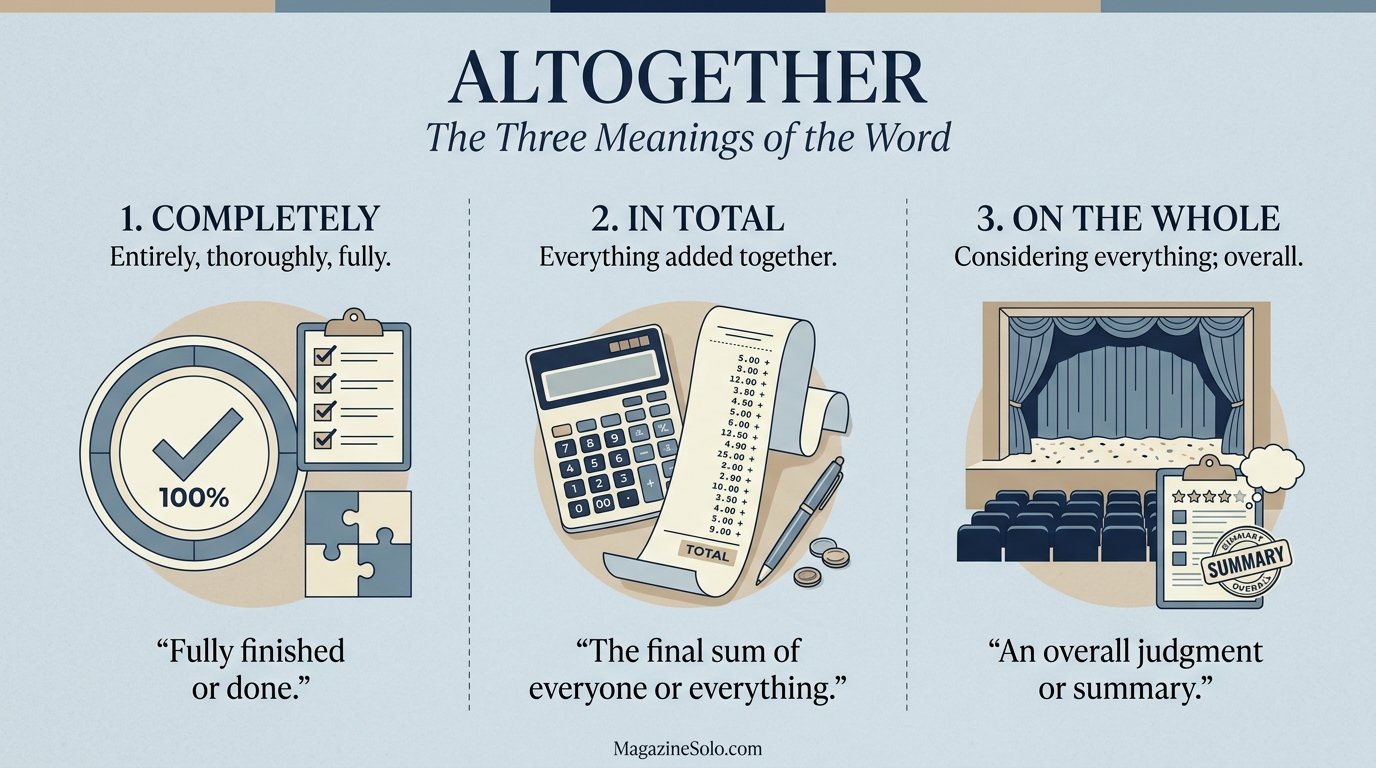
All together vs altogether is a choice between a group acting as one and a degree, a total, or a summary. Write all together when people or things are gathered, in one place, or acting at the same time, because those two words can be split apart. Write altogether when the meaning is completely, in total, or on the whole, because that one word never splits.
The two forms sound identical, so nothing in speech tells you where the space belongs. The one word form was also fused from the two word phrase centuries ago, which is why the meanings feel related. The checks below are written tests, not listening rules, and they settle every sentence in seconds.
The Quick Answer and the Base Rule
The base rule sorts by meaning, not spelling preference. If a group is gathering or acting together, the answer is two words. If something is entire, totalled, or summed up, the answer is one word.
|
Form |
Word class |
Core meaning |
Test result |
|---|---|---|---|
|
All together |
Two word phrase: quantifier all plus the adverb together |
Everyone or everything in a group, in one place, or at the same time |
Splits apart; all can be dropped |
|
Altogether |
One word adverb |
Completely; in total; on the whole |
Never splits; nothing drops out |
The Blue Book of Grammar reduces the pair to one short ruling for each form, and the major dictionaries draw the same line. Merriam-Webster, Cambridge and Oxford all separate the forms by what the sentence means. When in doubt, run the three tests in the order taught below.
All Together: The Group Phrase
All together is the quantifier all plus the adverb together, doing two separate jobs in one phrase. It says that every member of a set is in one place, gathered, or acting at the same moment. Because the words are separate items, other words can stand between them.
In One Place: Gathered and Assembled
The home reading is physical assembly. The children were all together in the kitchen means every child was in the room at once. A caption reading the whole team all together at last reports the same fact: the group, complete, in one place.
Oxford’s learner entry models the phrase with objects, not just people. Its Which Word box for altogether gives the example of putting your books all together in one box. Anything that can be gathered into one spot can be all together.
At the Same Time: Acting in Unison
The phrase also covers simultaneous action. A choir that comes in all together starts on the same beat, as one body. The conductor’s call, all together now, asks for exactly that: everyone, at the same moment.
Unison is the classic trap, because a group acting as one feels like a single fused act. It is still group action, so it still takes two words. The split test proves it: all of you, together, now still makes sense.
Things Gather Too
People are not the only things that assemble. Files sit all together on a desk, ingredients mix all together in a bowl, and parts stay all together in one bag. If the sentence is about items ending up in one place, the phrase is the right tool.
Split in the Wild
Real sentences split the phrase constantly. Writers produce all the pieces together, they all came together, and all of us together without noticing the gap. The American Heritage usage note states the rule behind this: the phrase is used only where all and together can be separated by other words.
That separability is the phrase’s fingerprint. If your sentence happily accepts words in the middle, you are looking at two words doing two jobs. No such gap exists inside the one word adverb, as the next section shows.
Altogether: The One Word Adverb
Altogether is a single adverb with three main senses, and keeping them separate prevents most errors. It can grade something as completely so, state a total, or sum up a whole situation. Vocabulary.com’s entry for altogether lists the three adverb senses side by side, which is the cleanest map of the word.
Completely: The Degree Sense
Before an adjective or after a verb, altogether works as a degree adverb meaning completely or entirely. An altogether different plan is different in every respect. When the rain stopped altogether, it did not ease off; it ended.
The substitution check proves this sense in one step. Replace the word with completely and reread: a completely different plan keeps the meaning exactly. Cambridge’s example of a tax abolished altogether works the same way, because abolition is total or it is nothing.
In Total: The Summing Sense
Altogether also means in all, or all told, and this is the sense that appears on bills and headcounts. Merriam-Webster’s example has someone spending a hundred dollars altogether. Oxford’s model invites fifty people altogether to an event.
A total is a sum, not a gathering, so it always takes the one word form. Writing a total with two words would describe the numbers assembled in a group, which is not what an invoice means. The overlap section below gives this boundary its own decision table.
On the Whole: The Sentence Adverb
At the front of a sentence, altogether becomes a sentence adverb commenting on the whole statement. Altogether, it was a great evening does not describe how anything was done. It sums up everything before it, like on the whole or all in all.
This use is normally set off with a comma, because the comma marks the word as a comment on the sentence. Degree and total uses inside a sentence take no comma. Position and punctuation together are a reliable signal of which sense is working.
Not Altogether: The Softened Negative
In not altogether sure or not altogether happy, the word softens the negative instead of strengthening it. The speaker is partly, not completely, sure. Collins singles this pattern out: altogether modifying a negative statement makes it less forceful.
Not entirely works the same way, and not altogether is its slightly more formal twin. This is the one place where altogether reduces a claim rather than completing it. It still never splits, because no group is involved.
In the Altogether: The Noun Sense, Labelled
One short passage covers the sense most pages skip. In the altogether is an informal noun phrase meaning naked, with no clothes on. Merriam-Webster lists the noun as informal and dates its first known use to 1893, and Cambridge labels it old fashioned.
The origin comes in strands, not one agreed story. Paul Brians suggests it is perhaps a shortening of altogether naked, while a separate strand credits the 1894 novel Trilby with popularising the sense. Treat it as a real but dated, humorous sense, kept out of formal writing.
The Three Tests That Settle Every Sentence
One tip is not enough for this pair, because each test catches cases the others miss. Run them in order: split first, removal second, meaning last. Together they cover every sense the dictionaries list, including totals, sentence openers, and softened negatives.
Test 1: The Split Test
Try to put other words between all and together. If the sentence survives, the form is the phrase: they all came together, put all the files together, all of us together. Separate items accept company between them.
Altogether can never be split this way. There is no sentence like all the decision together meaning completely, because the fused word has no inside. If your sentence wants words in the middle, it wants two words.
Test 2: The Removal Test
Delete all and reread the sentence. If together still carries the meaning, the original was the phrase: the children were all together in the kitchen becomes the children were together in the kitchen. That is exactly the example in the Collins usage note.
The test fails cleanly on the adverb. Not altogether sure cannot become not together sure, because there is no separate all to remove. Droppability works because all is an optional quantifier in the phrase, and nothing in altogether is optional.
Test 3: The Meaning Test
Ask what job the word is doing. Group or simultaneity points to two words: gathering, assembling, singing as one. Degree, total, or summary points to one word: completely, in all, on the whole.
Each sense also has its own substitute. Use in a group for the phrase, completely for degree, in total for sums, and on the whole for summaries. If one substitute fits and the others fail, the meaning test has your answer.
|
Test |
How to run it |
What a pass means |
Worked example |
|---|---|---|---|
|
Split test |
Insert words between all and together |
The sentence survives, so two words |
All the pieces together |
|
Removal test |
Delete all and reread |
Together still carries the meaning, so two words |
The children were together in the kitchen |
|
Meaning test |
Ask group or degree |
Group takes two words; completely, total or whole takes one word |
Thirty people altogether, a count |
The Summing Overlap: Counting vs Gathering
The two meanings genuinely approach each other in one place only: numbers of people. A sentence about thirty people can be counting them or gathering them, and each job takes a different form. This is the overlap most pages show by example but never turn into a decision procedure.
|
The job the sentence does |
Form |
Example |
|---|---|---|
|
Counting: reporting a total number |
Altogether |
There were 30 people altogether. |
|
Gathering: reporting people assembled in one place |
All together |
There were 30 people all together in the hall. |
|
Totalling money |
Altogether |
It came to 52.50 altogether. |
|
Physically combining items |
All together |
Put the receipts all together in one envelope. |
Choose by the job first, then confirm with the split test. The gathering version splits happily: thirty people, all of them, together in the hall. The counting version refuses, because a total has no group inside it to spread apart.
Invoices, attendance figures, and headcounts all take altogether, because they report sums. Group photos, seating plans, and rehearsal directions take all together, because they report assembly. When a sentence could do either job, decide which fact you are actually reporting before you spell it.
Position and Punctuation: Where Each Form Sits
Position is a quiet clue to the sense at work. The summing and degree senses of altogether prefer the end of a clause or the spot just before an adjective. The summary sense prefers the front, where a comment on the whole sentence belongs.
The phrase behaves differently, because it follows the group it describes. All together usually sits after the verb or at the end of the clause, attached to the people or things assembled. When it opens a sentence, as in all together, they answered, it still reports the group acting, not a summary.
Punctuation follows the same split. A front position altogether in the summary sense takes a comma after it, marking the comment off from the statement. No other use of either form needs a comma of its own, and totals inside a sentence take none.
Register adds one last signal. The adverb altogether is neutral to slightly formal, at home in reports, reviews, and edited prose. The phrase is neutral everywhere, and only the noun sense, in the altogether, carries an informal, old fashioned flavour.
Minimal Pairs: Same Sentence, Two Meanings
Worked pairs teach faster than rules alone. In each pair below, only the spelling changes, and the meaning moves with it. Read the gloss after each sentence to see which test does the work.
- The family was all together at last. The family had finally gathered in one place. Split test: all six of them, together, works.
- The family was altogether delighted. The family was completely delighted. Meaning test: altogether grades the adjective delighted.
- The whole office stopped all together at noon. Everyone stopped at the same moment, as a group. Removal test: they stopped together still works.
- The practice stopped altogether last year. The practice ended completely and for good. Substitute completely and the meaning holds.
- There were 30 people altogether. A count: thirty in total, wherever they were standing. Summing sense, one word.
- There were 30 people all together in the hall. The same thirty, assembled in one room. Gathering sense, two words.
- Keep the pieces all together in one bag. Physically combine the parts in a single place. Split test: all the pieces together.
- The set costs forty dollars altogether. The total price, everything included. Substitute in total and nothing changes.
- Altogether, it was a great success. A summary judgement on the whole event, set off by a comma. Sentence adverb, front position.
- All together, they answered. The group replied in unison, at the same time. Group action, even at the front of the sentence.
- I am not altogether convinced. I am partly, not completely, convinced. The softened negative takes the adverb.
- We were not all together until six. Not everyone had arrived before six. A gathering report takes the phrase.
- They were all together in the garden, and altogether delighted to be there. Both forms in one sentence, each doing its own job. The first gathers the group; the second grades the delight.
Common Errors and How to Catch Them
Most errors with this pair are meaning errors wearing a spelling costume. The wrong form rarely looks wrong, because both spellings are real English. The gallery below grades the common failures by what they cost the reader.
Writing Altogether for a Group
The classic error claims a group was complete when the writer meant it was assembled. A caption or rehearsal note with altogether tells the reader the wrong fact. Even large grammar sites have contradicted their own worked examples on this pair, which is why examples must be checked, not copied.
Cambridge prints the model failure openly: Put your clothes altogether in one pile is given as the wrong version. The Cambridge Grammar ruling on altogether or all together corrects it to the two word phrase, because clothes are being gathered, not graded. Run the split test on any group sentence before trusting it.
Writing All Together for a Total
The reverse error turns a sum into a gathering. A total line reading all together tells the reader the money assembled somewhere. Totals on invoices, expense reports, and attendance figures always take altogether, the summing sense.
Headcounts fail the same way. How many people were there altogether asks for the summed number, all told. Asking it with two words would ask how many were standing in one place, a different question with a different answer.
The Misspelling Alltogether
Alltogether, with a doubled t and no space, is not a variant and not an informal option. It is simply a misspelling, and no dictionary lists it. The real choice is only ever between the two word phrase and the one word adverb.
A related slip is the hypercorrection: writers who learn that altogether exists start using it everywhere, because it looks more educated. It is not the fancier form of the phrase. It is a different word, and using it for a group is an error, not an upgrade.
Trusting the Spellchecker
No spellchecker can save you here, because both forms are correctly spelled words. The checker sees two valid spellings and stays silent. Autocorrect and dictation tools make the same blind spot worse by substituting the form they predict, not the meaning you intended.
The only reliable check is a meaning check: split, remove, or substitute, as the tests section teaches. Ten seconds of testing beats any tool on this pair. Keep your own error gallery of past slips, and the pattern in your writing becomes easy to spot.
The Cousin Pair: All Ready vs Already
A neighbouring confusion deserves one bridge, not a merged lesson. All ready means completely prepared, and already means by now or before a given time. The pair turns on the same pattern as this one: a fused adverb sitting beside an all phrase.
The traps differ, though. Already is a time word, while altogether is a degree and total word, so the meanings are never interchangeable. If prepared versus by now is your problem, work through all ready vs already on its own page, where its own tests live.
Where the Word Came From
The etymology arrives as two strands, and this page prints them side by side rather than merging them. Merriam-Webster and Collins give the origin as Middle English altogedere, built from al, all, plus togodere, together. On that strand, the adverb was in use before the 12th century.
Oxford’s learner entry phrases the origin differently, as an Old English composite of all and together. The disagreement is about the label for the same fusion, not about the modern rule. Both strands agree that a phrase wore down into one word, and the meanings drifted apart afterward.
One more strand explains the exceptions in old books. Some references list altogether as an archaic form of all together, from before the modern line hardened. That is history, not permission: in current edited English, group action is all together, and the dictionaries draw the line firmly.
Same Tests, Other Pairs
This pair belongs to a family of fused forms beside all phrases and lookalike pairs, and the same testing habit serves them all. Each page below runs its own checks, because each fused meaning drifted in its own direction.
- Adapt vs adopt sorts adjusting something from taking it as your own.
- Adverse vs averse separates hostile conditions from personal reluctance.
- Passed vs past keeps the verb form apart from the time and place word.
- Affect vs effect divides the usual verb from the usual noun.
Work one pair at a time and test, do not guess. The split, removal, and meaning checks on this page will not transfer word for word, but the discipline will. A writer who runs a test never has to relearn a rule from memory.
Frequently Asked Questions
What is the difference between all together and altogether?
All together is two words: a phrase meaning everyone or everything in a group, in one place, or acting at the same time. Altogether is one word: an adverb meaning completely, in total, or on the whole. If a group is gathering, write two words; if something is entire, totalled, or summarised, write one.
What does altogether mean?
Altogether is an adverb with three main senses in Merriam-Webster: completely or wholly, in all or all told, and on the whole. Collins and Oxford list the same three senses in the same shape. An altogether different problem, a hundred dollars altogether, and Altogether, a success cover the three.
What does all together mean?
All together is the quantifier all plus the adverb together. It means every member of a set is in one place, gathered, or acting at the same moment. Cambridge gives the restaurant exchange: Are you all together? Yes, can you do a table for five?
Is it all together or altogether in a group photo caption?
All together. A caption such as the whole team all together at last describes people gathered in one place, which is the phrase. Altogether would claim the team was completely or in total at last. Run the split test: the whole team, all six of them, together still works.
How does the split test work?
Try to put other words between all and together. If the sentence survives, the form is the phrase: they all came together, put all the files together. Altogether can never be split, because there is no sentence like all the decision together meaning completely. The American Heritage usage note states the separation rule outright.
How does the removal test work?
Delete all and reread. If together still carries the sentence, the original was the phrase: the children were all together in the kitchen becomes the children were together in the kitchen, the Collins example. If deleting breaks the meaning, as in not altogether sure, you had the one word adverb.
Which one means in total when you add numbers up?
Altogether. The summing sense belongs to the adverb: Merriam-Webster glosses it in all, all told, with the example of spending a hundred dollars altogether. Oxford’s model invites fifty people altogether. Writing a total with two words would describe the numbers gathered in a group, which is not a total.
Is it there were 30 people altogether, or all together?
Both spellings exist, and they report different facts. There were 30 people altogether gives the count: thirty in total. There were 30 people all together in the hall says the thirty were gathered in one place. Choose by the job the sentence is doing, counting or gathering.
What does in the altogether mean?
It is an informal noun use meaning naked, with no clothes on. Merriam-Webster lists the noun as informal and dates its first known use to 1893. Cambridge labels it old fashioned. It is a real dictionary sense, but it belongs in light, dated, or humorous contexts, not formal writing.
Where does the phrase in the altogether come from?
The sources give strands, not one agreed story. Merriam-Webster dates the noun to 1893. Paul Brians suggests it is perhaps a shortening of altogether naked. A further strand credits the 1894 novel Trilby with popularising the sense. This page prints all three as strands and asserts no single origin.
Can altogether start a sentence?
Yes, in its summary sense. Altogether, it was a great evening is the Oxford example, and Merriam-Webster gives Altogether, their efforts were successful. At the front of a sentence the word works as a sentence adverb commenting on the whole statement, and it is normally followed by a comma.
What is a sentence adverb, in Altogether, it was a success?
A sentence adverb modifies the whole sentence rather than one verb or adjective: it gives the speaker’s overall judgement. In Altogether, it was a success, the word sums up everything before it, like all in all or on the whole. Oxford lists this as a separate sense: used to introduce a summary.
Is not altogether the same as not entirely?
Nearly. In not altogether sure, the word softens the negative: the speaker is partly, not completely, sure. Collins singles this out as its own pattern, using altogether to modify a negative and make it less forceful. Not entirely works the same way; not altogether is the slightly more formal twin.
Can all together be split by other words?
Yes, and that is the surest sign you have the phrase. All the books together, they all sang together, all of the pieces together: in each case all and together do separate jobs, so other words can stand between them. Grammarly’s own examples make the same point with tickets put all together in a wallet.
Can altogether ever be split?
No. Altogether is one fused word, historically Middle English altogedere worn into a single adverb. There is no grammatical sentence that inserts words inside it. If your sentence wants words in the middle, it wants all together.
Is all together now one word or two?
Two. All together now is the conductor’s or teacher’s call for everyone to start at the same moment, a group acting in unison, which is the phrase. Oxford’s Which Word box uses exactly this example with a birthday song: let’s sing, all together now.
Which is correct: the family was all together, or the family was altogether?
The family was all together. The sentence reports the family gathered in one place. The family was altogether would claim the family was completely or in total, which needs a different sentence around it, such as the family was altogether delighted, where the adverb modifies delighted.
Which is correct: he gave up smoking altogether, or all together?
Altogether. Giving something up completely is the degree sense of the one word adverb, like a tax abolished altogether. All together would need a group quitting at the same time: the whole office gave up smoking all together, a different and much rarer claim.
Can both forms appear in the same sentence?
Yes, and careful writers do it on purpose: they were all together in the garden, and altogether delighted to be there. The first form gathers the group; the second grades the delight. It is the cleanest demonstration that the two forms are different tools, not spelling variants.
What is wrong with put your clothes altogether in one pile?
Cambridge prints this as its explicit wrong example. The clothes are being gathered into one place, so the phrase is all together. Altogether would claim the clothes were completely in one pile, a degree claim the sentence is not making. Gathering takes two words, always.
Is altogether formal or informal?
The adverb is neutral to slightly formal: at home in edited prose, reviews, and reports, and graded for learners at B1 and B2 level by Cambridge. The noun phrase in the altogether is the informal, old fashioned outlier. All together is neutral everywhere.
Do all together and altogether sound the same?
Yes. They are homophones, pronounced identically, which is the root of the confusion: nothing in speech tells you whether a space belongs there. That is why the checks on this page are written tests, the split, removal, and meaning tests, rather than listen and guess rules.
Why do so many writers confuse this pair?
Three pressures combine. The forms sound identical; the one word form was historically fused from the phrase, so the meanings feel related; and the summing sense of altogether sits close to the gathering sense of the phrase. No error rate is printed here, because no fetched authority publishes one; claims of a fixed rate are invented.
Is all together also an adverb?
Reference works label it differently, and this page prints both strands. One school calls all together an adverb meaning collectively; another says the two words are a phrase, never an adverb. The working answer: together is the adverb and all a quantifier strengthening it, so the pair behaves like an adverbial phrase.
Can all together mean at the same time as well as in one place?
Yes. The phrase covers two close readings: assembled in one place, as with files all together on a desk, and acting simultaneously or in unison, as when a choir comes in all together. Both readings take two words, and both pass the split test.
How is this pair different from all ready vs already?
They are cousins, not twins. All ready means completely prepared, and already means by now or before; all together means gathered as a group, and altogether means completely or in total. The traps differ too: already is a time word, altogether a degree and total word. Each pair keeps its own page and its own tests.
Did older books ever use altogether for a group?
A strand in some references lists an archaic sense of altogether as a form of all together, printed here as history, not permission. Modern dictionaries draw the line firmly: group action is all together. In current edited English, using altogether for a group reads as an error.
What does altogether mean in an altogether different plan?
Completely. Before an adjective, altogether works as an intensifier grading the adjective to its full extent: an altogether different plan, an altogether new approach. This is the degree sense, and the substitution check proves it: a completely different plan keeps the meaning exactly.
Can altogether come at the end of a sentence?
Yes, in two senses. For totals: it cost fifty dollars altogether. For degree: the custom vanished altogether, they gave up trying altogether. End position is normal for the total and degree senses; the summary sense prefers the front of the sentence.
Does altogether need a comma when it opens a sentence?
In the summary sense, yes: standard practice sets it off with a comma, as in Altogether, it was a great evening. The comma marks it as a comment on the whole sentence. Degree and total uses inside the sentence take no comma: the rain stopped altogether.
Is all together used for things as well as people?
Yes. Oxford’s example is books: can you put your books all together in this box? Files, ingredients, parts, and furniture all gather the same way: mix them all together, keep the pieces all together in one bag. Anything that can be in one place or combined can be all together.
How many altogether: why is the count not all together?
Because a count is a total, and totals belong to the adverb: how many people were there altogether asks for the summed number, all told. All together would ask how many were gathered in one place at one moment, a question about assembly, not arithmetic. Invoices, headcounts, and attendance figures all take altogether.
What is the fastest way to remember the difference?
Run the split test first: if words can go between all and together, write two words. If they cannot, ask the meaning question: completely, in total, or on the whole means one word. Two checks, under ten seconds, and they cover every sense the dictionaries list.
Is in total a safe replacement check for altogether?
For the summing sense, yes: if in total or all told can replace the word without changing the claim, altogether is right. For the degree sense, use completely instead; for the summary sense, use on the whole or all in all. Each sense has its own substitute, which is why the meaning test names all three.
Can I replace altogether with all in all everywhere?
No. All in all only matches the summary sense: Altogether, a success and All in all, a success say the same thing. It fails for degree, since an all in all different plan is wrong, and for totals, since fifty dollars all in all is wrong. Sense first, substitute second.
The choir sang altogether: is that right or wrong?
Wrong, on the natural reading. A choir singing as one body is group action, so the sentence wants all together: the choir sang all together. Altogether would claim the choir sang completely, which is not what the sentence reports. Music directions are the classic trap, because unison feels like a single fused act.
Do British and American English treat this pair differently?
No fetched authority states a difference in the core distinction: Cambridge teaches the same rule in its British grammar material and its American dictionary alike, and Oxford’s American and British learner entries match sense for sense. The one register note is the noun: in the altogether reads as a British flavoured survival, labelled old fashioned.
What does altogether mean on a bill or receipt?
The total. On bills, receipts, and invoices, altogether states the summed amount with everything included: that will be 52.50 altogether is the Cambridge example pattern. It is the summing sense doing commercial work, and it is always one word.
Can I drop all from all together and keep the meaning?
Yes, and Collins builds its usage note on exactly that: the children were all together in the kitchen, and this all can be omitted without seriously affecting the meaning. That droppability is the removal test, and it works because all is an optional quantifier in the phrase. Nothing can be dropped from altogether.
Is there a hyphenated form, all-together?
No standard one. None of the dictionaries checked, Merriam-Webster, Oxford, Cambridge, or Collins, lists a hyphenated all-together as a headword or variant. The choice is binary: two words for the phrase, one word for the adverb.
Where does the word altogether come from?
Merriam-Webster gives the etymology as Middle English altogedere, from al, all, plus togodere, together, with the adverb in use before the 12th century. Oxford’s learner entry phrases the origin as Old English, a composite of all and together. This page prints both strands side by side rather than merging them.
Are there other pairs like this one?
Yes: English keeps fusing all phrases into single adverbs and adjectives. All ready and already, all ways and always, every day and everyday, any more and anymore, a part and apart, a while and awhile all follow the same pattern of a phrase and a fused form with different meanings. Each pair needs its own test, because the fused meanings drift in different directions.
Conclusion
The choice between all together vs altogether is never really about spelling. It is about which fact your sentence reports: a group gathered or acting as one, or a degree, a total, or a summary. Decide the fact first, and the form follows on its own.
Keep the three tests in order and the pair stops being a memory problem. Split the words if you can, drop all if the sentence allows it, and ask the meaning question when the first two tests leave doubt. Totals take the adverb, gatherings take the phrase, and alltogether is never an option.
For more pairs tested the same way, start from the MagazineSolo homepage and work through the cluster one pair at a time. Each page runs its own checks, because each fused form drifted its own way. Test, do not guess, and the space between all and together will never be a coin flip again.

Dilawar is a content writer at MagazineSolo, covering travel, home improvement, interior design, and everyday lifestyle topics. He enjoys researching practical solutions, exploring travel destinations, and sharing helpful guides that make daily life easier. His writing focuses on clear information, useful advice, and engaging stories for a wide audience.