Common Grammar Mistakes in English: 28 Errors, the Rule Behind Each One, and a Self-Test to Find Yours
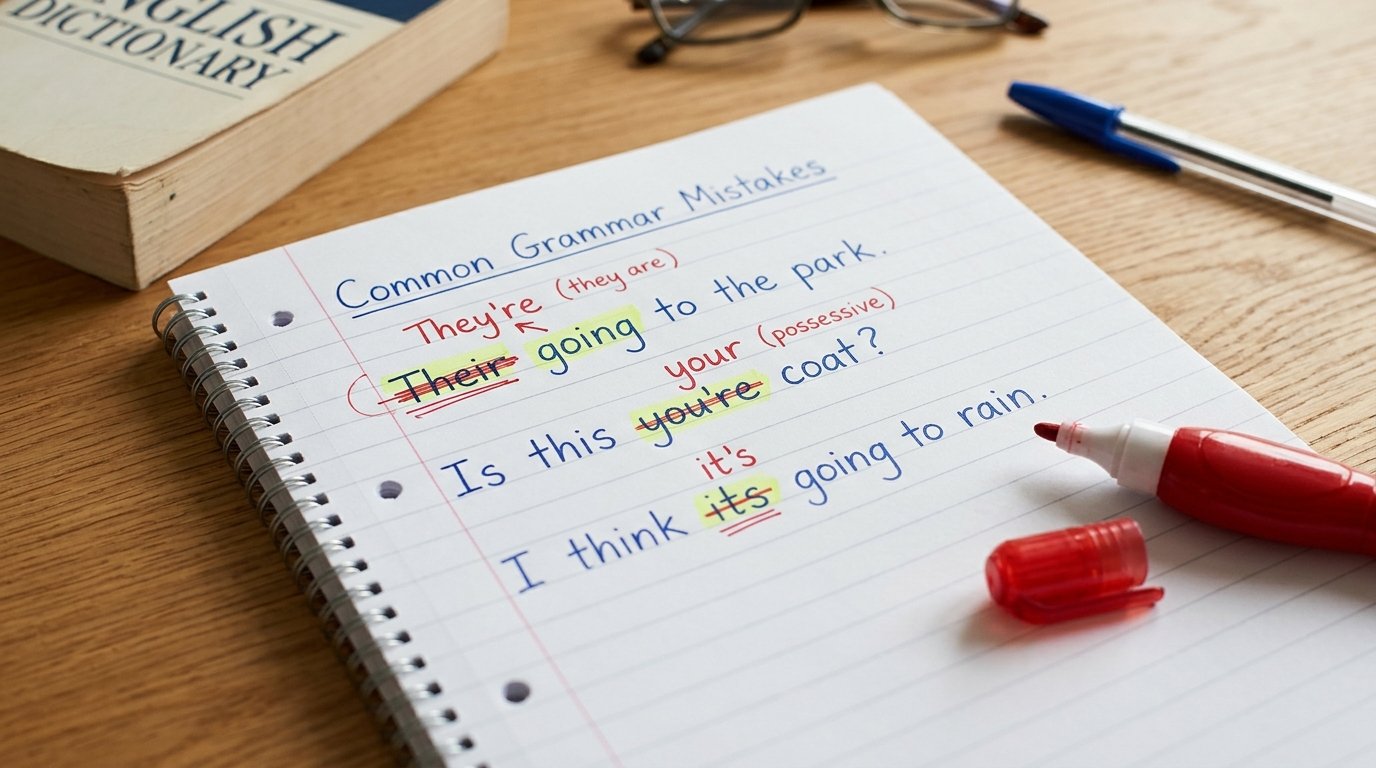
Common grammar mistakes in English are rarely random: most writers repeat the same few errors, because eachone breaks a rule they were never shown plainly.
This page fixes that. Every mistake below carries a wrong sentence, a right sentence, the rule, and a reusable check, grouped by category instead of dropped in a flat list.
Start with the self-test, not the gallery. Fourteen quick questions sort your errors by category, so you read the sections that fix your writing, not everyone else’s. One boundary, printed honestly: what grammar is, sense by sense, lives on our grammar meaning page; this page starts at the errors.
The Mistakes in 60 Seconds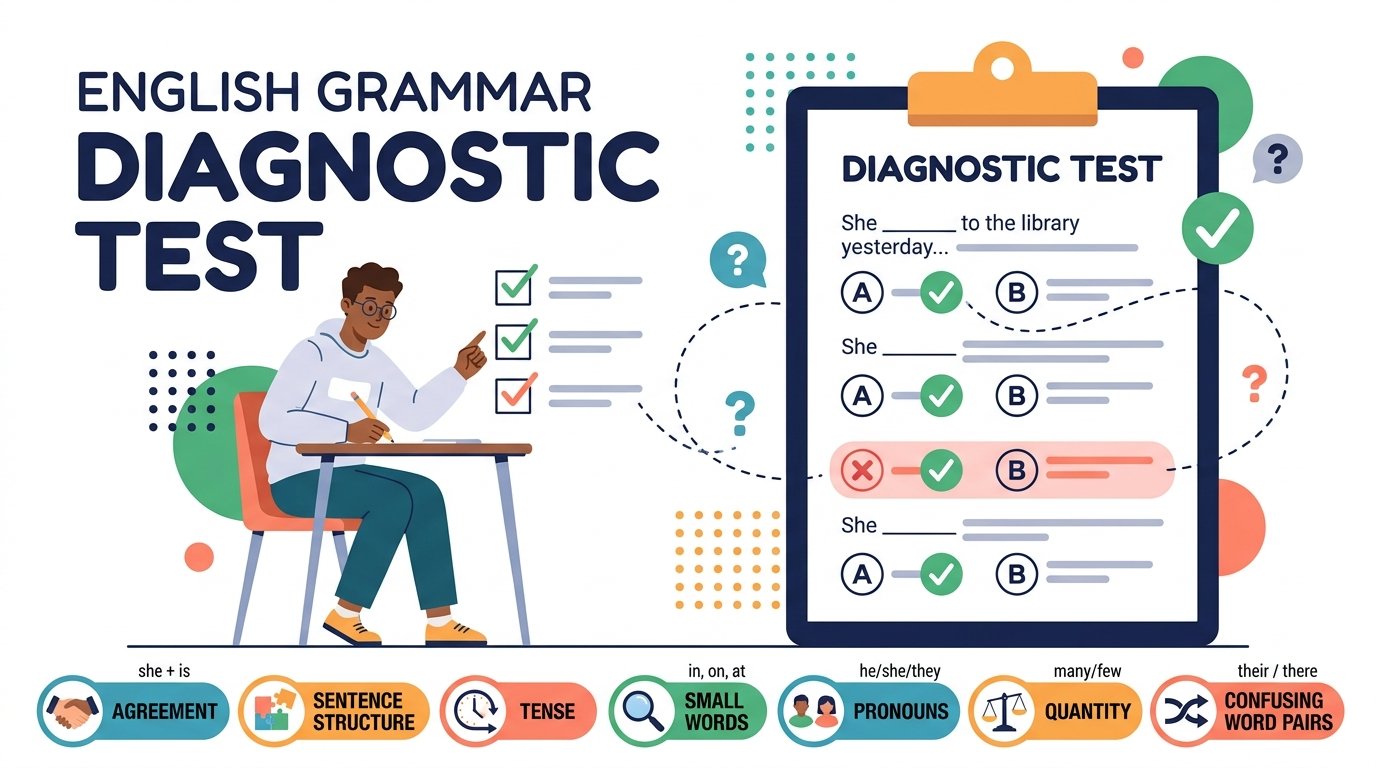
Short on time? The whole page fits in these lines.
- Seven categories hold all 28 mistakes: agreement, sentence structure, tense, small words, pronouns, quantity and word class, and confusable pairs.
- The mistakes with the widest agreement across teaching sources: subject verb agreement, its and it’s, their and they’re, apostrophe misuse, run-ons.
- Corpus research from the Cambridge Learner Corpus finds article, tense and preposition errors among the largest learner error categories.
- No honest league table exists: no source names one single most common mistake, so this page is ordered by category, not rank.
- Three items here are punctuation wearing a grammar badge (comma splices and two comma rules), flagged in place, not hidden.
- One famous item is not a grammar error at all: the passive voice is a style choice, fenced off as style below.
Find Your Mistakes First: The 14-Question Diagnostic
Do not guess which mistakes are yours: take the test. Each sentence contains one error; pick the corrected version, a or b.
Work fast and trust your ear. The answer key sits under the questions.
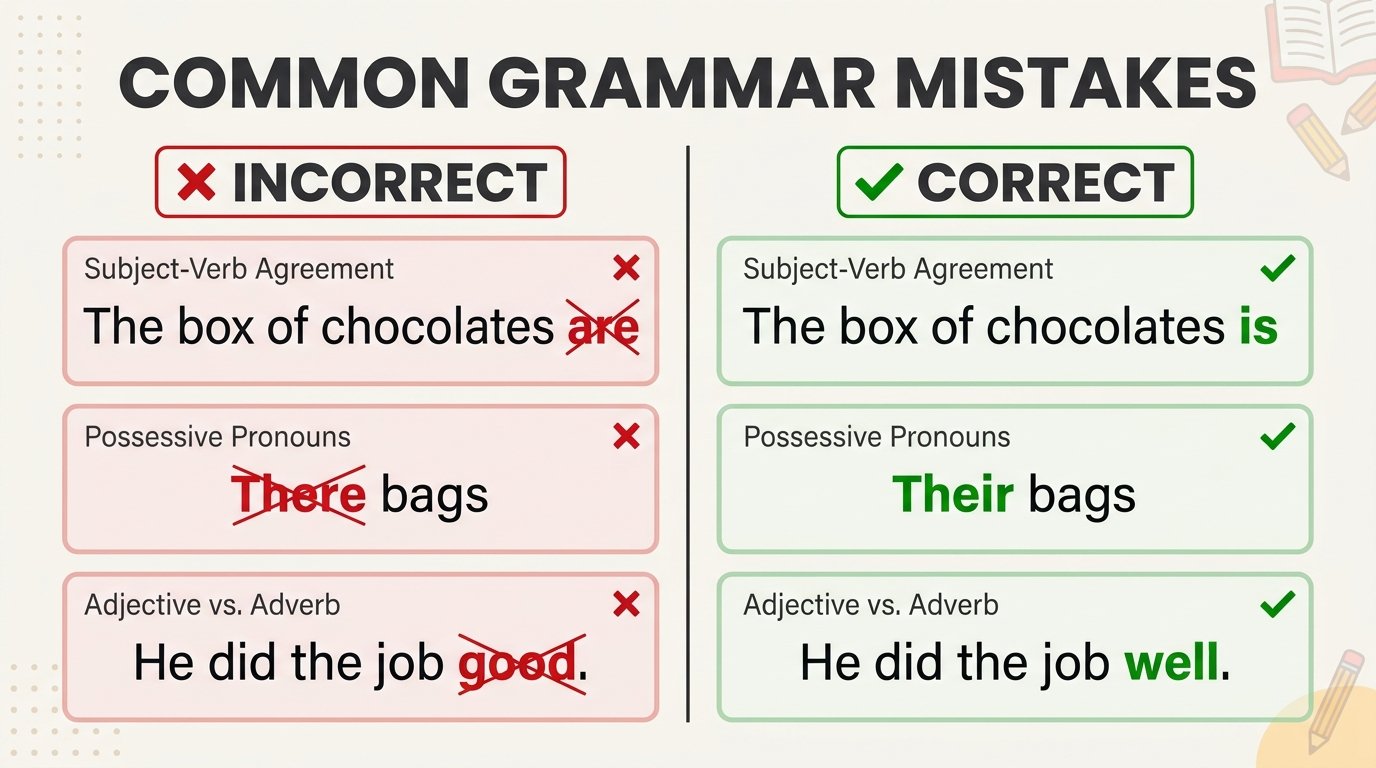
- The box of chocolates are on the table. a) The box of chocolates is on the table. b) The box of chocolates be on the table.
- Every student must bring their own laptop. (formal writing) a) Every student must bring his or her own laptop. b) Every student must bring them own laptop.
- I finished the report I sent it to the manager. a) I finished the report, I sent it to the manager. b) I finished the report. I sent it to the manager.
- Running late, the bus left without me. a) Running late, I watched the bus leave without me. b) Running late, the bus was left without me.
- I have met her last summer. a) I met her last summer. b) I have meet her last summer.
- He works here since 2021. a) He works here for 2021. b) He has worked here since 2021.
- She is best player on the team. a) She is the best player on the team. b) She is a best player on the team.
- We discussed about the plan. a) We discussed the plan. b) We discussed on the plan.
- The prize was shared between you and I. a) The prize was shared between you and myself. b) The prize was shared between you and me.
- Him and his sister run the cafe. a) He and his sister run the cafe. b) His and his sister run the cafe.
- There were much cars on the road. a) There were many cars on the road. b) There were more much cars on the road.
- He did the job good. a) He did the job well. b) He did the job goodly.
- Its raining again. a) It’s raining again. b) Its’ raining again.
- She is taller then her brother. a) She is taller than her brother. b) She is taller then, her brother.
Answer key: 1a, 2a, 3b, 4a, 5a, 6b, 7a, 8a, 9b, 10a, 11a, 12a, 13a, 14a. If you missed one, the fix is one category, not a full reread.
How to Score It, by Category
Questions 1 and 2 test agreement; 3 and 4, sentence structure; 5 and 6, tense.
Questions 7 and 8 test small words; 9 and 10 test pronouns; 11 and 12 test quantity and word class; 13 and 14 test confusable pairs.
Two misses in one category means that category is your leak. Read its section slowly, run its checks on your own writing, and retake the questions in a week.
The Category Map
Every gallery section opens with its governing rule, because the fix is a rule, not a correction.
|
Category |
Governing rule |
Mistakes inside |
|---|---|---|
|
Agreement |
The verb fits its true subject |
Subject verb agreement; pronoun antecedent agreement |
|
Sentence structure |
Every sentence needs boundaries that match its clauses |
Run-ons; comma splices; fragments; misplaced and dangling modifiers; two comma rules; apostrophe misuse |
|
Tense |
One time frame per stretch, unless the meaning moves it |
Tense shift; present perfect with finished time; since and for |
|
Small words |
Articles and prepositions follow systems, not guesses |
Missing article; dependent prepositions |
|
Pronouns |
Case follows job: subject forms do, object forms receive |
Me vs I |
|
Quantity and word class |
Countable and uncountable nouns take different partners |
Less and fewer; much and many; pluralised uncountables; adjective as adverb |
|
Confusable pairs |
Same sound, different job |
Their set; your set; its set; then and than; to and too; affect and effect; who’s and whose; complement and compliment |
The categories run from sentence machinery to single words, the order a self-editor checks a page: an editorial order, labelled as such.
Agreement Mistakes: When the Verb Does Not Match
Agreement is the machinery that ties a sentence together: the verb must fit its subject, and a pronoun must fit the noun it stands for.
Mistake 1: Subject Verb Agreement
Wrong: The quality of the photos were poor. Right: The quality of the photos was poor.
The check: find the head noun of the subject and ignore the nouns in between. The verb answers to the head noun, never to the nearest word.
Agreement traps repeat: phrases with of, with and along with hide the true subject.
Mistake 2: Pronoun Antecedent Agreement
Wrong: Each of the runners must collect their own number before the race, in formal writing. Right: Each of the runners must collect his or her own number, in formal writing.
The rule: a pronoun matches its antecedent in number: each is singular, so the formal pronoun is singular too. Name the antecedent first, then choose.
Register matters, and this page prints both sides: singular they is accepted in most current style guidance; formal and exam registers still teach his or her.
Sentence Structure Mistakes: Where Sentences Break
Structure errors are boundary errors: clauses joined without a boundary, sentences missing a load-bearing part, or describing phrases parked beside the wrong subject.
Mistake 3: Run-On Sentence
Wrong: The train was late we waited on the platform for an hour. Right: The train was late. We waited on the platform for an hour.
The rule: two complete clauses need a visible boundary: a full stop, a semicolon, or a comma with a joining word.
Mistake 4: Comma Splice
Wrong: The shop was closed, we went home. Right: The shop was closed, so we went home. A comma alone cannot join two complete clauses.
Flagged honestly: this is punctuation-adjacent, a boundary mark rather than a word rule. It sits here because teaching sources list it as a top error.
The check: cover the comma and read both sides. If both sides stand alone, the comma needs a partner word, a semicolon, or a full stop.
Mistake 5: Sentence Fragment
Wrong: Because the road was flooded. Right: We turned back because the road was flooded. A fragment is a clause part dressed as a whole sentence.
The rule: a sentence needs a subject and a complete verb in a clause that can stand alone. Because, when and although open dependent clauses that must attach to a main clause.
Fragments are not always crimes: skilled writers use them for deliberate emphasis. In exams, essays and work writing, treat each one as an accident until proven a choice.
Mistake 6: Misplaced Modifier
Wrong: She served coffee to the guests in paper cups. Right: She served coffee in paper cups to the guests.
The rule: a describing phrase sits next to the word it describes. Ask what the phrase is about, then move it against that word.
Mistake 7: Dangling Modifier
Wrong: After reading the instructions, the machine was switched on. Right: After reading the instructions, I switched the machine on.
The rule: an opening describing phrase describes the subject of the main clause, whether you meant it to or not. If that subject is a machine, the sentence claims the machine read.
The check: read the opener, then ask who or what did it. If the next noun is not that doer, rebuild the sentence.
Mistake 8: Missing Comma After an Introductory Element
Wrong: When the concert ended the crowd moved slowly to the doors. Right: When the concert ended, the crowd moved slowly to the doors.
Flagged honestly: another punctuation-adjacent item. A long opening clause closes with a comma so the reader finds the main clause; short openers often run without one.
Mistake 9: Unnecessary Comma Before Because
Wrong: The match was cancelled, because the pitch was waterlogged. Right: The match was cancelled because the pitch was waterlogged. The because clause is part of the main sentence, not an aside.
The rule: do not split a main clause from its because clause with a comma. A comma before because is right only to prevent a misreading, which is rare.
Mistake 10: Apostrophe Misuse
Wrong: The library book’s were returned late. Right: The library books were returned late. An apostrophe never makes a plain plural.
The rule: apostrophes mark possession or missing letters, nothing else: the teacher’s desk, the teachers’ room, it’s for it is. If nothing is owned, the apostrophe goes.
Tense Mistakes: When Time Slips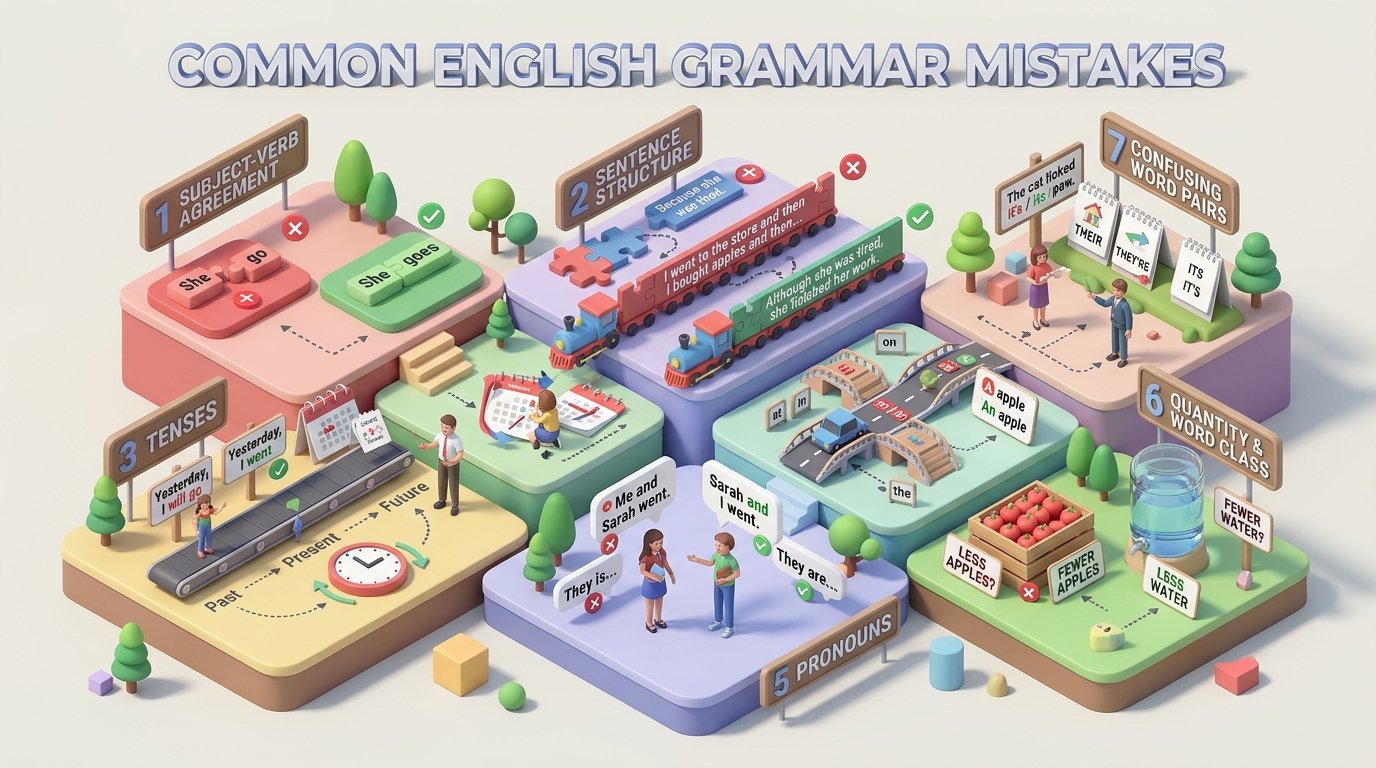
Tense errors are time errors: the verb’s form places an event in one time slot while the sentence’s words place it in another.
Mistake 11: Tense Shift Inside a Text
Wrong: The guide explains the route, then pointed at the river. Right: The guide explains the route, then points at the river.
The rule: stay in the tense you started unless the meaning itself moves in time. Mark each verb’s time as you read; a lone verb in another time is the slip.
Mistake 12: Present Perfect With a Finished Time Marker
Wrong: We have visited the museum last Saturday. Right: We visited the museum last Saturday.
The rule: the present perfect connects a past event to now, so it refuses finished time words. Hunt for a finished time marker first; if one is present, the perfect is out.
Mistake 13: Since and For
Wrong: I have known him since ten years. Right: I have known him for ten years. For takes a length of time; since takes the starting point.
The check: ask whether the phrase answers how long or when it started. Durations take for; starting points take since.
Small Word Mistakes: Articles and Prepositions
Small words carry outsized error counts: corpus research places article and preposition choice among the largest learner error categories of all.
Mistake 14: Missing Article
Wrong: She is teacher at a school in Leeds. Right: She is a teacher at a school in Leeds. A singular countable noun standing alone needs a determiner in front of it.
The rule: one countable thing, named for the first time, takes a or an; a job title after be is the classic trap. Count the noun: if it is one, look for its article.
Learners whose writing drops articles often come from languages that manage without them. The fix is mechanical: scan every singular noun.
Mistake 15: Wrong Dependent Preposition
Wrong: The result depends of the weather. Right: The result depends on the weather. Many verbs and adjectives marry one fixed preposition: depend on, interested in, afraid of, good at.
The rule: these pairs are single vocabulary units, learned whole, not chosen by logic. Learn the pair when you learn the verb, and list the pairs that catch you.
Pronoun Mistakes: Case and Reference
Pronoun errors are job errors: English keeps different forms for the doer and the receiver, and swapping them is the mistake readers notice fastest.
Mistake 16: Me vs I
Wrong: My brother and me run the stall on Saturdays. Right: My brother and I run the stall on Saturdays. Subject position takes I; object position takes me.
The check: remove the other person and read what is left. Me run the stall fails aloud; the ear settles case in one second.
The same test fixes the receiving end: between you and me, after the coach spoke to Sam and me. Prepositions take object forms.
Quantity and Word Class Mistakes
These errors come from one fork in the road: is the noun countable or not, and is the word doing a noun’s job or a verb’s?
Mistake 17: Less vs Fewer
Wrong: There were less cars on the road this morning. Right: There were fewer cars on the road this morning.
The check: if you can put a number in front of the noun, use fewer. One register note: less than ten miles is standard, because the amount reads as one measure.
Mistake 18: Much vs Many
Wrong: How much people came to the talk? Right: How many people came to the talk?
The check: the same counting test. People, cars and books count, so they take many; time and traffic do not, so they take much.
Mistake 19: Uncountable Nouns Pluralised
Wrong: The advices in the leaflet were helpful. Right: The advice in the leaflet was helpful. Advice, information, news, furniture and luggage have no plural and take no a or an.
The rule: these nouns name masses and abstracts, counted with part words: a piece of advice, two items of luggage. Treat any plural -s on them as an alarm.
Mistake 20: Adjective Used as Adverb
Wrong: The choir sang beautiful at the wedding. Right: The choir sang beautifully at the wedding.
The check: ask what the word describes. Singing is an action, so beautifully; a voice is a thing, so a beautiful voice. One fence: sense verbs take adjectives, so the soup tastes good.
Confusable Pairs: Same Sound, Different Job
Pairs errors are ear errors: the words sound identical or close, so the hand writes the one it hears first. Each pair is two jobs wearing one sound, and each has a test.
Mistake 21: Their, There and They’re
Wrong: The students left there bags in the hall. Right: The students left their bags in the hall. Their owns, there points at a place, and they’re is they are squeezed together.
The check: expand the word. If they are fits, write they’re; if something is owned, write their; there even contains here as a memory hook.
Mistake 22: Your and You’re
Wrong: Your welcome to join us tomorrow. Right: You’re welcome to join us tomorrow. Your owns; you’re is you are with the a traded for an apostrophe.
The check: the same expansion test. Read the sentence with you are in full; if it survives, the apostrophe form is the one you need.
Mistake 23: Its and It’s
Wrong: The dog wagged it’s tail. Right: The dog wagged its tail. Its is the owning form, and owning pronouns never carry an apostrophe; it’s always means it is or it has.
The check: expand it. The dog wagged it is tail collapses on reading, which proves its.
Mistake 24: Then and Than
Wrong: The second route is shorter then the first. Right: The second route is shorter than the first.
The check: if the sentence weighs one thing against another, the word is than. If it answers what happened next, the word is then.
Mistake 25: To and Too
Wrong: We walked to the market and bought to much bread. Right: We walked to the market and bought too much bread.
The check: if the word can be replaced by also or excessively, it is too. The extra letter is the hook: too has too many o’s, deliberately.
Mistake 26: Affect and Effect
Wrong: The long meeting did not effect her decision. Right: The long meeting did not affect her decision. Affect is usually the verb, to influence; effect is usually the noun, the result.
The check: the RAVEN line, affect verb, effect noun, covers most sentences. One named exception: effect as a verb means to bring about, and our meaning of affect vs effect with examples page treats the pair in full.
Mistake 27: Who’s and Whose
Wrong: Whose coming to the meeting on Friday? Right: Who’s coming to the meeting on Friday? Who’s is who is; whose is the owning form.
The check: expand before you write. If who is fits, the apostrophe form wins; if the next word is a thing that is owned, whose is the word.
Mistake 28: Complement and Compliment
Wrong: She gave me a kind complement about my work. Right: She gave me a kind compliment about my work. A compliment is praise; a complement completes something.
The check: the letter i is the hook. I like receiving compliments, and compliment carries that i; complement with an e completes.
Grammar, Punctuation, Spelling or Style? The Honest Boundary
Lists in this arena quietly mix four different things and call them all grammar. This page prints the split.
|
Kind |
What it covers |
On this page |
|---|---|---|
|
Grammar |
Word order, agreement, tense forms, article and preposition choice, pronoun case |
The core 28, minus the flagged items |
|
Punctuation-adjacent |
Comma splices, the introductory comma, the because comma, apostrophe placement |
Treated in the gallery, flagged in place |
|
Spelling |
How a word is written: its letters |
Handed off, never treated here |
|
Style |
Choices both of whose forms are grammatical |
Fenced in the note below |
Spelling has its own traps and its own pages here: the necessary spelling rule and the passed vs past pair live on the spelling rail. Even grammar itself is often spelled grammer, a trap our grammar spelling page will cover once it is published here.
Style, Not Grammar: The Passive Voice
The report was written by the team breaks no grammar rule. The passive voice is a choice about emphasis: it foregrounds the thing acted on, and official writing uses it deliberately.
Active voice is usually clearer and shorter, so push it as advice, not as law: listing the passive among grammar mistakes, as several popular lists do, is itself an error.
Why These Mistakes Happen
Four mechanisms produce nearly everything in the gallery, and knowing yours tells you which fix will stick.
Sound-alike spelling drives the confusable pairs: the ear hears one sound and the hand picks the familiar shape. Expansion tests beat memorising, because they make the ear check its own work.
Overgeneralised rules drive the plural and apostrophe errors: a real rule, add -s, add an apostrophe, stretched past its border. The fix is the rule’s edge, not the rule again.
Word choice slips are the quiet giant: corpus summaries of learner writing put choosing the wrong content word at about a fifth of coded errors. Meaning traps like what does literally mean and what does irony mean show how single words mislead.
Habit and haste drive the rest: writers reproduce the word order they think in and skip the checking pass.
The Self-Editing Routine: Five Passes Over Your Own Writing
One slow reread catches almost nothing. Five short passes, each hunting one category, catch most of what this page teaches.
- The verb pass: underline every verb. Does it fit its true subject, and does its tense match the time words around it?
- The small words pass: scan articles and prepositions only. Every singular countable noun needs its determiner; every fixed pair keeps its married preposition.
- The boundary pass: read each sentence’s edges. No splices, no run-ons, no fragments, and opening phrases describe the subject that follows them.
- The pairs pass: search your text for the confusables and expand each contraction aloud. University writing centres teach the same hunt; the Purdue OWL guide to avoiding common errors is the classic list.
- The read-aloud pass: read the piece aloud once, slowly, and keep an error log of every slip. The OWL’s companion essay-mistakes list, hosted on Humanities LibreTexts, rewards the same habit.
Work one category a week through your own writing, not all five passes at full depth every day. The log turns your personal top five into a checklist no generic list can give you.
Practice: 12 Sentences to Fix
Cover the key and fix each sentence using the gallery’s checks. Every sentence breaks one rule from the core 28.
- The committee have decided to postpone the vote.
- Their is a small cafe near the station.
- I am interested on learning Spanish.
- He don’t have a car.
- We have lived in this town since five years.
- The informations on the website are out of date.
- Walking through the park, the flowers looked beautiful.
- He gave the keys to John and I.
- This soup tastes well.
- I need to buy some furnitures for the flat.
- The report was finished, we sent it the same day.
- Your welcome to stay for dinner.
Answer key: 1. has decided (1). 2. There is (21). 3. interested in (15). 4. does not have (1). 5. for five years (13). 6. information is (19). 7. add the doer: I thought the flowers looked beautiful (7). 8. John and me (16). 9. tastes good; sense verbs take adjectives (20). 10. some furniture (19). 11. split into two sentences (4). 12. You’re welcome (22).
The Printable Checklist
Print this block and tick each row against your next piece of writing: the whole gallery on one page.
|
Mistake |
One-line rule |
Done |
|---|---|---|
|
Subject verb agreement |
The verb answers to the head noun |
☐ |
|
Pronoun antecedent agreement |
Name the antecedent, then choose the pronoun |
☐ |
|
Run-on sentence |
Every clause pair gets a boundary |
☐ |
|
Comma splice |
A comma alone cannot join two clauses |
☐ |
|
Sentence fragment |
A sentence needs a subject and a complete verb |
☐ |
|
Misplaced modifier |
Describing phrases sit beside their word |
☐ |
|
Dangling modifier |
The opener describes the main subject |
☐ |
|
Introductory comma |
Close a long opening clause with a comma |
☐ |
|
Comma before because |
Do not split a clause from its because clause |
☐ |
|
Apostrophe misuse |
Apostrophes own or omit, never pluralise |
☐ |
|
Tense shift |
One time frame unless the meaning moves |
☐ |
|
Present perfect, finished time |
Finished time words take the past simple |
☐ |
|
Since and for |
For measures length, since marks the start |
☐ |
|
Missing article |
One countable noun needs its determiner |
☐ |
|
Dependent preposition |
Learn verb and preposition as one unit |
☐ |
|
Me vs I |
Remove the other person and listen |
☐ |
|
Less vs fewer |
Fewer counts, less measures |
☐ |
|
Much vs many |
Many counts, much measures |
☐ |
|
Pluralised uncountables |
Advice and information have no plural |
☐ |
|
Adjective as adverb |
Actions take adverbs, sense verbs take adjectives |
☐ |
|
Their, there, they’re |
Expand they’re; their owns; there places |
☐ |
|
Your and you’re |
Expand to you are before writing |
☐ |
|
Its and it’s |
Expand to it is before writing |
☐ |
|
Then and than |
Than compares, then orders time |
☐ |
|
To and too |
Too means also, or more than enough |
☐ |
|
Affect and effect |
Affect acts, effect results |
☐ |
|
Who’s and whose |
Expand who’s; whose owns |
☐ |
|
Complement and compliment |
Compliment praises, complement completes |
☐ |
FAQs
What are the most common grammar mistakes in English?
The mistakes teaching sources agree on most are subject verb agreement, its and it’s, their and they’re, apostrophe misuse and run-on sentences. This page treats 28 core mistakes in seven categories.
What is the most common grammar mistake of all?
No verified winner exists. Corpus research, including the Cambridge Learner Corpus, ranks categories of learner error, with article, tense and preposition errors among the largest; it crowns no single mistake, and neither does this page.
How do I know which grammar mistakes I make?
Take the 14-question diagnostic above and score it by category. Your missed categories are your leaks; an error log confirms the pattern.
Why do I keep making the same grammar mistakes?
Because most errors are habits, not knowledge gaps: an overgeneralised rule or sound-alike pair fires automatically. Habits yield to checks, which is why every gallery item carries a reusable test.
Is a comma splice a grammar mistake or a punctuation mistake?
It is punctuation-adjacent: a missing boundary mark between two clauses, not a wrong word form. This page treats it in the gallery, flagged as punctuation.
Is using the passive voice a grammar mistake?
No. The passive is grammatical in every case; it is a style choice about emphasis. Active voice is usually clearer, so prefer it as advice; lists that file the passive as an error are wrong.
What is the difference between a grammar mistake and a spelling mistake?
A grammar mistake breaks a rule of structure: word order, agreement, tense, case. A spelling mistake breaks a word’s letters: separate written as seperate.
Why is subject verb agreement the mistake teachers mark most?
Labelled honestly, that is editorial consensus, not a measured ranking: agreement drew the widest support in the sources behind this page, seven lists, and it is mechanically checkable.
What is the rule for subject verb agreement in one line?
The verb agrees with the head noun of its subject, not with the nearest noun. Strip out the phrases between subject and verb and choose the verb that fits the head.
Why do people write “their” when they mean “they’re”?
The three words sound identical, so the hand writes the shape it knows best. The fix is the expansion test: read the sentence with they are in full; write they’re only when the expansion survives.
How can I stop mixing up its and it’s?
Expand before you write: it’s always means it is or it has. Possessive pronouns never take an apostrophe. If the expansion breaks the sentence, the word you want is its.
Is “me and Sara went” really wrong?
In standard English, yes: subject position takes I, so the standard form puts the other person first with I. The removal test proves it: me went fails, I went stands.
When do I use I and when do I use me?
Use I where the pronoun does the action, me where it receives it or follows a preposition. With another person in the spot, remove them and let your ear choose.
Is it fewer or less for people?
Fewer, because people are countable: fewer people, fewer cars. Less measures uncountable amounts: less time, less traffic. The exception is measured quantities read as one amount, like less than ten miles.
Why is “informations” wrong?
Information is an uncountable noun: it names a mass, not items, so it has no plural and takes no a or an. Count it with part words: a piece of information.
Which nouns have no plural in English?
The core list is short: information, advice, news, furniture, luggage, equipment, knowledge and homework. Each takes a singular verb and is counted with part words like a piece of or an item of.
Why do learners leave out “a” and “the”?
Many languages manage without articles, so the words feel optional to a learner writing fast. English treats them as load-bearing: a singular countable noun needs its determiner.
When do I use a and when do I use an?
By sound, not by letter: an goes before a vowel sound, as in an apple and an hour; a goes before a consonant sound, as in a university.
Why is “I have seen him yesterday” wrong?
Yesterday names finished time, and finished time takes the past simple: I saw him yesterday. The present perfect links a past event to now, so it refuses words that close the time frame.
What is the difference between since and for?
For measures a length of time: for three years. Since names the starting point: since 2021, since Monday. Ask how long or when it started, and the word chooses itself.
Is “if I was you” wrong?
In formal English the unreal conditional uses were for every person: if I were you. Was is common in informal speech; exams and formal writing still expect were, so know both registers.
Is a sentence fragment always wrong?
Not always: skilled writers use fragments for deliberate emphasis, and dialogue runs on them. In exams, essays and work writing, treat a fragment as an accident and attach it to its main clause.
What is a dangling modifier in simple words?
It is an opening phrase whose doer never arrives: Walking to work, the rain started claims the rain walked. The fix puts the real doer after the comma: Walking to work, I felt the rain start.
How do I fix a run-on sentence?
Give each clause its own boundary: a full stop, a semicolon, or a comma with a joining word like and, but or so. Count the complete clauses; each needs its border.
Why is “could of” wrong?
The modal perfect is could have: could have gone, should have known. Of is never part of it; the error is pure ear spelling: have shrinks to a sound like of in fast speech.
Is “alot” a word?
No. A lot is two words, always; allot is a different verb meaning to share out. Our a lot vs allot vs alot page settles the trio with examples.
Do native speakers make grammar mistakes too?
Yes, constantly, especially the ear errors: its and it’s, their and they’re, could of, and agreement slips in long sentences. Native fluency automates speech, not proofreading.
What grammar mistakes do native speakers make most?
Labelled as editorial observation, not a measured ranking: the confusable pairs and apostrophes dominate, because they are spelling-shaped traps inside fluent writing. Learner errors cluster elsewhere: articles, tense and prepositions.
Are double negatives always wrong in English?
In standard English, yes: I don’t know anything is the standard form, and two negatives cancel or mark dialect. Double negatives live in many dialects, but exams and formal writing mark them as errors.
Is singular “they” a grammar mistake?
No. Singular they is centuries old and is accepted by most current style guides for general writing. Formal and exam registers may still teach his or her; the register you write in decides.
Should I use who or whom?
Use who for the doer and whom for the receiver, in formal writing: who called, the man whom I called. Everyday English increasingly uses who in both spots; whom survives in formal prose.
Is it wrong to end a sentence with a preposition?
No, that is a usage myth, not a rule of English grammar. What are you waiting for is natural English; forcing the preposition forward often produces stiffer sentences.
How many grammar mistakes are there in total?
There is no true count, because mistakes split and join depending on how the counter groups them. This page’s inventory coded 52 candidate mistakes across sixteen source lists, keeping the 28 with the widest support.
Can a grammar checker catch all of these mistakes?
No. Tools are strong on agreement and confusable pairs, weaker on article choice, dangling modifiers and unclear reference, where a sentence is grammatical word by word and wrong only in meaning.
What mistakes can a grammar checker not catch?
The meaning-level errors: a modifier parked beside the wrong noun, a pronoun with two possible owners, a wrong dependent preposition that still reads smoothly. A checker cannot know what you meant.
How long does it take to stop making a grammar mistake?
There is no honest fixed number: a mistake dies when its check becomes automatic, which takes weeks of deliberate catches, not hours of reading.
What is the best way to practise fixing grammar mistakes?
Practise on your own sentences, not only on exercises: fix, name the rule, and write the check in an error log. The practice set on this page is built on that loop.
Should I fix one mistake at a time or all of them together?
One category at a time: a week hunting only agreement errors in your writing rewires that check, while hunting everything at once teaches your eye to skim past all of it.
Do grammar mistakes matter in speaking as much as in writing?
Less, and differently: speech is forgiven in real time, while writing stands still and gets reread. The mistakes that matter in speech are the ones that change meaning, like tense slips.
Which grammar mistakes hurt most in exams?
Examiners mark against band descriptors, and the corpus strand points the same way: article, tense and agreement errors recur in learner scripts. Labelled plainly, that is category guidance, not a leaked marking scheme.
Which grammar mistakes hurt most at work?
The ones a reader cannot unsee: agreement slips in the first lines, its for it’s, and splices in formal reports. They cost credibility rather than marks.
How can I check my own writing before I send it?
Run the five passes from this page: verbs, small words, boundaries, pairs, then one read aloud. Let your error log, not a generic list, set the order.
Conclusion
Common grammar mistakes in English shrink fast once each one is treated as what it is: a rule you can learn, with a check you can run, not a correction to memorise and forget.
Start with your diagnostic score, work one category a week, and keep the error log honest. Print the checklist above, tick it, and let it travel with your writing.
More plain English help lives across MagazineSolo, written the same way: the short answer first, the rule after, and no claim printed without its basis.

Dilawar is a content writer at MagazineSolo, covering travel, home improvement, interior design, and everyday lifestyle topics. He enjoys researching practical solutions, exploring travel destinations, and sharing helpful guides that make daily life easier. His writing focuses on clear information, useful advice, and engaging stories for a wide audience.