Separate or Seperate: Which Is the Correct Spelling?
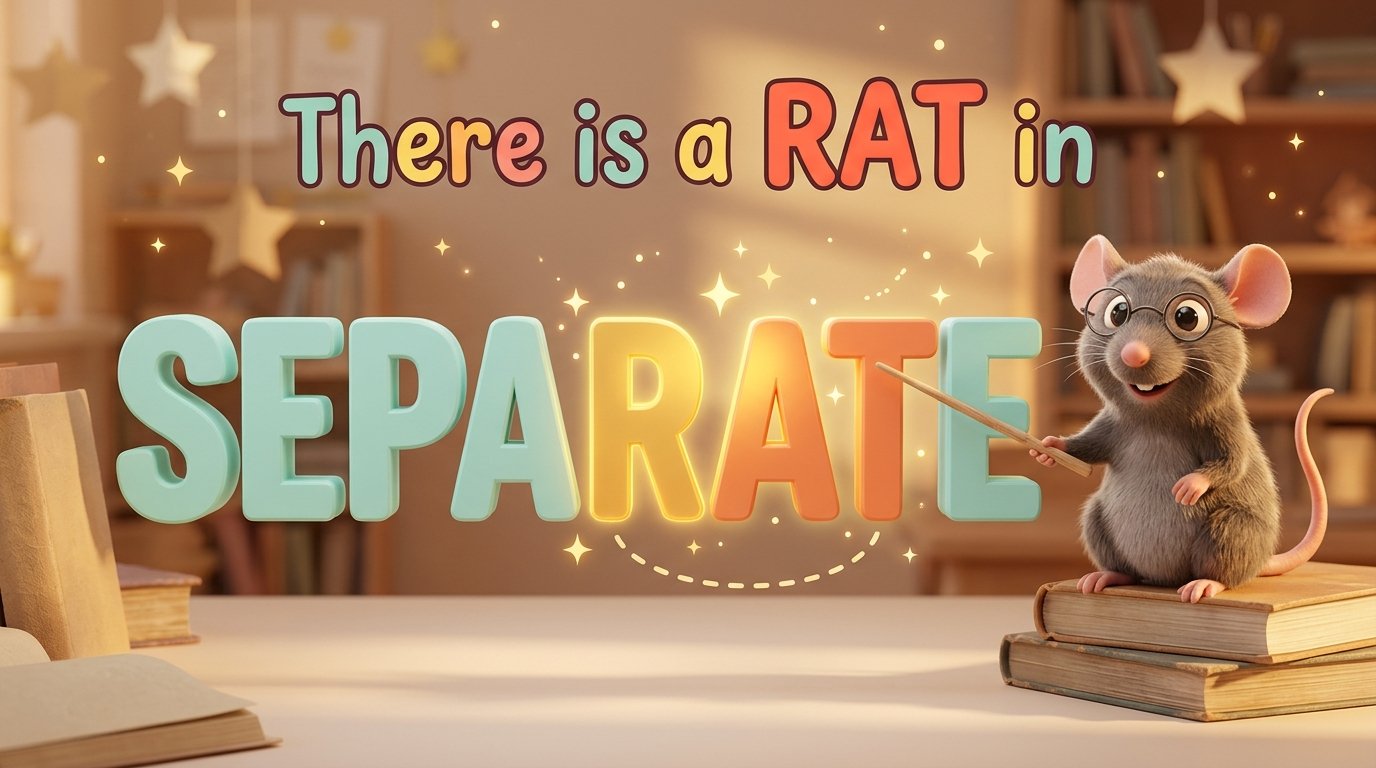
Separate is the correct spelling. Seperate is not a word. If you arrived asking separate or seperate, the correct spelling is settled in one line: the middle letter is a, every time, in every form of the word.
Separate is the only spelling any standard dictionary lists. Cambridge Dictionary carries the headword as separate, and its own spelling note for this exact trap says the word is spelt with -ar-, not -er-.
The verdict is not a close call. Type seperate into Dictionary.com and the site sends you to the separate entry, flagged as a misspelling match, because seperate has no entry of its own.
The Quick Answer: Separate, With an A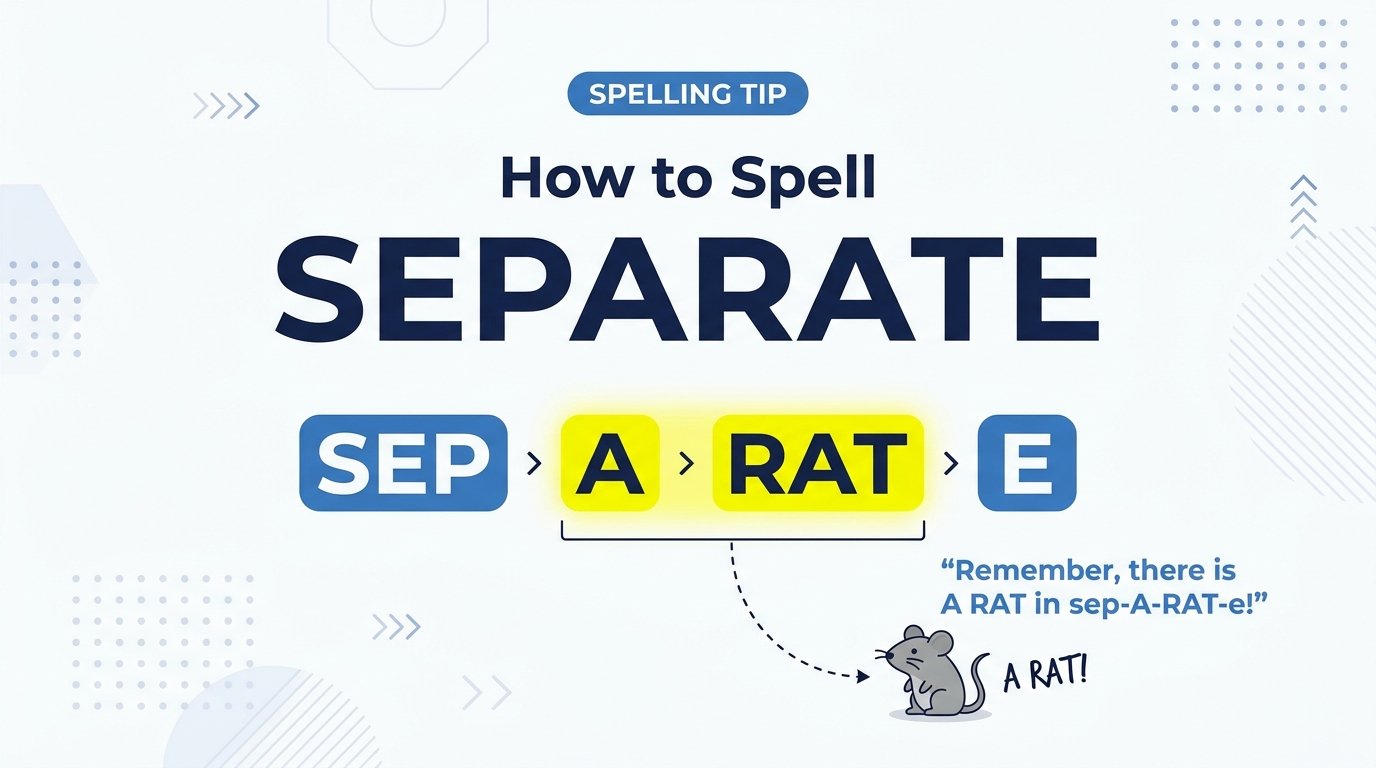
The letter pattern is s-e-p-a-r-a-t-e: eight letters, three syllables, and two a’s with an r between them. Dictionary.com sums it up the same way: separate has two a’s, separated by an r.
Every form built on the word keeps that a. Separated, separating, separately, separation, separable: change the ending as much as you like, and the a in the middle never moves.
Why the Answer Is Never Seperate
Seperate is not a regional variant, an older spelling, or a formal alternative. It is simply an error string, a misspelling of separate that dictionaries record only to redirect you away from it.
That is what makes this pair different from a genuine word pair like affect vs effect. Both of those are real words with different jobs; seperate has no job at all, because it is not a word.
The Rat in Separate: The Trick That Ends the Confusion
There is a rat in separate. Read the middle of the word slowly, sep-a-rat-e, and the animal is sitting right there, spelled with the a you keep forgetting.
The trick works because it turns an invisible vowel into a picture. You may not hear the middle letter when you say the word, but you can see the rat every time you write it.
The Sep-a-Rat-e Breakdown
Chunk the word into four beats: sep-a-rat-e. The first beat ends the prefix, the rat carries the middle, and the final -ate is the ending shared by hundreds of English adjectives and verbs.
Say the chunks once, write the word once, and the pattern locks in. Spellers who use visual chunking beat spellers who rely on sound, because this word’s sound is exactly what misleads you.
Two More Memory Devices
Count the vowels if the rat escapes you. Separate runs e-a-a-e, a neat symmetry: one e at each end and two a’s in the middle, never two e’s anywhere in the word.
Oxford’s own spelling guidance offers a third hook: remember -par- in the middle. The letters p-a-r sit at the word’s centre, and Dictionary.com adds a playful variant, urging you to separate the pirate with an a.
Why Separate Is So Easy to Misspell
The Schwa: The Vowel You Cannot Hear
Say separate out loud and the middle vowel almost disappears. Unstressed vowels in English shrink into the schwa, the soft uh sound, so the a in separate sounds like it could be a, e, or nothing.
That is the whole trap: pronunciation hides the spelling. The same hidden-vowel problem drives errors like seing vs seeing, where the letters you cannot hear are the letters you get wrong.
Muscle Memory and the Autocorrect Miss
Type the wrong form often enough and your fingers learn it. Muscle memory is indifferent to correctness; it repeats whatever you have practised, which is why this error survives in fast, confident typing.
Spellcheckers usually flag seperate, because it is not a headword in their dictionaries. The misses happen where checking is switched off, in form fields, or after the error was once saved into a personal dictionary.
The Desperate Trap: The Word That Teaches You the Wrong Letter
Meet the real culprit: desperate. It sounds like separate’s twin, it ends in the same -ate, and it genuinely is spelled with e in the middle, d-e-s-p-e-r-a-t-e, no exceptions.
Your brain learns desperate’s pattern and lends it to separate. The loan feels safe because the words rhyme in shape, but the two descend from different Latin roots, and each keeps its own root’s vowel.
Desperate Has E, Separate Has A: The Contrast Table
|
Word |
Middle letter |
Full spelling |
|---|---|---|
|
desperate |
E |
d-e-s-p-e-r-a-t-e |
|
separate |
A |
s-e-p-a-r-a-t-e |
|
desperately |
E |
desperately keeps the e |
|
separately |
A |
separately keeps the a |
|
desperation |
E |
desperation keeps the e |
|
separation |
A |
separation keeps the a |
Learn the pair as a contrast, not as neighbours. Desperate is the e word; separate is the a word; and neither borrows the other’s letter, however similar they sound at speed.
Temperate, Corporate, and the -ate Crowd
The wider -ate crowd gives no rescue either. Temperate carries an e, like desperate, while corporate and moderate carry an a, like separate, so the ending itself predicts nothing.
The rule is blunt: the -ate sound is spelling-neutral. Each word’s middle vowel belongs to its own history, which is why the rat, not the rhyme, is the reliable test.
Where Separate Comes From: Se- Plus Parare
Merriam-Webster’s entry traces separate through Middle English to Latin separatus, the past participle of separare, and then splits separare into its two working parts: se-, apart, plus parare, to prepare or procure.
Notice where the a lives: inside parare. Separate keeps the a of its Latin root, so the etymology and the mnemonic point at the same letter, the a standing in the middle of the word.
What Separate Means: Verb, Adjective, and Noun
Separate as a Verb, With the Pronunciation Split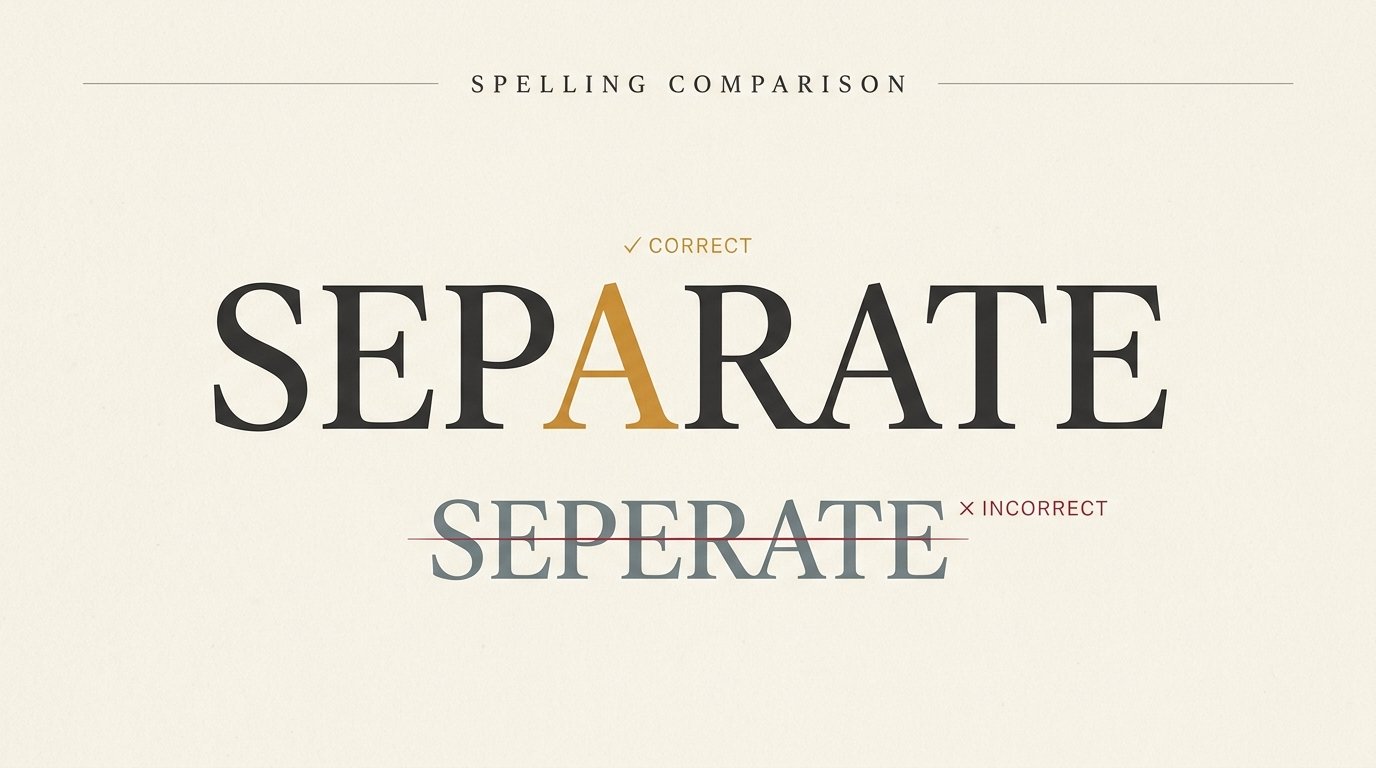
As a verb, separate means to divide, part, or keep apart: separate the laundry, separate the mixture, separate the fighters. Dictionaries give the verb pronunciation as SEP-uh-rate, with a full -ate ending.
The spelling never changes with the job. Whether you are separating two things or describing them as already apart, the word is built on the same s-e-p-a-r-a-t-e frame.
Separate as an Adjective
As an adjective, separate means distinct or not connected: separate rooms, separate accounts, separate lives. The adjective’s ending reduces in speech, and dictionaries respell it SEP-uh-rut, though the written form stays identical.
That split makes separate a heteronym, one spelling with two pronunciations. The adjective form is the one you use in phrases like separate checks and separate ways, and it still takes the a.
Separates as a Noun
Separate also works as a noun, mostly in the plural. Separates are clothing items sold as individual pieces, tops and bottoms you mix yourself, and dictionary entries also record a noun sense for an offprint.
The noun changes nothing about the letters. Separates keeps the a in the middle, exactly like the verb and the adjective, because all three grow from the same root.
The table below collects the pronunciation split in one place. These are simplified respellings of the pronunciations the dictionaries print, offered as guidance, not as a second spelling system.
|
Form |
Job |
Dictionary pronunciation |
|---|---|---|
|
separate |
verb |
SEP-uh-rate |
|
separate |
adjective |
SEP-uh-rut |
|
separately |
adverb |
SEP-uh-rut-lee |
|
separation |
noun |
sep-uh-RAY-shun |
The Whole Family Keeps the A
Learn one form and you own them all, because the family is ruthlessly consistent. Every derivative of separate keeps the a, and every common error is the same a flipped to e.
The Family Table
|
Correct |
Common error |
|---|---|
|
separate |
seperate |
|
separates |
seperates |
|
separated |
seperated |
|
separating |
seperating |
|
separately |
seperately |
|
separation |
seperation |
|
separations |
seperations |
|
separator |
seperator |
|
separable |
seperable |
|
inseparable |
inseperable |
The form readers need most after the headword is separately, the adverb. It is separate plus -ly, with the a untouched, and seperately is simply the family error wearing an adverb’s ending.
Separable and inseparable close the set: able to be taken apart, and impossible to take apart. Both keep the a, and seperable is wrong for the same single reason as seperate.
The Misspelling Gallery: Every Wrong Form, Sorted by Error
The gallery below collects the wrong forms that actually circulate. Seperate and its family are documented misspellings: the pair appears in Wikipedia’s documented list of commonly misspelled words and in the Oxford English Corpus tradition of misspelling lists.
The A-Swap Family
One error pattern produces nearly all of them: the middle a swapped for e. Seperate, seperated, seperation, seperately, seperating, seperates, seperator, and seperable are one mistake in eight costumes.
Fix the pattern and the whole family heals at once. That is why this page teaches the a-swap as a single fault, instead of asking you to memorize eight separate corrections.
Doubled Letters, Transpositions, and Dropped Letters
The stranger variants below survive mainly as wrong options in spelling exam questions, where test setters invent plausible errors. They are labelled here as exam distractor spellings, documented as distractors, not as frequency data.
|
Wrong form |
Error pattern |
|---|---|
|
sepparate |
doubled p |
|
seperete |
double a-swap, both a’s flipped to e |
|
saparate |
vowel scramble, first vowel changed |
|
sepreate |
transposition, letters reordered |
|
seprate |
dropped letter, the middle a deleted |
You will rarely meet these outside a test paper, and that is the point. The error that costs real writers marks is the quiet a-swap, not these stage villains.
Is Separate One of the Most Misspelled Words? What the Lists Actually Say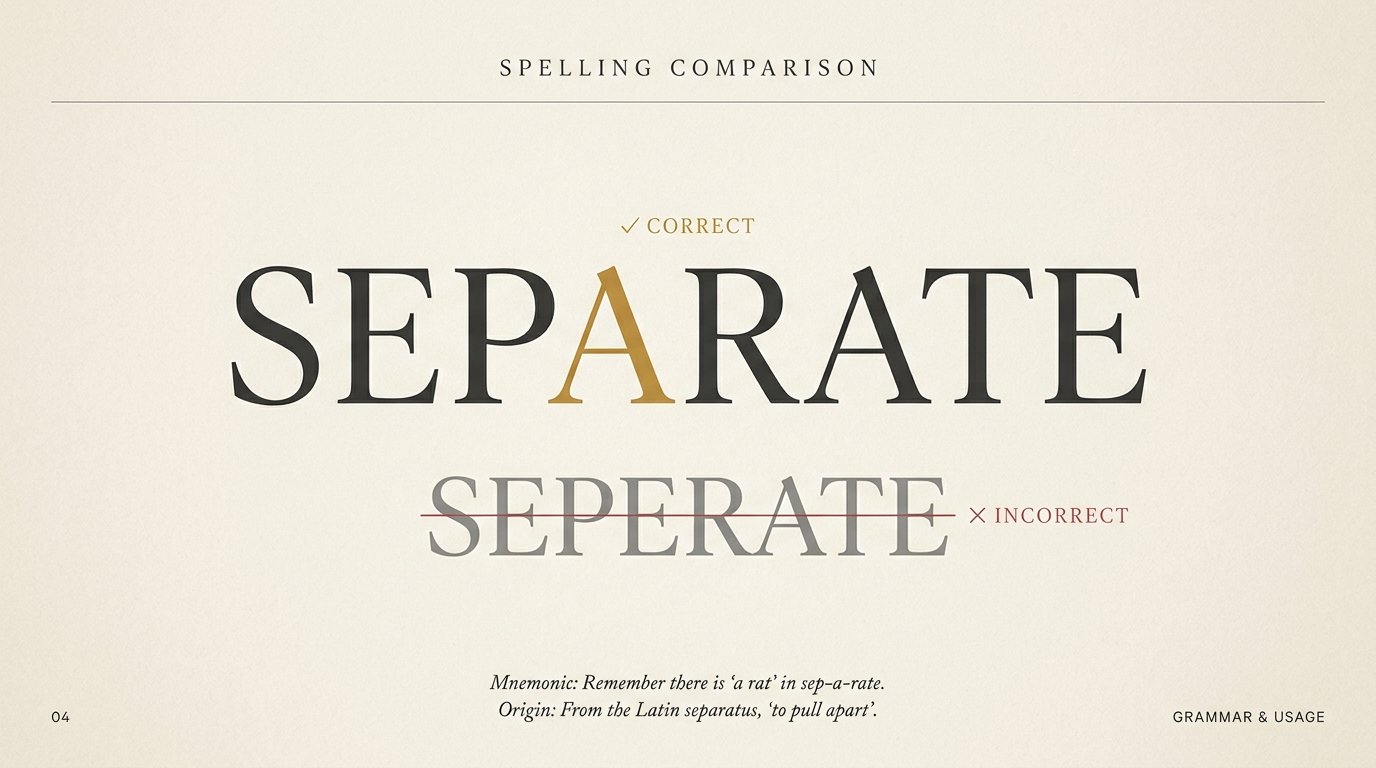
In a 2010 OnePoll survey reported by the Daily Telegraph and republished in Oxford University Press’s Learning English list, separate ranked number one in a top twenty of most misspelled words, with definitely at number two.
Fellow list regulars fill out the same survey tradition, among them the word behind the atleast or at least verdict. The lists change their membership over time; separate’s place near the top of them does not.
A decade later, Lexico’s 2020 list of the 100 most commonly misspelled words, compiled from Oxford English Corpus data and reported by Mental Floss, again carried separate with seperate as its error form.
Grammar Monster also places separate at number one of its top twenty, ordered by how often the misspellings were Googled in one month, the site’s own stated method, and the weakest method in this set. Dictionary.com’s own most-misspelled list, built from its search data, includes separate too.
What no fetched source supports is a percentage: how often writers produce seperate. This page prints the rankings with their sources attached and no invented figure, because none was found.
Separate in Sentences: Judged Examples
Each sentence below uses a family form correctly, labelled by job. Read them once and the a starts to look inevitable, which is exactly the familiarity that protects you.
- Verb: Separate the recyclables from the trash before pickup day.
- Verb: The teacher separated the class into four discussion groups.
- Adjective: They booked separate rooms so the children could sleep early.
- Adjective: Keep work files and personal files in separate folders.
- Noun: She bought the separates on sale and mixed them with older pieces.
- Adverb: Please wrap each glass separately before packing the box.
- Noun (separation): The separation of the two departments took effect in June.
- Adjective (inseparable): The twins were inseparable until university split their cities.
Test Yourself: 12 Sentences, Right or Wrong
Judge each sentence: is the spelling right or wrong? The key follows the set, and every wrong sentence fails on the same a-swap, so a perfect score means the pattern is beaten.
- Please keep the glass items in a separate box.
- The twins sleep in seperate rooms now.
- She carefully separated the egg whites from the yolks.
- They live in seperate apartments in the same building.
- The report lists each cost seperately.
- We took separate cars to the airport.
- A thin partition was built as a seperation between the offices.
- His work life and home life stay completely separate.
- The kit includes a seperator for the loose parts.
- Sort the laundry into seperate piles by colour.
- The two ideas are hard to separate in practice.
- Inseperable since childhood, the friends still call every day.
Answer key: Right: 1, 3, 6, 8, 11. Wrong: 2 (separate), 4 (separate), 5 (separately), 7 (separation), 9 (separator), 10 (separate), 12 (inseparable).
Print the printable practice pack version of the family table, the gallery, and this test, and the rat stays in sight while you write.
Frequently Asked Questions
Is it separate or seperate?
Separate. It is the only spelling in any standard dictionary, for the verb, the adjective, and every form built on it. Seperate is a common misspelling, and the middle letter is a, never e.
Is seperate a word?
No. Dictionaries hold no headword for seperate. Dictionary.com treats it as a misspelling and redirects the search to separate, which is what dictionaries do with error strings, not with real words.
How do you spell separate?
S-e-p-a-r-a-t-e. Eight letters in three syllables: sep, a, rate. Say it in chunks, sep-a-rat-e, and the spelling and the rat trick arrive together.
Why is separate spelled with an A in the middle?
Because its Latin root carries the a. Separate descends from parare, to prepare, inside separare, and English kept the root’s vowel even after speech wore it down to a schwa.
What is the easiest trick to remember how to spell separate?
Picture the rat: there is a rat in separate, sep-a-rat-e. The image fixes the one letter sound cannot give you, and it works for the whole family at once.
Is there really a rat in separate?
Yes, letter for letter. Inside s-e-p-a-r-a-t-e sit the letters a, r, a, t, which spell a rat. It is a mnemonic, not an etymology, but it has ended more confusion than any rule.
How do you spell separated?
Separated: separate plus the past ending, s-e-p-a-r-a-t-e-d. The a stays in the middle, and the final e of separate meets the -ed without doubling or dropping anything else.
Is it seperated or separated?
Separated. Seperated is the family error applied to the past tense: the same middle a flipped to e. If the present tense takes a, every tense takes a.
How do you spell separation?
Separation: s-e-p-a-r-a-t-i-o-n. It is the noun form, naming the act or state of being apart, and it keeps the family a before the -tion ending.
Is seperation ever correct?
Never. No dialect, register, or historical period of standard English uses seperation. It appears only as a misspelling of separation, in the same way seperate appears only as a misspelling of separate.
How do you spell separately?
Separately: s-e-p-a-r-a-t-e-l-y. Take separate, add -ly, and change nothing else. It is the adverb form, and the one family member writers reach for most often after the headword itself.
Is it seperately or separately?
Separately. Seperately is the a-swap wearing an adverb ending. Check the middle of the word, not the end: the letter after the r is a, in separately just as in separate.
How do you spell separating?
Separating. Separate drops its final e before -ing, giving s-e-p-a-r-a-t-i-n-g. The dropped letter is the final e, never the middle a, which stays exactly where the rat put it.
How do you spell separates?
Separates: s-e-p-a-r-a-t-e-s. It is the third-person verb form, he separates, and also the plural noun for clothing sold as individual pieces. Both jobs keep the a.
Is separate spelled differently in British and American English?
No. Separate is spelled identically in British and American English, and in every other standard variety. This is one verdict with no regional split to hide behind.
Is seperate the British spelling of separate?
No. That is a durable myth. British dictionaries list separate with the a, exactly as American ones do, and seperate is marked as an error on both sides of the Atlantic.
How do you pronounce separate?
It depends on the job. The verb is SEP-uh-rate, with a full ending; the adjective is SEP-uh-rut, with the ending reduced. These are the pronunciations the dictionaries print, offered as guidance.
Why is separate pronounced differently as a verb and an adjective?
Because separate is a heteronym: one spelling, two pronunciations. English often keeps the full -ate sound in verbs and reduces it in adjectives, and separate follows that wider pattern.
How many syllables does separate have?
Three: sep, a, rate in the verb, and a reduced three in the adjective. The middle syllable is the quiet one, which is why its vowel causes all the trouble.
How many letters are in the word separate?
Eight: s, e, p, a, r, a, t, e. Two of them are a’s, and remembering the count helps: if your written version has seven letters or two e’s in the middle pattern, it is wrong.
Does separate have two As?
Yes. The a’s stand at positions four and six, with the r between them: sep-a-r-a-te. Dictionary.com’s summary is the shortest: two a’s, separated by an r.
What does separate mean?
As a verb, to divide or keep apart. As an adjective, distinct or not connected. One word covers both the action of parting things and the state of things already apart.
Is separate a verb or an adjective?
Both, and a noun besides. The verb divides, the adjective describes, and the noun appears in separates, the clothing term. The spelling is identical in all three jobs.
Can separate be a noun?
Yes, chiefly in the plural separates, clothing sold as individual pieces to mix and match. Dictionary entries also record a noun sense for an offprint, a separately printed article.
Where does the word separate come from?
From Latin, through Middle English. The source verb is separare, to set apart, and its past participle separatus is the direct ancestor of the English word and its a.
What Latin words does separate come from?
Two parts: se-, meaning apart, and parare, meaning to prepare or procure. Merriam-Webster’s entry gives exactly that split, and the a you must remember lives inside parare.
Why do so many people misspell separate?
Three causes stack up: the middle vowel is an unstressed schwa that sound cannot identify, desperate teaches the wrong letter by example, and muscle memory then practises the error at typing speed.
Is separate one of the most misspelled words in English?
Labelled sources say yes. A 2010 OnePoll survey ranked it first in its top twenty, and Lexico’s 2020 corpus list of 100 most misspelled words includes it. No fetched source supports a percentage figure.
What is the most common misspelling of separate?
Seperate. It is the single a-swap, named as the common misspelling by Dictionary.com and recorded in Wikipedia’s documented list of commonly misspelled words beside the correct form.
What are other common misspellings of separate?
The family a-swaps come first: seperated, seperation, seperately. Beyond them sit stranger forms such as sepparate, sepreate, and seprate, documented mainly as distractor spellings in exam questions.
Is desperate spelled with an A or an E?
With an e: d-e-s-p-e-r-a-t-e. Desperate is the trap word of this page, the sound-alike that genuinely carries e and trains your fingers to put e in separate too.
Why is desperate spelled with E but separate with A?
Because they descend from different Latin roots with different vowels. English spelling follows each word’s own root, not the shared -ate sound, so the neighbours keep their own letters.
Is it separable or seperable?
Separable, with the a. It means able to be separated, it is built directly on separate, and it inherits the family vowel. Seperable is the a-swap in adjective dress.
What is the difference between separate and separable?
Separate is the verb and general adjective: to divide, or distinct. Separable is a narrower adjective meaning capable of being divided. One performs or describes; the other says the dividing is possible.
Is it separate from or separate to?
In American English, separate from is the standard pairing: separate the yolks from the whites. Separate to appears in some British usage, but from is the safe choice in US writing.
How do you use separate in a sentence?
Verb: separate the recycling from the trash. Adjective: they chose separate paths home. Both sentences use the same spelling, and the adjective one is where the word does its everyday work.
What does separate but equal mean?
It names a phrase from United States history: the doctrine that racially separate facilities could be treated as equal, a doctrine the courts later overturned. The phrase is spelled with separate, a included.
What is the difference between separate and separation?
Separate is the verb and adjective; separation is the noun, the act or the state. You separate two things, and the result is a separation. Both keep the family a.
How do you spell separation anxiety?
Separation anxiety: s-e-p-a-r-a-t-i-o-n, then anxiety. The term names distress at being apart from a person or place, and its first word keeps the a like every family form.
Does spellcheck catch seperate?
Usually, yes. Seperate is not a headword, so checkers flag it, and Dictionary.com even redirects it as a misspelling. The protection fails only where checking is off or overridden.
Why does autocorrect sometimes miss seperate?
Because the safety net has holes: checking disabled, an unchecked form field, or the error once accepted into a personal dictionary. Autocorrect also cannot fix a word it was taught to trust.
How can I stop misspelling separate?
Learn the pattern, not the word: see the rat, check the middle for a, and run the family table once. Then practise with the self-test above until the a arrives uninvited.
Conclusion
So, separate or seperate: the correct spelling is separate, with a rat in the middle and the a of Latin parare at its heart. Seperate is not a word, in no dialect, in no form of the family, and it never has been.
The same verdict pattern settles its neighbours on this site: gluing or glueing and cacoon or cocoon for spelling verdicts, precede vs proceed and desert vs dessert for look-alike pairs, and passed vs past for the difference rail.
Writers who settle this one usually settle the rest of the rail too: a lot vs allot vs alot, all together vs altogether, all ready vs already, adverse vs averse, and adapt vs adopt.
Print the printable practice pack, keep the family table near your keyboard, and let the rat do the remembering from here.
How this page was checked: the verdict, family forms, and pronunciations were re-verified on 25 November 2026 against the Cambridge Dictionary entry and Dictionary.com; Merriam-Webster’s etymology is quoted from its entry wording, and every ranking claim on this MagazineSolo page names its source.

Dilawar is a content writer at MagazineSolo, covering travel, home improvement, interior design, and everyday lifestyle topics. He enjoys researching practical solutions, exploring travel destinations, and sharing helpful guides that make daily life easier. His writing focuses on clear information, useful advice, and engaging stories for a wide audience.